Skip to Content Facebook Feature Image

AI may be scoring your college essay. Welcome to the new era of admissions

TECH

AI may be scoring your college essay. Welcome to the new era of admissions
TECH

TECH

AI may be scoring your college essay. Welcome to the new era of admissions

2025-12-02 13:22 Last Updated At:12-05 13:33

Students applying to college know they can’t — or at least shouldn’t — use AI chatbots to write their essays and personal statements. So it might come as a surprise that some schools are now using artificial intelligence to read them.

AI tools are now being incorporated into how student applications are screened and analyzed, admissions directors say. It can be a delicate topic, and not all colleges are eager to talk about it, but higher education is among the many industries where artificial intelligence is rapidly taking on tasks once reserved for humans.

More Images
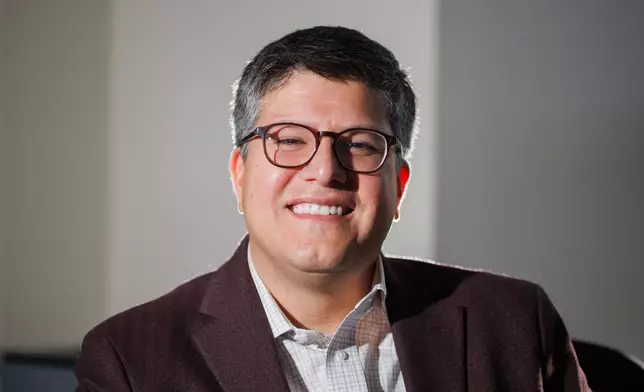
Juan Espinoza, vice provost for enrollment management at Virginia Tech, poses for a photo in his office, Nov. 12, 2025, in Blacksburg, Va. (AP Photo/Shaban Athuman)
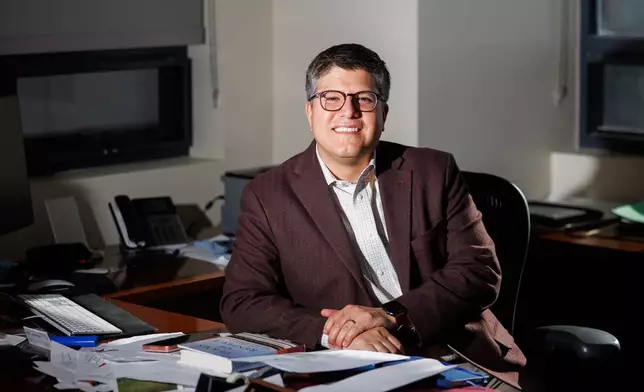
Juan Espinoza, vice provost for enrollment management at Virginia Tech, poses for a photo in his office, Nov. 12, 2025, in Blacksburg, Va. (AP Photo/Shaban Athuman)
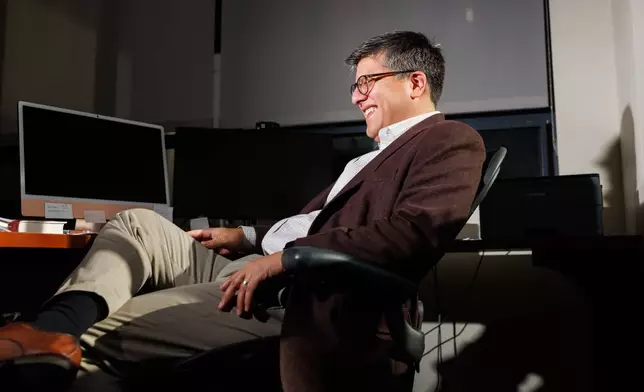
Juan Espinoza, vice provost for enrollment management at Virginia Tech, poses for a photo in his office, Nov. 12, 2025, in Blacksburg, Va. (AP Photo/Shaban Athuman)

Juan Espinoza, vice provost for enrollment management at Virginia Tech, poses for a photo in his office, Nov. 12, 2025, in Blacksburg, Va. (AP Photo/Shaban Athuman)

Juan Espinoza, vice provost for enrollment management at Virginia Tech, poses for a photo in his office, Nov. 12, 2025, in Blacksburg, Va. (AP Photo/Shaban Athuman)

Juan Espinoza, vice provost for enrollment management at Virginia Tech, poses for a photo in his office, Nov. 12, 2025, in Blacksburg, Va. (AP Photo/Shaban Athuman)

Juan Espinoza, vice provost for enrollment management at Virginia Tech, poses for a photo in his office, Nov. 12, 2025, in Blacksburg, Va. (AP Photo/Shaban Athuman)

Juan Espinoza, vice provost for enrollment management at Virginia Tech, poses for a photo in his office, Nov. 12, 2025, in Blacksburg, Va. (AP Photo/Shaban Athuman)

Juan Espinoza, vice provost for enrollment management at Virginia Tech, poses for a photo in his office, Nov. 12, 2025, in Blacksburg, Va. (AP Photo/Shaban Athuman)

Juan Espinoza, vice provost for enrollment management at Virginia Tech, poses for a photo in his office, Nov. 12, 2025, in Blacksburg, Va. (AP Photo/Shaban Athuman)

In some cases, schools are quietly slipping AI into their evaluation process, experts say. Others are touting the technology’s potential to speed up their review of applications, cut processing times and even perform some tasks better than humans.

“Humans get tired; some days are better than others. The AI does not get tired. It doesn’t get grumpy. It doesn’t have a bad day. The AI is consistent,” says Juan Espinoza, vice provost for enrollment management at Virginia Tech.

This fall, Virginia Tech is debuting an AI-powered essay reader. The college expects it will be able to inform students of admissions decisions a month sooner than usual, in late January, because of the tool's help sorting tens of thousands of applications.

Colleges stress they are not relying on AI to make admissions decisions, using it primarily to review transcripts and eliminate data-entry tasks. But artificial intelligence also is playing a role in evaluating students. Some highly selective schools are adopting AI tools to vet the increasingly curated application packages that some students develop with the help of high-priced admissions consultants.

The California Institute of Technology is launching an AI tool this fall to look for “authenticity” in students who submit research projects with their applications, admissions director Ashley Pallie said. Students upload their research to an AI chatbot that interviews them about it on video, which is then reviewed by Caltech faculty.

“It’s a gauge of authenticity. Can you claim this research intellectually? Is there a level of joy around your project? That passion is important to us,” Pallie said.

The prevalence of AI usage is difficult to gauge because it is such a new trend, said Ruby Bhattacharya, chair of the admission practices committee at the National Association for College Admission Counseling. NACAC updated its ethics guide this fall to add a section on artificial intelligence. It urges colleges to ensure the way they use it “aligns with our shared values of transparency, integrity, fairness and respect for student dignity.”

The University of North Carolina at Chapel Hill faced a barrage of negative feedback from applicants, parents and students after its student newspaper, The Daily Tar Heel, reported in January the school was using AI to evaluate the grammar and writing style of applicants' essays.

The university declined to comment for this article and referred to its admissions website, which it updated after the criticism. “UNC uses AI programs to provide data points about students’ common application essay and their school transcripts,” the website says. Every application “is evaluated comprehensively by extensively trained human application evaluators.”

At Virginia Tech, Espinoza said he has been contacted by several colleges that are interested in the new technology but wary of backlash. “The feedback from a lot of colleagues is, ‘You roll this out, we’re watching you, and we’ll see how everyone’s reacting,’” he said.

He stressed the AI reader his school spent three years developing is being used only to confirm human readers' essay scores.

Until this fall, each of the four short-answer essays Virginia Tech applicants submit was read and scored by two people. Under the new system, one of those readers is the AI model, which has been trained on past applicant essays and the rubric for scoring, Espinoza said.

A second person will step in if the AI and human reader disagree by more than two points on a 12-point scoring scale.

Like many colleges, Virginia Tech has seen a huge increase in applications since making SATs optional. Last year, it received a record 57,622 applications for its 7,000-seat freshman class. Even with 200 essay readers, the school has struggled to keep up and found itself notifying students later and later.

The AI tool can scan about 250,000 essays in under an hour, compared with a human reader who averages two minutes per essay. Based on last year’s application pool, “We’re saving at least 8,000 hours,” Espinoza said.

The messaging is sensitive for colleges, many of which now have students certify that they have not used AI unethically for essays and other parts of the application. But schools say AI tools can help admissions offices eliminate errors in tasks like uploading transcripts and can simplify the process for students.

Georgia Tech this fall is rolling out an AI tool to review the college transcripts of transfer students, replacing the need for staff to enter each course manually into a database. It will allow the school to inform applicants more quickly how many transfer credits they'll receive, cutting down on uncertainty and wait times, said Richard Clark, the school's executive director of enrollment management.

“It’s one more layer of delay and stress and inevitable errors. AI is going to kill that, which I’m so excited about,” Clark said. The school hopes to expand the service soon to all high school transcripts. Georgia Tech also is testing out AI tools for other uses, including one that would identify low-income students who are eligible for federal Pell Grants but may not have realized it.

Stony Brook University in New York is also using artificial intelligence to review applicants' transcripts and testing AI tools for a variety of tasks, like summarizing student essays and letters of recommendation to highlight things an admissions officer should consider, said Richard Beatty, the school’s senior associate provost for enrollment management.

“Maybe a student was fighting a disease sophomore year. Or maybe a parent passed away, or they’re taking care of siblings at home. All these things matter, and it allows the counselors to look at the transcript differently,” Beatty said.

Colleges are interested in AI summaries of transcripts, extracurricular activities and letters of recommendation that tell human readers the students’ story in a more digestible way, said Emily Pacheco, founder of NACAC’s special interest group for AI and admission.

“Humans and AI working together — that is the key right now. Every step along the way can be greatly improved: transcript reading, essay reviews, telling us things we might be missing about the students,” said Pacheco, a former assistant director of admission at Loyola University Chicago. “Ten years from now, all bets are off. I’m guessing AI will be admitting students.”

The Associated Press’ education coverage receives financial support from multiple private foundations. AP is solely responsible for all content. Find AP’s standards for working with philanthropies, a list of supporters and funded coverage areas at AP.org.
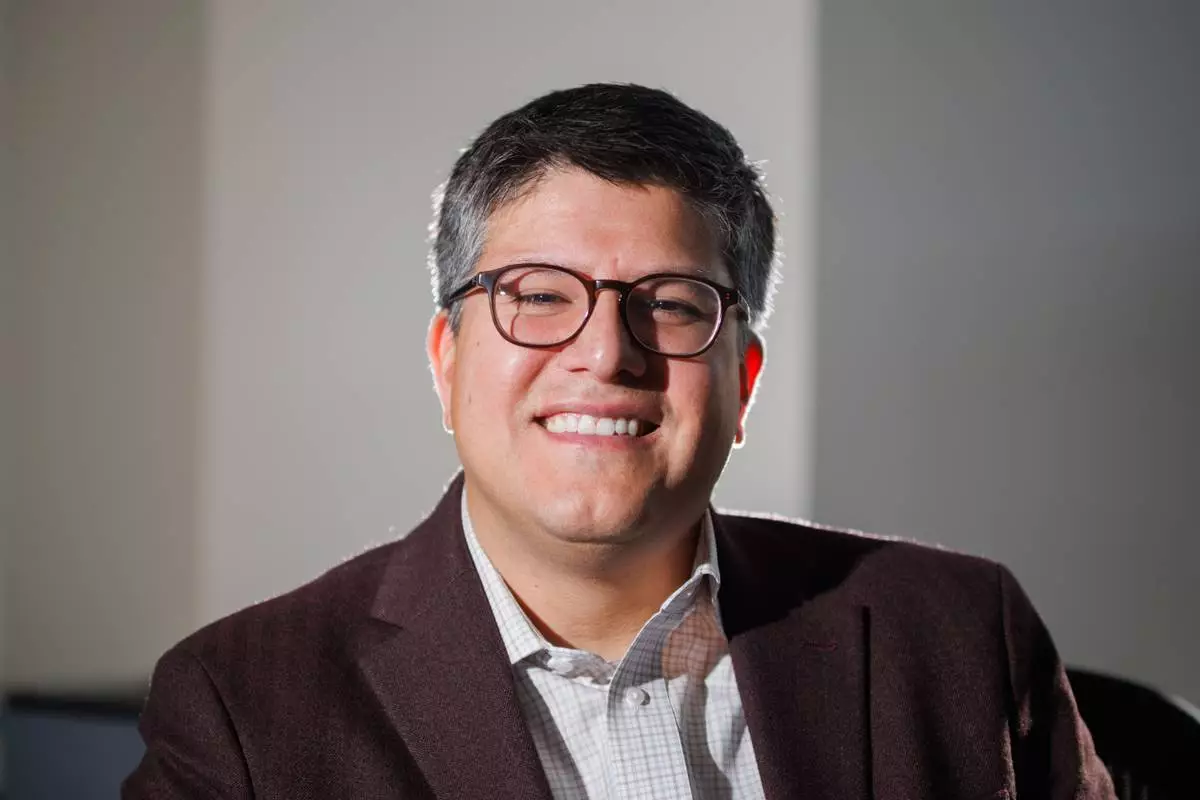
Juan Espinoza, vice provost for enrollment management at Virginia Tech, poses for a photo in his office, Nov. 12, 2025, in Blacksburg, Va. (AP Photo/Shaban Athuman)

Juan Espinoza, vice provost for enrollment management at Virginia Tech, poses for a photo in his office, Nov. 12, 2025, in Blacksburg, Va. (AP Photo/Shaban Athuman)

Juan Espinoza, vice provost for enrollment management at Virginia Tech, poses for a photo in his office, Nov. 12, 2025, in Blacksburg, Va. (AP Photo/Shaban Athuman)

Juan Espinoza, vice provost for enrollment management at Virginia Tech, poses for a photo in his office, Nov. 12, 2025, in Blacksburg, Va. (AP Photo/Shaban Athuman)

Juan Espinoza, vice provost for enrollment management at Virginia Tech, poses for a photo in his office, Nov. 12, 2025, in Blacksburg, Va. (AP Photo/Shaban Athuman)

Juan Espinoza, vice provost for enrollment management at Virginia Tech, poses for a photo in his office, Nov. 12, 2025, in Blacksburg, Va. (AP Photo/Shaban Athuman)

Juan Espinoza, vice provost for enrollment management at Virginia Tech, poses for a photo in his office, Nov. 12, 2025, in Blacksburg, Va. (AP Photo/Shaban Athuman)
Juan Espinoza, vice provost for enrollment management at Virginia Tech, poses for a photo in his office, Nov. 12, 2025, in Blacksburg, Va. (AP Photo/Shaban Athuman)
Juan Espinoza, vice provost for enrollment management at Virginia Tech, poses for a photo in his office, Nov. 12, 2025, in Blacksburg, Va. (AP Photo/Shaban Athuman)
Juan Espinoza, vice provost for enrollment management at Virginia Tech, poses for a photo in his office, Nov. 12, 2025, in Blacksburg, Va. (AP Photo/Shaban Athuman)
DUBAI, United Arab Emirates (AP) — Iran fired more missiles at Israel and Gulf Arab states Thursday, demonstrating Tehran’s continued ability to strike its neighbors even as U.S. President Donald Trump claimed the threat from the country was nearly eliminated.

Iran’s attacks on Gulf states along with its chokehold on the Strait of Hormuz have disrupted the world’s energy supplies with effects far beyond the Middle East. That has proved to be Iran’s greatest strategic advantage in the war. Britain held a call with nearly three dozen countries about how to reopen the strait once the fighting is over.

Trump has insisted the strait can be taken by force — but said it is not up to the U.S. to do that. In an address to the American people Wednesday night, he encouraged countries that depend on oil from Hormuz to “build some delayed courage” and go “take it.”

Before the U.S. and Israel started the war on Feb. 28 with strikes on Iran, the waterway was open to traffic and 20% of all traded oil passed through it.

Iran responded defiantly to Trump’s speech, in which the American president claimed U.S. military action had been so decisive that “one of the most powerful countries” is “really no longer a threat.”

A spokesman for Iran’s military, Lt. Col. Ebrahim Zolfaghari, insisted Thursday that Tehran maintains hidden stockpiles of arms, munitions and production facilities. He said facilities targeted so far by U.S. strikes are “insignificant.”

Just before Trump began his address — in which he said U.S. “core strategic objectives are nearing completion” — explosions were heard in Dubai as air defenses worked to intercept an Iranian missile barrage.

Less than a half-hour after the president was done, Israel said its military was also working to intercept incoming missiles. Sirens sounded in Bahrain, home to the U.S. Navy’s 5th Fleet, immediately after the speech.

Attacks continued across Iran on Thursday, with strikes reported in multiple cities.

Even amid the conflict, families went to a park in Tehran to play games and grill food to mark the last day of Iranian New Year, or Nowruz.

In Lebanon — home to Iran-backed Hezbollah militants who are fighting Israel, which has launched a ground invasion — an Israeli strike killed four people in the south, the Health Ministry said.

More than 1,900 people have been killed in Iran during the war, while 19 have been reported dead in Israel. More than two dozen people have died in Gulf states and the occupied West Bank, while 13 U.S. service members have been killed.

More than 1,300 people have been killed and more than 1 million displaced in Lebanon. Ten Israeli soldiers have also died there.

Iranian attacks on about two dozen commercial ships, and the threat of more, have halted nearly all traffic in the waterway that connects the Persian Gulf to the open ocean.

Since March 1, traffic through the strait has dropped 94% over the same period last year, according to the Lloyds List Intelligence shipping data firm. Two ships are confirmed to have paid a fee, the firm said, while others were allowed through based on agreements with their home governments.

Saudi Arabia piped about 1 billion barrels of oil away from the Strait of Hormuz in March, according to maritime data firm Kpler, while Iraq said Thursday that it had started to truck oil across Syria to avoid the strait.

The 35 countries that spoke Thursday, including all G7 industrialized democracies except the U.S., as well as the United Arab Emirates and Bahrain, signed a declaration last month demanding Iran stop blocking the strait.

Thursday’s talks were focused on political and diplomatic measures, but British Foreign Secretary Yvette Cooper said military planners from an unspecified number of countries will also plot ways to ensure security once fighting ends, including potential mine-clearing work and “reassurance” for commercial shipping.

No country appears willing to try to open the strait by force while the war is raging. French President Emmanuel Macron, while on a visit to South Korea, called a military operation to secure the waterway “unrealistic.”

But there is a concern that Iran might limit traffic through the waterway even after U.S. and Israeli attacks cease.

The idea of an international effort has echoes of the “coalition of the willing,” led by the U.K. and France, that was assembled to underpin Ukraine’s security in the event of a ceasefire in that war. The coalition is, in part, an attempt to demonstrate to Washington that Europe is doing more for its own security in the face of frequent criticism from Trump.

The conflict is driving up prices for oil and natural gas, roiling stock markets, pushing up the cost of gasoline and threatening to make a range of goods, including food, more expensive.

On Thursday, Brent crude, the international standard, rose again and was around $108, up about 50% from Feb. 28.

Though the oil and gas that typically transits the strait is primarily sold to Asian nations, Japan and South Korea were the only two countries from the region joining Thursday's call about the strait. The supply of jet fuel has also been interrupted, with consequences for travel worldwide.

Weissert reported from Washington and Rising from Bangkok. Associated Press writer David McHugh in Frankfurt, Germany, contributed to this story.

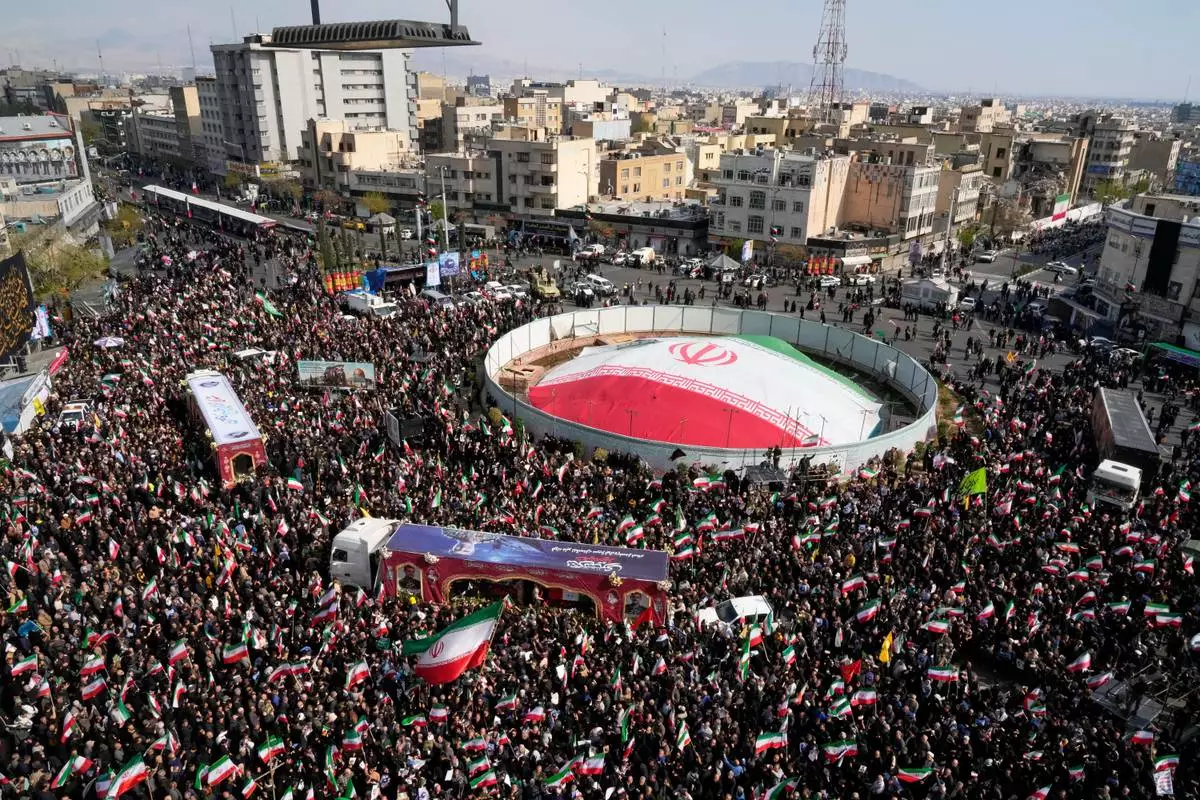
Mourners gather during a funeral procession for Alireza Tangsiri, head of Iran's Islamic Revolutionary Guard Corps Navy, and others killed in Israeli strikes in late March, in Tehran, Iran, Wednesday, April 1, 2026. (AP Photo/Vahid Salemi)

Mourners gather during a funeral procession for Alireza Tangsiri, head of Iran's Islamic Revolutionary Guard Corps Navy, and others killed in Israeli strikes in late March, in Tehran, Iran, Wednesday, April 1, 2026. (AP Photo/Vahid Salemi)

A firefighter extinguishes a car at the site of Israeli airstrikes, in Beirut, Lebanon, Wednesday, April 1, 2026. (AP Photo/Hussein Malla)

A firefighter extinguishes a car at the site of Israeli airstrikes, in Beirut, Lebanon, Wednesday, April 1, 2026. (AP Photo/Hussein Malla)

People take cover in a bomb shelter as air raid sirens warn of incoming Iranian missile strikes in Bnei Brak, Israel, Wednesday, April 1, 2026. (AP Photo/Oded Balilty)

People take cover in a bomb shelter as air raid sirens warn of incoming Iranian missile strikes in Bnei Brak, Israel, Wednesday, April 1, 2026. (AP Photo/Oded Balilty)

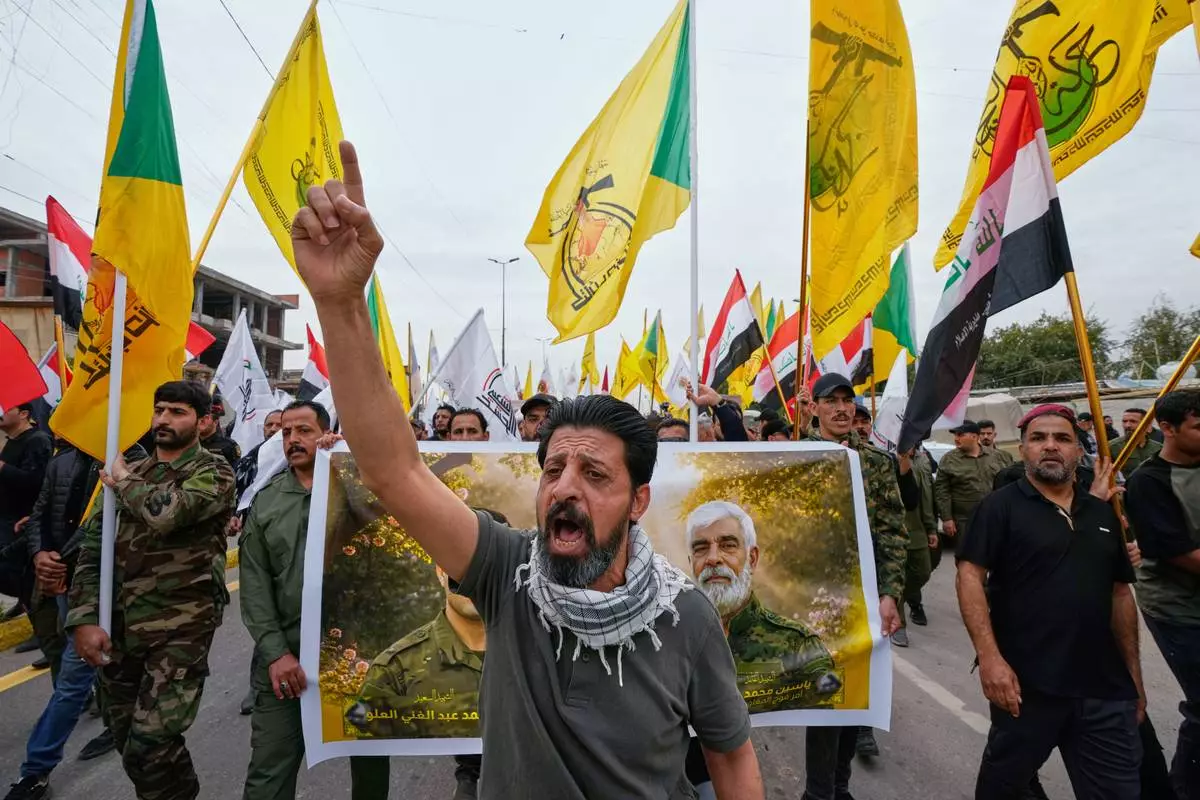
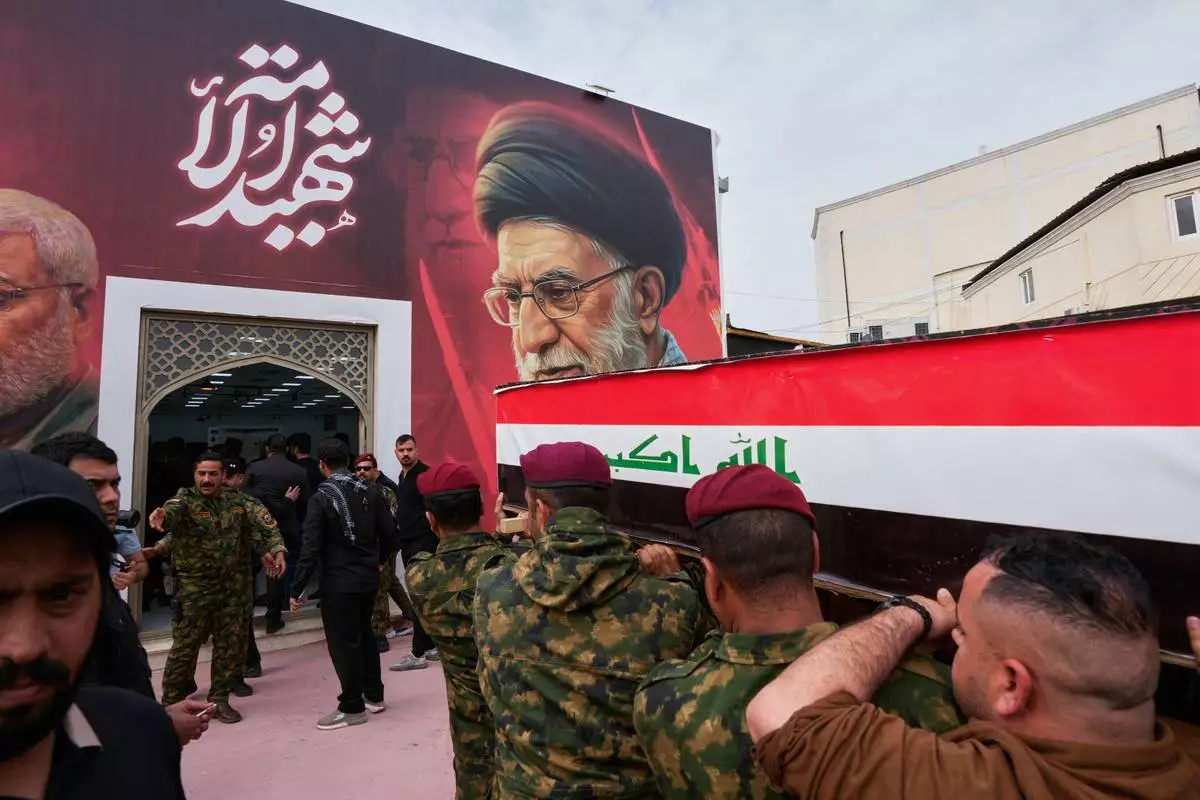
Members from the Popular Mobilization Forces attend a funeral of fighters who were killed in a U.S. airstrike, in Tal Afar, Nineveh province, north of Baghdad, Iraq, Thursday, April 2, 2026. (AP Photo/Hadi Mizban)

Members from the Popular Mobilization Forces attend a funeral of fighters who were killed in a U.S. airstrike, in Tal Afar, Nineveh province, north of Baghdad, Iraq, Thursday, April 2, 2026. (AP Photo/Hadi Mizban)

Members from the Popular Mobilization Forces attend a funeral of fighters who were killed in a U.S. airstrike, in Tal Afar, Nineveh province, north of Baghdad, Iraq, Thursday, April 2, 2026. (AP Photo/Hadi Mizban)

Members from the Popular Mobilization Forces attend a funeral of fighters who were killed in a U.S. airstrike, in Tal Afar, Nineveh province, north of Baghdad, Iraq, Thursday, April 2, 2026. (AP Photo/Hadi Mizban)

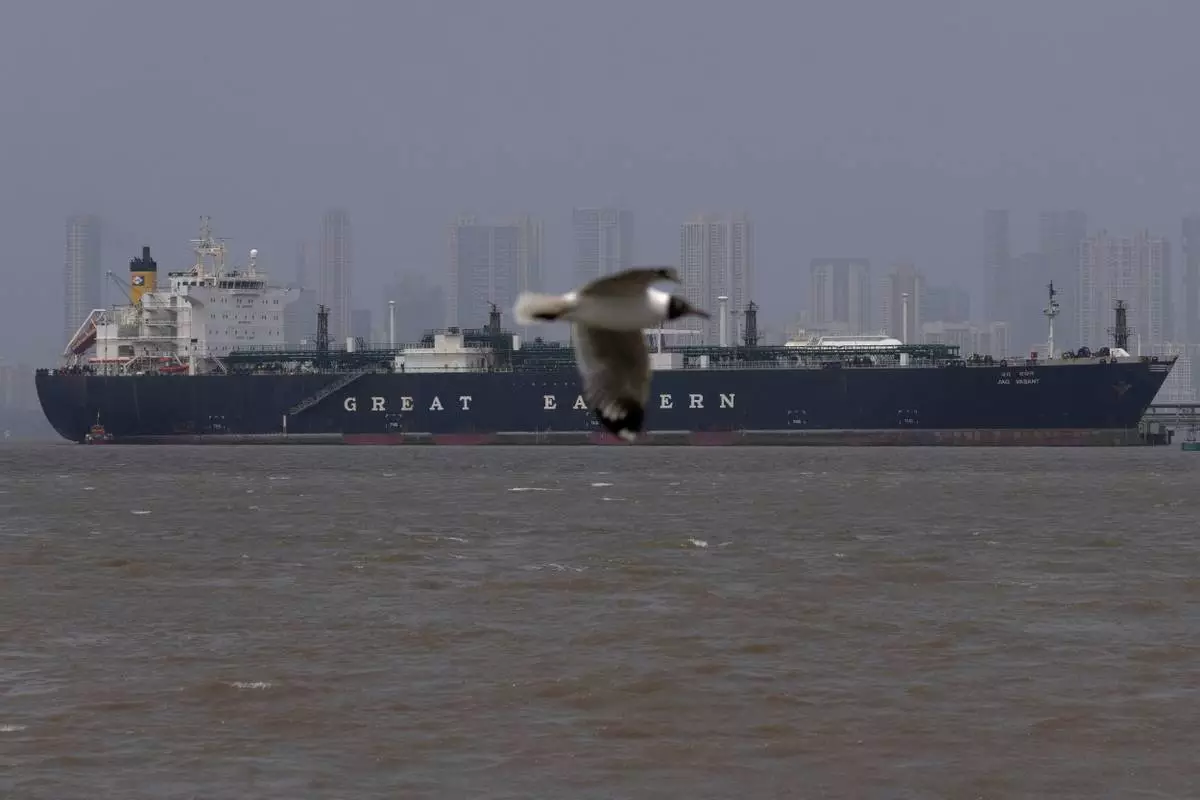
The Indian flagged LPG carrier Jag Vasant transporting liquefied petroleum gas, is seen at the Mumbai Port in Mumbai, India, after it arrived clearing the Strait of Hormuz, Wednesday, April 1, 2026. (AP Photo/Rafiq Maqbool)

The Indian flagged LPG carrier Jag Vasant transporting liquefied petroleum gas, is seen at the Mumbai Port in Mumbai, India, after it arrived clearing the Strait of Hormuz, Wednesday, April 1, 2026. (AP Photo/Rafiq Maqbool)

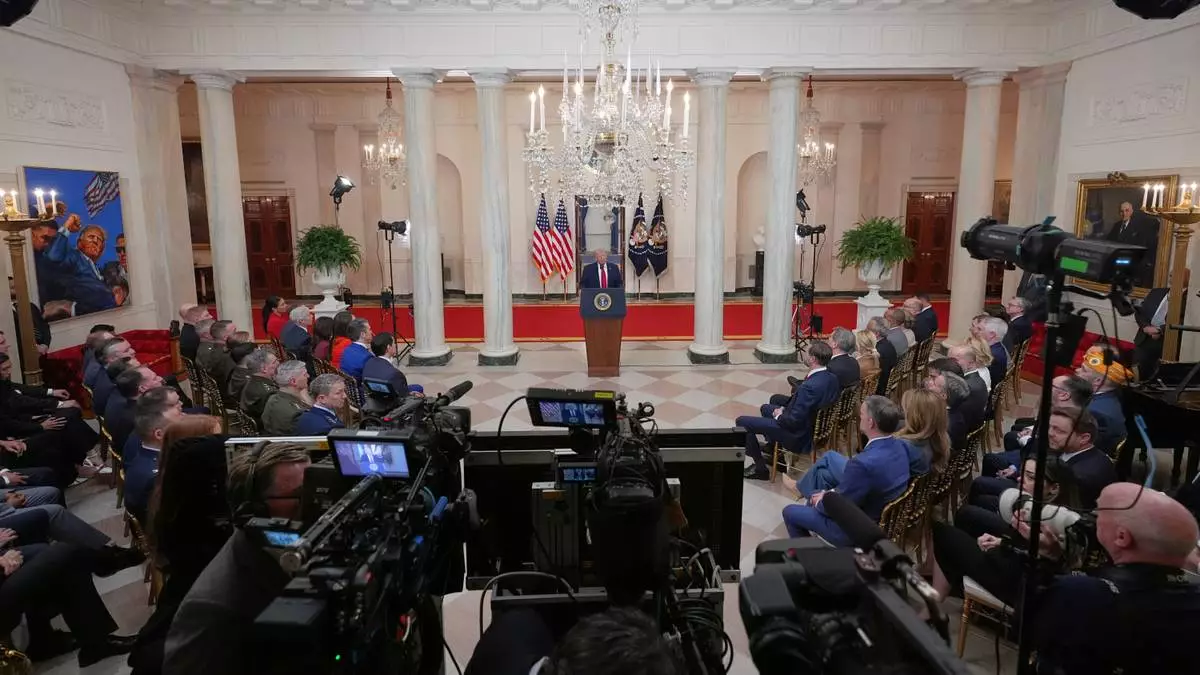
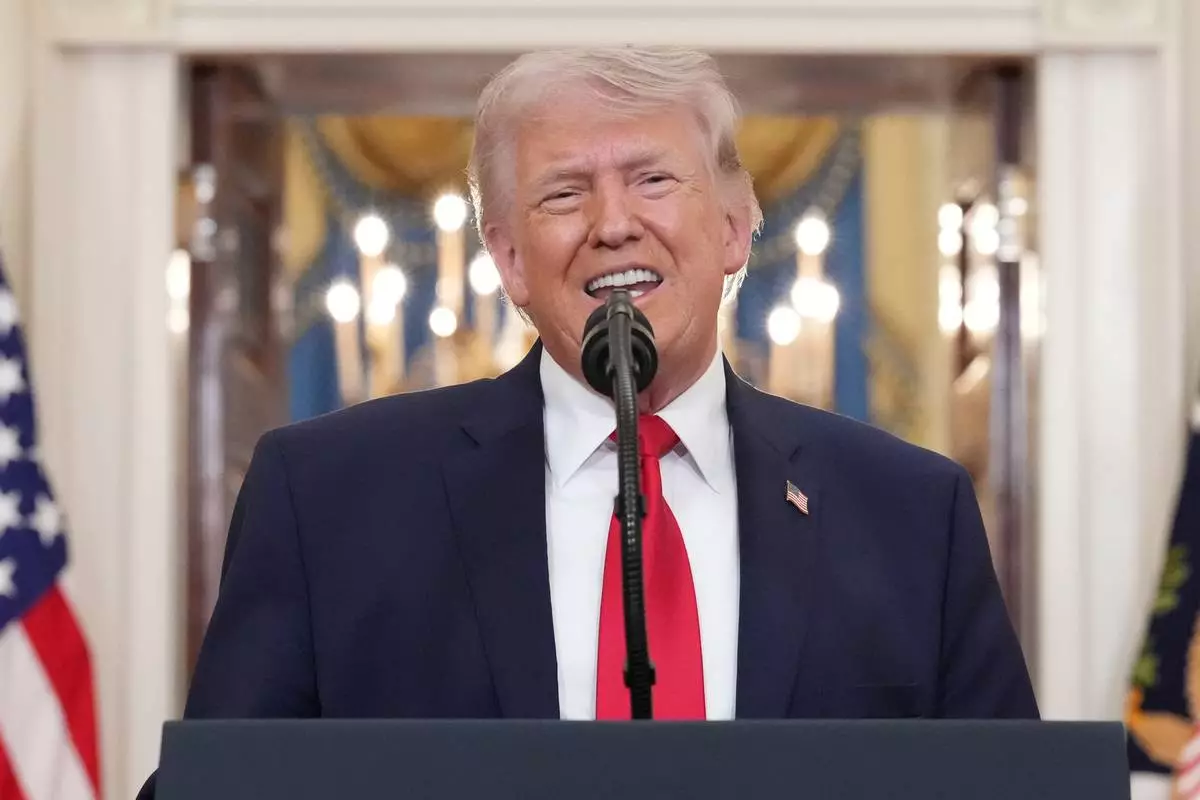
President Donald Trump speaks about the Iran war from the Cross Hall of the White House on Wednesday, April 1, 2026, in Washington. (AP Photo/Alex Brandon, Pool)

President Donald Trump speaks about the Iran war from the Cross Hall of the White House on Wednesday, April 1, 2026, in Washington. (AP Photo/Alex Brandon, Pool)

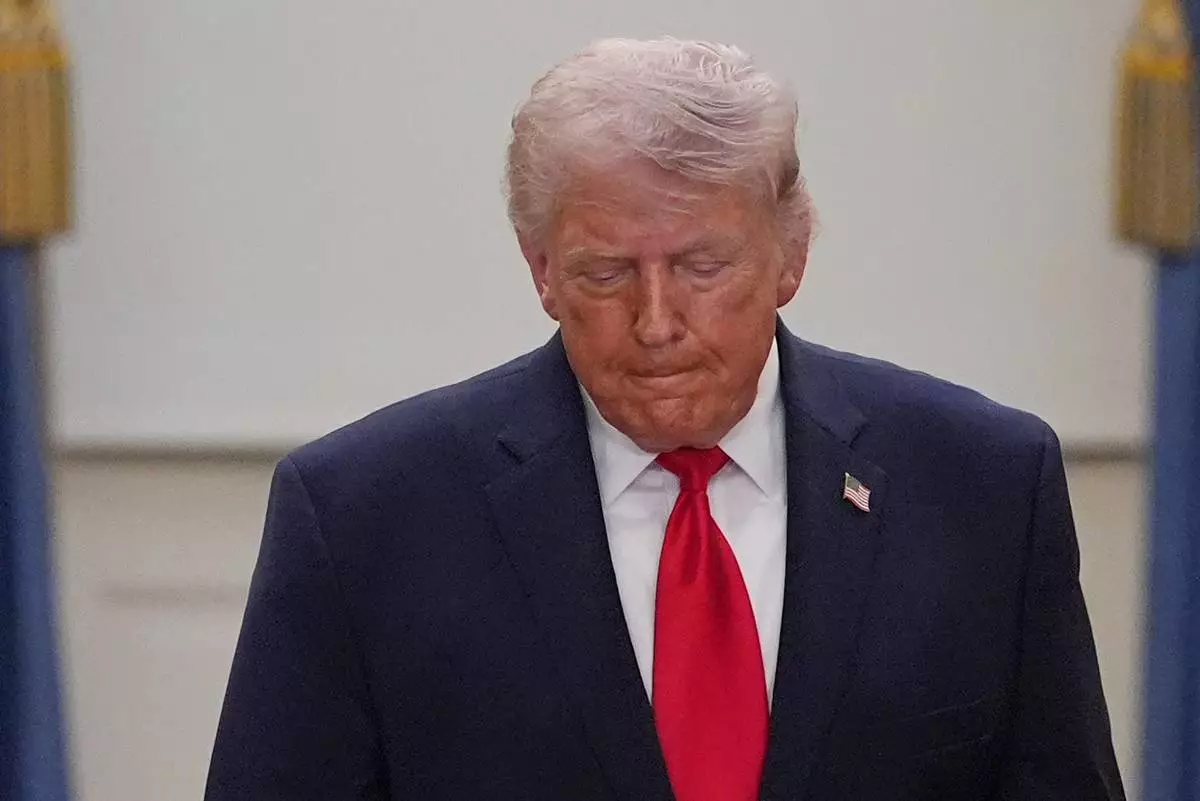
President Donald Trump walks from the Blue Room to speak about the Iran war from the Cross Hall of the White House on Wednesday, April 1, 2026, in Washington. (AP Photo/Alex Brandon, Pool)

President Donald Trump walks from the Blue Room to speak about the Iran war from the Cross Hall of the White House on Wednesday, April 1, 2026, in Washington. (AP Photo/Alex Brandon, Pool)

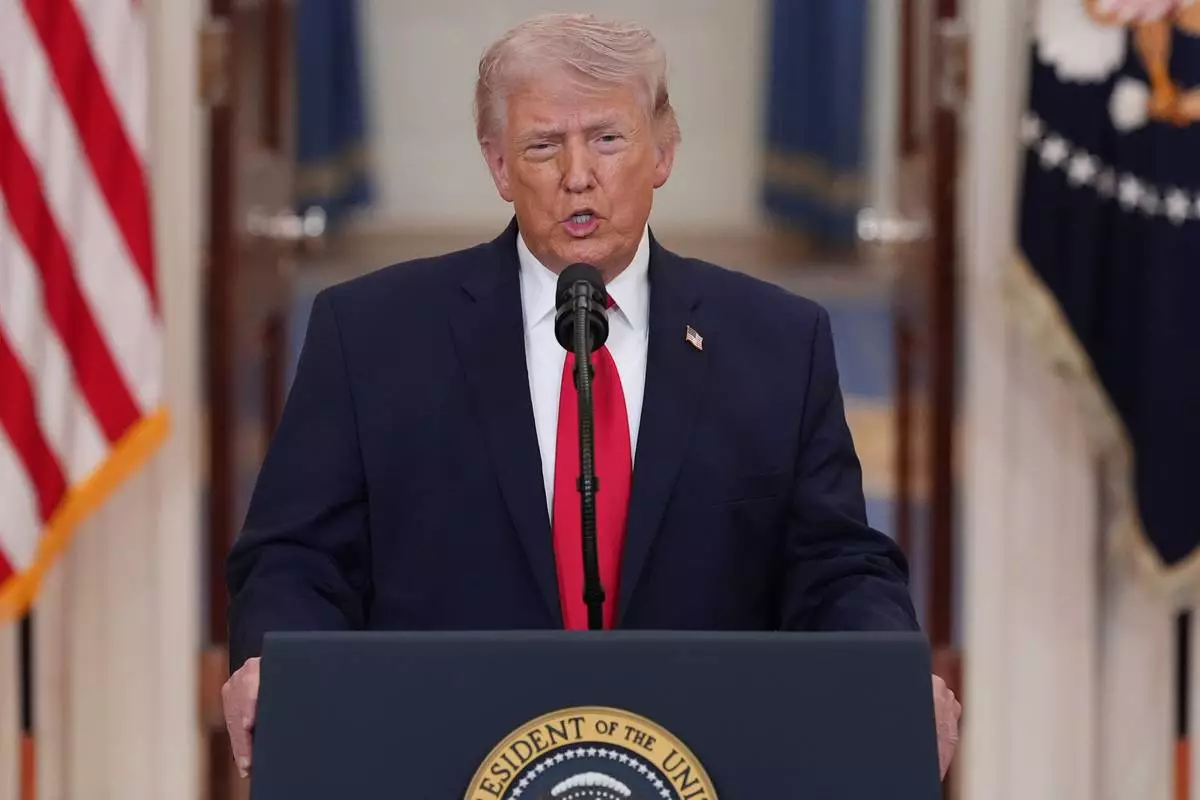
President Donald Trump speaks about the Iran war from the Cross Hall of the White House on Wednesday, April 1, 2026, in Washington. (AP Photo/Alex Brandon, Pool)

President Donald Trump speaks about the Iran war from the Cross Hall of the White House on Wednesday, April 1, 2026, in Washington. (AP Photo/Alex Brandon, Pool)

President Donald Trump speaks about the Iran war from the Cross Hall of the White House on Wednesday, April 1, 2026, in Washington. (AP Photo/Alex Brandon, Pool)

President Donald Trump speaks about the Iran war from the Cross Hall of the White House on Wednesday, April 1, 2026, in Washington. (AP Photo/Alex Brandon, Pool)

Recommended Articles