LONDON--(BUSINESS WIRE)--Dec 2, 2025--
ThetaRay, a global leader in Cognitive AI financial crime compliance, today released a landmark study on the future of anti-money laundering in Europe. The study warns that Europe’s anti-money laundering (AML) system is approaching structural failure, and that financial institutions will be unable to meet upcoming supervisory expectations without advanced AI-driven monitoring and customer screening systems.
This press release features multimedia. View the full release here: https://www.businesswire.com/news/home/20251202058684/en/
The report, “ Next-Generation AML Solutions: An Analysis of AI-Based Tools vis-à-vis the Reform of the European AML Institutional and Substantive Architecture,” offers some of the most comprehensive examinations to date of how the EU’s sweeping AML reform package and the Artificial Intelligence Act will reshape compliance across the region.
Co-authored by Prof. Andrea Minto, a leading authority on EU financial regulation at Ca’ Foscari University of Venice and the University of Stavanger, and Yaron Hazan, ThetaRay’s Vice President of Regulatory Affairs, Advisory board member at the AI APAC Institute and former Head of Compliance at HSBC Israel, the study blends academic rigor with supervisory and operational expertise rarely found in a single publication.
The report finds that despite rising budgets and stronger enforcement, Europe’s AML framework continues to underperform:
According to the study, the global AML system suffers from persistent structural inefficiencies, high false-positive rates, and poor conversion from alerts to meaningful intelligence, the result of legacy rule-based systems that generate low-quality alerts, rely on siloed architectures, and lack the cross-border visibility required to detect modern networked financial crime.
“The data is clear: Europe’s AML system is no longer keeping pace with financial complexity,” said Yaron Hazan, Vice President of Regulatory Affairs at ThetaRay. “For years, institutions have been trapped in a cycle of rule tuning, manual investigations, and defensive reporting, without materially improving outcomes. Under the new regulatory regime, failing to adopt AI will become a compliance vulnerability.”
The report highlights how the EU’s two major regulatory initiatives, the AML Package and the AI Act, together represent the most consequential shift in AML expectations in decades. The AML Package strengthens due diligence obligations, expands governance requirements, and establishes a new EU-level Anti-Money Laundering Authority (AMLA), harmonizing obligations across Member States. At the same time, the AI Act classifies transaction monitoring and sanctions screening as “high-risk” uses of AI, imposing strict requirements on transparency, human oversight, data governance, and model lifecycle management.
The authors also highlight heightened vulnerabilities in correspondent banking and crypto-asset flows, where traditional rule engines struggle to detect hidden network behaviour across complex cross-border transaction chains. The study further identifies growing friction between the AML Regulation (AMLR) and GDPR data processing constraints, warning that without clearer guidance, institutions could face overlapping regulatory and legal risks.
“Europe’s new AML framework fundamentally raises the standard for what effective compliance means,” said Andrea Minto, Professor of Law and Regulation of Financial Markets at Ca’ Foscari University of Venice and the University of Stavanger. “The AML Package and the AI Act make clear that the integration of AI into customer due diligence and AML monitoring is inevitable. Financial institutions must now prepare for a world in which technological capability and legal obligation are inseparable.”
The report ultimately calls for a fundamental shift from volume-driven alerting to intelligence-led detection, emphasizing hybrid human-AI oversight, robust data governance aligned with the AI Act, transparent and explainable models, integrated customer and transaction screening workflows.
Read the report here.
About ThetaRay
ThetaRay harnesses the power of Cognitive AI for financial crime compliance, enabling financial institutions to precisely identify legitimate customers while flagging bad actors. The SaaS solutions overcome the limitations of traditional rule-based systems by shortening long implementation lifecycles, enabling efficient, risk-aware compliance operations. By transforming compliance from a regulatory obligation into a driver of growth, ThetaRay allows institutions to scale faster and expand confidently into new markets. By uncovering hidden criminal networks and delivering actionable insights, ThetaRay empowers organizations to combat evolving threats, maintain positive regulator relationships, and enhance customer experiences. Implemented at some of the world’s leading financial institutions including Santander, Clear Bank, Mashreq Bank, Payoneer, Onafriq and Travelex, ThetaRay helps financial institutions thrive, fostering trust and confidence across the global financial ecosystem. For more information, visit www.thetaray.com.

Next Generation AML Solutions
BETHLEHEM, West Bank (AP) — Mohamad Al-Assi ran beneath the concrete wall as the sun rose over Bethlehem. His Nikes pounded the gravel, his breath fogging the air as graffiti and paint splatter blurred past with each stride.
The road along the barrier separating Israel from the occupied West Bank makes up a stretch of a marathon route that Al-Assi and thousands of others ran on Friday. The event is open to people in other parts of the world running in solidarity with the Palestinians and another, shorter race was happening in Gaza.
The race, known as the Palestine Marathon, was held for the first time in three years and was among the first big international events in the West Bank since the start of the Israel-Hamas war. Festivals, conferences and holiday festivities that once drew thousands have been scaled back or canceled because of the war in Gaza and heightened Israeli restrictions.
It marked a turning point for Al-Assi, 27, who was released from Israeli detention six months ago. Video from that day shows him gaunt-faced and hollow-eyed, his once muscular legs weakened after more than two and a half years of prison.
He began training in December, gradually upping his mileage every month since. He ran 62 miles (100 kilometers) that first month, and in April reached 135 miles (217 kilometers), according to his account on the tracking app Strava.
He jogs in the morning after his mother wakes him up in their home in Dheisheh, a Palestinian refugee camp made up of graffiti-covered cinderblock homes in tangled alleyways.
“The main difficulties we face are the cars on the roads and the presence of Israeli security forces along the route where I train,” Al-Assi said.
He had to suspend his training several times because of military operations in the camp.
“I would return home feeling hopeless because I couldn't do what I had intended to do,” Al-Assi said.
In the West Bank, runners cannot complete a 26.2-mile (42.2-kilometer) course without hitting a checkpoint or military gate, which is why Friday's marathon route looped around the same circuit twice.
They ran up through the narrow streets of two Palestinian refugee camps and down to a farming town next to Bethlehem where fields are divided by the concrete wall, barbed wire and cameras. The course hooked back to finish at Bethlehem’s Manger Square.
Organizers say the race highlights restrictions facing Palestinians in the occupied West Bank, where checkpoints can disrupt even routine commutes and where open land for hiking, biking and running is increasingly taken by Israeli settlements and outposts.
“Marathon runners anywhere may ‘hit a wall’ under the physical and emotional strain of completing the 42-kilometer race course," they said on the marathon's website.
But in the West Bank, they added, "runners literally hit the Wall.”
At a time when the West Bank’s economy is struggling and in the shadow of Gaza's fragile ceasefire and stalled rebuilding efforts, the atmosphere in Bethlehem was celebratory. Crowds gathered near the Church of the Nativity to cheer runners at the race's early morning start and finish. Bagpipes blared and drummers pounded out traditional rhythms through streets along the route.
On a beachside road in Nuseirat in central Gaza — which is roughly the length of a marathon — 15 disabled people, including amputees, ran a 2K, and a couple thousand of people ran a 5K. Thirteen years after the U.N. agency for Palestinian refugees, known as UNRWA, canceled a 2013 marathon because Hamas forbade women from participating, the women were back.
Haya Alnaji, a 22-year-old woman who ran in the 5K, said the number of people taking part reflected that Palestinians in Gaza were determined to live and persevere despite the devastation wrought by more than two years of war.
“All of Gaza loves sports,” she said.
Al-Assi was arrested in April 2023, and imprisoned under administrative detention, which allows Israel to hold detainees for months without charge. Between 3,000 and 4,000 Palestinians are being held under that system, according to Israeli rights groups and the Palestinian Prisoners Society.
In October 2023, Al-Assi was sentenced for transferring money to suspicious entities, a charge he denies. Israel closely monitors money transfers — particularly to Gaza — for fear that funds could end up in the hands of militants. Palestinians, however, say donations and charitable contributions are often swept up in the dragnet. Israel’s military, Shin Bet and Prison Service did not answer questions about Al-Assi's charges.
In Israeli prisons — where detainees routinely complain of inadequate diets — Al-Assi said nearly everyone goes hungry. The weight he lost eroded the endurance built through 10 years of training.
“I have more muscle mass than fat, so when I lost weight, the loss came from my muscles rather than fat,” he said. “This had a major impact on my physical fitness.”
He also had to regain the mental fortitude to run a marathon.
“I was emotionally shattered after spending such a long period in prison,” he said.
On Friday, he collapsed to his knees, bowing and thanking God after finishing second overall, as supporters and journalists encircled him. He dedicated his run to Palestinians still in Israeli detention.
“After 32 months in prison, Mohamad Al-Assi is first in his class!” he shouted through tears, raising his hands and looking up to the sky.
__ Imad Isseid contributed from Bethlehem, West Bank and Abdel Kareem Hana from Nuseirat, Gaza Strip.
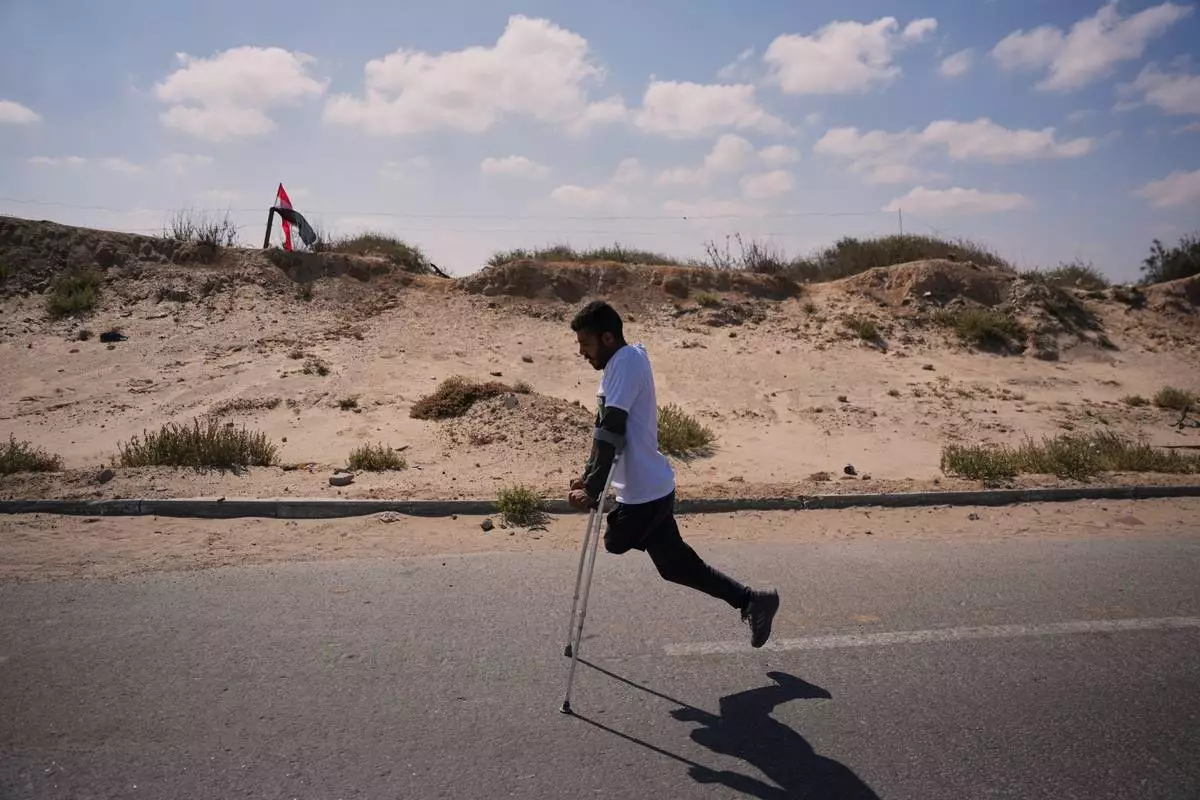
A Palestinian amputee runner takes part in the 2-kilometer Palestine Marathon along the coastal road near Nuseirat in the central Gaza Strip, Friday, May 8, 2026. (AP Photo/Abdel Kareem Hana)

Palestinian runners take part in the 5-kilometer Palestine Marathon along the coastal road near Nuseirat in the central Gaza Strip, Friday, May 8, 2026. (AP Photo/Abdel Kareem Hana)

Runners participate in the Palestine Marathon in the West Bank city of Bethlehem, Friday, May 8, 2026. (AP Photo/Mahmoud Illean)

Runners pass by Israel's separation wall as they compete in the Palestine Marathon in the West Bank city of Bethlehem, Friday, May 8, 2026. (AP Photo/Mahmoud Illean)

Palestinian Mohamad Al-Assi, who was released from Israeli detention six months ago, runs past Israel's separation wall as he trains ahead of the Palestine Marathon in the West Bank city of Bethlehem, Thursday, May 7, 2026. (AP Photo/Sam Metz)