Schoolchildren in Altay, northwest China's Xinjiang Uygur Autonomous Region, are spending this week on the ski slopes as the region has launched a nine-day "snow holiday" for primary and junior high school students.
Since Saturday, large numbers of children have flocked to ski resorts in Altay, including the General Mountain International Ski Resort, accompanied by family members.
"I basically go skiing every year. I think the snow break is really great. Skiing with good friends is delightful, and we've planned to come every day during this holiday," said Dong Qiye, a fourth-grade student at Altay Experimental Primary School.
As one of China's most popular winter destinations, Altay offers student-exclusive discounts at four major ski resorts, cultural venues, and hotels, including free admission to ski resorts, 15 percent off dining at resorts, and 20 percent off ski lessons. Several resorts also provide free half-hour beginner classes to help children get started.
"The demand for ice and snow experiences from students will attract parents to travel with them. It can boost local weekend tourism and draw wider attention to Altay's winter resources and services. This will drive spending on skiing, lodging, dining and cultural products," said Delida Nabi, head of the region's culture, sports, broadcasting and tourism bureau.

Altay in China's Xinjiang launches nine‑day "snow holiday" for students
Chinese box-office hit "Dear You" premiered in Vietnam's Ho Chi Minh City on Tuesday ahead of its nationwide theatrical release, warming the hearts of numerous local viewers.
The premiere was jointly organized by Vietnamese distributors Mockingbird Pictures and Galaxy Studio, with the support of the China Cultural Center in Hanoi.
Nearly 1,000 guests, including representatives of Vietnam's film industry, cultural scholars, members of the overseas Chinese community, representatives of Chinese enterprises in Vietnam and media organizations, attended the event.
Shot entirely in the Chaoshan (Teochew) dialect, the low-budget film became a massive box-office phenomenon in China this summer, with its global box office revenues surpassing 2.1 billion yuan (about 310 million U.S. dollars) since its April 30 release.
Known in Chinese as "Love Letters to Grandma," the movie centers on remittance letters used by overseas Chinese to stay connected with their families back home from the 1940s to 1970s. Through these letters, the characters uncover memories, love and interconnected family bonds in a simple yet deeply genuine narrative.
Even before its premiere, "Dear You" had generated significant buzz across Vietnamese social media platforms.
Doan Thi Trang Anh, deputy CEO of Mockingbird Pictures, said securing the distribution rights for "Dear You" in Vietnam was a special opportunity for the company, hoping that it could bring more Chinese films to Vietnamese audiences in the future.
"We consider it a remarkable piece of work full of new and creative touches. We can see that it is more than just a movie -- it carries deep cultural and historical significance for China, while also offering a moving portrayal of the true emotional connection between a husband and wife," Doan Thi Trang Anh told China Media Group (CMG).
After the premiere, the audience responded with great enthusiasm and offered glowing reviews.
"I feel that this movie speaks to the hearts and minds of Vietnamese audiences as well," said Nguyen Tuan, an audience member.
"There are many scenes in the film that remind me of my own grandparents. it really struck a chord with me," said Thu Thuy, a Vietnamese singer who also attended the premiere.
The film is set to hit cinemas nationwide in Vietnam beginning Wednesday. It will be available in three language versions: Mandarin Chinese, Chaochan dialect, and Vietnamese to cater to different viewing preferences.
The movie has also hit the screens in several other Southeast Asian countries, including Malaysia, Singapore, Brunei, Thailand and Indonesia.
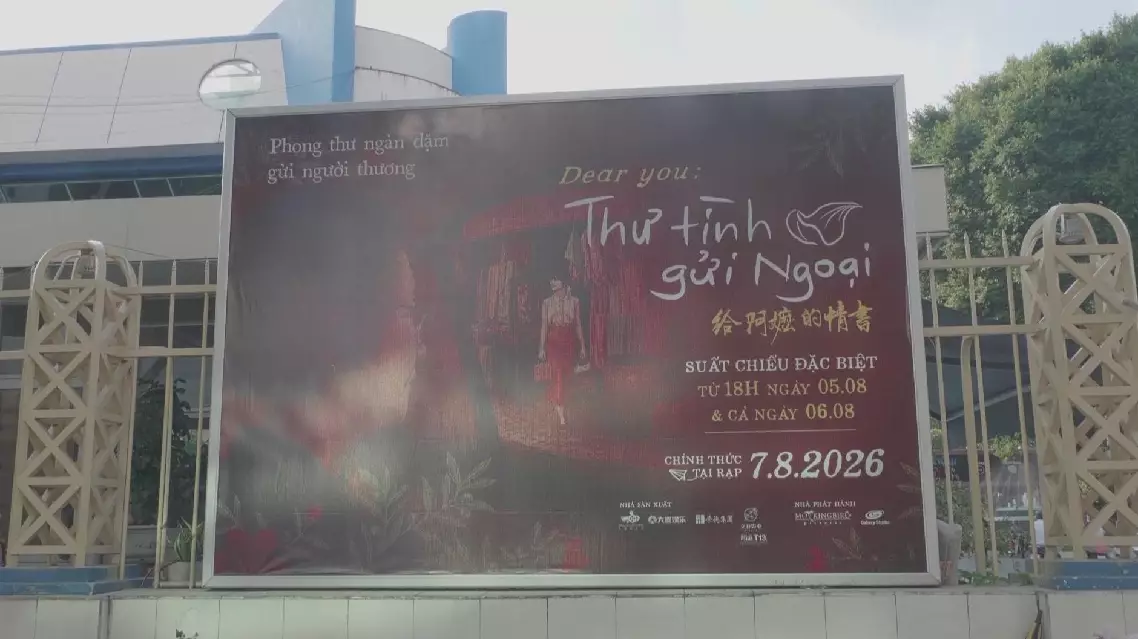
Chinese film 'Dear You' resonates with Vietnamese audience at premiere