MANHASSET, N.Y.--(BUSINESS WIRE)--Dec 2, 2025--
Northwell Health’sFeinstein Institutes for Medical Research received $4 million from the National Institute of Mental Health (NIMH) to improve how severe mental health conditions are assessed and treated. By using an AI-powered advanced speech and language analysis, the research aims to develop personalized metrics to gauge the severity of psychosis. This research has the potential to transform the way patients with mental illness are diagnosed and treated, leading to more precise and effective care.
This press release features multimedia. View the full release here: https://www.businesswire.com/news/home/20251202063895/en/
Led by Sunny Tang, MD, assistant professor in the Institute of Behavioral Science at the Feinstein Institutes, this research will explore methods to extract objective information from patient speech samples using computational algorithmic approaches, including artificial intelligence (AI) and deep learning. Her team will leverage a large existing dataset of approximately 3,500 speech samples from individuals on the psychosis spectrum and collect prospective data from 100 new participants to develop and evaluate these AI models, aiming to provide rapid and accurate, individual symptom prediction over time. By identifying a change in a patient’s language use and speech patterns, clinicians may be able to identify potential mental health episodes and intervene sooner.
“Psychiatry has long sought objective markers to guide diagnosis and treatment, much like other fields of medicine use vital signs or blood work to monitor physical health,” said Dr. Tang. “This grant empowers us to innovate at the intersection of artificial intelligence and mental health, developing a precision tool that can provide real-time, personalized insights into psychosis severity to change how we care for these patients sooner.”
Dr. Tang and her team’s research addresses a critical unmet need in mental health care: The scarcity of objective, low-cost markers for illness severity in psychosis which currently hinders effective measurement-based care. This project harnesses advanced automated speech and language analysis to generate objective data to gauge concurrent psychosis severity. This rapid, scalable and non-invasive method can be deployed using ordinary smartphones, making it highly accessible even in low-resource settings.
A key aspect of the research is to evaluate whether trajectories in these predicted severity scores can accurately capture concrete instances of clinical stressors, such as emergency room visits or hospitalizations. This will be assessed through both advanced AI algorithms and a “human intelligence” approach, where clinicians interpret plotted trajectories of symptom severity scores. The study also emphasizes community engagement, ensuring individuals with lived experience of psychosis and community mental health clinicians contribute to the study’s design and the development of future randomized controlled trials, fostering a person-centered approach to implementation in real-world clinical settings.
“The diagnosis of psychosis can be challenging, but accurate and early diagnosis can enhance the responses to therapy,” said Kevin J. Tracey, MD, president and CEO of the Feinstein Institutes and Karches Family Distinguished Chair in Medical Research. “Dr. Tang’s research using AI-enabled speech analysis offers a significant new pathway to early and specific diagnosis.”
About the Feinstein Institutes
The Feinstein Institutes for Medical Researchis the home of the research institutes of Northwell Health, the largest health care provider and private employer in New York State. Encompassing 50+ research labs, 3,000 clinical research studies and 5,000 researchers and staff, the Feinstein Institutes raises the standard of medical innovation through its six institutes of behavioral science, bioelectronic medicine, cancer, health system science, molecular medicine, and translational research. We are the global scientific leader in bioelectronic medicine – an innovative field of science that has the potential to revolutionize medicine. The Feinstein Institutes publishes two open-access, international peer-reviewed journalsMolecular MedicineandBioelectronic Medicine. Through theElmezzi Graduate School of Molecular Medicine, we offer an accelerated PhD program. For more information about how we produce knowledge to cure disease, visithttp://feinstein.northwell.eduand follow us onLinkedIn.

Dr. Sunny Tang led the study. (Credit: Feinstein Institutes)
WASHINGTON (AP) — Chief Justice John Roberts has led the Supreme Court 's conservative majority on a steady march of increasing the power of the presidency, starting well before Donald Trump's time in the White House.
The justices could take the next step in a case being argued Monday that calls for a unanimous 90-year-old decision limiting executive authority to be overturned.
The court's conservatives, liberal Justice Elena Kagan noted in September, seem to be “raring to take that action.”
They already have allowed Trump, in the opening months of the Republican's second term, to fire almost everyone he has wanted, despite the court's 1935 decision in Humphrey's Executor that prohibits the president from removing the heads of independent agencies without cause.
The officials include Rebecca Slaughter, whose firing from the Federal Trade Commission is at issue in the current case, as well as officials from the National Labor Relations Board, the Merit Systems Protection Board and the Consumer Product Safety Commission.
The only officials who have so far survived efforts to remove them are Lisa Cook, a Federal Reserve governor, and Shira Perlmutter, a copyright official with the Library of Congress. The court already has suggested that it will view the Fed differently from other independent agencies, and Trump has said he wants her out because of allegations of mortgage fraud. Cook says she did nothing wrong.
Humphrey's Executor has long been a target of the conservative legal movement that has embraced an expansive view of presidential power known as the unitary executive.
The case before the high court involves the same agency, the FTC, that was at issue in 1935. The justices established that presidents — Democrat Franklin D. Roosevelt at the time — could not fire the appointed leaders of the alphabet soup of federal agencies without cause.
The decision ushered in an era of powerful independent federal agencies charged with regulating labor relations, employment discrimination, the air waves and much else.
Proponents of the unitary executive theory have said the modern administrative state gets the Constitution all wrong: Federal agencies that are part of the executive branch answer to the president, and that includes the ability to fire their leaders at will.
As Justice Antonin Scalia wrote in a 1988 dissent that has taken on mythical status among conservatives, “this does not mean some of the executive power, but all of the executive power.”
Since 2010 and under Roberts' leadership, the Supreme Court has steadily whittled away at laws restricting the president's ability to fire people.
In 2020, Roberts wrote for the court that “the President’s removal power is the rule, not the exception” in a decision upholding Trump’s firing of the head of the Consumer Financial Protection Bureau despite job protections similar to those upheld in Humphrey’s case.
In the 2024 immunity decision that spared Trump from being prosecuted for his efforts to overturn the 2020 election results, Roberts included the power to fire among the president's “conclusive and preclusive” powers that Congress lacks the authority to restrict.
But according to legal historians and even a prominent proponent of the originalism approach to interpreting the Constitution that is favored by conservatives, Roberts may be wrong about the history underpinning the unitary executive.
“Both the text and the history of Article II are far more equivocal than the current Court has been suggesting,” wrote Caleb Nelson, a University of Virginia law professor who once served as a law clerk to Justice Clarence Thomas.
Jane Manners, a Fordham University law professor, said she and other historians filed briefs with the court to provide history and context about the removal power in the country's early years that also could lead the court to revise its views. “I'm not holding my breath,” she said.
Slaughter's lawyers embrace the historians' arguments, telling the court that limits on Trump's power are consistent with the Constitution and U.S. history.
The Justice Department argues Trump can fire board members for any reason as he works to carry out his agenda and that the precedent should be tossed aside.
“Humphrey’s Executor was always egregiously wrong,” Solicitor General D. John Sauer wrote.
A second question in the case could affect Cook, the Fed governor. Even if a firing turns out to be illegal, the court wants to decide whether judges have the power to reinstate someone.
Justice Neil Gorsuch wrote earlier this year that fired employees who win in court can likely get back pay, but not reinstatement.
That might affect Cook's ability to remain in her job. The justices have seemed wary about the economic uncertainty that might result if Trump can fire the leaders of the central bank. The court will hear separate arguments in January about whether Cook can remain in her job as her court case challenging her firing proceeds.
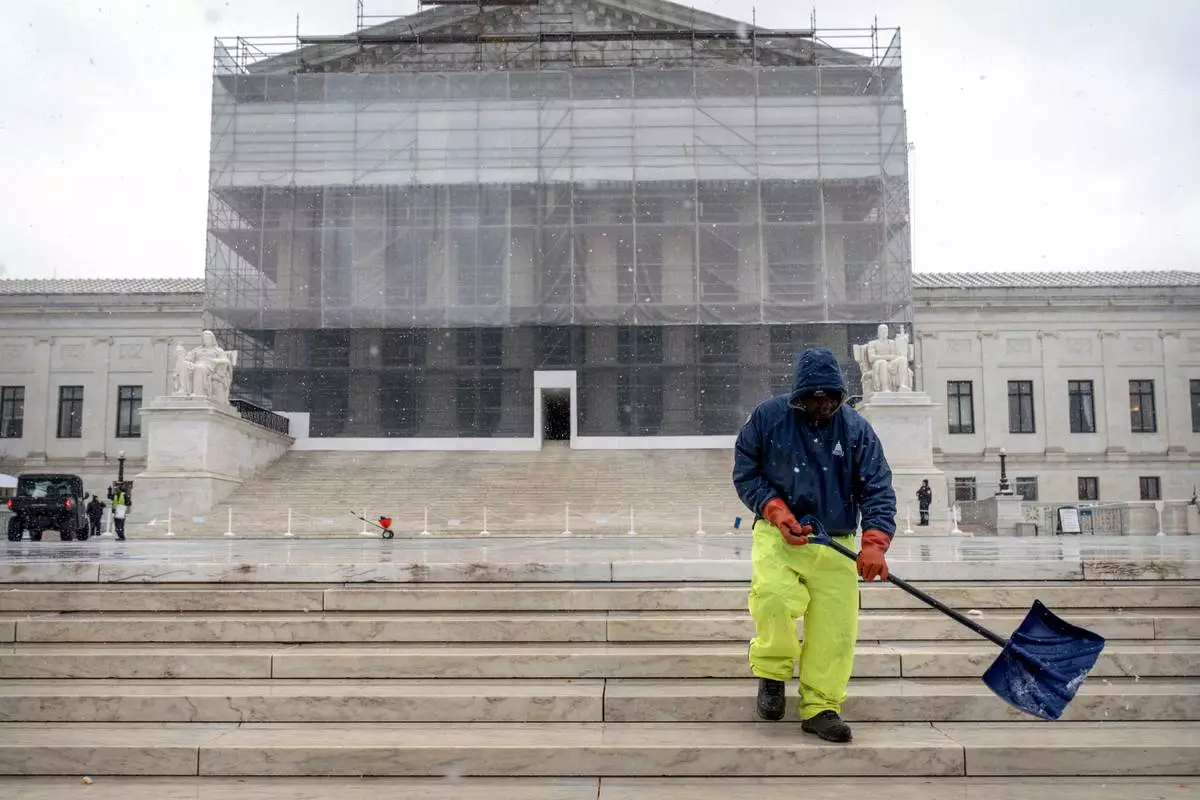
A worker shovels snow and ice in front of the Supreme Court building during the first snowfall of the winter season on Friday, Dec. 5, 2025, in Washington. (AP Photo/Mark Schiefelbein)
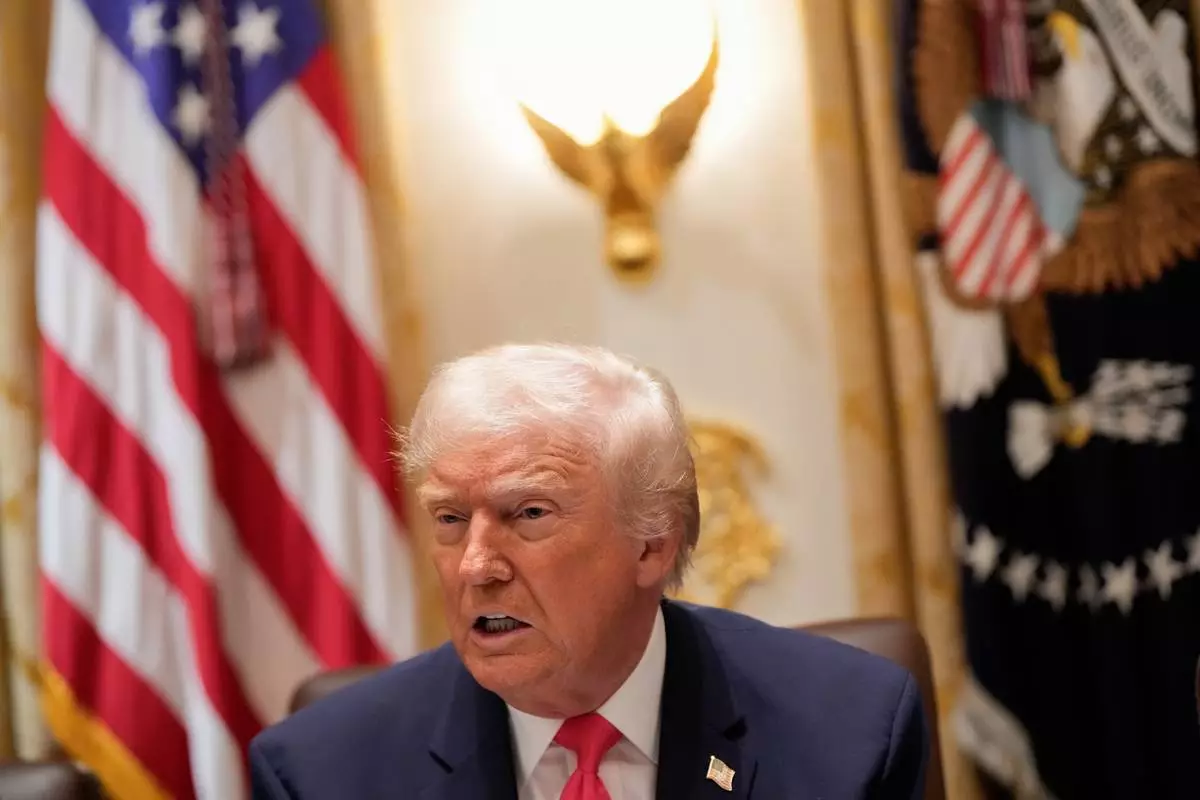
President Donald Trump speaks during a Cabinet meeting at the White House, Tuesday, Dec. 2, 2025, in Washington. (AP Photo/Julia Demaree Nikhinson)