WASHINGTON (AP) — When the children of wealthy households leave the nest, they often benefit from their parents' largesse in the form of a trust fund. Less affluent peers may receive nothing at all — or even be expected to support their families when they become adults.
But what if all children, regardless of their family’s circumstances, could get a financial boost when they turn 18?
That's the idea behind “Trump Accounts,” a lesser-known provision of President Donald Trump's tax legislation. The bill, signed into law earlier this year, gives $1,000 to every newborn, so long as their parents open an account. That money is invested in the stock market by private firms, and the child can access the funds when they turn 18. The parents of older children can also open accounts, but they won't get the $1,000 bonus.
Backers say it's a way to bolster capitalism and help children from low-income households build wealth at a time when openly socialist candidates are growing more popular.
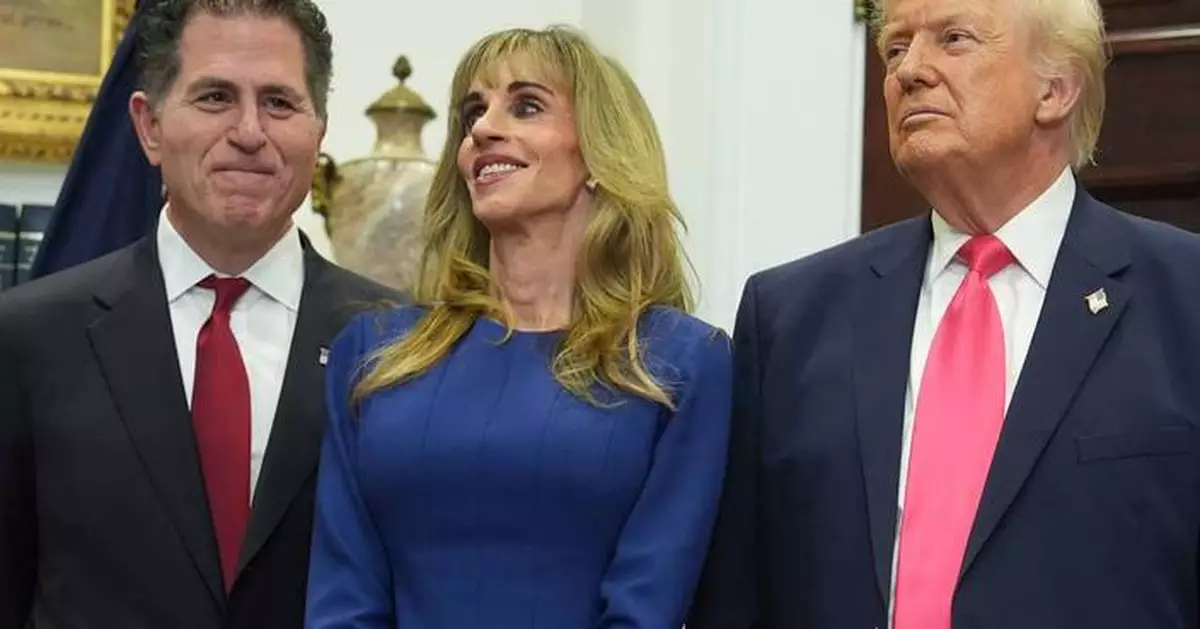
The new program gives the $1,000 bonus only to babies born during the calendar years of the Trump administration. Thanks to a historic donation announced Tuesday by billionaires Michael and Susan Dell, some children 10 and under could receive $250 in seed money if their parents open an account. That money is reserved for kids who live in ZIP codes with a median family income of $150,000 or less and who won’t get the $1,000 seed money from the Treasury.
Here's what you need to know about Trump Accounts and how to claim them.
It's new savings tool where money is invested in the stock market on behalf of a child. The child can't access the money until they turn 18 and can only use it for specific purposes, such as paying tuition, starting a business or making a down payment on a home.
After a parent opens an account, the U.S. Treasury will contribute $1,000 for newborns. Private banks and brokerages will manage the money, which must be invested in U.S. equity index funds that track the stock market and charge the accounts no more than 0.10% in annual fees.
Parents can contribute up to $2,500 annually in pretax income, much like they do for retirement accounts. Parents' employers, relatives, friends, local governments and philanthropic groups can also pitch in. Yearly contributions are capped at $5,000, but contributions from governments and charities don’t count toward that total.
To qualify for the $1,000 seed money, a baby must be a U.S. citizen, have a Social Security number and be born between Jan. 1, 2025, and Dec. 31, 2028. Any parent can open an account for a qualifying child, regardless of the parent's immigration status.
It's important to note that the child won't be able to access the money until they turn 18, except in rare circumstances, so it can't help with immediate expenses. And disbursements from the accounts will be subject to taxes.
Children born before 2025 won't qualify for the $1,000 incentive, but parents can still open accounts for them as long as they're under 18. Parents can still invest up to $2,500 pretax for those kids, and they may benefit from the Dells' donation, giving $250 to children 10 and under in certain ZIP codes.
The accounts won't be open for contributions until July 2026. But parents of eligible kids can sign up now by filling out Form 4547 from the Internal Revenue Service. As of Tuesday afternoon, that form was not yet available on the Trump Accounts website.
In May, parents who sign up will get information about how to finish opening the accounts. Beginning in July, the White House says it will have a website where parents can register for the accounts.
Backers of the accounts say they want to introduce more people to the stock market and give even children born into poverty a chance to benefit from it. They believe that giving every newborn $1,000 will help combat the rising popularity of socialism and offer more people the opportunity to build wealth. About 58% of U.S. households held stocks or bonds in 2022, according to the U.S. Securities and Exchange Commission, though the wealthiest 1% owned almost half the value of stocks in that same year.
Before Trump created the accounts, California, Connecticut and the District of Columbia were piloting “baby bonds” programs that are similar to Trump Accounts in some ways. Several other states, including Maryland, are weighing programs.
But those programs are targeted for youth growing up in poverty or foster care, plus children who lost a parent to COVID-19. Wealthier children don't benefit.
They're also managed by the state, not private investment firms.
Critics point out the accounts do little to help children in their early years, when they're most vulnerable and most likely to be in poverty. They also say the accounts do little to offset the cuts the Trump administration and congressional Republicans have made to other programs that benefit young people and their families, including food assistance and Medicaid. Republicans created the accounts in the same Trump tax bill that reduced spending for some of those programs.
And even with the contribution from the government, critics say the Trump Accounts will widen the wealth gap. Affluent families that can afford to make the maximum pretax contribution to the accounts will realize the greatest benefits. Poor families who can't afford to set aside money for the accounts will benefit the least. Assuming a 7% return, the $1,000 in seed money would grow to roughly $3,570 over 18 years.
The Associated Press’ education coverage receives financial support from multiple private foundations. AP is solely responsible for all content. Find AP’s standards for working with philanthropies, a list of supporters and funded coverage areas at AP.org.
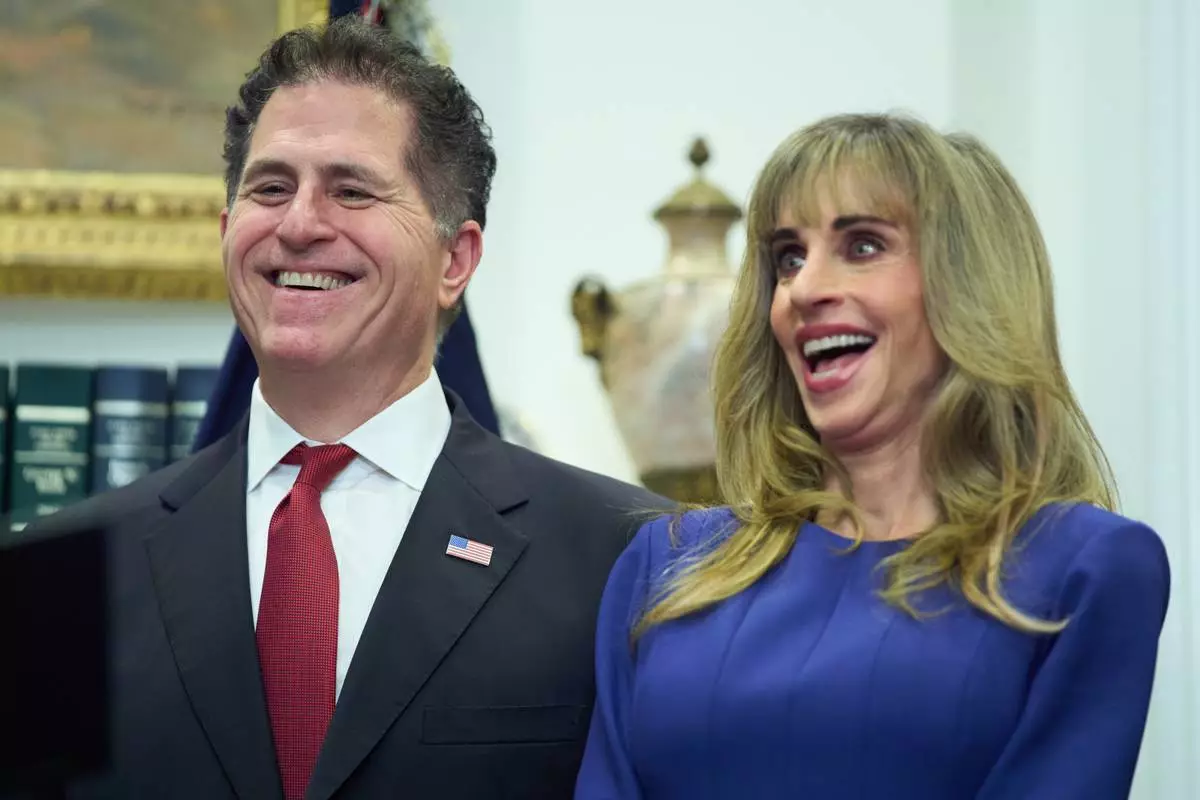
Michael Dell, and his wife Susan, laugh as President Donald Trump speaks during an event on "Trump Accounts" for kids in the Roosevelt Room of the White House, Tuesday, Dec. 2, 2025, in Washington. (AP Photo/Evan Vucci)
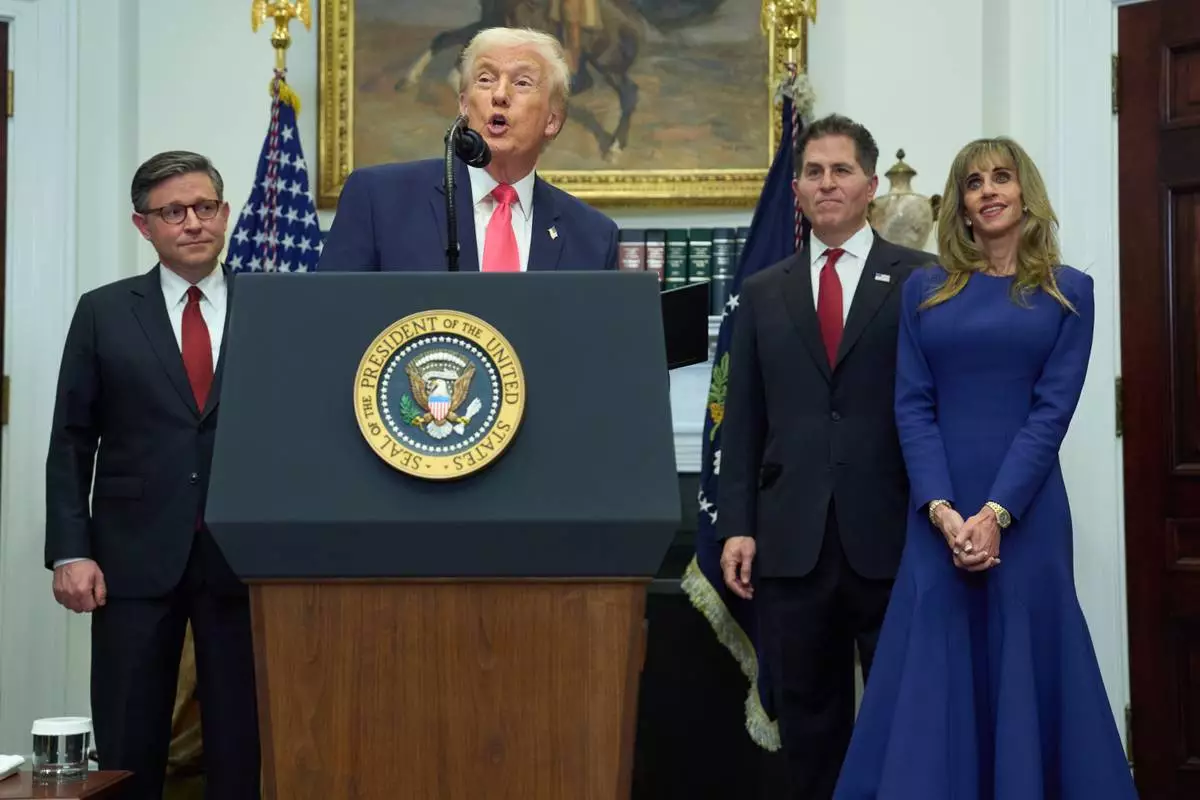
President Donald Trump speaks during an event on "Trump Accounts" for kids in the Roosevelt Room of the White House, Tuesday, Dec. 2, 2025, in Washington. From left, Speaker of the House Mike Johnson, of La., Trump, Michael Dell, and his wife Susan. (AP Photo/Evan Vucci)
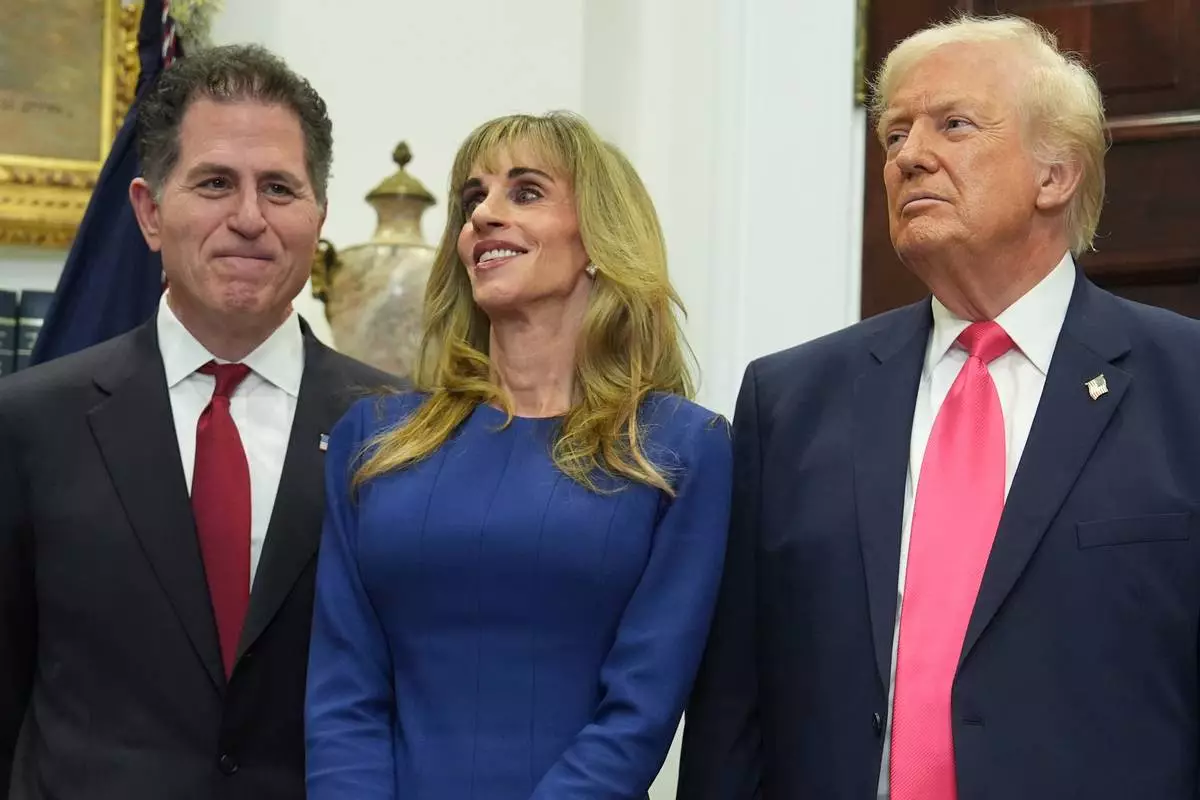
Michael Dell, left, his wife Susan and President Donald Trump listen during an event on "Trump Accounts" for kids in the Roosevelt Room of the White House, Tuesday, Dec. 2, 2025, in Washington. (AP Photo/Evan Vucci)

Indiana’s Republican-led Senate has decisively rejected a redrawn congressional map that would have favored their party, defying months of pressure from President Donald Trump and delivering a stark setback to the White House ahead of next year’s midterm elections.
The vote on Thursday was overwhelmingly against the proposed redistricting, with more Republicans opposing than supporting the measure, signaling the limits of Trump’s influence even in one of the country’s most conservative states.
Trump has been urging Republicans nationwide to redraw their congressional maps in an unusual campaign to help the party maintain its thin majority in the House of Representatives. Although Texas, Missouri, Ohio and North Carolina went along, Indiana did not — despite cajoling and insults from the president and the possibility of primary challenges.
The latest:
Trump acknowledged in an interview with the Wall Street Journal that he had pushed Kevin Warsh, a former Fed governor, to cut interest rates if he is made chair.
“He thinks you have to lower interest rates,” Trump told the Wall Street Journal, referring to Warsh. “And so does everybody else that I’ve talked to.”
Right now the Fed is sharply divided over whether further rate cuts are needed, with many officials pointing to inflation at nearly 3% -- above the Fed’s 2% target -- as reason to hold off on further cuts. By demanding further reductions, Trump has broken from decades of precedent under which previous administrations avoided publicly pressuring the central bank.
Trump has previously hinted that he has made his choice to replace the current Federal Reserve Chair Jerome Powell, who Trump has sharply criticized for not lowering rates quickly enough. He also has referred to Kevin Hassett, his top economic adviser, as a “potential Fed chair,” seemingly anointing Hassett as the favorite.
But in the Journal interview he suggested Warsh is the front runner.
“I think the two Kevins are great,” Trump said.
A West Virginia National Guard member who was shot last month in the nation’s capital is being transitioned from hospital acute care to in-patient rehabilitation, a doctor said Friday.
Staff. Sgt. Andrew Wolfe was airlifted to MedStar Washington Hospital Center with a critical gunshot wound to the head on Nov. 26. Wolfe and Spc. Sarah Beckstrom were ambushed as they patrolled a subway station three blocks from the White House. Beckstrom died the next day.
Wolfe has “made extraordinary progress” and can stand with assistance, Dr. Jeffrey Mai, a MedStar neurosurgeon, said in a news release. Wolfe’s family chose not to disclose the location of his rehabilitation.
Beckstrom was buried in a private funeral on Wednesday.
Rahmanullah Lakanwal, a 29-year-old Afghan national who was also shot during the confrontation, has been charged with murder. He has pleaded not guilty.
Top Democrats in Congress are making it clear they want the public and members of Congress to see video of a Sept. 2 military strike that killed two survivors of an initial attack on a boat allegedly carrying drugs in the Caribbean.
The Democratic leaders in both congressional chambers -- Sen. Chuck Schumer and Rep. Hakeem Jeffries -- as well as the top Democrats on committees on national intelligence -- Sen. Mark Warner and Rep. Jim Himes -- signed a letter to Defense Secretary Pete Hegseth calling for members of Congress to see the full, unedited video of the strike. They also say the video should be released publicly, though with precautions to make sure sensitive intelligence information is not revealed.
Hegseth has told lawmakers that he is weighing whether to hand the video over to Congress, including whether that would reveal classified information. The Trump administration has released edited videos of the overall campaign on social media for the last several months.
Spokesperson Abigail Jackson said House Democrats are “selectively releasing cherry-picked photos with random redactions to try and create a false narrative.”
House Democrats released 19 photos from Epstein’s estate on Friday without captions or context. It included a black-and-white image of Trump alongside six women whose faces were blacked out. The committee did not say why their faces were blacked out.
Jackson said the Trump administration has done more to help Jeffrey Epstein’s victims than Democrats, by releasing thousands of pages of documents.
Trump signed a bill compelling the Justice Department to release case files last month, reversing course after he opposed the bill for months.
The fighting is rooted in a history of enmity over competing territorial claims. These claims largely stem from a 1907 map created while Cambodia was under French colonial rule, which Thailand maintains is inaccurate.
Tensions were exacerbated by a 1962 International Court of Justice ruling that awarded sovereignty to Cambodia, which still riles many Thais.
Thailand has deployed jet fighters to carry out airstrikes on what it says are military targets. Cambodia has deployed BM-21 rocket launchers with a range of 30-40 kilometers (19-25 miles).
According to data collected by public broadcaster ThaiPBS, at least six of the Thai soldiers who were killed were hit by rocket shrapnel.
The Thai army’s northeastern regional command said Thursday that some residential areas and homes near the border were damaged by BM-21 rocket launchers from Cambodian forces.
The Thai army also said it destroyed a tall crane atop a hill held by Cambodia where the centuries-old Preah Vihear temple is located, because it allegedly held electronic and optical devices used for military command and control purposes.
President Donald Trump says Thai and Cambodian leaders have agreed to renew a truce after days of deadly clashes had threatened to undo a ceasefire the U.S. administration had helped broker earlier this year.
Trump announced the agreement to restart the ceasefire in a social media posting on Friday following calls with Thai Prime Minister Anutin Charnvirakul and Cambodian Prime Minister Hun Manet.
The original ceasefire in July was brokered by Malaysia and pushed through by pressure from Trump, who threatened to withhold trade privileges unless Thailand and Cambodia agreed. Despite the deal, the two countries carried on a bitter propaganda war and minor cross-border violence continued.
Department of Justice attorneys make that argument in responding to a lawsuit against the White House by the National Association for the Deaf.
Government lawyers haven’t elaborated on how doing so might hamper the portrayal Trump seeks to present to the public. But overturning policies encompassing diversity, equity and inclusion have become a hallmark of his second administration.
The association sued the White House in May, saying not using American Sign Language interpretation at press briefings or when Trump gives remarks prohibits “meaningful access to the White House’s real-time communications” to the Deaf community and hard of hearing.
A White House spokesperson did not immediately comment Friday.
President Donald Trump’s administration is ending the temporary status that has allowed more than 4,500 Ethiopians to live and work in the United States for more than three years.
The decision announced Friday by the Department of Homeland Security comes as the White House moves to put more immigrants in the U.S. eligible for deportation. Ethiopia is the latest in a string of countries to lose Temporary Protection Status.
DHS said that conditions in Ethiopia have improved and no longer pose a serious threat to the safety of returning Ethiopian nationals.
Ethiopians in the U.S. with no other lawful status have 60 days to voluntarily leave the country, said DHS. After February 13, 2026, DHS may arrest and deport Ethiopians whose TPS has been terminated.
During the Biden administration, the number of people protected by TPS grew significantly. Nearly 1 million Venezuelans and Haitians were protected. President Trump has already ended TPS for Venezuelans, Hondurans, Haitians, Nicaraguans, Ukrainians, and thousands of people from Syria, Afghanistan, Nepal and Cameroon.
Trump successfully harnessed voter anxiety over the economy, immigration and crime last year to retake the White House — and lift plenty of other Republicans into office with him. But as the party tries to keep its grip on complete control in Washington, that strategy may be harder to replicate.
Republicans have lost a series of elections over the past month, some resoundingly. The latest setbacks came this week when a Democrat won the Miami mayor’s race for the first time in three decades. Democrats also won a special election in a historically Republican district in Georgia.
There are also signs that Trump’s influence over his party has its limits, and he failed Thursday to persuade Indiana state senators to approve a new congressional map that could have helped Republicans pick up two more seats.
Perhaps most concerning for Republicans, Trump is losing ground on the very issues that powered his comeback victory last year, potentially undermining his utility as a surrogate for the party’s candidates in the midterm elections. Only 31% of U.S. adults now approve of how he’s handling the economy, down from 40% in March, according to a poll from The Associated Press-NORC Center for Public Affairs Research.
Trump was sued on Friday by preservationists seeking an architecture review and congressional approval over his White House ballroom project.
The National Trust for Historic Preservation is asking a federal court to stop Trump’s White House ballroom project until it goes through comprehensive design reviews and public comments and wins approval from Congress.
The National Trust argues that Trump, by fast-tracking the project, has committed multiple violations of the Administrative Procedures Act and the National Environmental Policy Act, while also exceeding his constitutional authority by not seeking congressional approval for a project of this scale.
Trump, a Republican, already has bypassed the federal government’s usual building practices and historical reviews when he razed the East Wing of the White House. He has more recently fired the initial architects for a ballroom that itself would be nearly twice the size of the White House before East Wing’s demolition.
House Democrats released a selection of photos from the estate of Jeffrey Epstein on Friday, including some of Donald Trump, Bill Clinton and the former Prince Andrew.
The 19 photos released by Democratic lawmakers on the House Oversight Committee were a small part of more than 95,000 they received from the estate of Epstein, who died in a New York jail cell in 2019 while awaiting sex trafficking charges.
The photos released Friday were separate from the case files that the Department of Justice is now compelled to release.
The photos were released without captions or context and included a black-and-white image of Trump alongside six women whose faces were blacked out. The committee did not say why their faces were blacked out.
Trump has signed an executive order aimed at blocking states from crafting their own regulations for artificial intelligence, saying the burgeoning industry is at risk of being stifled by a patchwork of onerous rules while in a battle with Chinese competitors for supremacy.
Members of Congress from both parties, as well as civil liberties and consumer rights groups, have pushed for more regulations on AI, saying there is not enough oversight for the powerful technology.
But Trump told reporters in the Oval Office that “there’s only going to be one winner” as nations race to dominate artificial intelligence, and China’s central government gives its companies a single place to go for government approvals.
A bipartisan group in Congress is urging the Education Department to add nursing to a list of college programs that are considered “professional,” adding to public outcry after nurses were omitted from a new agency definition.
The Trump administration’s list of professional programs includes medicine, law and theology but leaves out nursing and some other fields that industry groups had asked to be included. The “professional” label would allow students to borrow larger amounts of federal loans to pursue graduate degrees in those fields.
The president will sign a bill awarding Congressional Gold Medals to members of the U.S. men’s ice hockey team who defeated the heavily favored Soviet Union team during the Cold War.
The game held in Lake Placid, New York, is widely regarded as one of the greatest upsets in the history of sports.
President Donald Trump reacts to guests in the Grand Foyer of the White House during the Congressional Ball, Thursday, Dec. 11, 2025, in Washington. (AP Photo/Alex Brandon)
President Donald Trump and first lady Melania greet guests in the Grand Foyer of the White House during the Congressional Ball, Thursday, Dec. 11, 2025, in Washington. (AP Photo/Alex Brandon)