WASHINGTON (AP) — The Senate failed to get anywhere on the health care issue this week. Now it's the House's turn to show what it can do.
Speaker Mike Johnson unveiled a Republican alternative late Friday, a last-minute sprint as his party refuses to extend the enhanced tax subsidies for those who buy policies through the Affordable Care Act, also called Obamacare, which are expiring at the end of the year. Those subsidies help lower the cost of coverage.
Johnson, R-La., huddled behind closed doors in the morning — as he did days earlier this week — working to assemble the package for consideration as the House focuses the final days of its 2025 work on health care.
“House Republicans are tackling the real drivers of health care costs to provide affordable care,” Johnson said in a statement announcing the package. He said it would be voted on next week.
Later Friday, though, House Democratic Leader Hakeem Jeffries said: “House Republicans have introduced toxic legislation that is completely unserious, hurts hardworking America taxpayers and is not designed to secure bipartisan support. If the bill reaches the House floor, I will strongly oppose it.”
Time is running out for Congress to act. Democrats engineered the longest federal government shutdown ever this fall in a failed effort to force Republicans to the negotiating table on health care. But after promising votes, the Senate failed this week to advance both a Republican health care plan and the Democratic-offered bill to extend the tax credits for three years.
Now, with just days to go, Congress is about to wrap up its work with no consensus solution in sight.
The House Republicans offered a 100-plus-page package that focuses on long-sought GOP proposals to enhance access to employer-sponsored health insurance plans and clamp down on so-called pharmacy benefit managers.
Republicans propose expanding access to what's referred to as association health plans, which would allow more small businesses and self-employed individuals to band together and purchase health coverage.
Proponents say such plans increase the leverage businesses have to negotiate a lower rate. But critics say the plans provide skimpier coverage than what is required under the Affordable Care Act.
The Republicans’ proposal would also require more data from pharmacy benefit managers, or PBMs, as a way to help control drug costs. Critics say PBMs have padded their bottom line and made it more difficult for independent pharmacists to survive.
Additionally, the GOP plan includes mention of cost-sharing reductions for some lower-income people who rely on Obamacare, but those do not take effect until January 2027.
The emerging package from the House Republicans does not include an extension of an enhanced tax credit for millions of Americans who get insurance coverage through the Affordable Care Act. Put in place during the COVID-19 crisis, that enhanced subsidy expires Dec. 31, leaving most families in the program facing more than double their current out-of-pocket premiums, and in some cases, much more.
President Donald Trump has said he believes Republicans are going to figure out a better plan than Obamacare — something he has promised for years — but offered few details beyond his idea for providing Americans with stipends to help buy insurance.
“I want to see the billions of dollars go to people, not to the insurance companies," Trump said late Friday during an event at the White House. “And I want to see the people go out and buy themselves great healthcare.”
The president did not comment directly on the House's new plan. He has repeatedly touted his idea of sending money directly to Americans to help offset the costs of health care policies, rather than extending the tax credits for those buying policies through Obamacare. It’s unclear how much money Trump envisions. The Senate GOP proposal that failed to advance would have provided payments to new health savings accounts of $1,000 a year for adult enrollees, or $1,500 for those ages 50 to 64.
It appeared there were no such health savings accounts in the new House GOP plan.
Going Johnson's route has left vulnerable House Republicans representing key battleground districts in a tough spot.
Frustrated with the delays, a group of more centrist GOP lawmakers is aligning with Democrats to push their own proposals for continuing the tax credits, for now, so that Americans don't face rising health care costs.
They are pursuing several paths for passing a temporary ACA subsidy extension, co-sponsoring a handful of bills. They are also signing onto so-called discharge petitions that could force a floor vote if a majority of the House signs on.
Such petitions are designed to get around the majority's control and are rarely successful, but this year has proven to be an exception. Lawmakers, for example, were able to use a discharge petition to force a vote on the release of the Jeffrey Epstein files held by the Department of Justice.
One petition, filed by Rep. Brian Fitzpatrick, R-Pa., had signatures from 12 Republicans and 12 Democrats as of Friday afternoon. It would force a vote on a bill that includes a two-year subsidy extension and contains provisions designed to combat fraud in the ACA marketplace. There are also restrictions for PBMs, among other things.
Another petition from Rep. Josh Gottheimer, D-N.J., has 39 signatures and is broadly bipartisan. It's a simpler proposal that would force a vote on a one-year ACA enhanced subsidy extension and would include new income caps limiting who qualifies for the enhanced credit.
Both discharge petitions have enough Republicans’ support that they would likely succeed if Jeffries encouraged his caucus to jump on board. So far, he's not tipping his hand.
“We’re actively reviewing those two discharge petitions and we’ll have more to say about it early next week,” Jeffries said.
Meanwhile, Jeffries is pushing Democrats' own discharge petition, which has 214 signatures and would provide for a clean three-year subsidy extension. No Republicans have signed onto that one.
And as Republicans made clear in the Senate this week, a three-year extension without changes to the program has no chance of passing their chamber.

Speaker of the House Mike Johnson, R-La., prepares to speak to reporters following a strategy session with House Republicans, at the Capitol in Washington, Wednesday, Dec. 10, 2025. (AP Photo/J. Scott Applewhite)
NUSEIRAT, Gaza Strip (AP) — Sitting in her wheelchair, Haneen al-Mabhouh dreams of rebuilding her family, of cradling a new baby. She dreams of walking again. But with her leg gone, her life in Gaza is on hold, she says, as she waits to go abroad for further treatment.
An Israeli airstrike in July 2024 smashed her home in central Gaza as she and her family slept. All four of her daughters were killed, including her 5-month-old baby. Her husband was severely burned. Al-Mabhouh’s legs were crushed under the rubble, and doctors had to amputate her right leg above the knee.
“For the past year and a half, I have been unable to move around, to live like others. For the past year and a half, I have been without children,” she said, speaking at her parents’ home.
The 2-month-old ceasefire in Gaza has been slow to bring help for thousands of Palestinians who suffered amputations from Israeli bombardment over the past two years. The World Health Organization estimates there are some 5,000 to 6,000 amputees from the war, 25% of them children.
Those who lost limbs are struggling to adapt, faced with a shortage of prosthetic limbs and long delays in medical evacuations out of Gaza.
The WHO said a shipment of essential prosthetic supplies recently made it into Gaza. That appears to be the first significant shipment for the past two years.
Previously, Israel had let in almost no ready-made prosthetic limbs or material to manufacture limbs since the war began, according to Loay Abu Saif, the head of the disability program at Medical Aid for Palestinians, or MAP, and Nevin Al Ghussein, acting director of the Artificial Limbs and Polio Center in Gaza City.
The Israeli military body in charge of coordinating aid, known as COGAT, did not respond when asked how many prosthetic supplies had entered during the war or about its policies on such supplies.
Al-Mabhouh was asleep with her baby girl in her arms when the strike hit their home in Nuseirat, she said. For several weeks while recovering in the hospital, al-Mabhouh had no idea her children had been killed.
She underwent multiple surgeries. Her hand still has difficulty moving. Her remaining leg remains shattered, held together with rods. She needs a bone graft and other treatments that are only available outside of Gaza.
She was put on the list for medical evacuation 10 months ago but still hasn’t gotten permission to leave Gaza.
Waiting for her chance to go, she lives at her parents’ house. She needs help changing clothes and can’t even hold a pen, and remains crushed by grief over her daughters. “I never got to hear her say ‘mama,’ see her first tooth or watch her take her first steps,” she said of her baby.
She dreams of having a new child but can’t until she gets treatment.
“It’s my right to live, to have another child, to regain what I lost, to walk, just to walk again,” she said. “Now my future is paralyzed. They destroyed my dreams.”
The ceasefire has hardly brought any increase in medical evacuations for the 16,500 Palestinians the U.N. says are waiting to get vital treatment abroad — not just amputees, but patients suffering many kinds of chronic conditions or wounds.
As of Dec. 1, 235 patients have been evacuated since the ceasefire began in October, just under five a day. In the months before that, the average was about three a day.
Israel last week said it was ready to allow patients and other Palestinians to leave Gaza via the Israeli-held Rafah crossing between Gaza and Egypt. But it's unsure that will happen because Egypt, which controls the crossing’s other side, demands Rafah also be opened for Palestinians to enter Gaza as called for under the ceasefire deal.
Dr. Richard Peeperkorn, the WHO's representative in the occupied Palestinian territory, told The Associated Press that the backlog is caused by the lack of countries to host the evacuated patients. He said new medevac routes need to be opened, especially to the Israeli-occupied West Bank and east Jerusalem, where hospitals are ready to receive patients.
Yassin Marouf lies in a tent in central Gaza, his left foot amputated, his right leg barely held together with rods.
The 23-year-old and his brother were hit by Israeli shelling in May as they returned from visiting their home in northern Gaza that their family had been forced to flee. His brother was killed. Marouf lay bleeding on the ground, as a stray dog attacked his mangled left leg.
Doctors say his right leg will also need to be amputated, unless he can travel abroad for operations that might save it. Marouf said he can’t afford painkillers and can’t go to the hospital regularly to have his bandages changed as they’re supposed to.
“If I want to go to the bathroom, I need two or three people to carry me,” he said.
Mohamed al-Naggar had been pursuing an IT degree at the University of Palestine before the war.
Seven months ago, shrapnel pierced his left leg during strikes on the house where his family was sheltering. Doctors amputated his leg above the knee. His right leg was also badly injured and shrapnel remains in parts of his body.
Despite four surgeries and physical therapy, the 21-year-old al-Naggar can’t move around.
“I’d like to travel abroad and put on a prosthetic and graduate from college and be normal like young people outside Gaza,” he said.
Some 42,000 Palestinians have suffered life-changing injuries in the war, including amputations, brain trauma, spinal cord injuries and major burns, the WHO said in an October report.
The situation has “improved slightly” for those with assistance needs but “there is still a huge overall shortage of assistive products,” such as wheelchairs, walkers and crutches. Gaza has only eight prosthetists able to manufacture and fit artificial limbs, the WHO said in a statement to the AP.
The Artificial Limbs and Polio Center in Gaza City, one of two prosthetics centers still operating in the territory, received a shipment of material to manufacture limbs just before the war began in 2023, said its director, Al Ghussein. Another small shipment entered in December 2024, but nothing since.
The center has been able to provide artificial limbs for 250 cases over the course of the war, but supplies are running out, Al Ghussein said.
No pre-made prosthetic legs or arms have entered, according to Abu Saif of MAP, who said Israel does not ban them, but its procedures cause delays and “in the end they ignore it.”
Ibrahim Khalif wants a prosthetic right leg so he can get a job doing manual labor or cleaning houses to support his pregnant wife and children.
In January, he lost his leg when an Israeli airstrike hit Gaza City while he was out getting food.
“I used to be the provider for my kids, but now I’m sitting here," Khalif said. "I think of how I was and what I’ve become.”
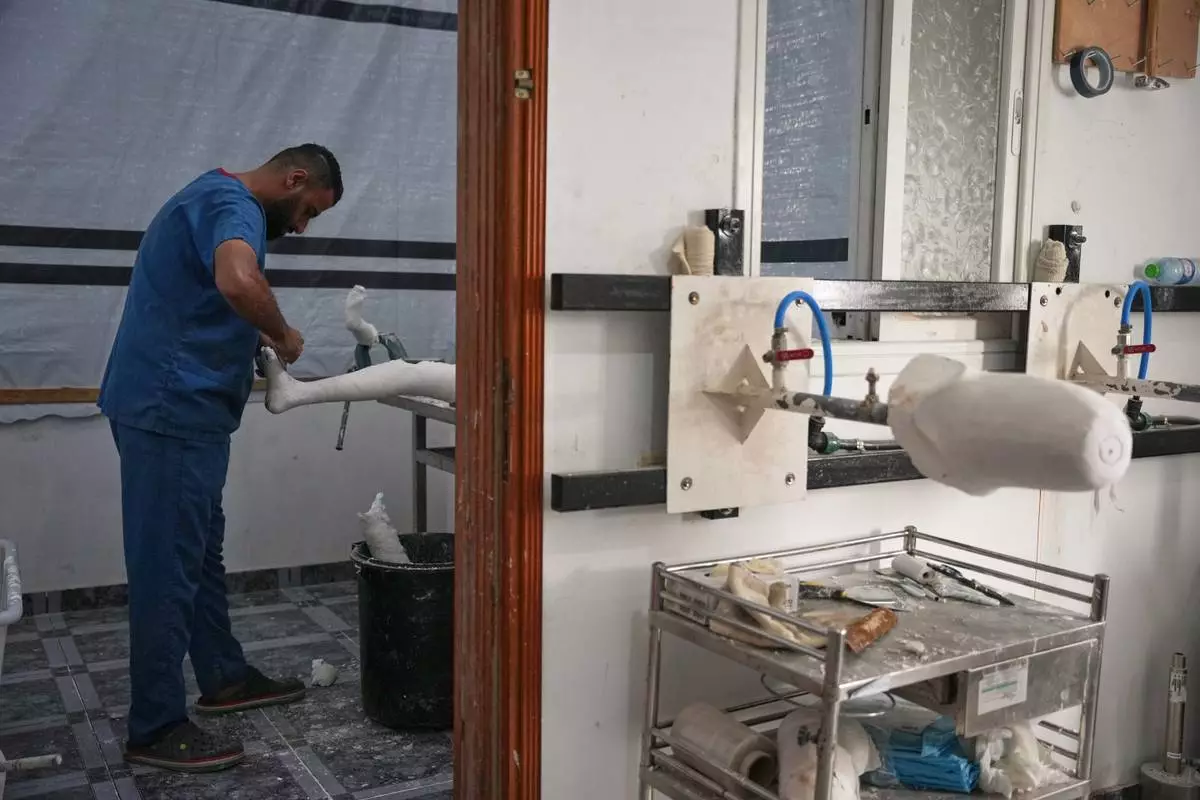
Prosthetic limb technician Ahmed Al-Ashqar, 34, prepares a leg amputation splint in the first stage of building an artificial leg at Hamad Hospital in Zawaida, central Gaza Strip, Thursday, Nov. 27, 2025. (AP Photo/Abdel Kareem Hana)
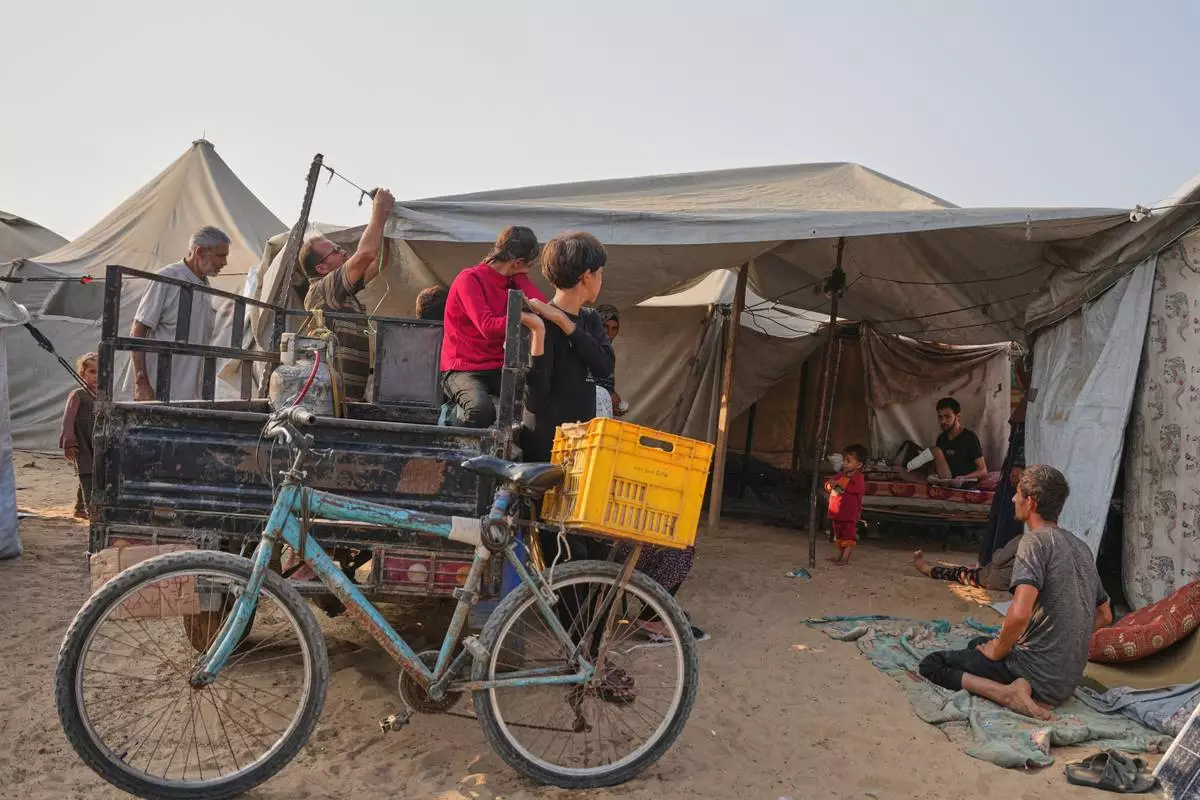
Yassin Marouf, 23, second from right, who lost his left foot and suffered a severe injury to his right leg after Israeli shelling in May, sits on a mattress in a tent surrounded by family and neighbors in Zawaida, central Gaza, Thursday, Nov. 6, 2025. (AP Photo/Abdel Kareem Hana)
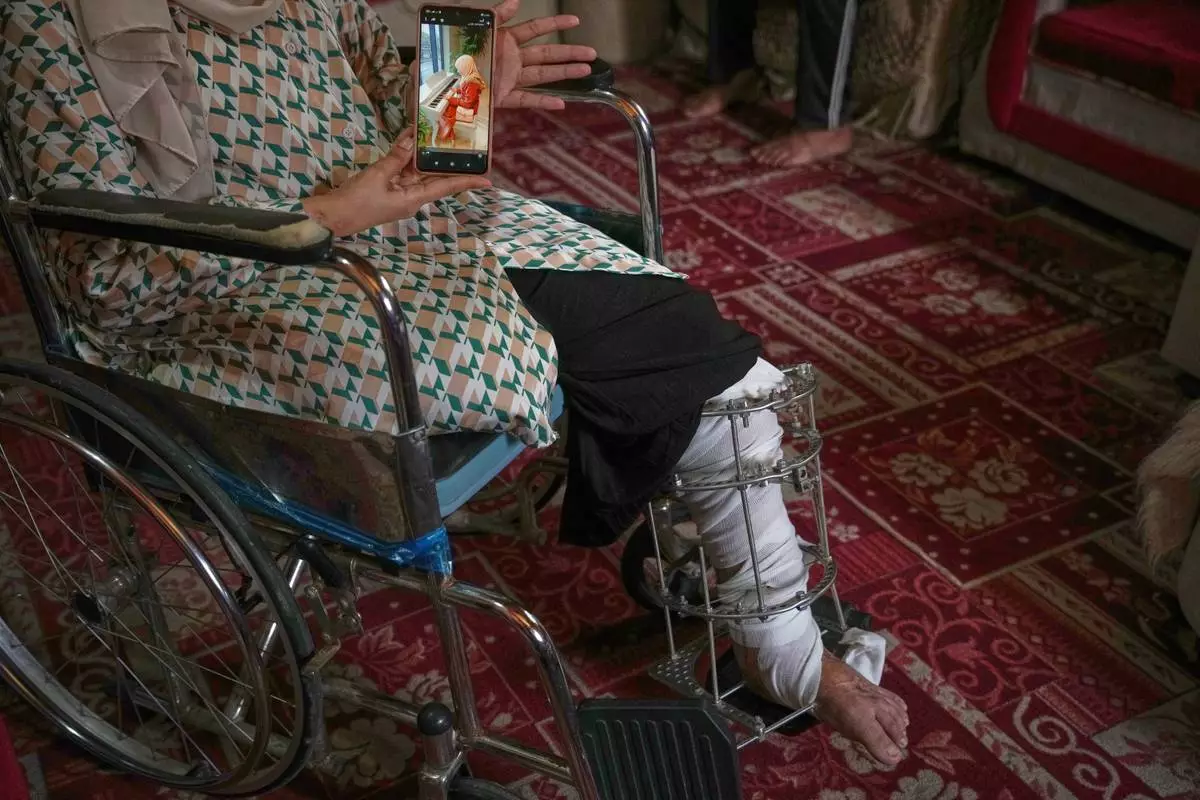
Haneen al-Mabhouh, 34, who lost her leg in an Israeli strike on her home that also killed all four of her daughters, including her 5-month-old baby, shows a photo of one of her daughters on a cellphone while sitting in a wheelchair in her family home in Nuseirat, central Gaza Strip, Thursday, Nov. 6, 2025. (AP Photo/Abdel Kareem Hana)
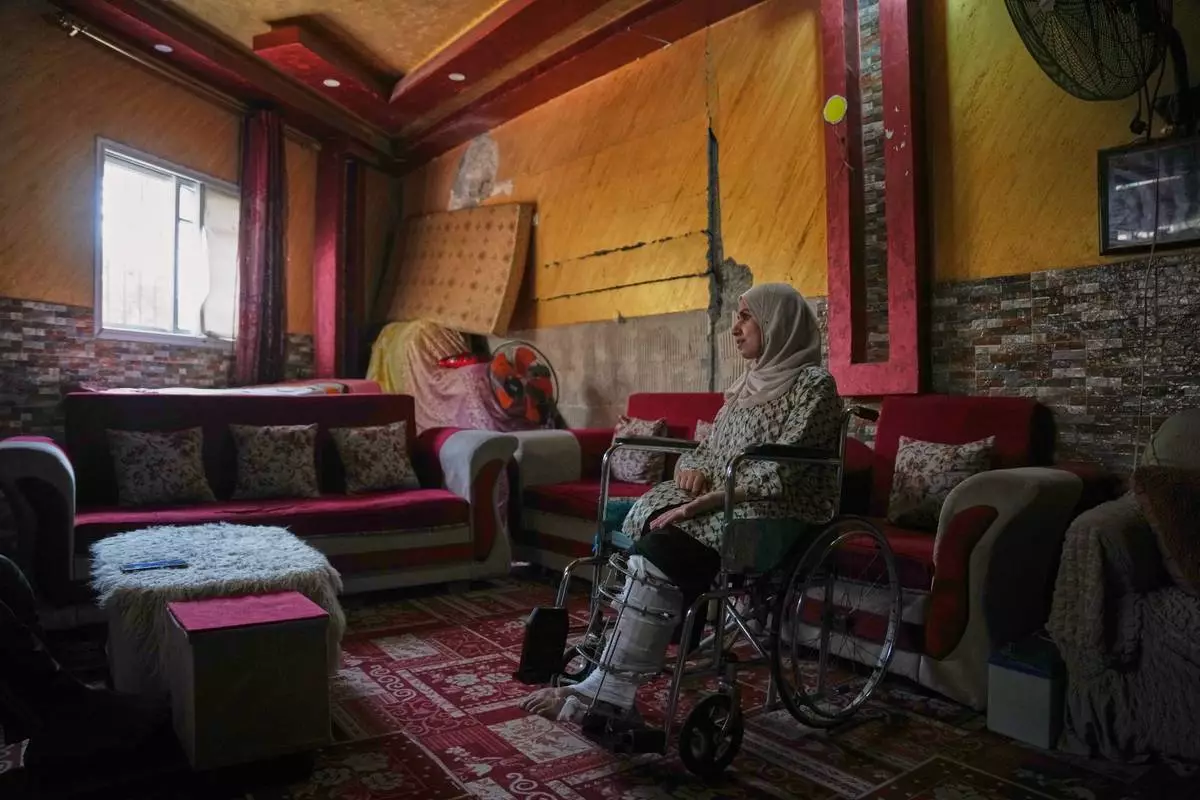
Haneen al-Mabhouh, 34, who lost her leg in an Israeli strike on her home that also killed all four of her daughters, including her 5-month-old baby, sits in a wheelchair in her family home in Nuseirat, central Gaza Strip, Thursday, Nov. 6, 2025. (AP Photo/Abdel Kareem Hana)
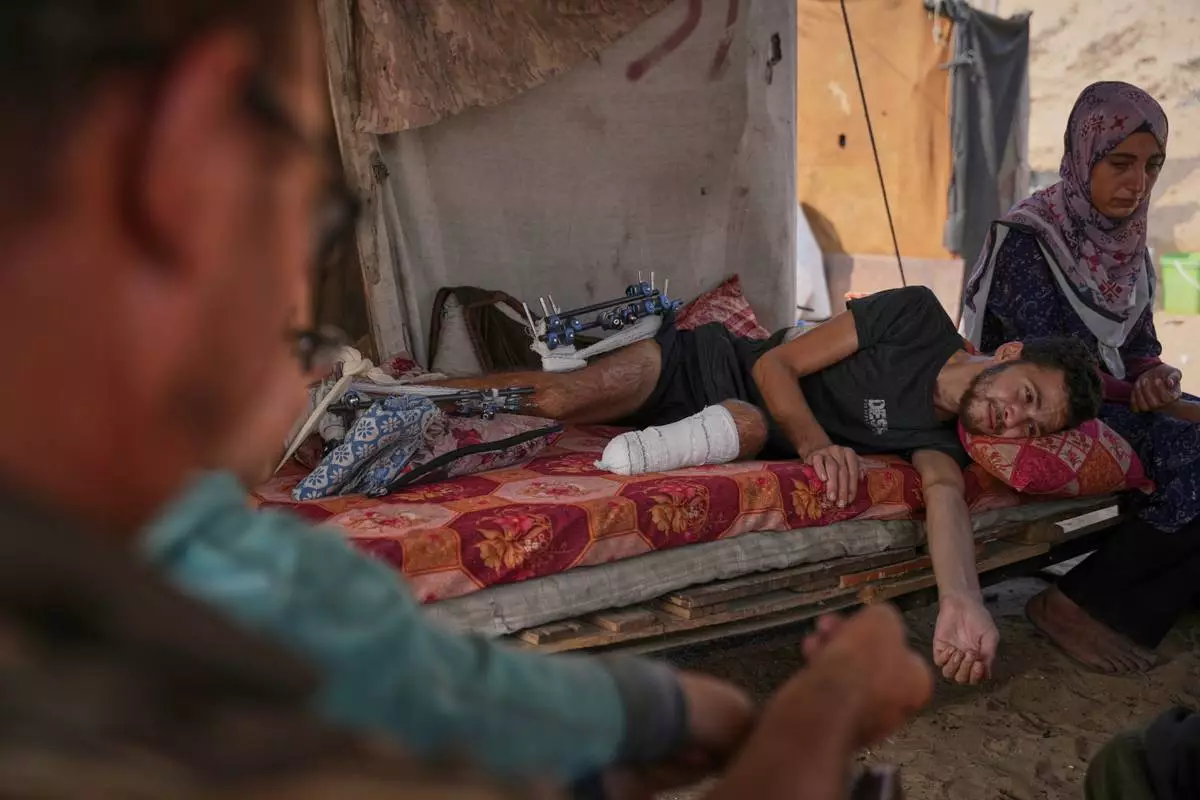
Yassin Marouf, 23, who lost his left foot and suffered a severe injury to his right leg after being hit by Israeli shelling in May, lies in a tent surrounded by his family in Zawaida, central Gaza, Thursday, Nov. 6, 2025. (AP Photo/Abdel Kareem Hana)