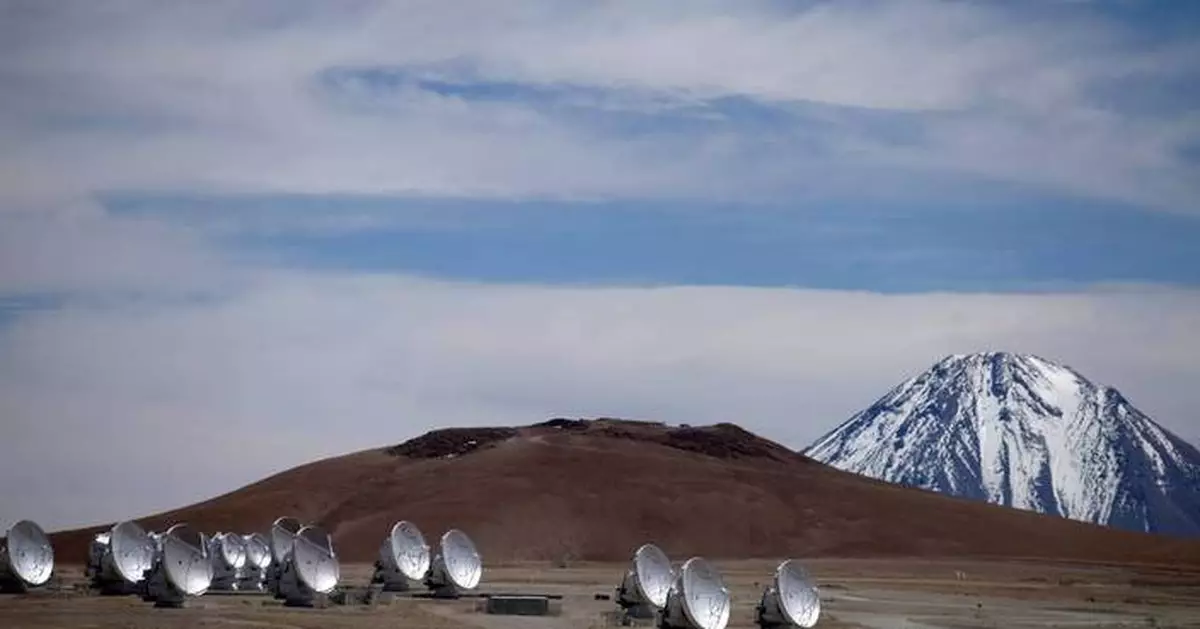
SANTIAGO, Chile (AP) — Chile’s Atacama Desert is one of the darkest spots on Earth, a crown jewel for astronomers who flock to study the origins of the universe in this inhospitable desert along the Pacific coast.
A rare confluence of factors makes the Atacama an ideal home for some of the world’s biggest ground-based astronomical projects — dry climate, high altitude and, crucially, isolation from the light pollution of civilization.
“It's a perfect cocktail for astronomy,” said Daniela González, executive director of the Skies of Chile Foundation, a nonprofit that defends the quality of the country’s night skies.
But that may not be the case for much longer, a group of leading scientists warned in an open letter to Chile’s government released Tuesday.
A private company is pressing ahead with plans to construct a giant renewable energy complex in sight of one of Earth’s most productive astronomical facilities — the Paranal Observatory, operated by an international consortium known as the European Southern Observatory, or ESO.
In the letter, 30 renowned international astronomers, including Reinhard Genzel, a 2020 Nobel laureate in astrophysics who conducted much of his prize-winning research on black holes with the ESO-operated telescopes in the Atacama Desert, describe the project as “an imminent threat” to humanity's ability to study the cosmos, and unlock more of its unknowns.
“The damage would extend beyond Chile’s borders, affecting a worldwide scientific community that relies on observations made at Paranal to study everything from the formation of planets to the early universe,” the letter reads.
“We are convinced that economic development and scientific progress can and must coexist to the benefit of all people in Chile, but not at the irreversible expense of one of Earth’s unique and irreplaceable windows to the universe.”
The scientists join a chorus of voices that have been urging the Chilean government to relocate the hydrogen-based fuel production plant since the plan was unveiled a year ago by AES Chile, an offshoot of the American-based multinational AES Corp.
In response to a request for comment, AES Chile said that its own technical studies showed the project would be fully compatible with astronomical observations and compliant with the Chilean government's strict regulations on light pollution.
"We encourage trust in the country’s institutional strength, which for decades has guaranteed certainty and environmental protection for multiple productive sectors," the company said.
The plan, which is still under environmental review, calls for 3,000 hectares (7,400 acres) of wind and solar energy farms, a desalination plant and a new port.
That means not only a major increase in light pollution but also new dust, ground vibrations and heightened atmospheric turbulence that blurs stars and makes them twinkle. All of that — just 3 kilometers (1.9 miles) from the Paranal Observatory’s high-powered telescopes — will mess the view of key astronomical targets and could obstruct scientific advances, experts say.
“At the best sites in the world for astronomy, stars don't twinkle. They are very stable, and even the smallest artificial turbulence would destroy these characteristics,” said Andreas Kaufer, the director of operations at ESO, which assesses that the AES project would increase light pollution by 35%.
“If the sky is becoming brighter from artificial light around us, we cannot do these observations anymore. They're lost. And, since we have the biggest and most sensitive telescopes at the best spot in the world, if they're lost for us, they're lost for everyone."
Although this controversy might be specific to Chile, home to 40% of the world’s astronomy infrastructure, the project reflects the wider tension between natural darkness and industrialization tearing at countless countries as light pollution makes the night sky about 10% brighter each year.
“Major observatories have been chased out to remote locations, and essentially now they’re chased out to some of the last remaining dark sky locations on Earth, like the Atacama Desert, the mountain peaks of Hawaii, areas around Tucson, Arizona,” said Ruskin Hartley, the executive director of DarkSky International, a Tuscon-based nonprofit founded by astronomers.
“All of them are now at risk from encroaching development and mining. It’s happening everywhere.”
DeBre reported from Buenos Aires, Argentina.
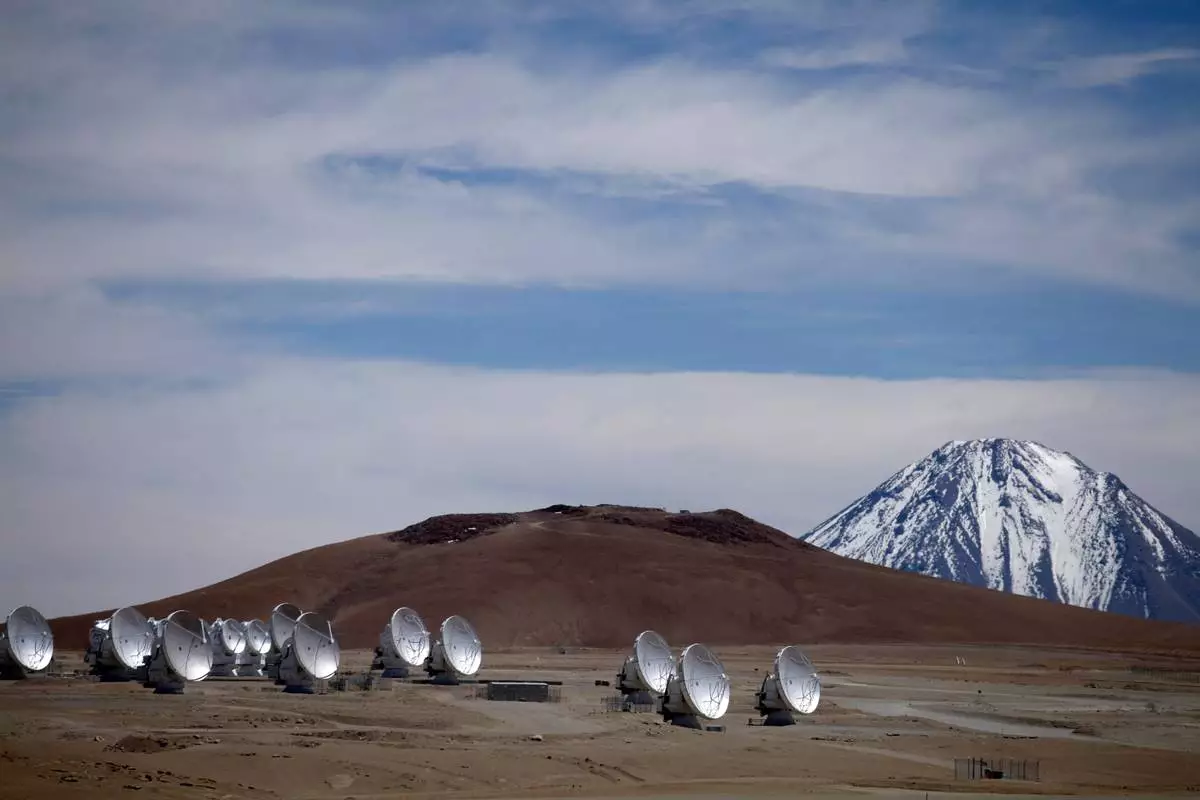
FILE - Radio antennas are spread out on the terrain as part of one of the world's largest astronomy projects, the Atacama Large Millimeter/submillimeter Array (ALMA) in Chajnator in the Atacama desert in northern Chile, Sept. 27, 2012. (AP Photo/Jorge Saenz, File)
Launch preparations have begun for the Artemis II mission, NASA’s planned lunar fly-around by four astronauts that will be the first moon trip in 53 years.
Tensions were high as hydrogen fuel started flowing into the rocket hours ahead of the planned launch. Dangerous hydrogen leaks erupted during a countdown test earlier this year, forcing a lengthy flight delay.
The launch team needs to load more than 700,000 gallons of fuel (2.6 million liters) into the 32-story Space Launch System rocket on the pad before the Artemis II crew can board.
The 32-story Space Launch System rocket is poised to blast off Wednesday evening with a two-hour launch window beginning at 6:24 p.m. EDT at Kennedy Space Center in Florida.
Artemis astronauts Reid Wiseman, Victor Glover, Christina Koch and Jeremy Hansen will be on board. They’ll hurtle several thousand miles beyond the moon, hang a U-turn and then come straight back. No circling around the moon, no stopping for a moonwalk — just a quick out-and-back lasting less than 10 days. NASA promises more boot prints in the gray lunar dust, but not before a couple practice missions.
Unlike the Apollo missions that sent astronauts to the moonfrom 1968 through 1972, Artemis’ debut crew includes a woman, a person of color and a Canadian citizen.
Artemis II is the opening shot of NASA’s grand plans for a permanent moon base. The space program is aiming for a moon landing near the lunar south pole in 2028.
The Latest:
The wind is picking up at Cape Canaveral, more clouds are appearing and rain is expected in about two hours. But there is no lightning threat, NASA says, and there’s still an 80% chance the weather will be good enough to launch.
L-minus tracks the overall time to liftoff, counting down the days, hours and minutes away before the planned blastoff. It doesn’t include built-in holds, or pauses — that’s T-minus time.
The T-minus countdown in the final 10 minutes is where nerves tense up and hearts start pounding. Automated software kicks off a series of highly choreographed milestones. During this period, the clock can be stopped if a problem is spotted and restarted if it’s fixed in time.
T-0 is the moment of liftoff — zero — when the boosters ignite and the rocket begins its journey.
NASA has a narrow time frame each month to fly to the moon.
The Earth and moon must be aligned just so to achieve the proper trajectory for the mission. In any given month, there’s only about a week when Artemis II astronauts can lift off.
The Orion capsule needs to get a check of its life-support and other systems in near-Earth orbit. If that goes well, Orion will fire its main engine to hurtle toward the moon, taking advantage of the moon and Earth’s gravity to get there and back in a slingshot maneuver that requires little if any fuel.
Orion also needs sunlight for power and can’t be in darkness for more than 90 minutes at a time. Plus NASA wants to minimize heating during reentry at flight’s end.
The latest launch window runs through April 6. The next opportunity opens on April 30.
The hydrogen tank of the rocket’s core stage is 100% filled. NASA said no significant leaks have been observed so far in fueling. It was hydrogen leaks that prevented the rocket from flying in February.
The alarm clocks just went off in Kennedy Space Center’s crew quarters.
That means it’s rise and shine for the three Americans and one Canadian who are about to become the first lunar visitors in more than 53 years.
They have a long day ahead of them, whether they launch or not.
After breakfast, they’ll start suiting up. NASA’s launch window opens at 6:24 p.m. and lasts a full two hours.
Launch director Charlie Blackwell-Thompson is wearing green as are many of the controllers alongside her in the firing room.
Green represents “go” for NASA, a color symbolizing good luck.
The team is monitoring the fueling of the 322-foot moon rocket, set to blast off Wednesday evening.
A plush toy named Rise will ride with the Artemis II astronauts around the moon, carrying the names of more than 5.6 million people.
Rise is what’s known as a zero gravity indicator, which gives the astronauts a visual cue of when they reach space.
The design was inspired by the iconic “Earthrise” photo during Apollo 8, showing the planet as a shadowed blue marble from space in 1968.
Rise was selected from more than 2,600 contest submissions. It was designed by Lucas Ye of California.
Commander Reid Wiseman and his crew tucked a small memory card into Rise before the toy was loaded into the Orion capsule. The card bears the names of all those who signed up with NASA to vicariously tag along on the nearly 10-day journey.
“Zipping that little pocket on the bottom of Rise was kind of the moment that put it all together for me,” Wiseman said. “We are going for all and by all. It’s time to fly.”
NASA is fueling the new rocket that will send four astronauts to the moon.
Launch teams have begun pumping more than 700,000 gallons (2.6 million liters) of liquid hydrogen and liquid oxygen into the Space Launch System rocket at Kennedy Space Center in Florida.
It’s the latest milestone in the two-day countdown that kicked off on Monday when launch controllers reported to duty.
It will take at least four hours to fully load the rocket before astronauts climb aboard for humanity’s first flight to the moon since Apollo 17 in 1972.
The two-hour launch window opens at 6:24 p.m. EDT.
▶ Read more about Apollo vs. Artemis
The Americans who blazed the trail to the moon more than half a century ago were white men chosen for their military test pilot experience.
The Artemis II crew includes a woman, a person of color and a Canadian, products of a more diversified astronaut corps.
▶ Read more about Christina Koch, Victor Glover, Jeremy Hansen and Reid Wiseman
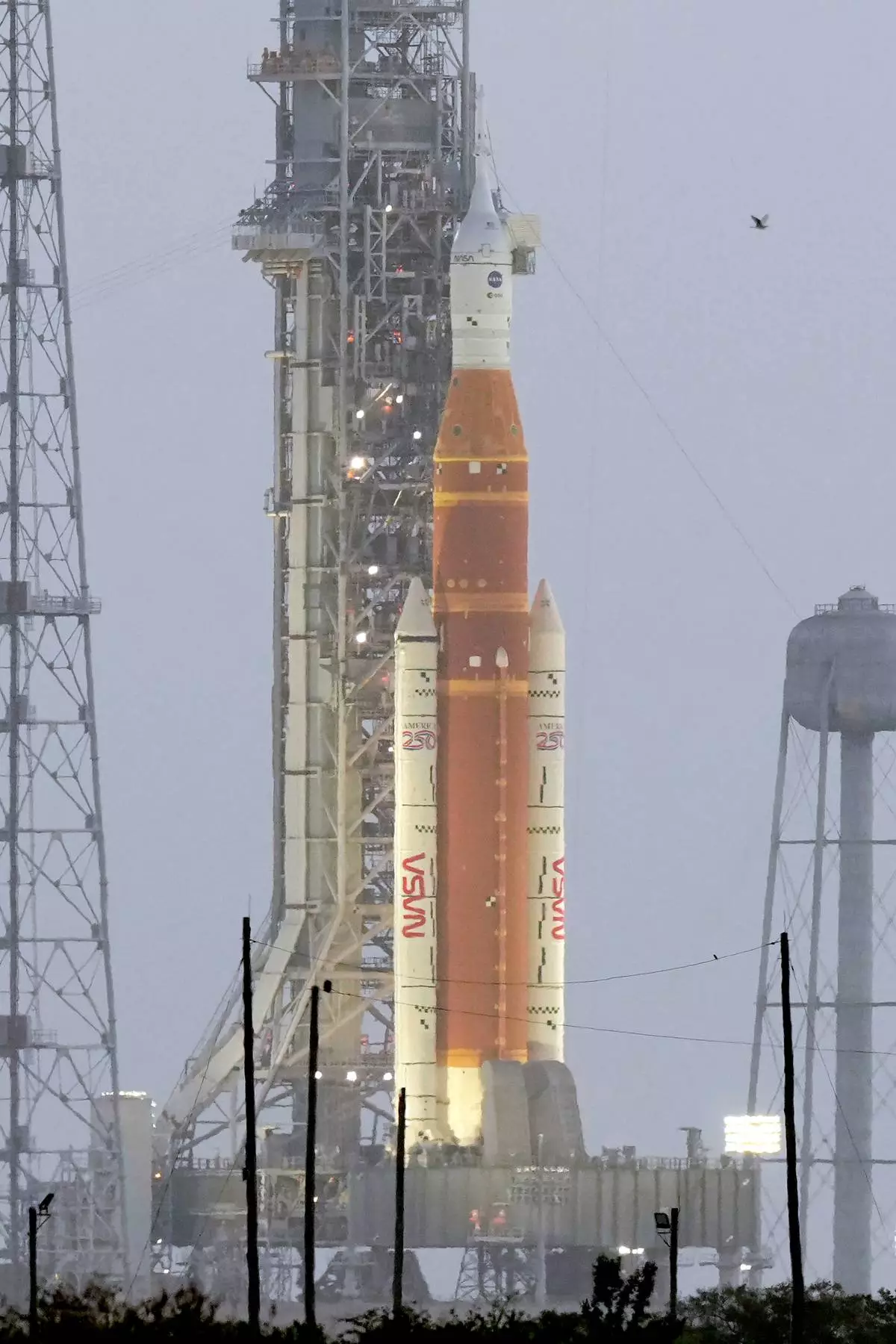
NASA's Artermis II moon rocket sits on Launch Pad 39-B at the Kennedy Space Center hours ahead of planned liftoff Wednesday, April 1, 2026, in Cape Canaveral, Fla. (AP Photo/Chris O'Meara)
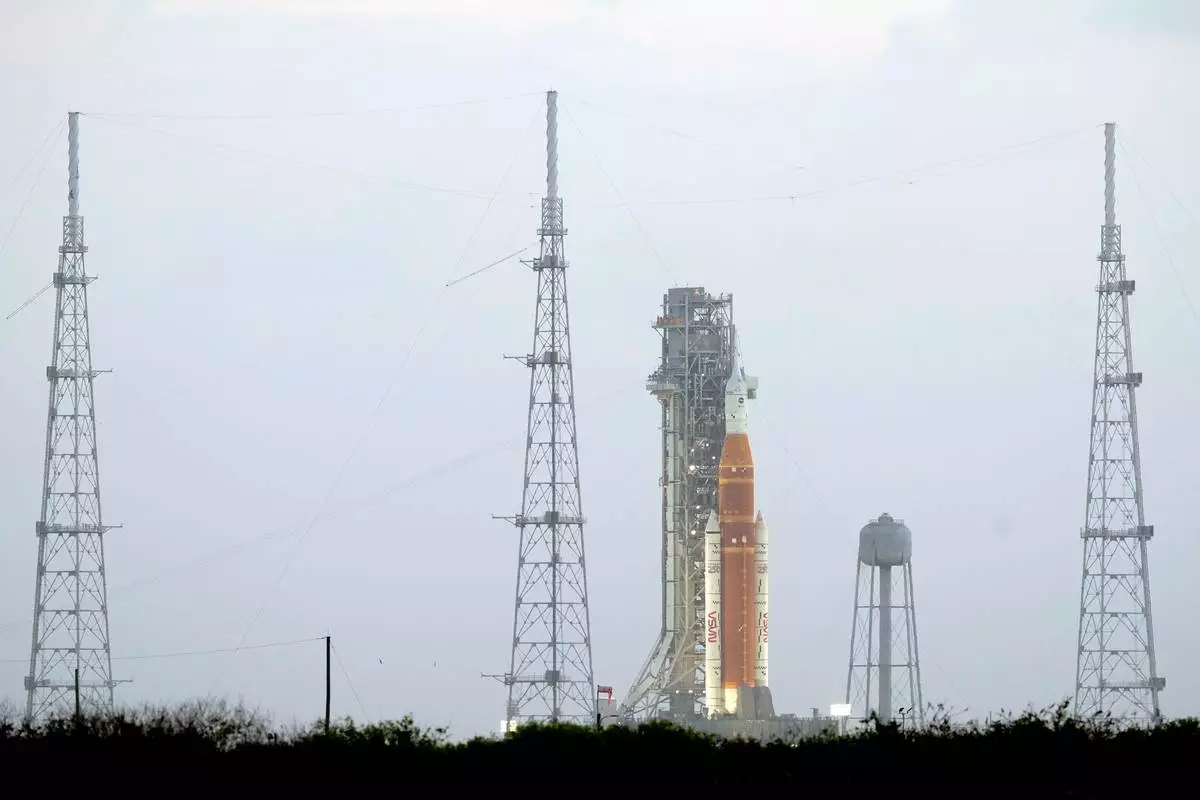
NASA's Artermis II moon rocket sits on Launch Pad 39-B at the Kennedy Space Center hours ahead of a planned launch attempt Wednesday, April 1, 2026, in Cape Canaveral, Fla. (AP Photo/Chris O'Meara)
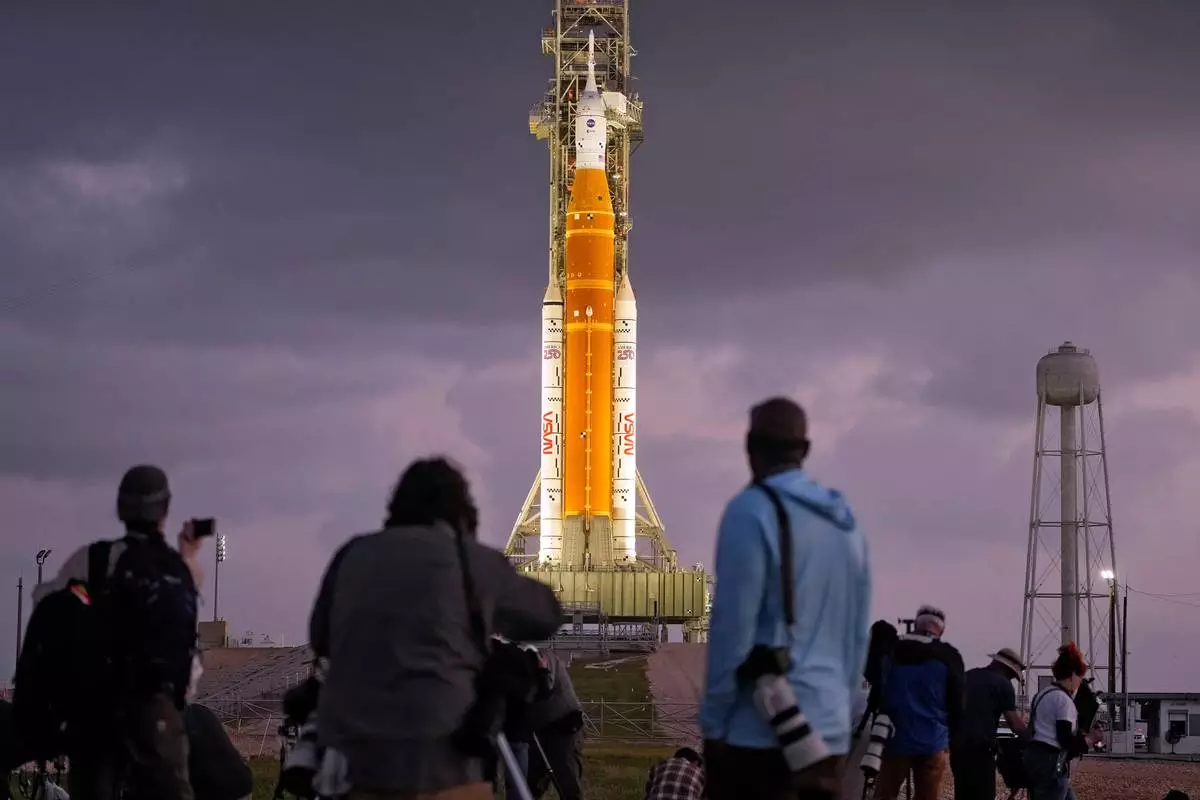
Photographers set up remote cameras near NASA's Artermis II moon rocket on Launch Pad 39-B just before sunrise at the Kennedy Space Center Tuesday, March 31, 2026, in Cape Canaveral, Fla. (AP Photo/Chris O'Meara)