Skip to Content Facebook Feature Image

French scholars eye deepening relations with China ahead of Macron's visit

China

China

China

French scholars eye deepening relations with China ahead of Macron's visit

2025-12-03 15:29 Last Updated At:23:57

France should seek to deepen cooperation with Chinese industrial and technology sectors where China has grown into a global giant, said French scholars ahead of President Emmanuel Macron’s visit to China.

Macron is scheduled to pay a three-day state visit to China from December 3 to 5. It will be his fourth state visit to China and a reciprocal visit to President Xi Jinping's historic state visit to France last year that marked the 60th anniversary of the establishment of diplomatic relations between the two countries. Sacha Courtial, an EU-China associate researcher at the Jacques Delors Institute, a European think tank, said that China's rapid rise in technology and advanced manufacturing marks a seismic shift with major consequences for Europe.

"So we have seen an increasing upgrading of the Chinese producing system from 20 years ago only a manufacturer of goods of low quality to now a dominant capacity on high level, high value chain producing goods and services. And this of course creates challenges for Europe and for France because we see many private companies that before were dominant on the global scale and now are challenged by some of Chinese private companies, such as in the EVs (electric vehicles) for instance," he said.

China accounted for more than 70 percent of global EV production in 2024, according to the International Energy Agency.

Loic Harriet, director of the Eklore-ed School of Management in France, said that European countries including France are becoming increasingly dependent on Chinese products.

"I like to tell my students this. Well, look at what you have on you now, on your table, on your desk, and so on. What is made in France? What is made in China? In fact, we have to be very pragmatic once again. Today, we are dependent on China," he said.

For many in France, deeper cooperation is not only about economics, but about long-term diplomacy, cultural exchange and a recognition of China's growing role on the world stage.

"Today France has a real chance to work with China, especially as cooperation with the United States has become complicated. I see a genuine opportunity to build long-term, cooperative, co-constructed partnerships with China based on mutual understanding," said Harriet.

French scholars eye deepening relations with China ahead of Macron's visit

French scholars eye deepening relations with China ahead of Macron's visit
French scholars eye deepening relations with China ahead of Macron's visit
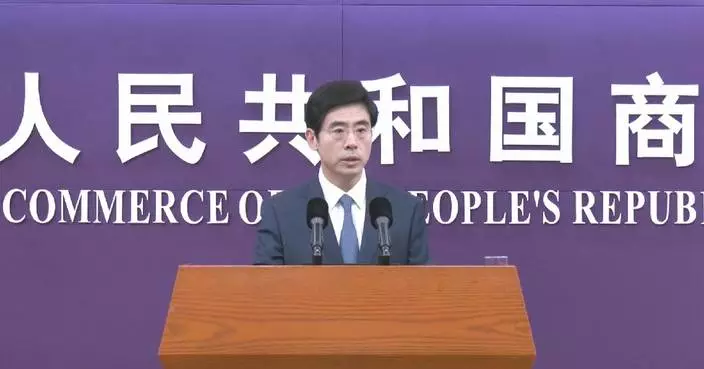
French scholars eye deepening relations with China ahead of Macron's visit
Denmark's Social Democrats, led by Prime Minister Mette Frederiksen, remained the largest party in Tuesday's parliamentary election, according to preliminary results from Denmark proper early Wednesday.

But neither the left-leaning red bloc nor the right-leaning blue bloc secured an outright majority in the Folketing, the unicameral Danish parliament.

The Folketing comprises 179 seats in total -- 175 elected in Denmark proper, plus two each from Greenland and the Faroe Islands. Results from Greenland and the Faroe Islands are yet to be finalized.

"Of course, I am disappointed that we did not get more votes. But there is nothing today that can stop me from being proud that the Social Democrats have once again become the Danes’ clearly preferred political party," said Frederiksen.

Preliminary results from Denmark proper showed that the Social Democrats won about 21.9 percent of the vote and 38 seats, down by 12 from the previous election. The Socialist People's Party secured 20 seats, followed by Venstre (the Liberal Party of Denmark) with 18 seats. Liberal Alliance and the Danish People's Party each took 16 seats.

Based on the tally for Denmark proper, the red bloc secured 84 seats, compared with 77 for the blue bloc. Since a majority in the Folketing requires 90 seats, the Moderates, which won 14 seats, were expected to play a pivotal role in the coming negotiations on government formation.

Morten Messerschmidt, the leader of the Danish People's Party, said he feels great to see more voters supporting his party in this election.

"The last election three years ago, we were almost eradicated with only two percent of the votes, and now we are between nine and ten. So it's like a quadrupling or whatever you call it. So that's quite remarkable, quite amazing. It feels great, I must say," he said.

Speaking after the vote, Frederiksen signaled that she was prepared to take responsibility in the upcoming negotiations and continue seeking to lead the country, while acknowledging that talks to form a new government were unlikely to be easy.

Under Denmark's multi-party parliamentary system, elections often lead to coalition or minority governments. Talks among party leaders will determine the formation of the new government.

Social Democrats lead Denmark's election, neither bloc wins majority

Social Democrats lead Denmark's election, neither bloc wins majority

Recommended Articles