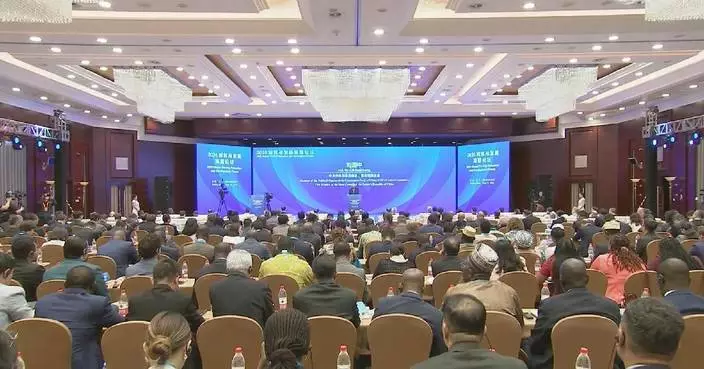
Experts from Africa and Latin America have expressed grave concern over the remarks made by Japanese Prime Minister Sanae Takaichi, warning that these erroneous remarks risk undermining the post-war international order and can be seen as an attempt at reviving militarism.
Last month, Takaichi said at a Diet hearing that the Chinese central authorities' "use of force on Taiwan" could constitute a "survival-threatening situation" for Japan and implied the possibility of armed intervention in the Taiwan Strait.
The Japanese prime minister's provocative rhetoric has triggered widespread global condemnation, with many analysts warning her comments could even threaten regional and global stability.
"The remarks by Sanae Takaichi present a dangerous sign of Japanese militarism revival, endangering the peace and stability of the region and the world. We are yearning for economic partnerships, not to see these levels of provocation and escalations," said Davison Mung'andu, a member of the National Assembly of Zambia.
"Prime minister Takaichi's remarks on Taiwan, in my view, are inflammatory. I believe that by showing some sort of toughness or 'teeth' so to speak, the Japanese are ingratiating themselves to the [U.S. President Donald] Trump administration. But this is of course a very risky strategy. It's dangerous rhetoric on their end, and I do believe that they should think twice before making such proclamations," said Daniel Gibson, a researcher at the University of Pretoria, South Africa.
Medard Moussodia, a member of the National Assembly of the Republic of the Congo, condemned Takaichi's remarks as being completely unacceptable in today's world.
"We refute the Japanese prime minister's remarks, which are messages of escalation for the return of violence. The world today, in 2025, rejects violence. There must be no pretext for engaging in military violence for the purpose of expansion," Moussodia said.
Javier Vadell, associate professor at the Department of International Relations of Pontifical Catholic University of Minas Gerais in Brazil, pointed out that Takaichi's erroneous remarks on Taiwan have violated international law.
"We now see that the situation is very complicated and dangerous, and the Japanese prime minister's wrong remarks have violated international law, because this is the result of extreme interference in other countries' internal affairs and may even lead to war, and we cannot rule out this possibility," Vadell said.
Meanwhile, the sustained revenue growth of major Japanese defense contractors, highlighted in the Stockholm International Peace Research Institute's (SIPRI) 2024 global arms sales report released on Monday, has attracted significant attention.
The SIPRI list, which tracks the world's top 100 arms producers, features five Japanese companies: Mitsubishi Heavy Industries (MHI), Kawasaki Heavy Industries, Fujitsu, Mitsubishi Electric Corporation, and NEC Corporation. The MHI leads the group, climbing to the 32nd place globally. SIPRI data indicates that the MHI's defense revenue is primarily driven by its aircraft and missile systems divisions.

Int'l experts condemn Takaichi's remarks as provocative, dangerous

Int'l experts condemn Takaichi's remarks as provocative, dangerous