BEAVER CREEK, Colo. (AP) — The plan was for American ski racer Lauren Macuga to be in Switzerland this week getting ready for some speed races.
Instead, she was hobbling around on crutches Thursday in the finish area at Beaver Creek as she awaits surgery to fix her torn right ACL.
The ever-positive Macuga found a bright side, though. She got to watch her younger brother, Daniel, test out the demanding downhill course before the World Cup racers took the stage.
“It was so fun to watch him,” Macuga, wearing her trademark bucket hat, said with a smile.
Macuga was being billed as one of the athletes to watch at the Milan Cortina Winter Olympics in February. Her plans flipped in an instant. She was training in giant slalom at Copper Mountain, Colorado, last Friday when her ski, as she explained, "caught weird. It was just kind of unlucky how I fell, I guess.”
She felt pain in her knee but it only lasted a moment.
“I didn’t actually know where the ACL even was, so I thought I was OK,” said Macuga, who will have surgery next week.
She began walking, though, and the knee became unsteady.
“It was then I was like, ‘Oh, something’s wrong, but I don't know what,'" Macuga said. “I was able to ski down and so you hold on to hope. I got there and they’re like, ‘Yeah, it (ACL) is gone.' I was like, ‘Oh, awesome.’”
The 23-year-old Macuga was coming off a season in which she had four top-five World Cup finishes, including a super-G win last January in Austria. She also won a bonze medal in the super-G at the world championships.
She was so looking forward to Italy.
She may still go.
“It would be nice to go out there and support my team,” said Macuga, who will rehab after surgery in Park City, Utah. “Just be there for them.”
Macuga has been overwhelmed by the amount of support she's received since her injury. She just finished responding to all the well-wishers.
“It’s nice to know that people are excited for me to come back,” Macuga said. "I’m excited. I can’t wait."
Still, it's going to be difficult watching races this season.
“I was feeling very good coming into this, like the strongest I’ve ever been,” Macuga said. “Skiing great. So it's a bummer, but I mean in this sport it happens. It’s going to suck through the season watching everyone race and everything but what are you going to do?”
For starters, learn German.
That's her plan, anyway. She may even take a class. She's also going to watch her brother race. Cheer on her sisters, too — Alli, the moguls standout, and Sam, the ski jumper.
“Someone told me that statistically you’re more likely to win an Olympic medal after you (tear) your ACL,” Macuga said with a grin. “So I'm hanging on to that."
AP Olympics: https://apnews.com/hub/milan-cortina-2026-winter-olympics

FILE - United States' Lauren Macuga skis during a women's giant slalom run at the World Cup Finals, March 25, 2025, in Sun Valley, Idaho. (AP Photo/Robert F. Bukaty, File)

FILE - United States' Lauren Macuga celebrates moments before being given a bronze medal for a women's Super-G race at the Alpine Ski World Championships in Saalbach-Hinterglemm, Austria, Feb. 6, 2025. (AP Photo/Gabriele Facciotti, File)
COPENHAGEN, Denmark (AP) — More than 200 years after being sunk by Adm. Horatio Nelson and the British fleet, a Danish warship has been discovered on the seabed of Copenhagen Harbor by marine archaeologists.
Working in thick sediment and almost zero visibility 15 meters (49 feet) beneath the waves, divers are working against the clock to unearth the 19th-century wreck of the Dannebroge before it becomes a construction site in a new housing district being built off the Danish coast.
Denmark’s Viking Ship Museum, which is leading the monthslong underwater excavations, announced its findings on Thursday, 225 years to the day since the Battle of Copenhagen in 1801.
“It’s a big part of the Danish national feeling,” said Morten Johansen, the museum’s head of maritime archaeology.
A great deal has been written about the battle “by very enthusiastic spectators, but we actually don’t know how it was to be onboard a ship being shot to pieces by English warships and some of that story we can probably learn from seeing the wreck, Johansen said.
In the Battle of Copenhagen, Nelson and the British fleet attacked and defeated Denmark’s navy as it formed a protective blockade outside the harbor.
Thousands were killed and wounded during the brutal hourslong naval clash, considered one of Nelson’s “great battles.” The intention was to force Denmark out of an alliance of Northern European powers, including Russia, Prussia and Sweden.
At the center of the fighting was the Danish flagship, the Dannebroge, commanded by Commodore Olfert Fischer.
The 48-meter (157-foot) Dannebroge was Nelson’s main target. Cannon fire tore through its upper deck before incendiary shells sparked a fire aboard.
“(It was) a nightmare to be on board one of these ships,” Johansen said. “When a cannonball hits a ship, it’s not the cannonball that does the most damage to the crew, it’s wooden splinters flying everywhere, very much like grenade debris.”
The battle also is believed to have inspired the phrase “to turn a blind eye.” After deciding to ignore a superior’s signal, Nelson, who had lost sight in his right eye, reportedly remarked: “I have only one eye, I have a right to be blind sometimes.”
Nelson eventually offered a truce and a ceasefire was later agreed with Denmark’s Crown Prince Frederik.
The stricken Dannebroge slowly drifted northward and exploded. Records say the sound created a deafening roar across Copenhagen.
Marine archaeologists have discovered two cannons, uniforms, insignia, shoes, bottles and even part of a sailor’s lower jaw, perhaps one of the 19 unaccounted-for crew members who likely lost their lives that day.
The dig site will soon be enveloped by construction work for Lynetteholm, a megaproject to build a new housing district in the middle of Copenhagen Harbor that is expected to be completed by 2070.
Marine archaeologists began surveying the area late last year, targeting a spot thought to match the flagship’s final position.
Experts say the sizes of the wooden parts found match old drawings. Dendrochronological dating, the method of using tree rings to establish the age of wood, match the year the ship was built. They also say the darkened dig site is full of cannonballs, a hazard for divers navigating waters darkened by clouds of silt stirred up from the seabed.
“Sometimes you can’t see anything, and then you really have to just feel your way, look with your fingers instead of with your eyes,” diver and maritime archaeologist Marie Jonsson said.
Chronicled in books and painted on canvases, the 1801 battle is deeply embedded in Denmark’s national story.
Archaeologists hope their discoveries may help reexamine the event that shaped the Scandinavian country and perhaps uncover personal stories of those who went into battle on that day 225 years ago.
“There are bottles, there are ceramics, and even pieces of basketry,” Jonsson said. “You get closer to the people onboard.”
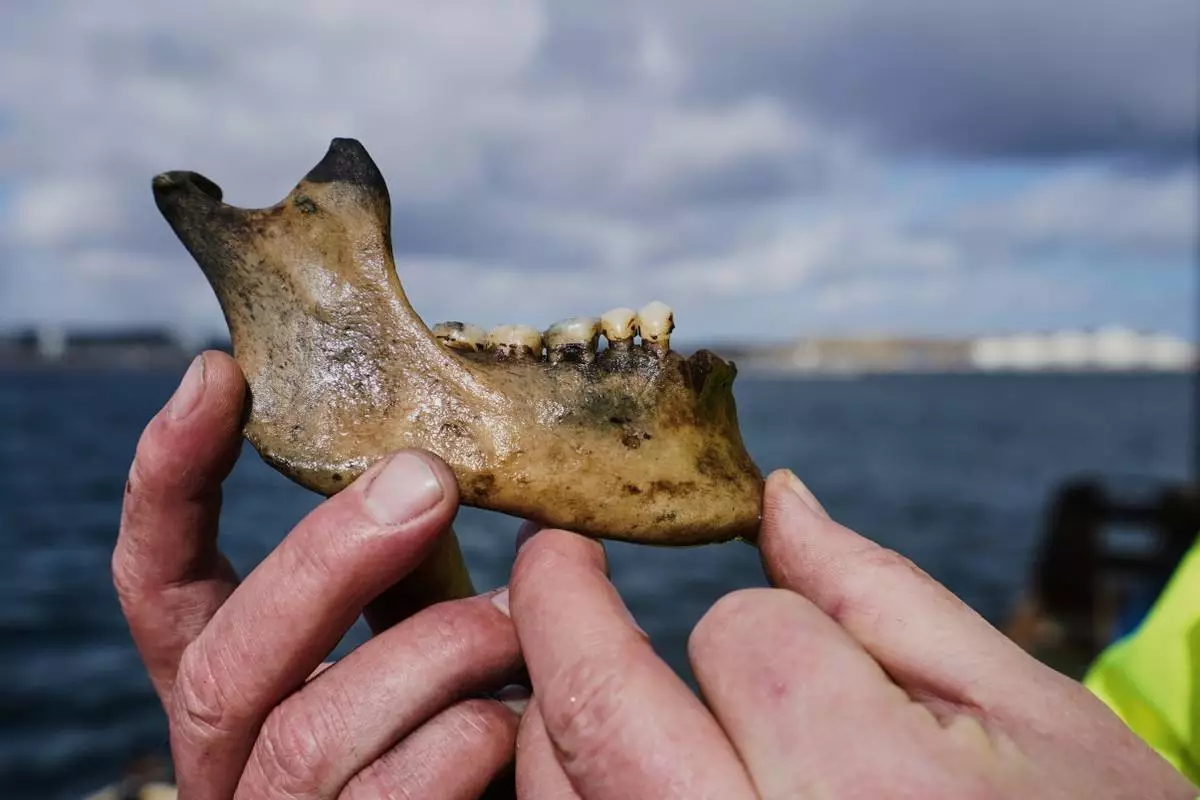
Morten Johansen, head of maritime archaeology at Denmark's Viking Ship Museum, shows part of a human lower jawbone recovered from the wreck of Danish flagship "Dannebroge" that sank during the Battle of Copenhagen in 1801, in Copenhagen, Denmark, Tuesday, March 31, 2026. (AP Photo/James Brooks)
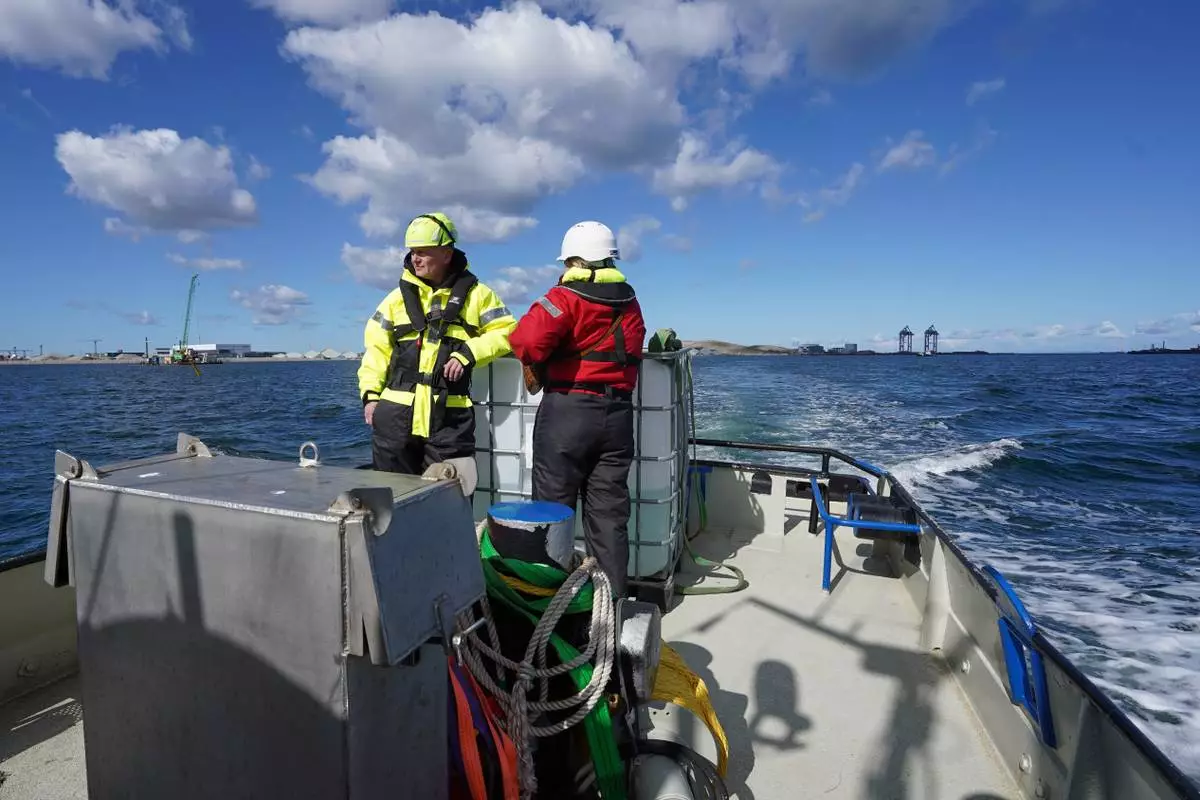
Archaeologists sail with boat through the harbor in Copenhagen, Denmark, Tuesday, March 31, 2026. (AP Photo/James Brooks)

An archaeologist points to a computer screen, showing a map of the wreck of Danish flagship "Dannebroge" that sank during the Battle of Copenhagen in 1801. in Copenhagen, Denmark, Tuesday, March 31, 2026. (AP Photo/James Brooks)
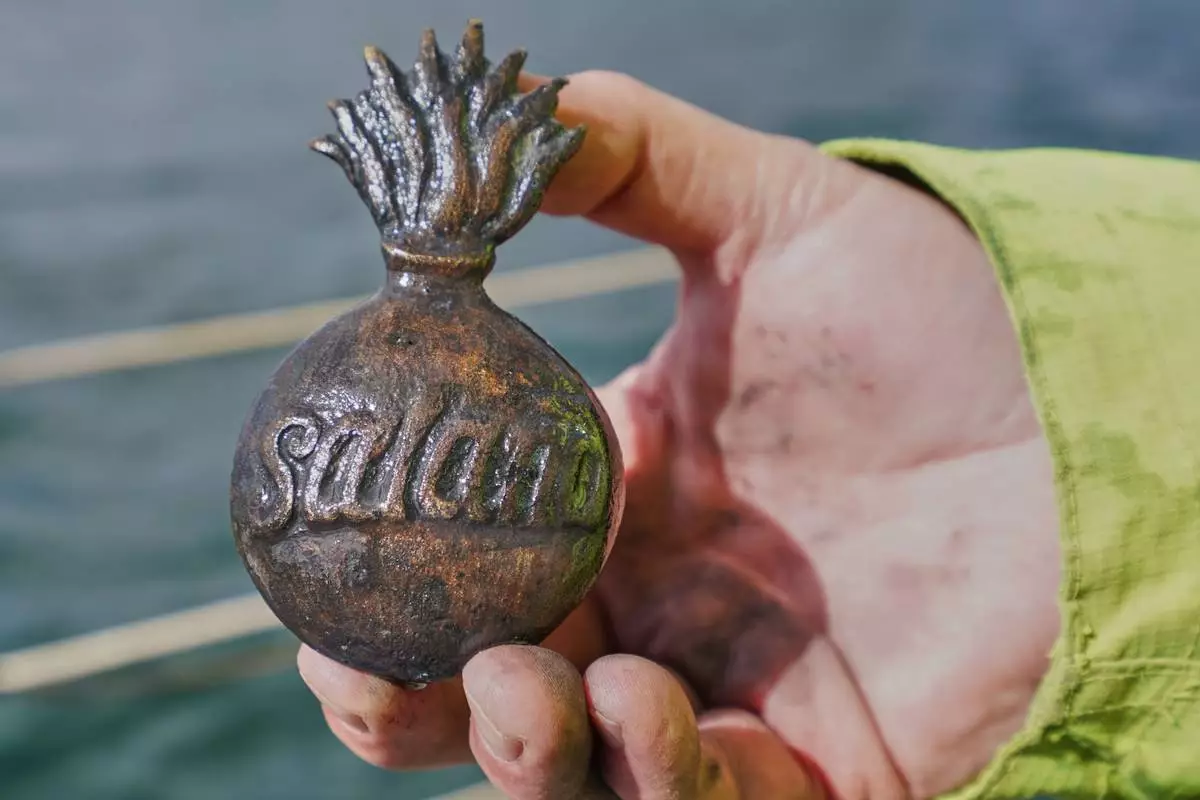
Morten Johansen, head of maritime archaeology at Denmark's Viking Ship Museum, shows a metal insignia recovered from the wreck of Danish flagship "Dannebroge" that sank during the Battle of Copenhagen in 1801, in Copenhagen, Denmark, Tuesday, March 31, 2026. (AP Photo/James Brooks)
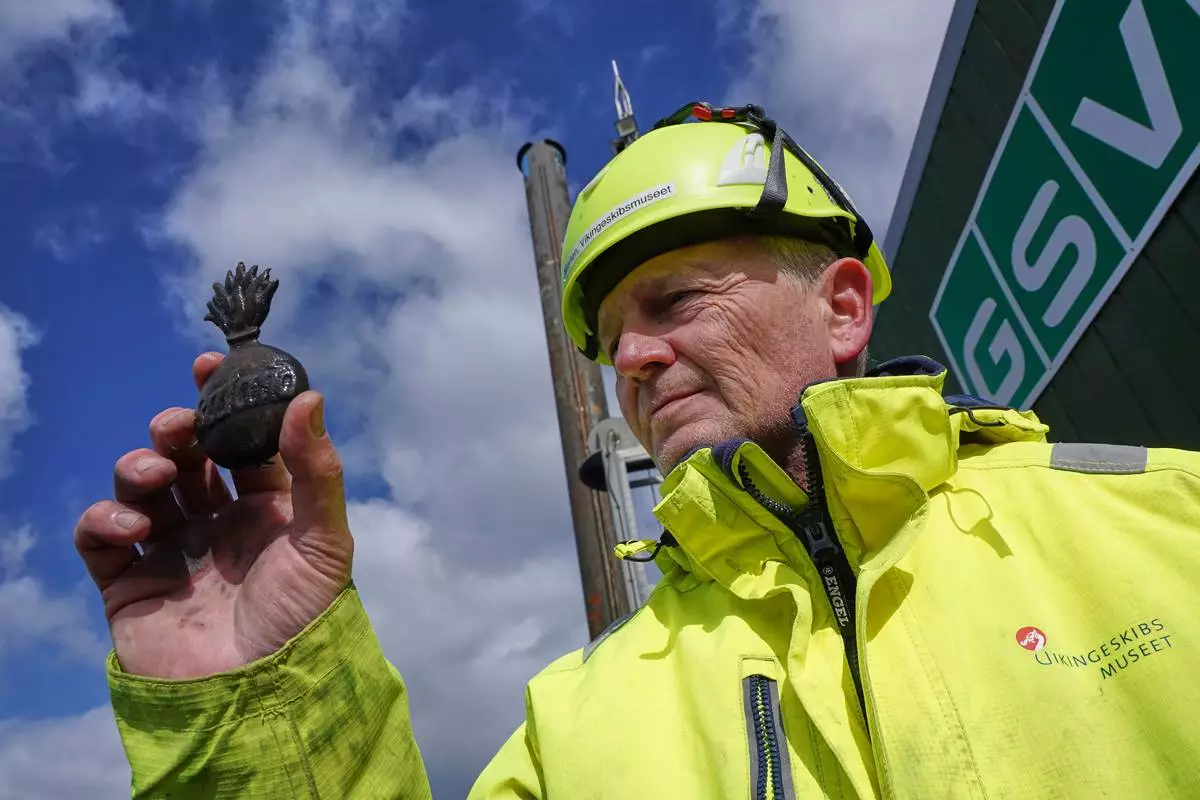
Morten Johansen, head of maritime archaeology at Denmark's Viking Ship Museum, shows a metal insignia recovered from the wreck of Danish flagship "Dannebroge" that sank during the Battle of Copenhagen in 1801, in Copenhagen, Denmark, Tuesday, March 31, 2026. (AP Photo/James Brooks)