PORT-OF-SPAIN, Trinidad (AP) — The steelpan, a percussion instrument created in Trinidad and Tobago in 1939, is making a comeback as a new generation embraces its bright, melodious sound on stage and on the dance floor.
Fans say new technology has made the steelpan more accessible — and affordable — and a growing number of schools in the twin-island nation are introducing students to its bell-like chime.
While its lilting sound brings images of the Caribbean to mind, it was the kind of music that attracted mostly elderly people in Trinidad and Tobago — until recently.
“That has been changing rapidly,” said Amrit Samaroo, son of Jit Samaroo, a legendary steelpan music arranger, player and composer.
The steelpan — or pan, for short — is “sexy again,” he told The Associated Press on a recent afternoon as he sat in the living room of his family’s home surrounded by a piano, a tenor steelpan and photos of his late father.
Amrit Samaroo, who leads the popular Trinidad and Tobago’s Supernovas Steel Orchestra, has witnessed the demographic change firsthand. He notes that social media is embracing the instrument, with fans playing everything from pop songs to reggae on steelpans.
“It’s good to have that type of recognizable material played on the instrument,” Samaroo said. “It’s a nice space we are in right now.”
Pannists, as the players are known, boast about the steelpan being able to belt out any genre of music. Add the influence of whatever is trending, and you get an instrument that’s growing its fanbase at a rapid pace.
“Pan is an out-of-body experience, that’s the best way I can describe it,” said 17-year-old student Jael Grant.
She has been playing since age 5 and is now a member of the Exodus Steel Orchestra, a band that her grandfather has supported for decades.
For Jahzara Lee-Babb, the steelpan provides an escape from the stresses of teenage life. At age 17, her love for the instrument led her to study fine arts at a local university.
“When I’m going through dark times or whatever, it’s like I can go home, stand behind my pan, run some scales, run some music and it will make me feel better,” she said.
On a recent Saturday morning at the “panyard” or home of the Exodus Steel Orchestra in east Trinidad, musicians were setting up a classroom.
Here, children as young as 5 are learning to play the steelpan as they prepare for an upcoming Christmas concert. Some looked expectantly at their teacher, who paused them occasionally to explain something.
Just like school, a bell rings to signal the start and end of a period, and the lessons become more advanced depending on the age group.
The students are learning from the best, since Exodus is the reigning champ of Panorama, the twin-island nation’s premiere national pan competition held annually during carnival.
The steelpan was born out of rebellion and resilience.
After slaves in Trinidad and Tobago were emancipated in the 1830s, a revolt prompted authorities to ban the playing of percussion, string and woodwind instruments during carnival celebrations.
But former slaves would not be silenced, and that led to them discovering the hidden musical instrument in discarded oil drums.
“Really, a spirit of a people…went into this and came out, from African roots to now global acceptance,” Amrit Samaroo said.
Steelpan manufacturers no longer have to wait for discarded drums to make the pan, which only officially became the national instrument of Trinidad and Tobago in July 2024.
Technology is changing how the instrument is made, which is contributing to its revival.
At Panland, a company that’s been making the steelpan for over 30 years, workers say a steelpan can now be made in a 9-to-5 shift with the help of power tools, a powerful flame-thrower and mobile apps.
Previously, it could take more than a month to make a single steelpan.
Panland makes steelpans that sell for cheaper and last longer, thanks to a powder coating they apply to the instrument.
“The powder coating is more durable in certain circumstances or situations than the chrome, although people might think otherwise, but chrome is very susceptible to moisture and rusting,” said Michael Cooper, Panland's president.
The steelpan has recently received more formal recognition. Earlier this year, the government of the twin-island republic changed the country’s coat of arms by replacing Christopher Columbus’ three ships with a steelpan.
And World Steelpan Day is now celebrated annually on August 11, following a proclamation by the United Nations.
An instrument that only men used to be allowed to play, it has now been picked up by countless women in Trinidad and Tobago.
“It’s been a lovely experience,” Grant, the student, said. “You don’t just hear the pan or play the pan, you…feel the music in your body.”
Follow AP’s coverage of Latin America and the Caribbean at https://apnews.com/hub/latin-america

FILE -A steelpan player performs during the National Panorama 2004 band competition Feb. 8, 2004 at the Queen's Park in Port of Spain, Trinidad. (AP Photo/ Shirley Bahadur, File)

FILE -Steelpan players perform during J'Ouvert carnival celebrations in Port-of-Spain, Trinidad, Feb. 7, 2005. (AP Photo/Andres Leighton, File)
When Kevin Ketels bought an electric 2026 Chevrolet Blazer last year, he wasn't thinking about the cost of gas. He just thought EVs were better and “wanted to be part of the future.” Now that the Iran war is spiking prices at the pump, the Detroit man is happy he is no longer filling up his 11-year-old gas-powered SUV.
“Electricity can go up, but it won’t go up nearly as much as gas will and it won’t go up nearly as fast, either,” said Ketels, 55, an assistant professor of global supply chain management at Wayne State University.
Experts say prolonged high gas prices may drive some EV interest and sales, especially if drivers assume their electricity prices won't be affected by the crises.
But many factors influence consumer EV purchases — and electricity rates.
Drivers of gas-powered vehicles are much more vulnerable to fluctuating prices that result from global conflict than those who charge their cars. The national average for a gallon of regular gas this week was $3.57, up from $2.94 a month ago, according to AAA.
Meanwhile, “residential electricity prices are regulated and are much less volatile than gasoline prices,” said University of California, Davis economics professor Erich Muehlegger. “As a result, EV owners are largely unaffected by oil price shocks.”
But experts say electricity prices have been increasing nationally for a variety of reasons, including surging power demand from new data centers.
“This is an inflationary event,” Holt Edwards, principal in Bracewell’s Policy Resolution Group, said of the war. “Is this the driver in electricity prices? I think probably not. But it’s certainly a contributing factor.”
To what extent oil and gas conflicts could translate to the electricity sector is yet to be seen.
When it comes to the electricity an EV owner is tapping, much of the cost depends on which sources of electricity are in a local grid's power mix, experts say.
Because regulators set residential electricity prices annually, most households are sheltered from month-to-month changes in natural gas costs. Though experts say higher natural gas prices can increase the cost of generating electricity, natural gas prices haven’t risen as quickly or as much as oil prices have recently.
Those are just two of many energy sources — including coal, nuclear and renewables — that power the electric grid.
“The energy component varies depending on the energy you’re using and the price of the energy that you’re using to generate electricity,” said Pierpaolo Cazzola, an energy expert at Columbia University’s Center on Global Energy Policy. “What happens is that in the U.S., the variation of the price of the energy component is smaller than it is elsewhere.”
The experts said persistent war could affect electricity bills in the future. And that is all the more reason for countries to transition to clean power, they said.
“Clean power and electrification combined is what provides the most security,” said Euan Graham, an analyst at energy think tank Ember.
Michael B. Klein, a 56-year-old software developer in Evanston, Illinois, has driven EVs for the past eight years to save on fuel costs and because of environmental concerns.
Every time electrical grid efficiency improves — especially as renewables are added — “I get that benefit no matter what,” said Klein, who drives a Chevy Bolt. “They can improve the efficiency of gas engines, but you have to get a new car in order to reap the benefit of that.”
Several experts say high gasoline prices are a strong driver of EV sales, particularly if high prices persist. Drivers also consider more gasoline-efficient hybrid vehicles during these times.
Car-shopping resource Edmunds analyzed consumer shopping data for the week starting March 2, after the Iran war had begun. They found that interest in hybrids, plug-in hybrids and battery EVs accounted for 22.4% of all vehicle research activity on their site that week, up from 20.7% the previous week. Analysts also looked back at the last major nationwide fuel price surges in 2022, and they saw that consideration of electrified vehicles rose sharply then, too.
But whether this means more EV purchases depends on whether buyers expect to save not just now but in the future, experts say.
Adding to the complexity: A sudden increase in EV demand could drive up prices, Graham said.
“I think the real step change would be in whether this causes governments to shift tax, tariff policies around EVs,” Graham said. Doing so would help reduce fossil fuel dependence, he said.
Pretty much.
People who buy EVs have a “really substantial” gas savings over the life of their vehicles even without government tax credits, said Peter Zalzal, an attorney with Environmental Defense Fund.
“We’re talking about thousands and thousands of dollars” in savings, Zalzal said. “And as gas prices increase, those savings are only greater. Fuel costs are a big piece of overall vehicle costs, and increases in fuel prices have significant impacts on people.”
However, the upfront cost of a new EV is still more than that of a gasoline-powered vehicle; new EVs sold for an average of $55,300 last month, while new vehicles overall sold for an average $49,353, according to auto-buying resource Kelley Blue Book. Some experts also expressed national security concerns with EVs because China dominates significant parts of the EV supply chain.
Ketels, the EV owner and professor, said he believes EVs and renewable energy should be a strategic priority for individuals and the U.S. because they could be produced domestically “and we don’t have those fluctuations and those worries.”
But because the federal government has withdrawn many incentives for both, “it puts us at a disadvantage globally,” Ketels said. “I think it’s been a terrible mistake to withdraw these incentives and to attack the sustainable energy industry,” and the war “is just making it that much more obvious.”
Read more of AP’s climate coverage.
The Associated Press’ climate and environmental coverage receives financial support from multiple private foundations. AP is solely responsible for all content. Find AP’s standards for working with philanthropies, a list of supporters and funded coverage areas at AP.org.
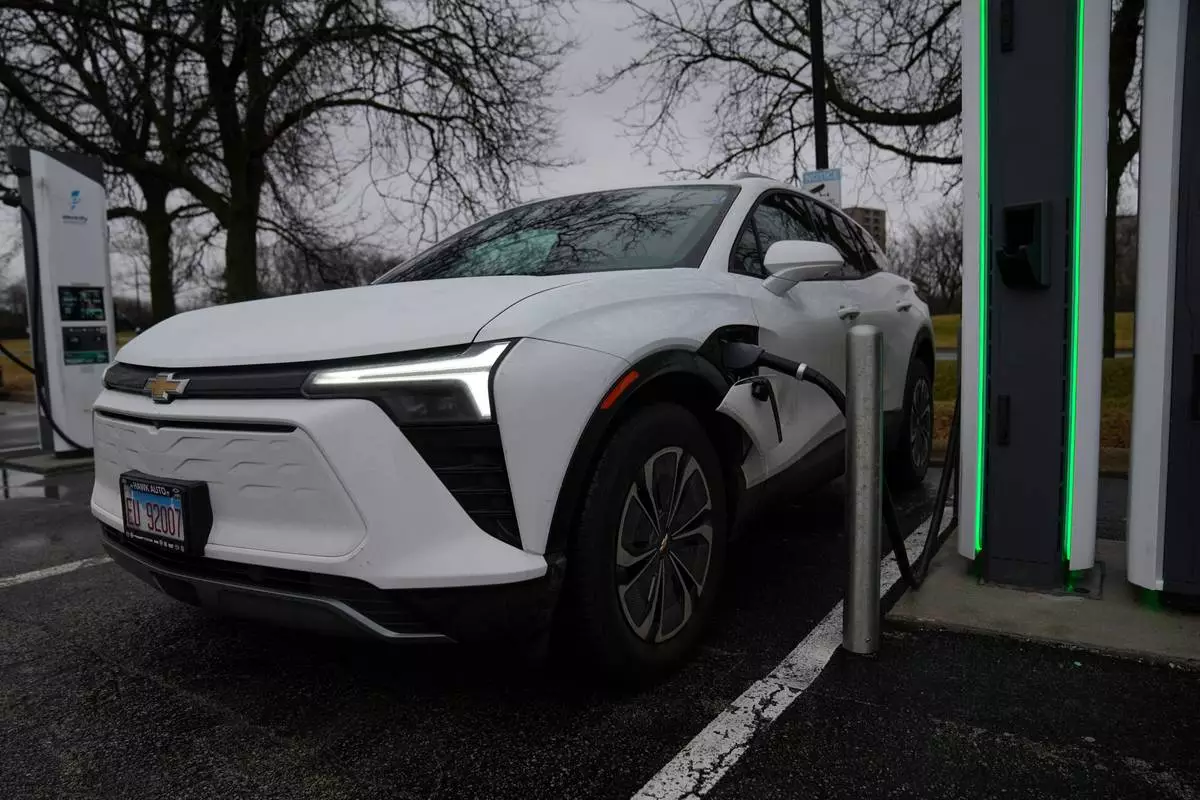
An electric vehicle charges at a station Wednesday, March 11, 2026, in Lincolnwood, Ill. (AP Photo/Erin Hooley)
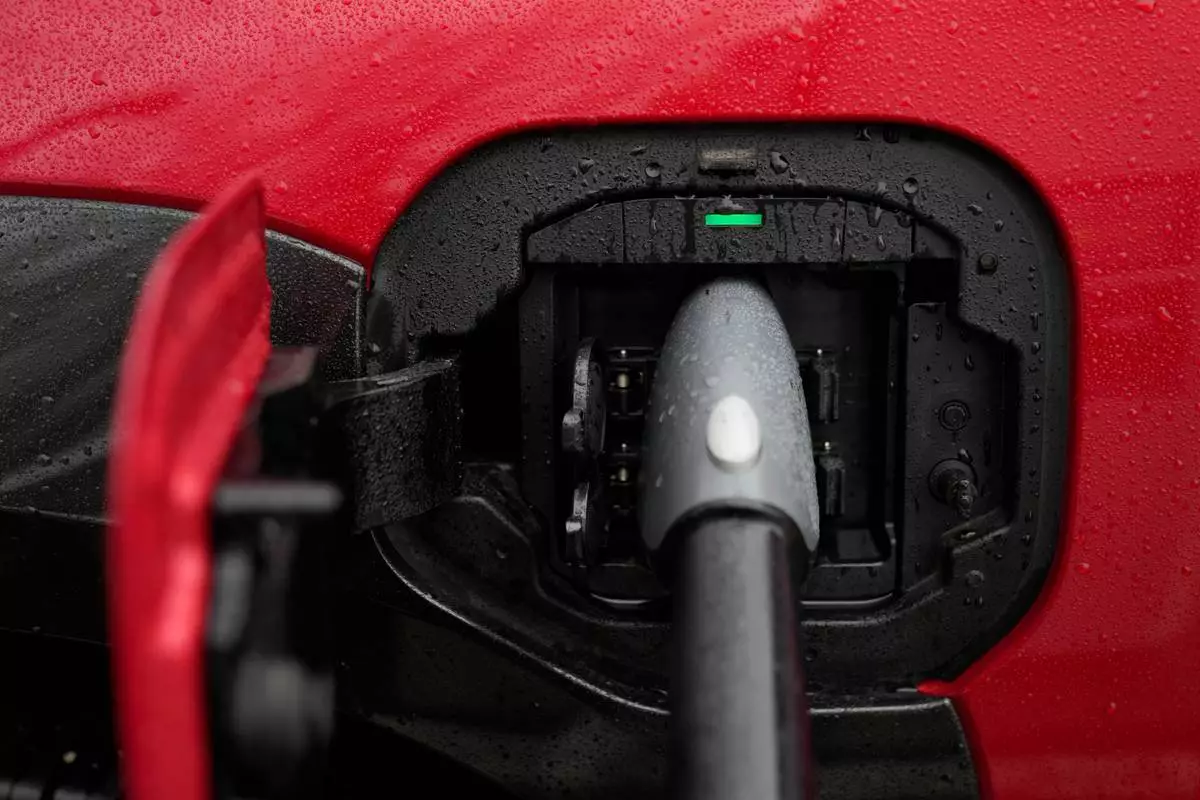
An electric vehicle charges at a station Wednesday, March 11, 2026, in Lincolnwood, Ill. (AP Photo/Erin Hooley)
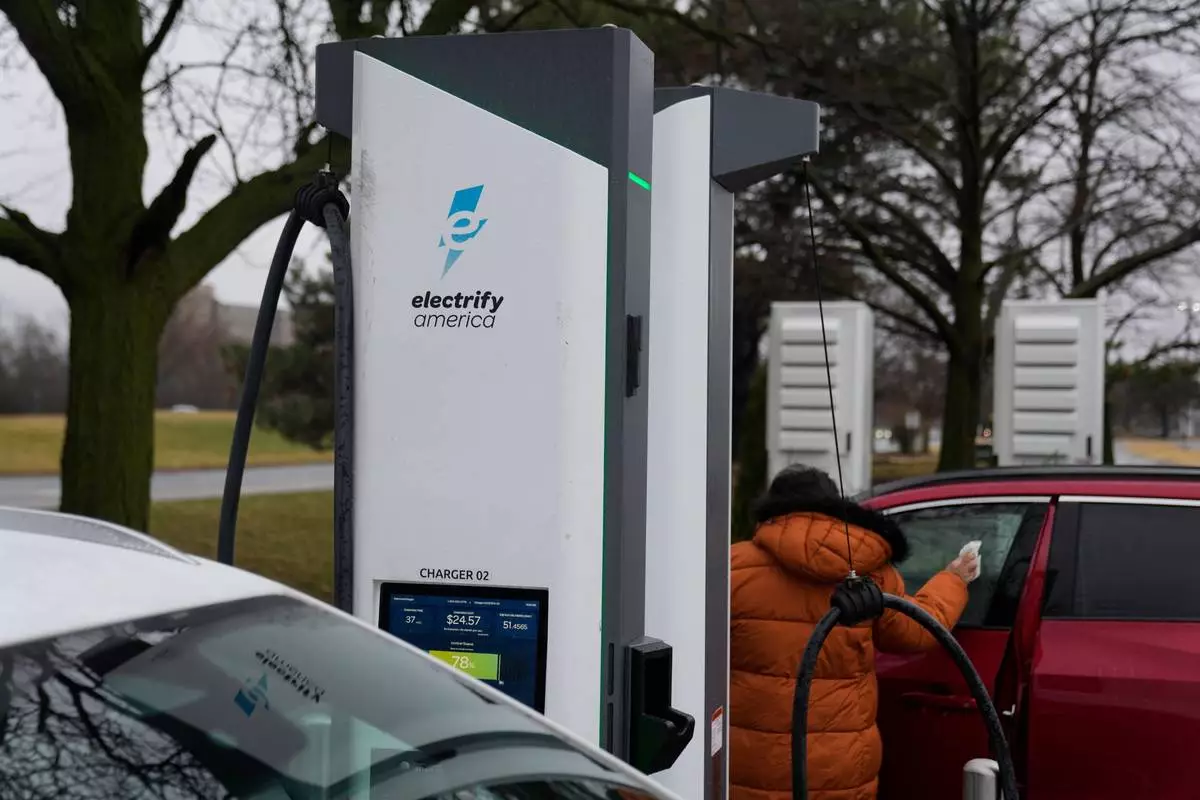
Electric vehicles charge at a station Wednesday, March 11, 2026, in Lincolnwood, Ill. (AP Photo/Erin Hooley)