Skip to Content Facebook Feature Image

German president visits WWII bombing site as Europe seeks to bolster united front against Russia

News

German president visits WWII bombing site as Europe seeks to bolster united front against Russia
News

News

German president visits WWII bombing site as Europe seeks to bolster united front against Russia

2025-12-05 23:04 Last Updated At:23:11

LONDON (AP) — Germany’s president laid a wreath Friday at Coventry Cathedral in central England, symbolically atoning for the atrocities of World War II as his country and the United Kingdom seek to bolster an alliance to combat the new war raging in Europe.

Frank-Walter Steinmeier’s pilgrimage commemorates the Nazi bombing of Coventry on the night of Nov. 14, 1940, which destroyed the 14th-century Gothic cathedral, leaving behind a roofless ruin that stands as a reminder of the ravages of war. At least 568 people were killed and more than half of Coventry’s homes were damaged or destroyed in what was the single most concentrated attack on a British city during the war.

More Images
Germany's President Frank-Walter Steinmeier, center, with his wife Elke Budenbender tour the new Coventry Cathedral, in Coventry, England, Friday, Dec. 5, 2025, on the final day of the state visit to the UK. (Oli Scarff/Pool Photo via AP)

Germany's President Frank-Walter Steinmeier, center, with his wife Elke Budenbender tour the new Coventry Cathedral, in Coventry, England, Friday, Dec. 5, 2025, on the final day of the state visit to the UK. (Oli Scarff/Pool Photo via AP)

Britain's Duke of Kent, third right, and Germany's President Frank-Walter Steinmeier, second right, tour the ruins of the old Cathedral in Coventry, Coventry Cathedral, in Coventry, England, Friday, Dec. 5, 2025, on the final day of the state visit to the UK. (Oli Scarff/Pool Photo via AP)

Britain's Duke of Kent, third right, and Germany's President Frank-Walter Steinmeier, second right, tour the ruins of the old Cathedral in Coventry, Coventry Cathedral, in Coventry, England, Friday, Dec. 5, 2025, on the final day of the state visit to the UK. (Oli Scarff/Pool Photo via AP)

The wreaths laid on behalf of Britain's Duke of Kent, Germany's President Frank-Walter Steinmeier and his wife Elke Budenbender, at the old Coventry Cathedral, in Coventry, England, Friday, Dec. 5, 2025, on the final day of the state visit to the UK. (Jacob King/Pool Photo via AP)

The wreaths laid on behalf of Britain's Duke of Kent, Germany's President Frank-Walter Steinmeier and his wife Elke Budenbender, at the old Coventry Cathedral, in Coventry, England, Friday, Dec. 5, 2025, on the final day of the state visit to the UK. (Jacob King/Pool Photo via AP)

Germany's President Frank-Walter Steinmeier tours the old Coventry Cathedral, in Coventry, England, Friday, Dec. 5, 2025, on the final day of the state visit to the UK. (Christopher Furlong/Pool Photo via AP)

Germany's President Frank-Walter Steinmeier tours the old Coventry Cathedral, in Coventry, England, Friday, Dec. 5, 2025, on the final day of the state visit to the UK. (Christopher Furlong/Pool Photo via AP)

Germany's President Frank-Walter Steinmeier speaks to the media on the grounds of the old Coventry Cathedral, in Coventry, England, Friday, Dec. 5, 2025, on the final day of the state visit to the UK. (Hannah McKay/Pool Photo via AP)
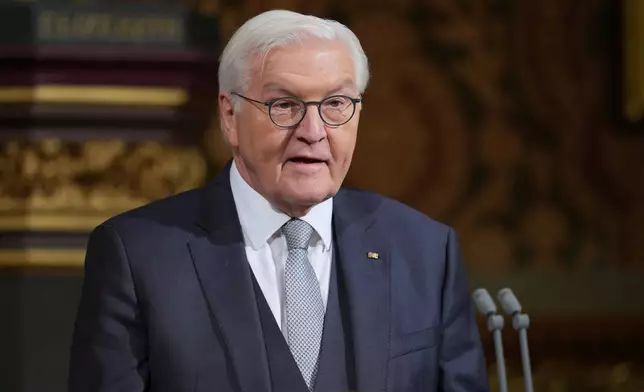
Germany's President Frank-Walter Steinmeier speaks to the media on the grounds of the old Coventry Cathedral, in Coventry, England, Friday, Dec. 5, 2025, on the final day of the state visit to the UK. (Hannah McKay/Pool Photo via AP)

German President Frank-Walter Steinmeier speaks to a joint session of Members of Parliament, in the Royal Gallery, at the Palace of Westminster, as part of his State Visit to the United Kingdom, in London, Thursday, Dec. 4, 2025. (AP Photo/Kin Cheung, Pool)

German President Frank-Walter Steinmeier speaks to a joint session of Members of Parliament, in the Royal Gallery, at the Palace of Westminster, as part of his State Visit to the United Kingdom, in London, Thursday, Dec. 4, 2025. (AP Photo/Kin Cheung, Pool)

Britain was represented at the event by the Duke of Kent, who has long fostered U.K.-German reconciliation. He served as the royal patron of the Dresden Trust, which seeks to build bonds between the people of Britain and Dresden following the Allied bombing that destroyed the German city’s historic center and killed an estimated 25,000 people in February 1945.

Steinmeier’s appearance wraps up a three-day state visit to Britain, the first by a German head of state in 27 years.

During a lavish banquet on Wednesday night at Windsor Castle, Steinmeier and King Charles III put on a show of Anglo-Saxon unity, exchanging toasts that celebrated the cultural and historic ties between their nations and highlighted efforts to build a common front against Russia's war in Ukraine.

In his toast, Steinmeier described Coventry as a symbol of the bonds that grew out of the war that ended 80 years ago.

“Flourishing cities grew out of the ashes. Enemies became friends,” he said. “That is our common history — and it shows what is possible when people have the courage to pursue reconciliation.”

The state visit came as European nations bond together to support Ukraine and confront Russian efforts to destabilize Western democracies through so-called hybrid attacks such as election interference, disinformation and sabotage. Shaken by what they see as U.S. President Donald Trump’s lack of reliability, European nations are increasing military spending and boosting military cooperation.

Earlier this year, the United Kingdom and Germany signed a treaty pledging to deepen cooperation on a range of issues, including defense, migration and the fight against climate change.

Martin Farr, an expert in modern British history at Newcastle University, said that Steinmeier’s visit highlights the fact that European nations are working together much more than at any time since 1815. That was the year that the continent’s major powers set up the Concert of Europe, a set of practices and principles designed to keep the peace after the Napoleonic Wars.

“War’s been mentioned in this visit,” Farr said. “War, in some part, has occasioned the visit and its importance. And so the historical echoes are really very profound, I think."

The pomp and ceremony of Steinmeier’s visit to Britain is part of that.

While state visits are hosted by the king, they are scheduled at the request of the elected government to reward friends — and sometimes nudge reluctant partners — with the red carpet treatment only the British royal family can provide.

On Wednesday, Charles welcomed Steinmeier and his wife, Elke Büdenbender, with a warm handshake before bundling them into a horse-drawn carriage for the ride to Windsor Castle, where a military band played the national anthems of both countries and Steinmeier inspected the assembled troops.

For the banquet, Queen Camilla and the Princess of Wales donned glittering tiaras and flowing evening gowns as they escorted their guests into St. George’s Hall for a sumptuous meal served on 200-year-old silver. The hall was decorated with a 6-meter-tall (nearly 20-foot-tall) Christmas tree adorned with thousands of lights.

Steinmeier also held talks with Prime Minister Keir Starmer, laid a wreath at the tomb of the late Queen Elizabeth II and addressed Parliament.

During his speech to lawmakers, Steinmeier described Russia’s invasion of Ukraine as an attack on the rules-based order that was built in Europe following World War II.

"We are seeing the resurgence of imperial ambitions, the attempt by destabilizing forces to divide us and pit us against one another,” he said. “And that is precisely why we must stand united. We need to stand up as one for what defines us."

Germany's President Frank-Walter Steinmeier, center, with his wife Elke Budenbender tour the new Coventry Cathedral, in Coventry, England, Friday, Dec. 5, 2025, on the final day of the state visit to the UK. (Oli Scarff/Pool Photo via AP)

Germany's President Frank-Walter Steinmeier, center, with his wife Elke Budenbender tour the new Coventry Cathedral, in Coventry, England, Friday, Dec. 5, 2025, on the final day of the state visit to the UK. (Oli Scarff/Pool Photo via AP)

Britain's Duke of Kent, third right, and Germany's President Frank-Walter Steinmeier, second right, tour the ruins of the old Cathedral in Coventry, Coventry Cathedral, in Coventry, England, Friday, Dec. 5, 2025, on the final day of the state visit to the UK. (Oli Scarff/Pool Photo via AP)

Britain's Duke of Kent, third right, and Germany's President Frank-Walter Steinmeier, second right, tour the ruins of the old Cathedral in Coventry, Coventry Cathedral, in Coventry, England, Friday, Dec. 5, 2025, on the final day of the state visit to the UK. (Oli Scarff/Pool Photo via AP)

The wreaths laid on behalf of Britain's Duke of Kent, Germany's President Frank-Walter Steinmeier and his wife Elke Budenbender, at the old Coventry Cathedral, in Coventry, England, Friday, Dec. 5, 2025, on the final day of the state visit to the UK. (Jacob King/Pool Photo via AP)
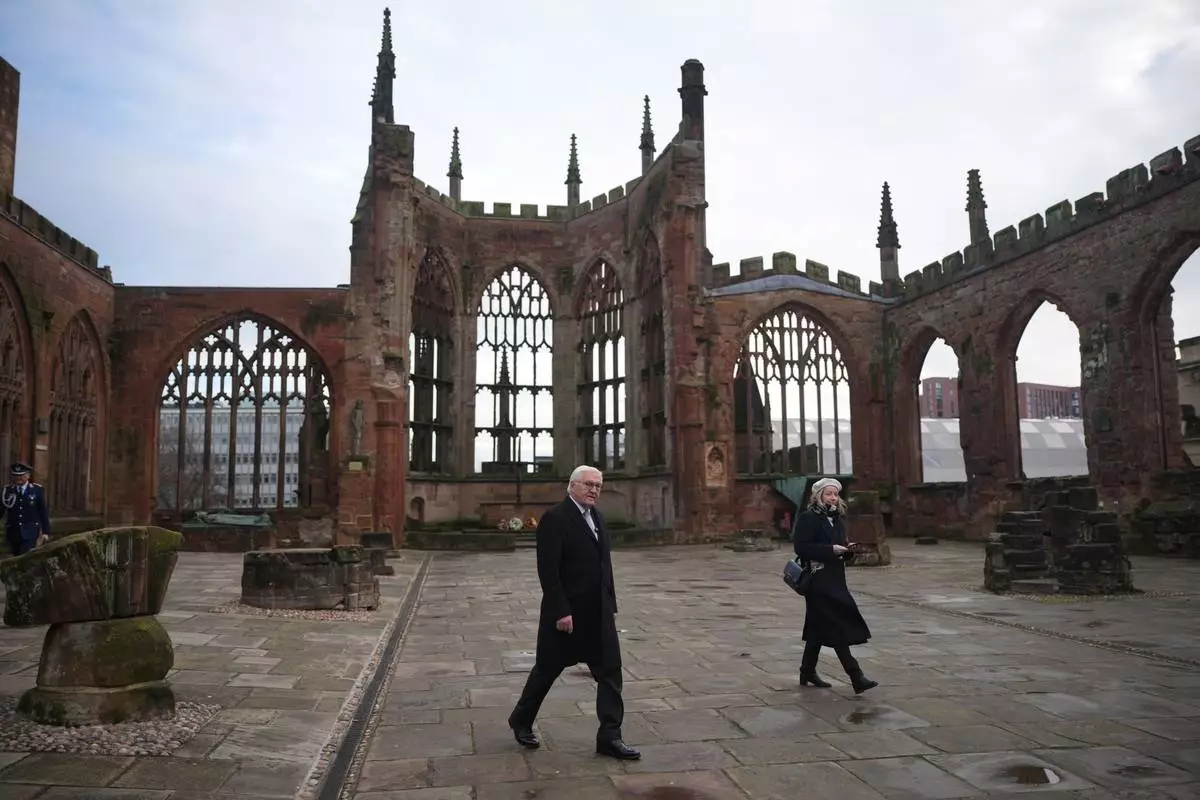
The wreaths laid on behalf of Britain's Duke of Kent, Germany's President Frank-Walter Steinmeier and his wife Elke Budenbender, at the old Coventry Cathedral, in Coventry, England, Friday, Dec. 5, 2025, on the final day of the state visit to the UK. (Jacob King/Pool Photo via AP)

Germany's President Frank-Walter Steinmeier tours the old Coventry Cathedral, in Coventry, England, Friday, Dec. 5, 2025, on the final day of the state visit to the UK. (Christopher Furlong/Pool Photo via AP)
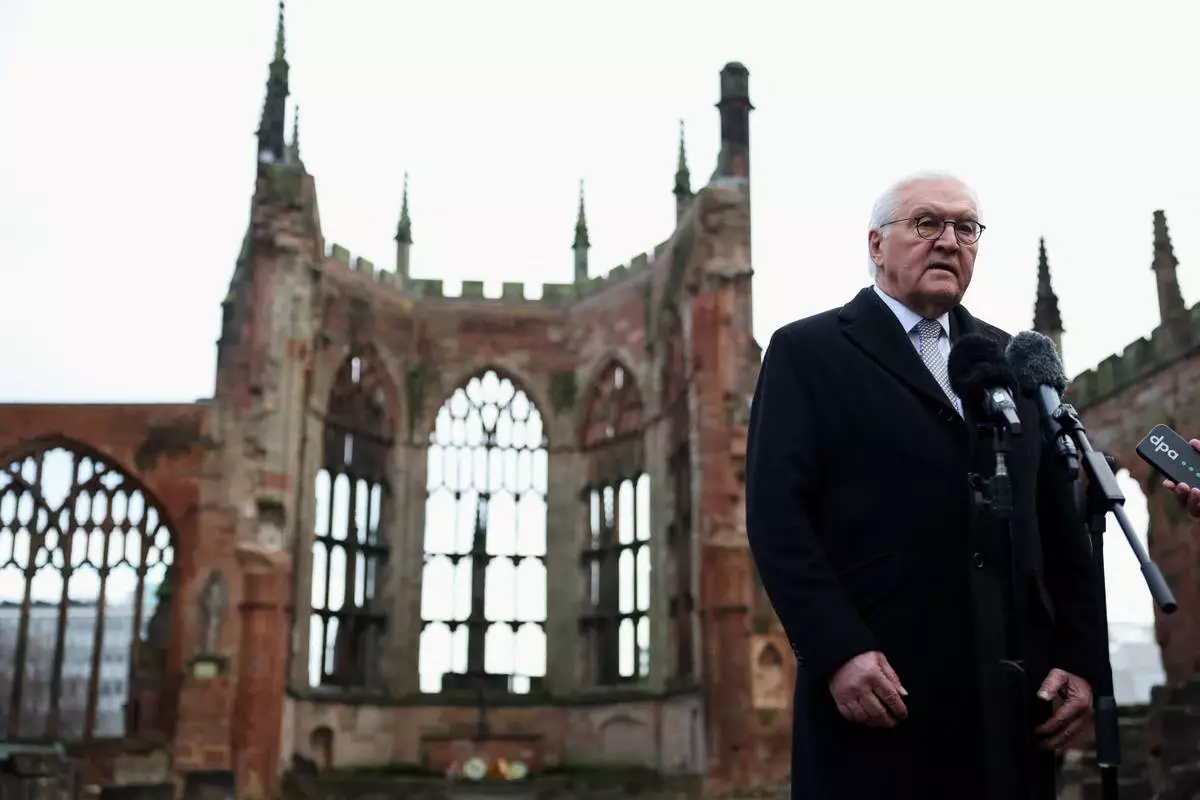
Germany's President Frank-Walter Steinmeier tours the old Coventry Cathedral, in Coventry, England, Friday, Dec. 5, 2025, on the final day of the state visit to the UK. (Christopher Furlong/Pool Photo via AP)

Germany's President Frank-Walter Steinmeier speaks to the media on the grounds of the old Coventry Cathedral, in Coventry, England, Friday, Dec. 5, 2025, on the final day of the state visit to the UK. (Hannah McKay/Pool Photo via AP)
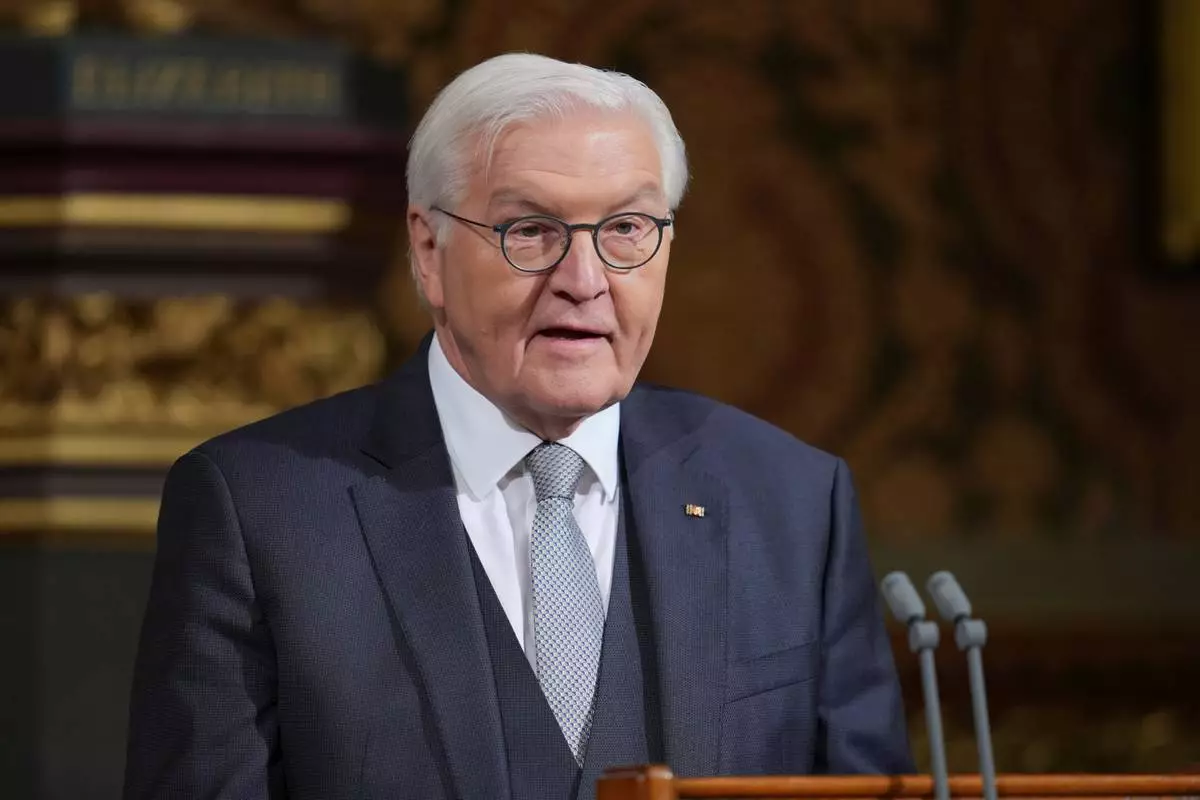
Germany's President Frank-Walter Steinmeier speaks to the media on the grounds of the old Coventry Cathedral, in Coventry, England, Friday, Dec. 5, 2025, on the final day of the state visit to the UK. (Hannah McKay/Pool Photo via AP)

German President Frank-Walter Steinmeier speaks to a joint session of Members of Parliament, in the Royal Gallery, at the Palace of Westminster, as part of his State Visit to the United Kingdom, in London, Thursday, Dec. 4, 2025. (AP Photo/Kin Cheung, Pool)

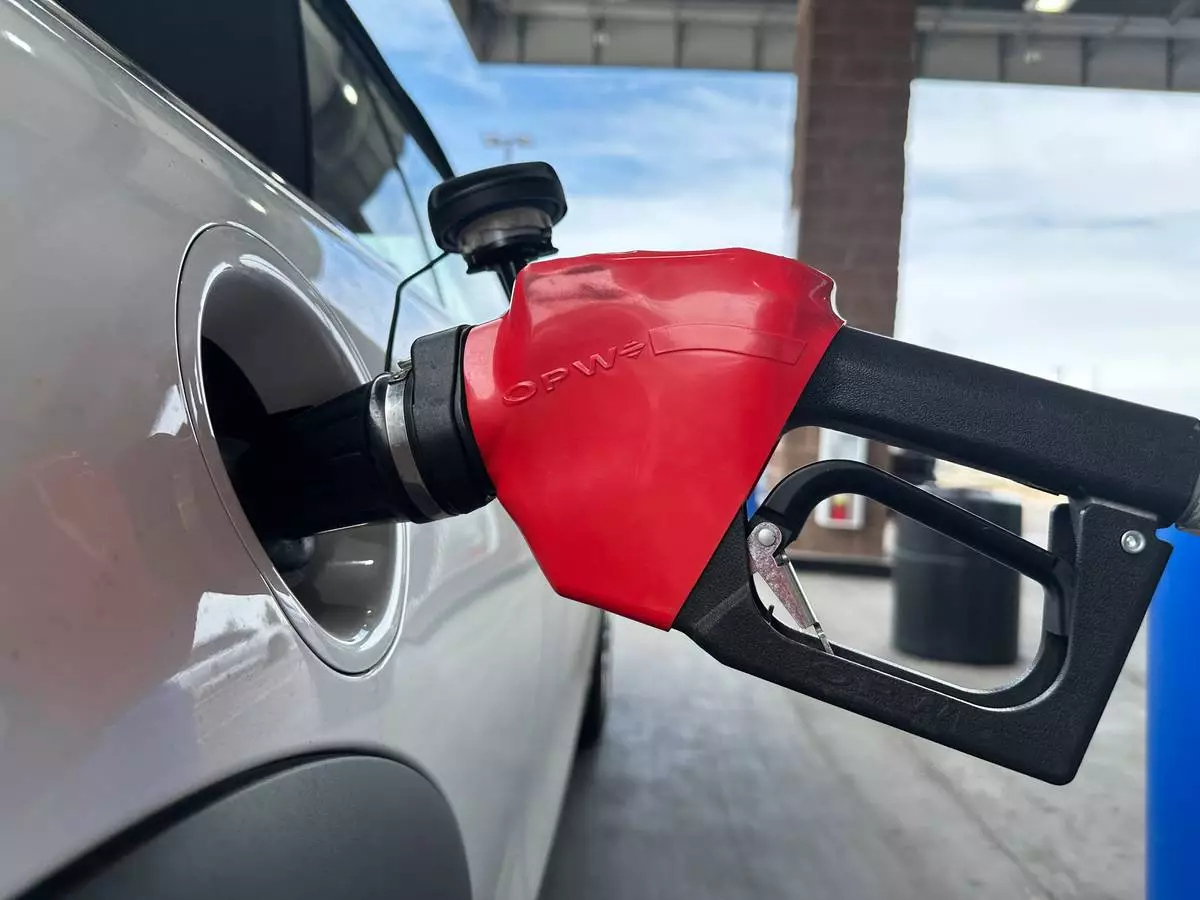
German President Frank-Walter Steinmeier speaks to a joint session of Members of Parliament, in the Royal Gallery, at the Palace of Westminster, as part of his State Visit to the United Kingdom, in London, Thursday, Dec. 4, 2025. (AP Photo/Kin Cheung, Pool)

Wall Street’s losses deepened as the ongoing fallout from the war in Iran keeps pushing oil prices higher, ratcheting up inflationary pressure on the global economy. After briefly easing early Friday, crude oil prices rose again, bringing the benchmark oil price back above $100 a barrel. The S&P 500 fell 0.6%. The Dow Jones Industrial Average lost 0.3% and the Nasdaq composite dropped 0.9%. A measure of inflation closely monitored by the Federal Reserve moved higher in January, even before the war with Iran sent energy prices higher.

THIS IS A BREAKING NEWS UPDATE. AP’s earlier story follows below.

Wall Street's losses deepened Friday as the ongoing fallout from the war in Iran keeps pushing oil prices higher, ratcheting up inflationary pressure on the global economy.

The S&P 500 was down 0.5% in afternoon trading after having been up as much as 0.9% in the early going. The Dow Jones Industrial Average was down 64 points, or 0.1%, as of 3:22 p.m. Eastern time, and the Nasdaq composite was 1% lower. The major indexes are headed for their third straight losing week.

In the energy market, which has been roiled by the Iran war and its impact on supplies of crude oil and gas, the price of a barrel of Brent crude, the international standard, climbed back above $100 per barrel after briefly dropping earlier in the day. It closed 2.7% higher at $103.14 per barrel. It's up about 40% for the month.

A barrel of U.S. crude oil rose 3.1% to settle at $98.71. It’s risen around 46% this month.

Oil prices have been volatile since the Iran war began. Iran’s actions have effectively stopped cargo traffic through the narrow Strait of Hormuz, where a fifth of the world’s oil typically sails. That has oil producers cutting production because their crude has nowhere to go.

If the war continues to hamper the production and transportation of oil from the Persian Gulf, it could cause a surge in inflation that could hurt the global economy. Analysts have said that if the Strait of Hormuz remains closed, oil prices could jump to $150 relatively quickly.

While the International Energy Agency said Wednesday its members would make a record 400 million barrels of oil available from their emergency reserves, some economists believe that would do little to reassure markets.

President Donald Trump signaled earlier this week that he would take more action to address the squeeze on oil flows. The move follows the administration’s decision to grant temporary permission for India to buy Russian oil.

A new snapshot of consumer spending Friday shows inflation crept higher in January, even before the Iran war caused oil and gas prices to spike.

The Commerce Department said prices rose 2.8% in January compared with a year earlier. But excluding the volatile food and energy categories — which the Federal Reserve pays closer attention to — core prices rose 3.1%, up from 3% in the prior month and the highest in nearly two years.

Even so, consumers still lifted their spending at a solid 0.4% pace in January, with their incomes rising at the same pace, according to the report.

Consumer spending powers about two-thirds of the economy, which is why economists keep a close watch on trends in incomes and spending.

The University of Michigan's latest gauge of consumer sentiment on Friday showed consumer sentiment declined slightly to its lowest reading of the year as gasoline price hikes since the start of the war in Iran.

Meanwhile, the Labor Department said Friday U.S. job openings jumped to nearly 7 million in January, topping economists’ forecasts.

Wall Street also got an update on how U.S. economic growth fared in the October-December quarter. The economy, hobbled by last fall’s 43-day government shutdown, grew at a sluggish 0.7% annual rate, a downgrade from its initial estimate last month.

“GDP and the job market have been expanding, but the rate of change has been slowing, which leads to concerns about the overall economy -- and that was even before we stared a war in the Middle East, which spiked the price of oil,” Chris Zaccarelli, chief investment officer for Northlight Asset Management, said in an email.

About 60% of the stocks in the S&P 500 were rising Friday, with financial services, health care and consumer goods companies among the gainers. Charles Schwab rose 2.5%, Eli Lilly added 1.2% and Philip Morris International gained 1.7%.

Software maker Adobe fell 5.9% even after it beat Wall Street’s sales and profit forecasts. Investors were likely underwhelmed by the company’s forecast for its recurring subscription revenue.

Ulta Beauty slid 13.5% for the biggest decline among S&P 500 stocks after the beauty and makeup retailer's latest quarterly results fell short of analysts’ profit targets. Ulta’s profit was dinged by a 23% increase in selling, general and administrative expenses, which jumped to $1 billion in the period.

Bitcoin rose 1.2% to just around $71,257, boosting companies that trade or hoard the cryptocurrency. Coinbase Global rose 0.8% and Strategy gained 1.6%.

In the bond market, the yield on the 10-year Treasury rose to 4.28% from 4.26% late Thursday. It was just 3.97% before the war started.

Higher yields help make all kinds of borrowing more expensive, such as mortgages for potential U.S. homebuyers and bond offerings for companies looking to expand. They also push down on prices for all kinds of investments, from stocks to crypto.

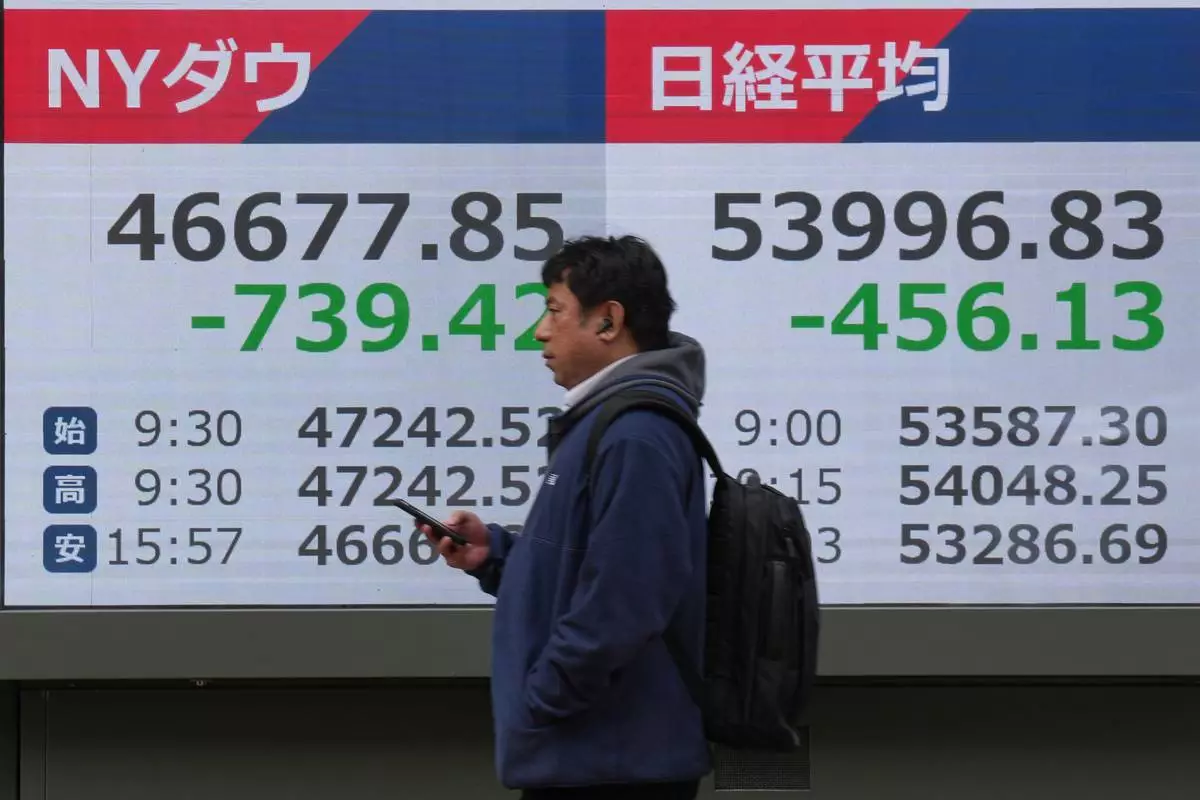
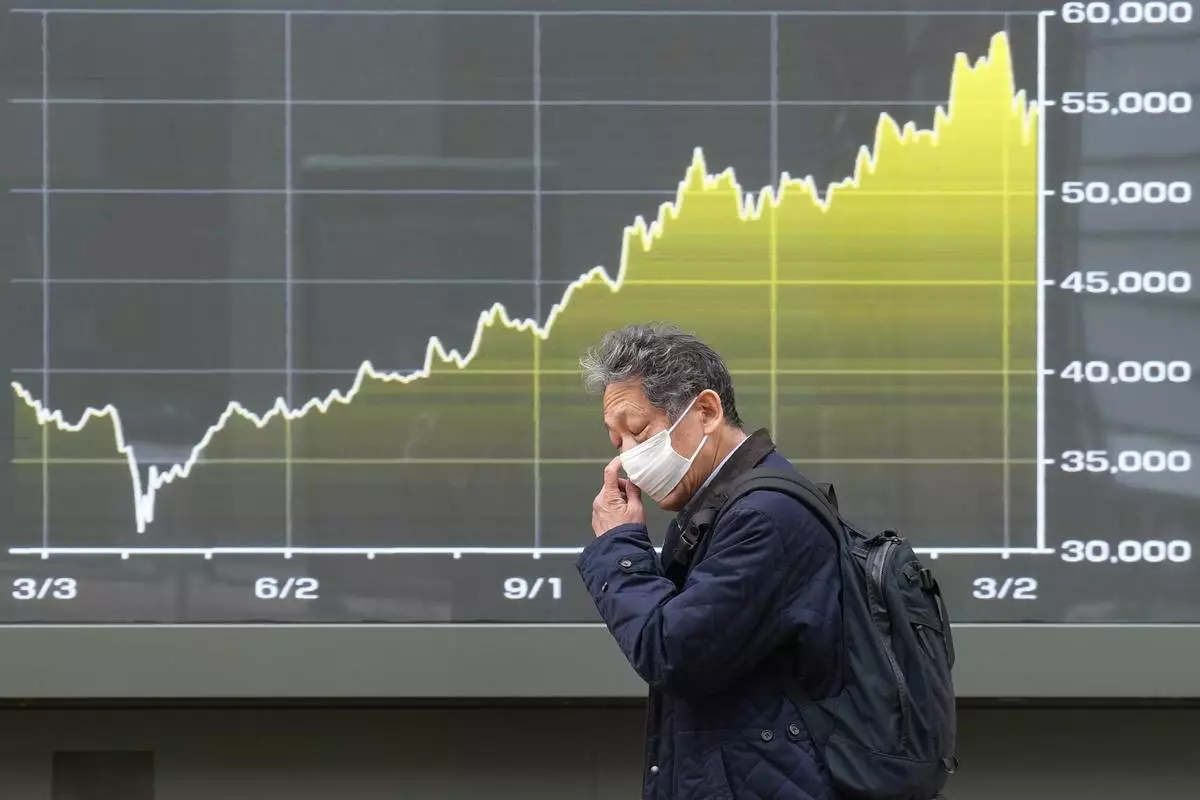
In stock markets abroad, indexes in Europe closed mostly lower after falling in Asia.

Ryan Falvey works on the floor at the New York Stock Exchange in New York, Tuesday, March 10, 2026. (AP Photo/Seth Wenig)

Ryan Falvey works on the floor at the New York Stock Exchange in New York, Tuesday, March 10, 2026. (AP Photo/Seth Wenig)

A motorist fills up the tank of a vehicle at a Coscto gasoline station Thursday, March 12, 2026, in east Denver. (AP Photo/David Zalubowski)

A motorist fills up the tank of a vehicle at a Coscto gasoline station Thursday, March 12, 2026, in east Denver. (AP Photo/David Zalubowski)

The per-gallon price for premium unleaded fuel is displayed electronically on a pump at a Costco gosoline station Thursday, March 12, 2026, in east Denver. (AP Photo/David Zalubowski)

The per-gallon price for premium unleaded fuel is displayed electronically on a pump at a Costco gosoline station Thursday, March 12, 2026, in east Denver. (AP Photo/David Zalubowski)

A person walks in front of an electronic stock board showing Japan's Nikkei index at a securities firm Friday, March 13, 2026, in Tokyo. (AP Photo/Eugene Hoshiko)

A person walks in front of an electronic stock board showing Japan's Nikkei index at a securities firm Friday, March 13, 2026, in Tokyo. (AP Photo/Eugene Hoshiko)

A person walks in front of an electronic stock board showing Japan's Nikkei index at a securities firm Friday, March 13, 2026, in Tokyo. (AP Photo/Eugene Hoshiko)

A person walks in front of an electronic stock board showing Japan's Nikkei index at a securities firm Friday, March 13, 2026, in Tokyo. (AP Photo/Eugene Hoshiko)

Gregg Maloney works on the floor at the New York Stock Exchange in New York, Tuesday, March 10, 2026. (AP Photo/Seth Wenig)

Gregg Maloney works on the floor at the New York Stock Exchange in New York, Tuesday, March 10, 2026. (AP Photo/Seth Wenig)

Recommended Articles