Former French Prime Minister Jean-Pierre Raffarin has said France and China can transcend their differences and jointly serve as messengers of peace for humanity.
In an interview with China Global Television Network (CGTN), Raffarin emphasized that both nations share a fundamental mission to protect the planet and promote global peace, despite different political systems, economic competition, and cultural divergences.
"Today, what is essential for the world is development. It is what China has done with a lot of energy by lifting hundreds of millions of people out of poverty. While growth is a priority today, the foremost priority is peace. The Chinese people are a peaceful people. They have not waged war outside China. They have fought only when their homeland was under attack. They can be the bearers of peace," he said.
"We, the French, have overcome the shames and tragedies of World War II by turning an enemy, Germany, into one of our best friends today. So France and China can together be the messengers of peace. So whatever our political systems, whatever our economic rivalries, whatever our cultural divergences, we fundamentally share a message for the planet. This message is to protect the planet, for the peace of humanity. And peace for humanity is a common goal that France and China share," he said.
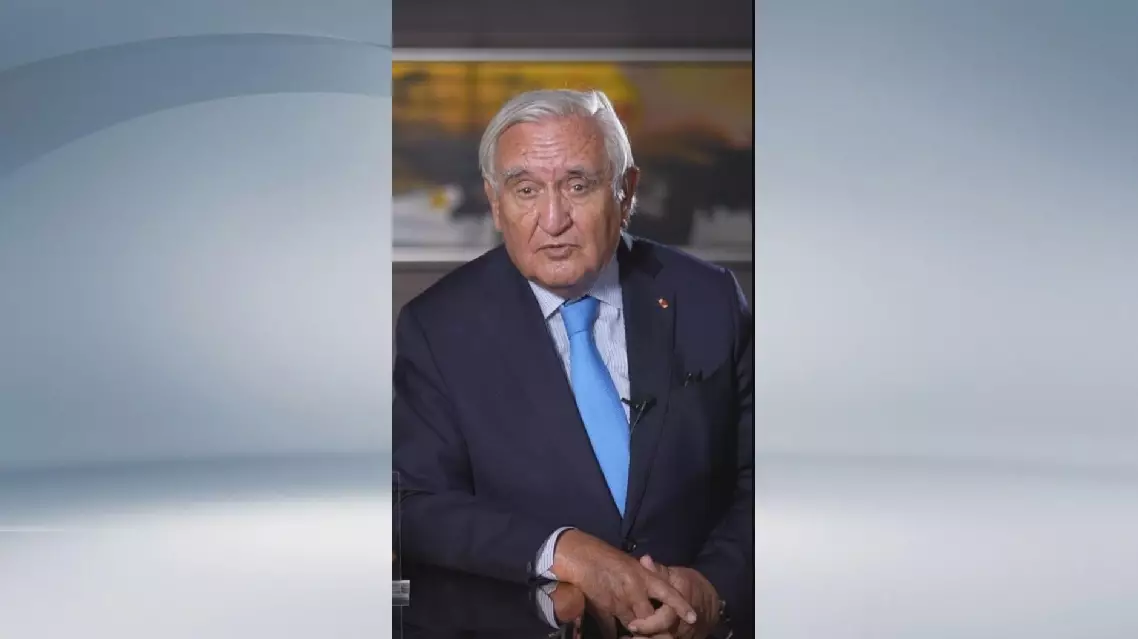
France, China can be messengers of peace: former French PM
There is a 55 percent chance of a weak La Nina impacting global weather and climate patterns during the next three months, according to the latest updates from the World Meteorological Organization (WMO) on Thursday.
La Nina refers to the periodic large-scale cooling of the surface temperatures in the central and eastern equatorial Pacific Ocean, coupled with changes in tropical atmospheric circulation, including shifts in winds, pressure, and rainfall patterns.
According to the latest forecasts from the WMO Global Producing Centers for Seasonal Prediction, as of mid-November 2025, oceanic and atmospheric indicators reveal borderline La Nina conditions, with a 55 percent probability of crossing La Nina thresholds during the period between December 2025 and February 2026.
For January-March and February-April 2026, the likelihood of returning to El Nino Southern Oscillation (ENSO)-neutral conditions gradually rises from about 65 percent to 75 percent. There is little likelihood of an El Nino, which typically has the opposite impacts of La Nina.
Naturally occurring large-scale climate events such as La Nina and El Nino are taking place in the broader context of human-induced climate change, which is increasing global temperatures in the long term, exacerbating extreme weather and climate events, and impacting seasonal rainfall and temperature patterns.
To provide a more comprehensive climate outlook, the WMO also issues regular Global Seasonal Climate Updates (GSCU), taking into account the influence of key climate variability patterns, such as the North Atlantic Oscillation, the Arctic Oscillation, and the Indian Ocean Dipole. The updates also monitor global and regional anomalies of surface temperature and precipitation and their evolution over the upcoming season.
According to the latest GSCU, for December 2025 to February 2026, temperatures are expected to be above normal in much of the Northern Hemisphere, and large parts of the Southern Hemisphere. Meanwhile, rainfall predictions resemble conditions typically observed during a weak La Nina.
WMO forecasts weak La Nina in coming months