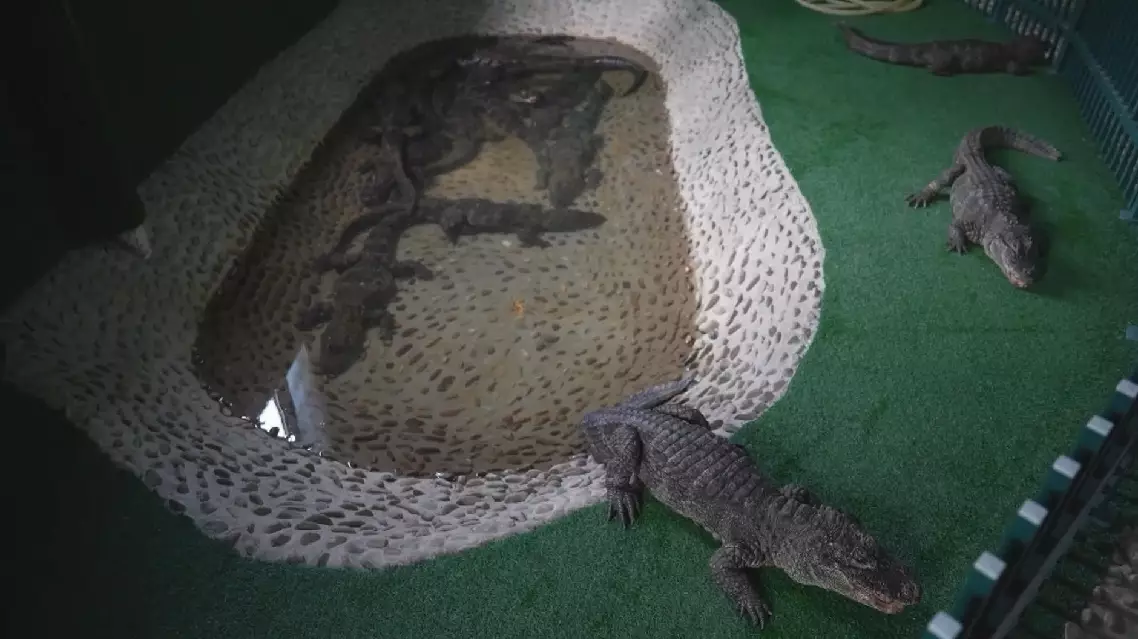
A nature reserve in Xuancheng City of east China's Anhui Province is moving Yangtze alligators to warm rooms to aid their brumation during winter.
The Yangtze alligator, also known as Chinese alligator, is a first-class protected animal endemic to China. The species lives along the middle and lower reaches of the Yangtze River, the longest waterway in the country.
They begin brumating in late November or early December and remain in dens until March.
"We begin moving the Yangtze alligators to their overwintering location when the outdoor water temperature drops below 10 degrees Celsius," said Yi Pingsi, head of animal management at the nature reserve.
The nature reserve has built warm rooms dedicated for the brumation of Yangtze alligators, with sound barriers installed at the bottom this year to reduce disturbance to brumating alligators during cleaning.
"During transportation, there is also a disinfection and cleaning stage to prevent outdoor microorganisms from entering the rooms. After the Yangtze alligators are moved indoors, we will collect their health data, especially from those under scientific research programs," Yi said.
The Anhui Yangtze alligator national nature reserve was established in 1979. Since its establishment, the reserve has been undertaking the work of artificial breeding, habitat protection, wild release and science popularization education of Yangtze alligators.
The reserve currently boasts more than 10,000 captive-born alligators. It began reintroducing the endangered reptiles into the wild since 2003. At present, there are more than 1,900 wild Yangtze alligators in the nature reserve.
East China nature reserve moves Yangtze alligators indoors for winter
China and Russia have agreed to resolutely safeguard the outcomes of the victory of World War II, safeguard world peace and security, and uphold historical truth and international justice, Foreign Ministry spokesman Lin Jian said at a press conference in Beijing on Friday.
In response to a related media query, Lin briefed the press on the outcomes of Chinese Foreign Minister Wang Yi's visit to Russia and the 20th round of China-Russia strategic security consultation earlier this week.
"This year marks the 80th anniversary of the victory of the Chinese People's War of Resistance Against Japanese Aggression and the Soviet Union's Great Patriotic War. The two heads of state attended commemorations in each other's country, and agreed to firmly safeguard the outcomes of the victory of World War II and resolutely oppose any retrogressive acts attempting to whitewash colonial aggression, sending a powerful message for upholding justice and fairness in the current era," Lin noted.
"During the recent China-Russia strategic security consultation, the two sides conducted strategic alignment on issues related to Japan, reaching a high degree of consensus. Both sides agreed to resolutely safeguard the outcomes of the victory of World War II won at the cost of lives and blood, firmly oppose any erroneous words and deeds that attempt to whitewash the history of colonial aggression, and resolutely counter any attempts to revive fascism or Japanese militarism. Both sides stressed that China and Russia, as major countries and permanent members of the United Nations Security Council, will shoulder their shared responsibility to safeguard world peace and security, and uphold historical truth and international justice," said the spokesman.
"We stand ready to continue coordinating and cooperating with Russia to resolutely curb the provocative acts of Japan's far-right forces that undermine regional peace and stability and attempt to remilitarize," Lin said.
China, Russia agree to resolutely safeguard outcomes of World War II victory: spokesman