Over 50 cooperation agreements were signed on Friday at the Second China-France Education Development Forum, which was held in Chengdu City, Sichuan Province, southwest China.
Held at Sichuan University, the forum brought together representatives from 70 Chinese and approximately 30 French universities. The two sides signed 54 cooperative agreements across five major areas: dual-degree joint training programs, joint scientific research laboratories, cooperative education, student exchange, and overseas campus construction, paving a broad path for future bilateral collaboration.
"Our partnership with French universities spans 20 years. At present, Beihang University operates three China-French cooperative education institutions in Beijing and Hangzhou, enrolling around 500 undergraduates annually. Students in these programs receive several years of joint training and, upon completion, earn academic qualifications and diplomas from both universities," said Dong Zhuoning, Assistant President and Dean of the Hangzhou International Innovation Institute at Beihang University.
Gilles Fleury, General Delegate of Centrale Schools Group, expressed his willingness to engage with Chinese universities in developing new exchange programs for future talent cultivation. He also proposed fostering innovative cooperation in humanities and social sciences through interdisciplinary research, with the aim of promoting a more balanced two-way flow of students.
"We decided to promote this interdisciplinary program for the young students, not only the Chinese students, we begin to recruit French students. It is a double degree program, indeed it's an interdisciplinary program. So it's the whole branch of engineering. So it comes from computer science to mechanic to turbulence to free mechanics, so it's a very broad program," said Fleury.
Chen Dali, Deputy Director of the Department of International Cooperation and Exchanges of the Ministry of Education of China, said that growing educational cooperation between China and France in recent years has drawn increasing numbers of students from across Europe to pursue studies in China.
"Over the past year, universities from both countries have engaged in extensive cooperation across various fields. This collaboration has resulted in 72 new joint educational institutions and programs, placing France's number of such cooperative points first in Europe. Additionally, the two sides have established 11 joint engineering institutes covering key fields such as aviation, energy, machinery, and electronics. To date, more than 8,300 French students have participated in exchange programs in China. This wave of exchange has, in turn, attracted over 32,000 students from across Europe to study in China, marking a new high," said Chen.
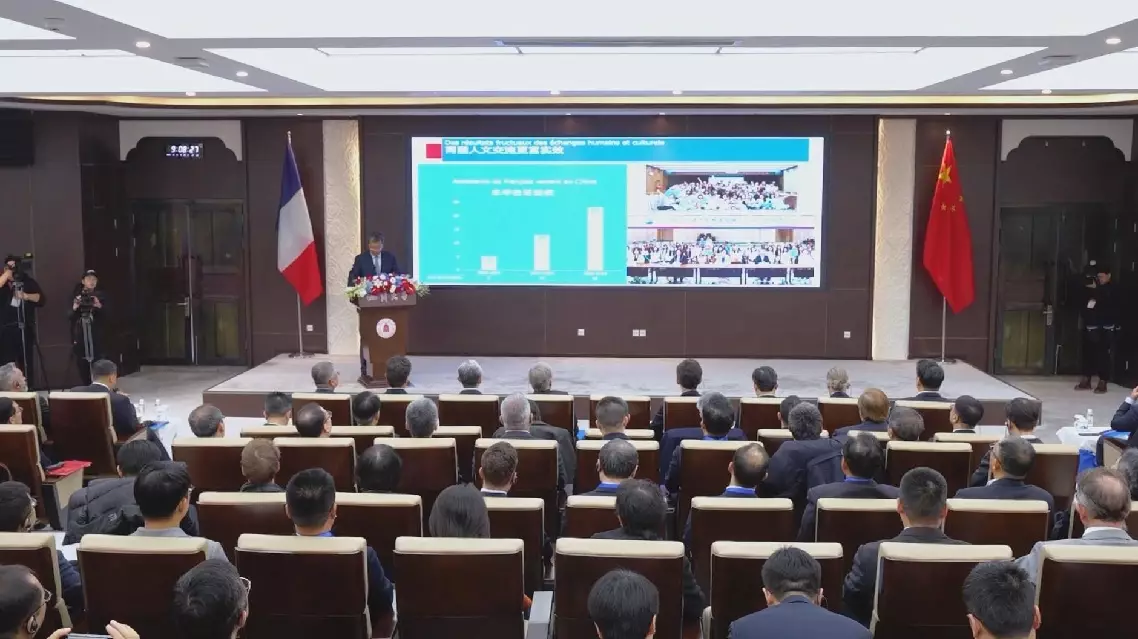
2nd China-France Education Development Forum yields fruitful outcomes