An exchange program between China and France has provided thousands of French students with the opportunity to attend Chinese universities over the past year, giving them a comprehensive and multidimensional view of the country through their studies.
In 2024, China proposed an initiative aimed at bringing the total number of French students in China to more than 10,000 and doubling the number of young Europeans on exchange programs to China within the next three years.
Then, in June of that year, the education ministries of China and France jointly launched the Young Envoys Scholarship (YES) program during the first China-France Education Development Forum held in Paris.
Among the students to take advantage of the program is Mathis Champaigne, a French master's exchange student from the Institute of Higher Electronic Education (ISEP) in Paris. Through YES, he arrived at the School of Artificial Intelligence and Automation, Huazhong University of Science and Technology (HUST) this September for a five-month study program.
According to the student, the program offered a valuable opportunity to learn about artificial intelligence (AI) from renowned scholars.
"In this country, you are very advanced in this AI field and so you have a lot of researchers, a lot of universities, very involved in this AI research. So for me that was an opportunity to learn from a great professor in a great university," Champaigne said.
Currently, 29 French students from seven French universities are studying at HUST across various majors, for periods ranging from two weeks to a full academic year. For some, a short-term exchange can give way to deeper ambitions.
"I want to extend my semester and stay longer because I feel like here the campus is made for students to have good experience while studying," said another YES program participant of HUST, an undergraduate student from the University of Strasbourg.
Since the initiative was proposed over a year ago, more than 8,300 French students have come to China for exchanges and studies, helping to spur a broader trend across Europe, with about 32,000 students from across the continent having chosen to undertake exchange programs in China.
The program also partners with other Chinese institutions, including the East China University of Science and Technology (ECUST), where exchange students have had similarly successful experiences.
"So, the YES program is a really good program to study abroad and you can choose many different topics and minors. I think that's the best way to see China," said Paul Ferrigno, another YES program participant of ECUST, a graduate student from Montpellier Higher College of Chemistry.
"And engineers in the future, they will have to see by themselves how this country is changing very quickly, how this country is very good in innovation, research, technology, and finally how China is addressing global warming and sustainable development," said Jacques Mercadier, French dean of the International Elite Engineering School of ECUST.
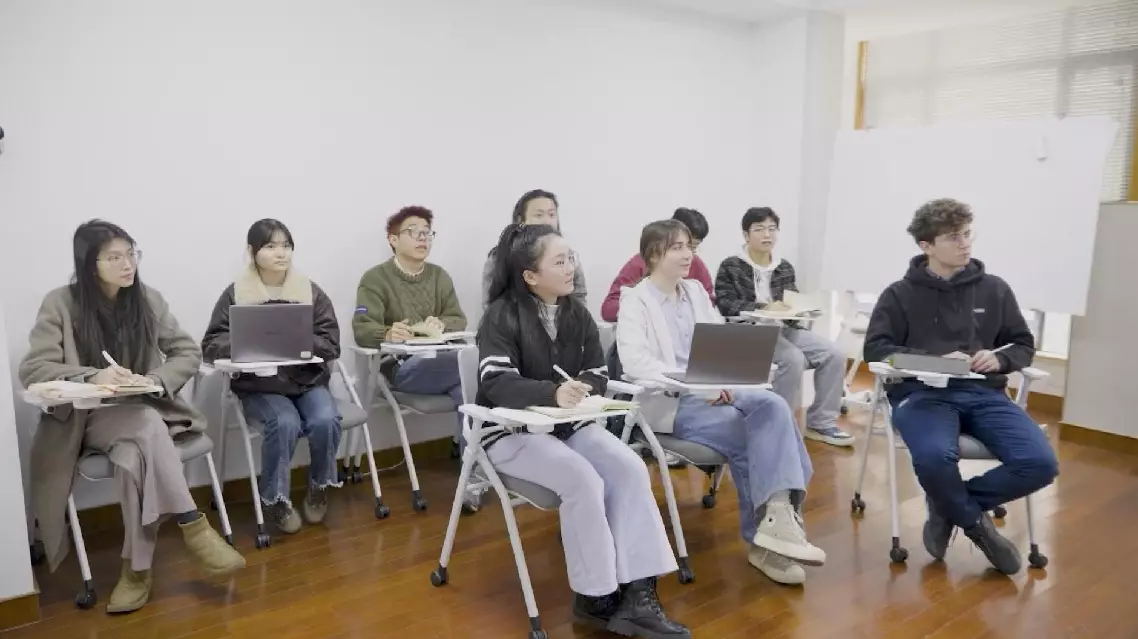
Exchange program fosters China-France partnership in talent cultivation