A record number of Americans left the United States last year, with data from the Brookings Institution showing between 210,000 and 405,000 people voluntarily moved overseas, marking the first time in at least half a century that more departed than arrived.
For decades, the U.S. was seen as a place to pursue a better life, often called "The American Dream." But surveys suggest many now see their future elsewhere.
A Gallup poll found about 20 percent of Americans would like to move abroad, while the Association of American Residents Overseas estimates 5.5 million Americans were already living overseas in 2024, a figure that has since grown.
Jen Barnett, an expat planning coach, said that she had always wanted to live abroad. She moved to Merida, Mexico a decade ago.
"I knew that there was life beyond Huffman, Alabama, and I wanted to see what was out there. In 2016 after the [presidential] election, I said, okay, let's do this," she said.
In 2022 she co-founded Expatsi, a company that helps Americans relocate. She says interest has surged since U.S. President Donald Trump was elected to a second term in 2024.
"It is not as simple as one politician. I think it is the realization that the U.S. is not what we thought it was and a feeling that the social contract has been broken," she said.
Mexico remains the most common destination, followed by Canada. Increasingly, expats are also choosing Uruguay, Costa Rica and Panama in Latin America, as well as Germany and Portugal in Europe.
Many cite crime and gun violence at home, while seeking lower living costs and affordable healthcare abroad.
"The amount of money that you need to retire is millions in the U.S. to guarantee that you can have health care, god forbid you need assisted living, which might cost 10,000 or 15,000 U.S. dollars a month. In a place like Portugal, you could have full-time live-in care for 2,000 dollars a month," she said.
Remote work and technology have made relocation easier, though language barriers, cultural differences and bureaucracy remain challenges.
"Most of the challenges that you face are internal. I think people just need to see others doing it," she said.
Many expats hold visas or dual citizenship, but growing numbers are making the move permanent.
Before 2009, only 200 to 400 Americans renounced their citizenship each year. In 2025, that figure was just under 5,000, with a backlog of about 30,000 awaiting appointments to formally give up their U.S. citizenship.

Record number of Americans moving abroad amid rising cost and discontent

Record number of Americans moving abroad amid rising cost and discontent

Record number of Americans moving abroad amid rising cost and discontent
After more than three months at sea, members of China's 16th Arctic Ocean expedition have jointly created a painting that captures both the triumphs and trials of polar scientific research.
Organized by the Ministry of Natural Resources, the expedition deployed four ships, Xuelong, Xuelong 2, Jidi, and Tansuo 3, to study extreme environmental changes in the Arctic against the backdrop of accelerating global warming. On September 29, Xuelong and Xuelong 2 returned to Shanghai after completing their missions.
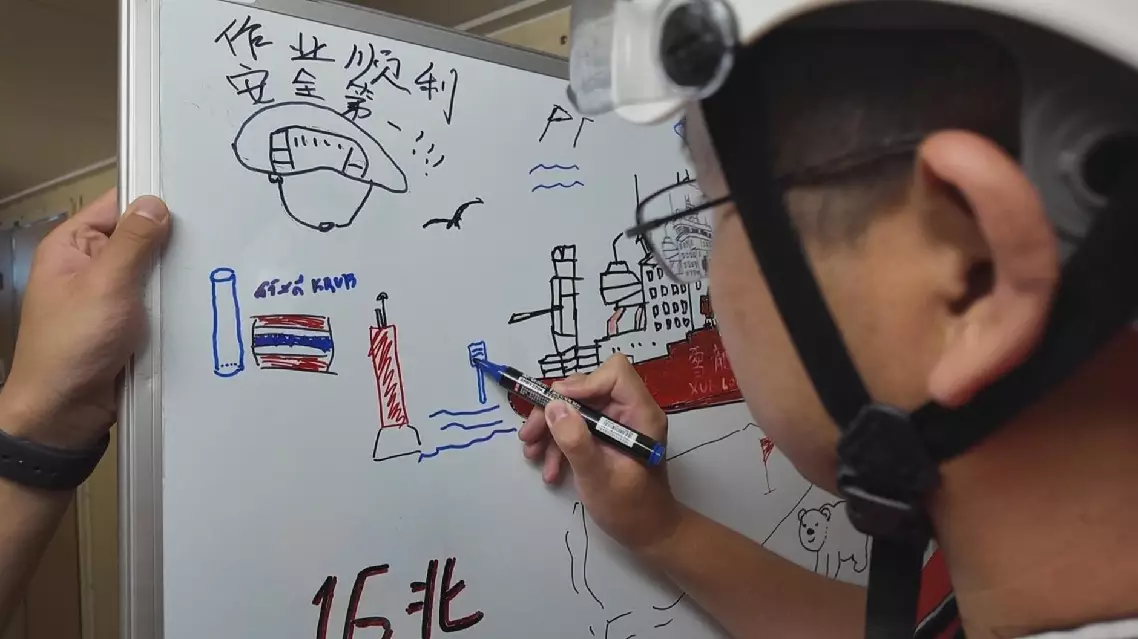
During the voyage, China Media Group (CMG) reporters aboard Xuelong invited nearly 100 crew members to collaborate on a canvas, sharing their experiences. The painting depicts the difficulties and challenges they faced, the honors and expectations of their research, and the images of those dedicated to science.
Before any crew member ever picked up a brush, the Arctic had already sketched the background with its extreme weather. Strong winds, torrents, and a harsh environment posed major challenges for the researchers.
"After staying outside for some five or ten minutes, our hands would already be frozen red. When we reached the trough of the waves [on a boat], it would look as if the waves were coming right over our heads," recalled Zhu Chengwei, an expedition member.
Despite the hardship, the researchers successfully tested and used domestically produced advanced ocean observation equipment in polar research -- one of their proudest moments, which they recorded on the canvas.
Qin Chuan, captain of the Xuelong ocean team, chose to paint a domestically produced monitor float.
"This is an Argo float we deployed, which automatically monitors ocean profiles. It has great significance for understanding the basic marine environment, and it's made in China," he said.
Xie Haixiang, director of the Xuelong laboratory, sketched a fundamental research equipment for the trip.
"I will draw a CTD (Conductivity, Temperature, and Depth instrument). The CTD is the most important equipment for ocean surveys, providing the most basic data and water samples," he said.
"Only by carrying equipment onto the Arctic sea ice yourself and lowering the instruments, can you get what you want. For instance, we take a little ocean water, and analyze what's in it, to understand the changes each year. Global warming needs to be understood through different dimensions," recalled researcher Zhu.
Beyond the canvas, what stands out even more striking are the moments of dedication: veteran members leading newcomers onto the ice, a group holding its ground in level-8 gales and heavy snow, and 30 people relaying to recover equipment stuck in the ice.
The most important element, beyond any record or image in the painting, is this group of expedition members who fear no hardship.
"Whenever I think of the polar spirit, countless images of those standing at the very front would flash before my eyes," Zhu said.
"What we have done today will benefit future generations. Although we are doing something that may seem very insignificant, I believe it will surely prove its worth in the future,"said Ning Wenfeng, another team member.
China's 16th Arctic expedition crews paint portrait of proud polar expedition moments, hardships