In a matter of hours Sunday, what had appeared to be a year no teams with losing records would be needed to fill out the bowl schedule suddenly changed when Notre Dame, Iowa State and Kansas State announced they would decline bids despite being eligible.
There are 41 bowls this year, and 82 teams won the necessary six games to be eligible. But Iowa State and Kansas State teams going through coaching changes almost simultaneously said they were hanging up their cleats for the season. Notre Dame, the first team left out of the College Football Playoff, followed a few hours later.
Mississippi State and Rice, both 5-7, swooped in to accept bids because they were among the first in line based on their Academic Progress Rate. The Bulldogs will play Wake Forest in the Duke's Mayo Bowl in Charlotte, North Carolina, and the Owls will face Texas State in the Armed Forces Bowl in Fort Worth, Texas.
The Birmingham Bowl, after multiple 5-7 teams declined bids, on Sunday night got Appalachian State to accept an invitation to play Georgia Southern in an all-Sun Belt Conference matchup. Georgia Southern won the regular-season meeting 25-23 on Nov. 6.
Iowa State, Kansas State and Notre Dame weren't going to play in any of those lower-level bowls, but their decisions altered the order of selections and presumably allowed three lesser teams to move up and bowls at the bottom to scramble.
Notre Dame's decision to shut down for the year came after it was announced as the first team left out of the playoff.
“As a team, we've decided to withdraw our name from consideration for a bowl game following the 2025 season,” the Fighting Irish said in a statement on social media. “We appreciate all the support from our families and fans, and we're hoping to bring the 12th national title to South Bend in 2026.”
Notre Dame won its last 10 games following a three-point loss to Miami and a one-point loss to Texas A&M. The Fighting Irish, which lost to Ohio State in the national championship game last season, finished 10-2 and ranked No. 9 on Sunday in The Associated Press poll and No. 11 in the CFP rankings.
Miami got into the playoff as an at-large selection after moving from No. 12 to No. 10 in the final rankings. Notre Dame dropped a spot and will now stay home for the postseason for the first time since 2016.
The Big 12 Conference said it will fine Iowa State and Kansas State $500,000 each for opting out of bowl participation. Both schools are going through coaching transitions with Matt Campbell leaving Iowa State for Penn State and Chris Klieman announcing his retirement.
“While the conference acknowledges the difficult timing around coaching changes, the Big 12 is responsible for fulfilling its contractual obligations to its bowl partners,” the Big 12 said in a statement.
Iowa State announced its players voted to not play in a bowl because the team doesn't have healthy players to safety practice and play. ISU did not mention the coaching change from Campbell to Jimmy Rogers in its statement.
The Cyclones sustained numerous injuries this season while going 8-4, and members of the athletics administration and the previous coaching staff met Sunday with the players to gauge their interest in a bowl.
“The administrative staff and coaches respect and support the players decision,” athletic director Jamie Pollard said. “Our student-athletes have had an incredible season and we are grateful for their leadership as we worked through this process with them today.”
K-State athletic director Gene Taylor said he had conversations with players and Big 12 Commissioner Brett Yormark before deciding to decline a bowl bid. The Wildcats were 6-6 after beating Colorado at home in their final home game.
“This decision was not taken lightly, but with our coaching staff transition and several uncertainties regarding player availability, I felt it was not in our best interest to try to field a team that was not representative of Kansas State University," Taylor said. "We applaud this group for fighting back from a 2-4 record to lead us to bowl eligibility yet again, and we are happy that our seniors were able to go out on top with a victory inside Bill Snyder Family Stadium.”
Get poll alerts and updates on the AP Top 25 throughout the season. Sign up here. AP college football: https://apnews.com/hub/ap-top-25-college-football-poll and https://apnews.com/hub/college-football
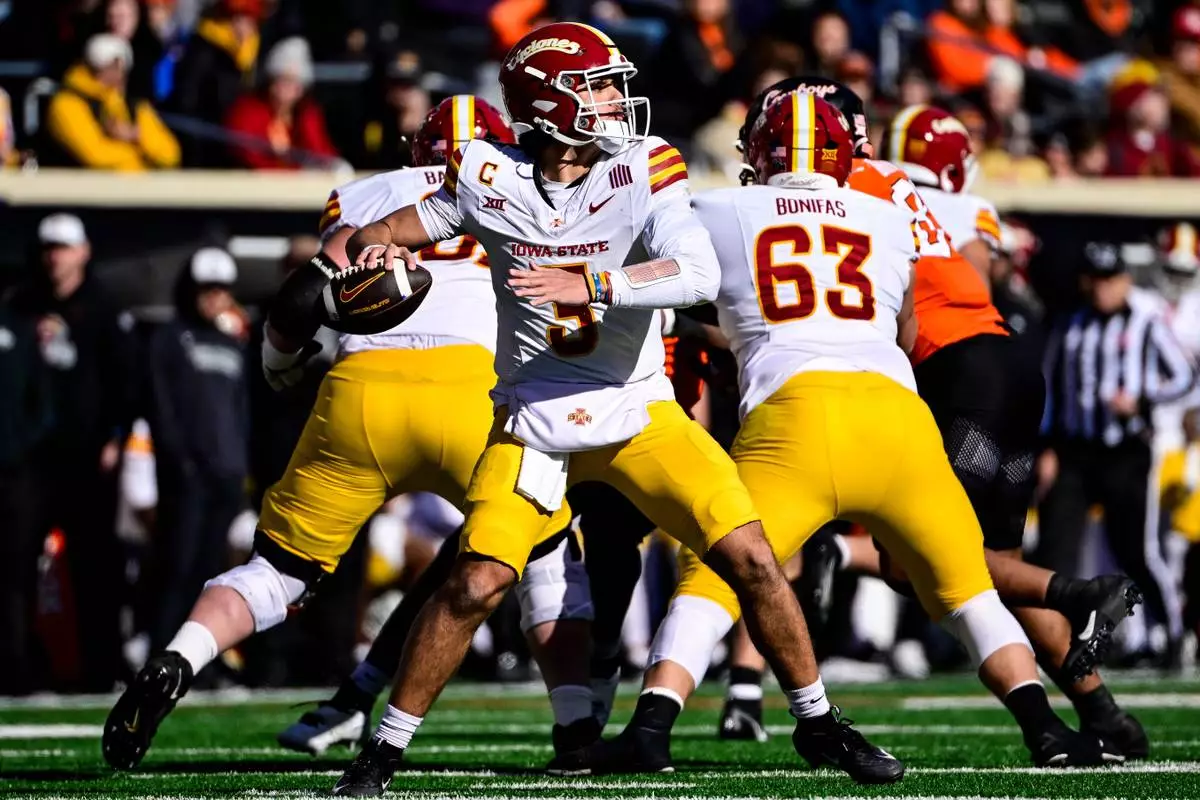
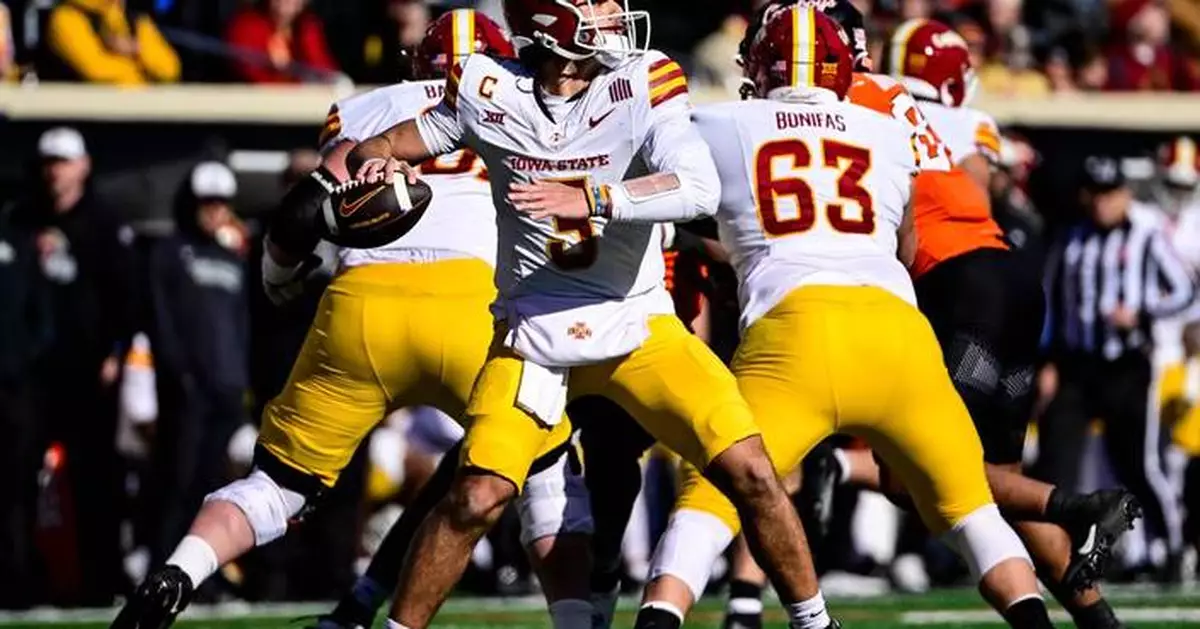
Iowa State quarterback Rocco Becht (3) looks to pass against the Oklahoma State during the second half of an NCAA college football game, Saturday, Nov. 29, 2025, in Stillwater, Okla. (AP Photo/Gerald Leong)
WASHINGTON (AP) — President Donald Trump on Tuesday said that “someone from within” the Iranian regime might be the best choice to take power once the U.S.-Israel military campaign is completed — but said “most of the people we had in mind are dead.”
The president, who four days ago had emphatically called on Iranians to “take over your government” once the U.S.-Israel bombardment ends, appeared to drift further away from the idea that the war presents an opportunity to end the theocratic rule that has been in place since the country's 1979 Islamic revolution.
Trump said that many Iranian officials his administration had viewed as potential new leaders for the country had been killed in the U.S.-Israeli campaign that killed Iranian Supreme Leader Ali Khamenei and many other top officials.
Trump has not publicly identified anyone whom he views as a credible future leader for Iran. And it’s unclear what, if any, outreach the White House had with Iranian officials since the war started.
“Most of the people we had in mind are dead,” he said in an exchange with reporters in the Oval Office. “Now we have another group, they may be dead also, based on reports. So you have a third wave coming. Pretty soon we’re not going to know anybody.”
Trump said Reza Pahlavi, the exiled crown prince of Iran’s last shah who is trying to position himself for a return should Iran’s Shiite theocracy fall, is not someone that his administration has considered in depth to take over leadership in Iran.
“It would seem to me that somebody from within maybe would be more appropriate,” Trump said, adding that it may make sense for “somebody that’s there, that’s currently popular, if there is such a person” to emerge from the power vacuum.
Trump's comments came as he hosted German Chancellor Friedrich Merz for his first in-person engagement with a foreign leader since the U.S. and Israel launched the war against Iran.
Trump said he wanted to avoid a “worst case” scenario where “somebody takes over who’s as bad as the previous person.”
“That could happen. We don’t want that to happen,” Trump added. “You go through this, and then in five years you realize you put somebody in who was no better.”
The White House has stepped up its push to counter criticism that it moved unnecessarily quickly to launch a war of choice against Iran.
Trump’s decision to strike last week followed lengthy negotiations by the president’s envoy Steve Witkoff and son-in-law Jared Kushner with the Iranians — talks the U.S. increasingly viewed as an effort to stall any progress.
After the most recent round of discussions in Geneva, Switzerland, last week, Witkoff and Kushner told Trump that reaching a nuclear agreement similar to one that former President Barack Obama struck in 2015 was possible, according to a senior administration official.
The official, who briefed journalists on condition of anonymity, described it as a potential “Obama-plus deal” and Witkoff and Kushner believed such an agreement would take months, but was possible.
Still, even as they expressed their willingness to pursue diplomacy and “fight for every point that we can” if that’s what Trump wanted, the negotiators stressed to the president that the Iranians were not willing to make a deal that would be satisfactory to the U.S.
Meanwhile, Trump sharply criticized British Prime Minister Keir Starmer on Tuesday for Britain's reluctance to join the U.S.-Israeli strikes on Iran.
“This is not Winston Churchill that we’re dealing with,” Trump said, blasting Britain’s reluctance to let U.S. warplanes use its bases.
Starmer had initially blocked American planes from using British bases for the attacks on Iran that started on Saturday. He later agreed to let the United States use bases in England and on Diego Garcia in the Indian Ocean to strike Iran’s ballistic missiles and their storage sites, but not to hit other targets.
The president also sought to push back on criticism from some of his staunchest allies over the decision to go to war — questions that grew louder after Secretary of State Marco Rubio said on Monday that the U.S. had decided to strike because “we knew that there was going to be an Israeli action.”
“And we knew that if we didn’t preemptively go after them before they launched those attacks, we would suffer higher casualties,” Rubio said.
But Trump rejected the notion that the White House had been dragged into the conflict by Israel. “We were having negotiations with these lunatics, and it was my opinion that they were going to attack,” Trump said. “If anything, I might have forced Israel’s hand.”
Merz said during his visit with Trump at the Oval Office that Germany is “looking forward to the day after” the Iran war is over.
He said Berlin wants to work with the U.S. on a strategy for when the current Iranian government no longer exists.
“We are having a high interest in common approach and common work and what we can do,” Merz said. “And this is this is important not just for the Americans,” he said. “This is extremely important for Europe and extremely important for Israel and their security.”
Merz also noted surging oil prices were damaging the world economy, laying down an argument for finding a quick endgame to the conflict.
The president acknowledged that oil and gas prices were going to rise as the U.S. remains engaged in the strikes — yet argued it would be fleeting.
“We have a little high oil prices for a little while, but as soon as this ends, those prices are going to drop, I believe, lower than even before,” Trump said.
The average price for a gallon of gasoline in the U.S. jumped 11 cents overnight Tuesday to about $3.11 in the United States, according to the AAA.
AP writers Kirsten Grieshaber in Berlin, Fatima Hussein and Michelle L. Price in Washington, and Jill Lawless in London contributed reporting.
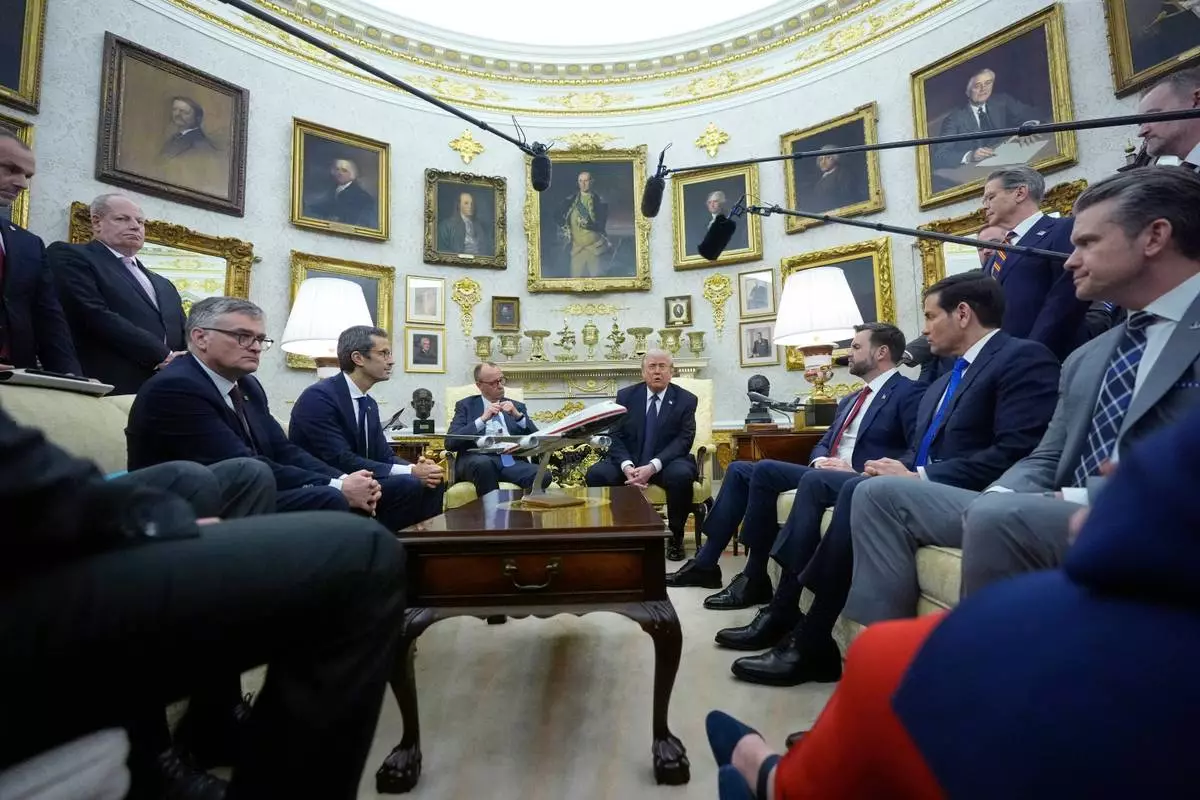
President Donald Trump meets with German Chancellor Friedrich Merz in the Oval Office at the White House, Tuesday, March 3, 2026, in Washington. (AP Photo/Mark Schiefelbein)
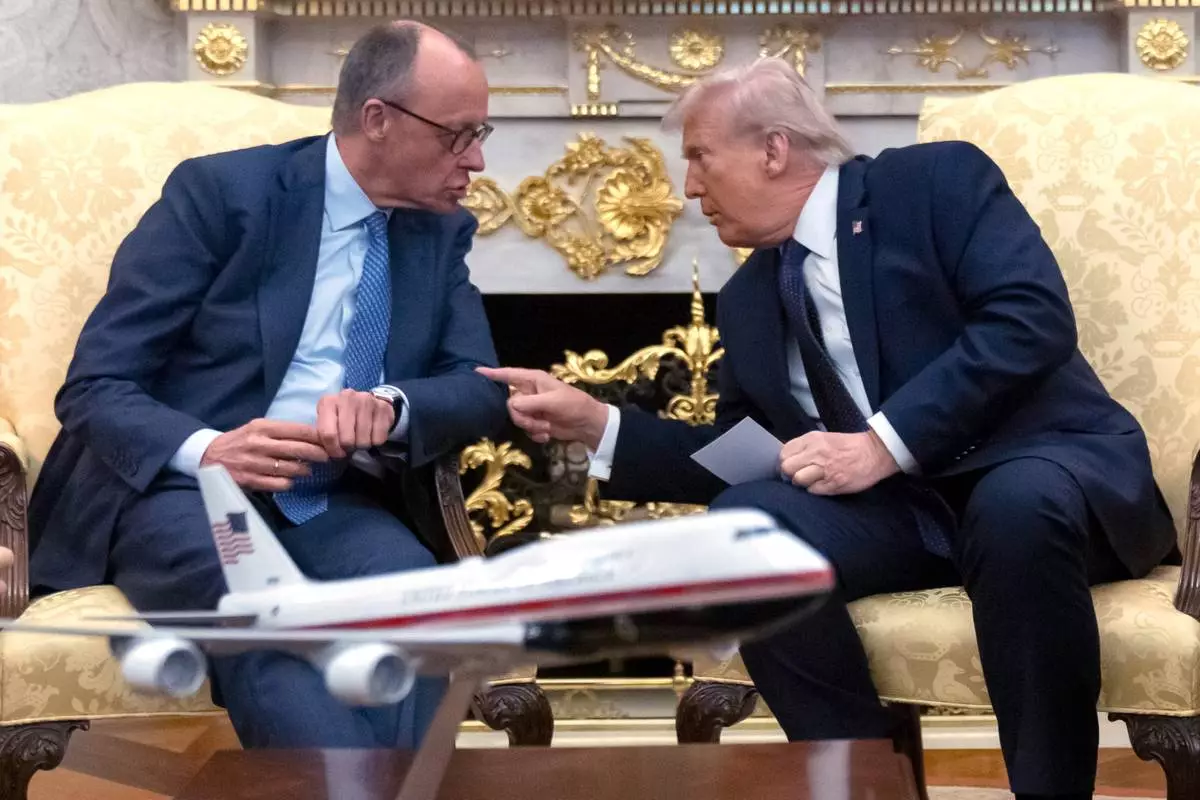
President Donald Trump, right, talks with German Chancellor Friedrich Merz during a meeting in the Oval Office at the White House, Tuesday, March 3, 2026, in Washington. (AP Photo/Mark Schiefelbein)
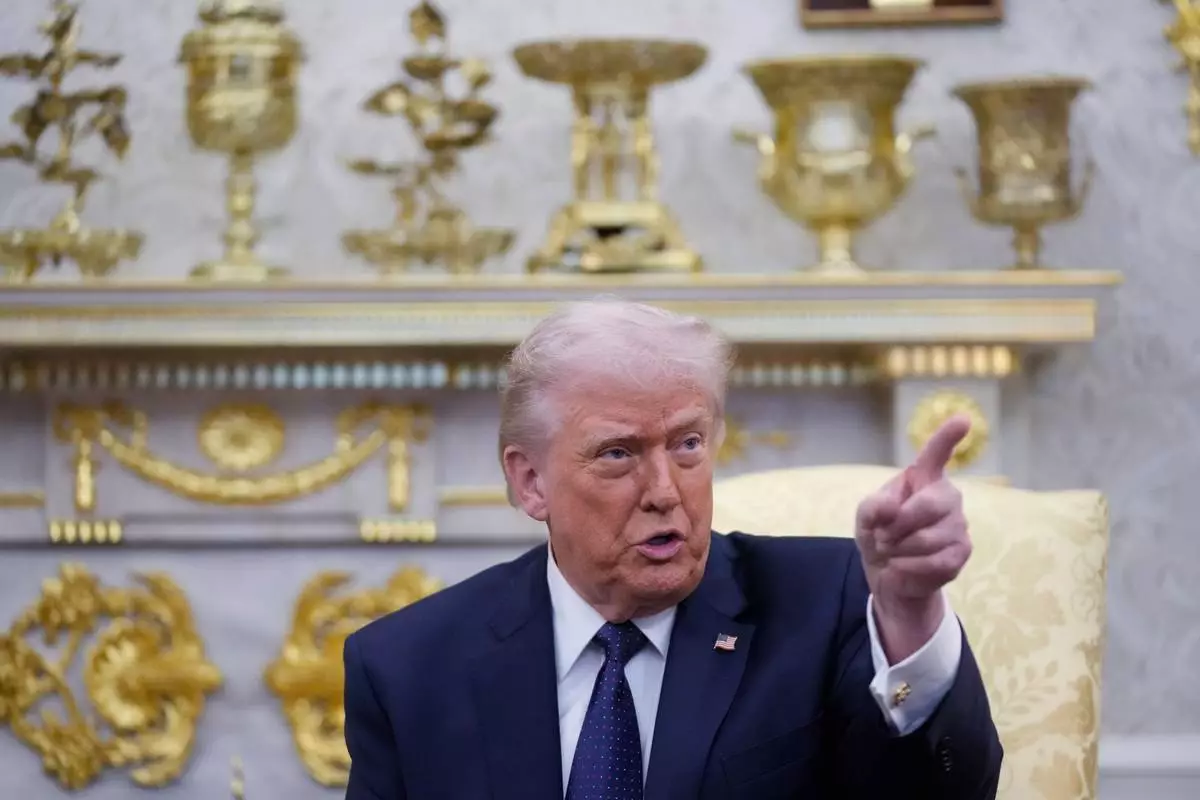
President Donald Trump speaks during a meeting with German Chancellor Friedrich Merz in the Oval Office at the White House, Tuesday, March 3, 2026, in Washington. (AP Photo/Mark Schiefelbein)