VANCOUVER, British Columbia--(BUSINESS WIRE)--Dec 8, 2025--
This press release features multimedia. View the full release here: https://www.businesswire.com/news/home/20251208945150/en/
Spanish Mountain Gold Drills Extensive Mineralization Over 140.67 metres Grading 0.68 g/t Including 1.07 g/t Over 17.00 metres and 0.95 g/t Over 67.31 metres and Extends the Orca Fault Target Trend 130 m to Southeast Drilling 26.46 metres Grading 0.80 g/t Gold
Spanish Mountain Gold Ltd. (the " Company " or " Spanish Mountain Gold ") (TSX-V: SPA) (FSE: S3Y) (OTCQB: SPAUF) is pleased to provide additional assay results from exploration drill holes 25-DH-1300, 25-DH-1302, and 25-DH-1304 that were completed as part of its 2025 Fall Diamond Drill program (“ 2025 Fall Drill Program ”) for the Spanish Mountain Gold (“ SMG ”) project, which is located in the Cariboo Gold Corridor, British Columbia, Canada.
The company has completed approximately 7,800 m of drilling to date of the 9,000 to 10,000 metres (“ m ”) of exploration drilling planned under the 2025 Fall Drill Program. Assays and geochemistry are pending receipt from the laboratory and or reporting from sixteen (16) additional drill holes completed on the newly defined Orca Fault area, and from three (3) completed drill holes on the A12 target.
Highlights:
Key Findings:
Peter Mah, Spanish Mountain Gold’s President & CEO commented, “These most recent Orca Fault area drill results continue to extend new higher grade gold mineralization in the heart of the Main Deposit. Gold assays received from three new holes reported intersecting large, near surface gold mineralization above the global average resource grade. Additionally, assays included multiple near surface high-grade intersections in each hole approaching and exceeding 1 g/t gold. The company is pleased with the consistency and growing number of above 1 g/t gold assays that further demonstrate the potential for growth through new high-grade gold mineralization within the Main Deposit. This coupled with ore sorting defines the Company’s twofold strategy to scale up gold production at its proposed mining operation in the Tier 1 Cariboo Gold Corridor, British Columbia, Canada.”
Main Deposit – Orca Fault area
Drill hole 25-DH-1300 (see Table 1) was designed to not only confirm the new Orca Fault target but also to start building stronger continuity northeast to southwest across section lines to increase the overall confidence in the geological interpretation of this important area (Figure 2). The drill hole intersected higher-grade mineralization approximately 36 m northeast of drill hole 25-DH-1299 (see December 1, 2025 news release) intersecting 140.67 m of 0.68 g/t gold including two high-grade intervals of 17.00 m of 1.07 g/t gold and 67.31 m of 0.95 g/t gold with a subset of 12.78 m of 2.85 g/t gold. It should be noted that this intercept aligns closely to the intersections in 25-DH-1299, which had a first interval near surface from 48.18 to 188.00 m of 0.82 g/t gold over 139.82 m and a second near the base of constraining open pit shell for the 2025 Mineral Resource Estimate (see July 3, 2025 news release) from 284.00 to 329.54 m, grading 1.67 g/t gold over 45.54 m, including 33.54 m of 2.19 g/t gold. The deeper intercept in 25-DH-1299 highlights the mineral potential at depth that will require additional drilling to further delineate, but investors should be cautioned it is not guaranteed that additional drilling will result in conversion of this area into the mineral resource estimate.
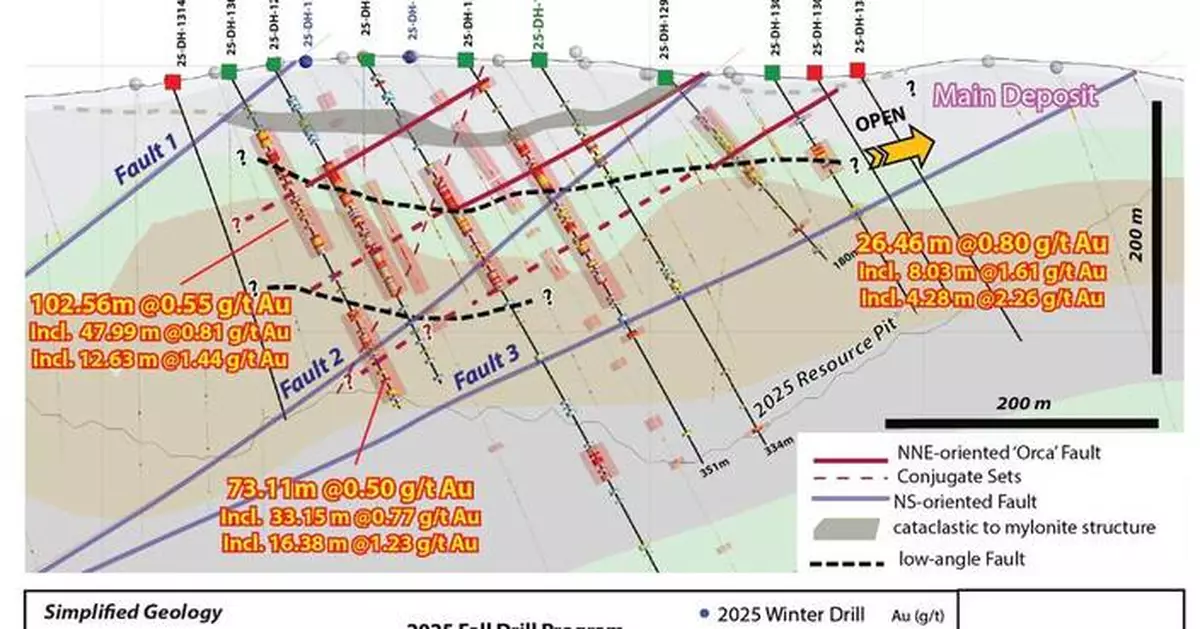
Drill hole 25-DH-1302 (Table 2) was designed to examine a critical area along the northwest trend of the new Orca Fault target at edge of the block model from the last mineral resource estimate (“MRE”) in the recent Preliminary Economic Assessment (see July 3, 2025 news release). The drill hole was collared 33 m northeast of 25-DH-1292 (Figure 3) and it intersected two key intervals of higher-grade mineralization (Figure 1), the first interval from 49.64 to 152.20 m, 102.56 m of 0.55 g/t gold including 47.99 m of 0.81 g/t gold with a higher-grade subset of 12.63 m of 1.44 g/t gold, and the second from 200.64 to 273.75 m, 73.11 m of 0.50 g/t gold including 33.15 m of 0.77 g/t gold with a higher-grade subset of 16.38 m of 1.23 g/t gold. These results compare very favorably with drill hole 25-DH-1292 (see November 3, 2025 news release) and extend gold mineralization to the northwest, highlighting the opportunity of systematically exploring these new structural trends both inside and outside of the MRE block model (Figure 1).
Drill hole 25-DH-1304 (Table 3), like 25-DH-1296 (see November 17, 2025 news release), it was designed to step into the structural domain between Fault 2 and Fault 3, looking to extend the high-grade gold mineralization to the southeast, where it is interpreted to be a southeasterly extension of the new Orca Fault target (Figure 1). This drill hole intersected 26.46 m of 0.80 g/t gold from 62.72 to 89.18 m, including 8.03 m of 1.61 g/t gold with a higher-grade subset of 4.28 m of 2.26 g/t gold (Figure 1) within the constraining open pit for the MRE (see July 3, 2025 news release). Although gold mineralization has been successfully hit historically in this area, it has not been through applying a systematic exploration approach using the preferred drilling orientation of 120-degrees that has proven successful in this work program.
The results from these three new exploration drill holes add significant confidence to the geological and structural interpretation of the new Orca Fault target area, when incorporating 25-DH-1281 and 25-DH-1282 (see April 21, 2025 news release), 25-DH-1292 and 25-DH-1293 (see November 3, 2025 news release), 25-DH-1294 and 25-DH-1296 (see November 17, 2025 news release), and 25-DH-1297, 25-DH-1298, and 25-DH-1299 (see December 1, 2025 news release). All these results continue to show that tighter exploration drill spacing at the preferred azimuth of 120-degrees is unlocking additional mineral potential in the Main deposit. These exploration drill holes are presented on a drill section (Figure 1 and Figure 2) that shows the alignment of the higher-grade mineralization to the new Orca Fault target.
Table 1: Assay Results for 25-DH-1300
Table 2: Assay Results for 25-DH-1302
Table 3: Assay Results for 25-DH-1304
The integration of assay results from 25-DH-1300, 25-DH-1302, and 25-DH-1304 with other recently released drill holes, strengthens the continuity for the new Orca Fault target and the association of higher-grade mineralization over a strike length of 430 m, northwest to southeast (see Figure 1 and Figure 2) now spanning two parallel, adjacent drill sections.
The current interpretation is that there is strong continuity between these section lines linking geology, structure and the higher-grade mineralization. The mineralization in these drill holes occurs in faults and quartz-dominated veins that appear to extend for more than 25 m beyond each drill hole. Two dominant sets of veins were identified, high-angle and low-angle. The lower-angle veins (~45 degrees) occur in proximity to the Orca Fault (see November 3, 2025 news releases).
Figure 3 illustrates the locations for three drill hole results outlined in this news release and the drill holes currently in the assay lab, or in process of being drilled. Drill collar location coordinates are summarized for the 2025 Fall Drill Program in Table 4 at the end of this news release.
Abbreviations: metres = m, grams per tonne = g/t, gold = Au, mineral resource estimate = MRE, Spanish Mountain Gold = SMG
Drill Core Processing, Data Verification and Quality Assurance – Quality Control Program (QAQC)
Once received from the drill and processed, all drill core samples were sawn in half, labeled, and bagged. The remaining half of the drill core was securely stored on-site. Numbered security tags were applied to sample shipments to ensure chain of custody compliance. The Company inserts quality control (QC) samples at regular intervals, including blanks and reference materials, for all sample shipments to monitor laboratory performance. Standards and blanks account for a minimum of 20% of the samples in addition to the laboratory’s internal quality assurance programs. The QAQC program was overseen by the Company’s Qualified Person, Julian Manco, P.Geo, Director of Exploration (as described below).
The data verification process involved a multi-step approach to ensure accuracy and integrity. This included a detailed quality control (QC) analysis of the data, which was performed using both internal and external platforms, such as the MxDeposit ™ software. These QC checks involved the analysis of certified reference materials (CRMs), blanks, and duplicates to confirm the reliability of the assay results. In addition, a field inspection of the specific drill intervals mentioned in this release has been conducted to directly observe the geological features and verified the nature of the results presented.
Drill core samples were submitted to MSALABS’s analytical facility in Prince George, British Columbia, for sample preparation and PhotonAssay ™ analysis. The MSALABS facilities are accredited to the International Standards ISO/IEC 17025 and ISO 9001 standard for gold and multi-element assays, with all analytical methods incorporating quality control materials at defined frequencies and established data acceptance criteria. MSALABS Inc. is independent of the Company.
PhotonAssay™
The PhotonAssay ™ method utilizes gamma ray analysis for gold detection using the Chrysos PhotonAssay ™ instrument (PA1408X). This non-destructive, fully automated technique offers high accuracy for analyzing ores and pulps. Sample preparation begins with drying and crushing up to 1 kg of material to achieve at least 70% passing through a 2-millimetre (mm) sieve. The sample is then riffle split to obtain a suitable aliquot for 2 testing cycles (MSALABS Method CPA-Au1).
The PhotonAssay ™ instrument bombards 400- to 600-gram samples contained in sealed containers with gamma rays. These containers remain sealed throughout the process, preserving the sample for potential further testing. The analysis is performed robotically, with results that integrate into existing laboratory management systems. Each sample is accompanied by a reference disc traceable to a Certified Reference Material (CRM). Both the sample and reference disc undergo gamma ray exposure, with signals detected and analyzed to ensure accurate and reliable results. The method offers a gold detection range from 0.015 parts per million (ppm - lower limit) to 10,000 ppm (upper limit). Quality control includes the use of reference materials and blanks, with all results reviewed by a competent person before reporting.
Spanish Mountain Gold implemented two QAQC methodologies to validate the accuracy of PhotonAssay ™ results, both demonstrating good comparability: 1) comparative analysis of diverse mineralization styles using Total Au screen metallic methods with both FAS-415 (gravimetric finish) and FAS-211 (AAS finish), and 2) comprehensive testing of both sample aliquots and rejects using FAS-211 (AAS finish). QAQC Testing typically can include the following spot checks: 1) Pulverizing tests to evaluate variability in sample preparation, 2) Cross-analysis at external laboratories using screen metallic method, and 3) Four-cycle radiation testing to identify and calibrate potential variability in gold results with variable radiation intensity.
Multi-Elemental Analysis
For the 2025 drilling campaign Spanish Mountain Gold used IMS-230 method to provide multi-element determination using a four-acid digestion followed by ICP-OES and ICP-MS analysis.
Key Process Steps:
Sample Preparation: Samples are dried and ground to a specific criterion (85% passing 75 microns (μm) for rocks and drill core; 180μm for soils and sediments). A homogeneous 10-gram sample is required. Digestion: Samples undergo sequential digestion with nitric, perchloric, hydrofluoric, and hydrochloric acids, followed by dilution with deionized water.
Analysis: The solution is analyzed via ICP-OES and ICP-MS for multi-element quantification. Quality Control: The process includes reference materials, blanks, and duplicates, with corrections for spectral interferences and thorough review before final reporting.
Qualified Person
Julian Manco, M.Sc., P.Geo., Director of Exploration with Spanish Mountain Gold, is the Qualified Person as defined under National Instrument 43-101 who has reviewed the technical information in this news release and has approved the content for dissemination.
About Spanish Mountain Gold Ltd.
Spanish Mountain Gold Ltd. is focused on advancing its 100%-owned Spanish Mountain Gold Project (Project) towards construction of the next gold mine in the Cariboo Gold Corridor, British Columbia. On August 18, 2025, the Company filed an NI 43-101 Technical Report on SEDAR+ that sets out the Project’s de-risked and optimized Preliminary Economic Assessment (PEA), with an updated Mineral Resource Estimate (MRE). We will continue to advance the Project to position the Company to make a construction decision in 2027. We are striving to be a leader in community and Indigenous relations by leveraging technology and innovation to build the 'greenest' gold mine in Canada. The Relentless Pursuit for Better Gold means seeking new ways to achieve optimal financial outcomes that are safer, minimize environmental impact and create meaningful sustainability for communities. Details on the Company are available on www.sedarplus.ca and on the Company's website: www.spanishmountaingold.com.
On Behalf of the Board,
“Peter Mah”
President, Chief Executive Officer and Director
Spanish Mountain Gold Ltd.
Neither the TSX Venture Exchange nor its Regulation Services Provider (as that term is defined in the policies of the TSX Venture Exchange) accepts responsibility for the adequacy or accuracy of this release.
FORWARD-LOOKING INFORMATION:
Certain of the statements and information in this press release constitute "forward-looking information". Any statements or information that express or involve discussions with respect to predictions, expectations, beliefs, plans, projections, objectives, assumptions or future events or performance (often, but not always, using words or phrases such as "expects", "anticipates", "believes", "plans", "estimates", "intends", "targets", "goals", "forecasts", "objectives", "potential" or variations thereof or stating that certain actions, events or results "may", "could", "would", "might" or "will" be taken, occur or be achieved, or the negative of any of these terms and similar expressions) are not statements of historical fact and may be considered forward-looking information. The Company's forward-looking information is based on the assumptions, beliefs, expectations and opinions of management as of the date of this press release and include but are not limited to information with respect to, the potential for adding more higher-grade gold mineralization within the pit or below current pit design; and the timing and size (m) of the 2025 Fall Drill Program, and the results thereof. Other than as required by applicable securities laws, the Company does not assume any obligation to update forward-looking information if circumstances or management's assumptions, beliefs, expectations or opinions should change, or changes in any other events affecting such statements or information. For the reasons set forth above, investors should not place undue reliance on forward-looking information.
Table 4: Drill Collar Information for Drill Holes

Figure 3: Drill Collar Location Map for 2025 Fall Drill Program

Figure 2: Drill Cross Section Through Orca Fault Area (looking northwest); section line B-B’ (see Figure 3)

Figure 1: Drill Long Section Through Orca Fault Area (looking northeast); section line A-A’ (see Figure 3)
As the war in the Middle East intensifies, U.S. President Donald Trump said that the U.S. has “the capability to go far longer" than its projected four-to-five-week time frame for its military operations against Iran.
Across Tehran, the sound of explosions rang out through the night and into the early morning hours Tuesday, as the U.S. and Israel have continued to pound Iran since killing its Supreme Leader Ayatollah Ali Khamenei on Saturday.
Tehran and its allies have hit back against Israel, neighboring Gulf states, and targets critical to the world’s production of oil and natural gas.
The intensity of the attacks and the lack of any apparent exit plan set the stage for a prolonged conflict with far-reaching consequences. Israel and the U.S. have given conflicting answers about what exactly the war’s objectives are or what the endgame might be.
Israeli Prime Minister Benjamin Netanyahu late Monday defended the decision to go to war, contending in an interview on Fox News Channel’s "Hannity" that Iran was rebuilding “new sites, new places” that would make “their ballistic missile program and their atomic bomb program immune within months,” without providing evidence.
Satellite photos analyzed by The Associated Press showed limited activity at two nuclear sites in Iran before the war, with analysts saying it was likely Tehran was trying to assess damage from American strikes in June and possibly salvage what remained there.
Here is the latest:
The Kremlin said Tuesday that Russian President Vladimir Putin will convey the Gulf leaders’ concern over the Iranian strikes on their territory to Iran.
Kremlin spokesman Dmitry Peskov told reporters that Putin will “make every effort to facilitate at least minor easing of tension.”
He noted that after Monday’s calls with the leaders of the United Arab Emirates, Qatar, Bahrain and Saudi Arabia, Putin will convey their “deep concern about the strikes on their infrastructure” to Tehran.
A senior Hezbollah official says that after more than a year of abiding by the ceasefire as Israel’s strikes continued on Lebanon, the group’s patience has ended, leaving it with no option “but to return to resistance” and fight an open war with Israel.
Mohamoud Komati said Tuesday that Hezbollah exercised patience since a ceasefire ended the Israel-Hezbollah war in November 2024, hoping the government’s diplomatic efforts would yield positive results in ending Israeli strikes.
In the comments released by Hezbollah’s media office, Komati blasted the Lebanese government for calling Hezbollah’s actions illegal and demanded it hand over its weapons, saying it did not act to stop Israel’s airstrikes that continued on almost daily basis for nearly 15 months.
“The Zionist enemy wanted an open war, which it has not stopped since the ceasefire agreement,” Komati said. “So let it be an open war.”
Saudi Arabia has condemned in the strongest terms Iran’s drone strike that hit the U.S. embassy in the Saudi capital, Riyadh.
“The brutal Iranian behavior … will push the region into further escalation,” the Saudi Foreign Ministry said in a statement, which reiterated the nation’s right to protect Saudi territories and interests, including “the option of responding to the aggression.”
The Saudi Defense Ministry said the U.S. embassy came under attack from two drones early Tuesday.
Footage aired by the Saudi-owned satellite news channel Al Arabiya showed fire damage on one part of the roof of U.S. Embassy in Riyadh after the drone attack.
Sirens sounded in Bahrain on Tuesday afternoon as a new Iranian attack was expected.
China, a major importer of oil and natural gas from the Mideast, has called on all sides to stop the fighting and ensure ships can pass safely through the Strait of Hormuz.
Iran has attacked several ships in the the narrow strait through which a fifth of all oil traded passes, sending oil and gas prices soaring.
“China urges all parties to immediately cease military operations, avoid escalating tensions, safeguard the safety of shipping lanes in the Strait of Hormuz and prevent greater impacts on the global economy,” Chinese Foreign Ministry spokesperson Mao Ning said in Beijing.
The Israeli military said Tuesday it has struck Iran’s presidential office and the building of the country’s Supreme National Security Council.
It said the airstrikes happened overnight.
“In addition, the gathering site of the regime’s most senior forum responsible for security decision-making was targeted, as well as the institution for training Iranian military officers and additional key regime infrastructure,” it added.
Iran did not immediately acknowledge the strikes.
The United Nations’ nuclear watchdog said Tuesday that Iran’s Natanz nuclear enrichment site sustained “some recent damage” during a U.S.-Israeli airstrike campaign, though it said there was “no radiological consequence expected” from it.
The International Atomic Energy Agency said the damage was focused on “entrance buildings” to the underground portion of the atomic site.
Natanz earlier came under attack by the U.S. in the 12-day Iran-Israel war in June.
The IAEA said it saw “no additional impact” detected at Natanz’s fuel enrichment plant, which is buried underground.
Nuclear material is still believed to be buried at the plant alongside damaged and destroyed centrifuges. However, the IAEA has not been allowed to visit any of the attacked sites by Iran since that war.
Airstrikes by the United States and Israel have killed at least 787 people in Iran since the start of the war, the Iranian Red Crescent Society said Tuesday.
The organization offered the toll in a message on X.
Israel’s military said Iran launched missiles at the country and it was working to intercept them.
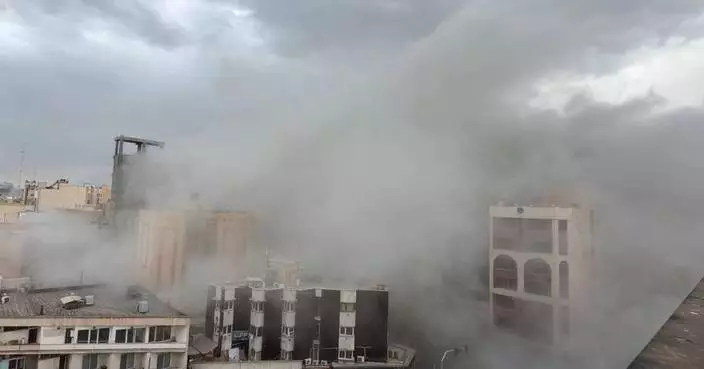
The Israeli military struck a building in a southern suburb of Beirut housing Hebzollah’s TV and radio station, causing heavy damage.
The strike after midnight Monday came after a warning by the Israeli military to evacuate the building. Hezbollah’s Al-Manar TV was interrupted for about an hour before the station resumed its programs.
During the 2006 Israel-Hezbollah war, Al-Manar TV and al-Nour Radio station were both struck but continued broadcasts from secret locations.
Cypriot officials say France will dispatch a warship to Cyprus to help bolster the country’s anti-drone defenses after a Rashed drone struck a British military base on the east Mediterranean island.
France also will send additional land-based, anti-drone and anti-missile systems to the country, officials confirmed Tuesday.
Germany also responded positively to a request to send a warship, according to three officials who spoke on condition of anonymity because they were not permitted to provide details publicly.
The equipment will arrive in Cyprus as soon as possible, they said
The French military did not respond immediately to a request for information from The Associated Press.
The drone struck the British base, RAF Akrotiri, shortly after midnight Monday and caused only minor material damage to an aircraft hangar. Another two drones were intercepted by British warplanes around midday Monday after they were scrambled from the air base, officials said.
Greece has sent four F-16 fighter jets to Cyprus while two of its state-of-the-art frigates are on their way.
A fire broke out in an oil industrial facility Fujairah, one of the seven emirates of the United Arab Emirates, as forces intercepted a drone attack, authorities said.
No casualties were reported.
The government media office in Fujairah said the drone was intercepted and that shrapnel landed in the Fujairah Oil Industry Zone.
The office said the fire was put down and operations resumed.
At least five people were killed or wounded in airstrikes in Iran’s western city of Hamadan, the state-run IRNA news agency reported.
Strikes also were reported across other cities, including Isfahan and Shiraz.
Lebanon’s state-run National News Agency said the Lebanese army is evacuating some of its positions along the border with Israel.
The agency said the troops are redeploying to other posts.
The report comes after Israel’s military said it is conducting operations inside Lebanon along the border with Israel.
Israel’s army said Tuesday that Iran’s firepower has been weakened.
Army spokesman Lt. Col. Nadav Shoshani said Israeli and U.S. attacks on Iran have “limited significantly” Iran’s ability to fire.
Shoshani said Israel has been going after Iran’s missile launchers and have taken out dozens of them.
Iran has fired hundreds of missiles but it’s hard to tally the total amount with Iran also striking other countries, he said.
The pace of missiles being launched at Israel has slowed since the first two days of the war.
Shoshani said the slowdown also could be partly attributed to Iran understanding the war could go on for longer than they had thought and they are trying to pace themselves.
Iran has started the process of returning Iranian pilgrims from the shrine cities of Mecca and Medina, state media said Tuesday.
Alireza Enayati, Iran’s ambassador to Saudi Arabia, said the process of returning 9,000 Iranians currently in the cities of Mecca and Medina began Monday.
In a report carried by the Iranian judiciary’s Mizan news agency, Enayati said the departure is taking place in the same manner as during the 12-day war between Israel and Iran in 2025. Iranian pilgrims will leave Saudi Arabia through Saudi–Iraqi border crossings and return to Iran from Iraq.
The announcement came during the Muslim holy month of Ramada and a widening that has seen Iran target sites in Saudi Arabia.
The U.S. ambassador in Israel told Americans there that the best way to leave is through Egypt’s Sinai Peninsula.
Mike Huckabee said in a social media post early Tuesday that the embassy was receiving lots of evacuations requests as embassy staff “are sheltering in place.”
“There are VERY LIMITED options,” he wrote. “Not sure when Ben Gurion Airport in Tel Aviv will reopen.”
He advised Americans to take buses to Egypt’s resorts of Sharm el-Sheikh and Taba in southern Sinai, describing that route as “best.”
The U.S. State Department evacuations of non-emergency personnel and family reached six nations on Tuesday with the inclusion of the United Arab Emirates.
The UAE, home to Dubai and Abu Dhabi and long considered a safe corner of the Middle East, has been dragged into the Iran war with interceptions and attacks.
The other countries include Bahrain, Iraq, Jordan. Kuwait and Qatar.
The U.S. Embassy in Abu Dhabi also warned there could be militant attacks in the UAE as well.
“Terrorists may attack with little or no warning and may target tourist locations, transportation hubs, shopping areas, government facilities, places of worship, and in particular locations associated with the Jewish and Israeli communities,” it added.
A camp for Iranian Kurdish opposition in the semiautonomous region of Kurdistan in northern Iraq was attacked Tuesday morning, an official said.
A missile and drone hit the Azadi camp in Irbil and slightly injured one person, according to Kareem Parwizi, a senior official with the Kurdistan Democratic Party of Iran.
Oman said a drone hit a fuel tank at its port in Duqm on Tuesday.
The state-run Oman News Agency said no one was hurt in the attack.
Duqm has been a key resupply route for the USS Abraham Lincoln aircraft carrier, which is operating in the Arabian Sea.
The Israeli military says one of its divisions is operating inside southern Lebnaon and took positions on several strategic points close to the border.
The Arabic language spokesperson of the Israeli military posted on X that the troops’ move inside Lebanon is part of its efforts to bolster the forward defense system and create an addition layer of security.
The military said that at the same time the air force is conducting strikes against Hezbollah infrastructure in the area to thwart threats and prevent infiltration attempts into Israel.
The Israeli operations inside Lebanon came after a long night of airstrikes on southern Lebanon and Beirut’s southern suburbs.
The Israeli military says there are no immediate plans to deploy ground troops in Iran.
Asked about the possibility of sending in ground forces, spokesman Lt. Col. Nadav Shoshani told reporters it is “not very likely.”
Thailand is intensifying security around the U.S., Israeli and Iranian embassies as the conflict in the Middle East intensifies.
Public broadcaster Thai PBS quoted the head of the National Security Council, Chatchai Bangchua, describing the additional measures as he said authorities would also monitor sites linked to the countries.
Thailand depends heavily on tourism and is one of Asia’s most-visited countries, attracting more than 32 million foreigners last year. It is a popular destination for Americans, Israelis and citizens of Gulf countries and before recent airspace closures received dozens of direct flights from the Middle East each week.
The Israeli military says soldiers are “operating in southern Lebanon’ as it continues strikes against Hezbollah.
In a statement, it said the troops are positioned at a several points near the border in what it described as a “forward defense posture” as it battles Hezbollah militants.
It says the deployment is part of a broader effort to increase security for residents in northern Israel near the border with Lebanon. It has also beefed up troops and air defenses in the area.
The army says there are no plans to evacuate Israeli residents of border areas.
Israel has been occupying five positions in southern Lebanon since a November 2024 ceasefire ended more than a year of fighting with Hezbollah. Lt. Col. Nadav Shoshani says the new deployment is in addition to those five positions, with the aim of preventing attacks on Israeli border towns.
The U.S. State Department added Kuwait and Qatar to the evacuation list from its Mideast diplomatic outposts.
The U.S. Embassy in Kuwait is shutting down as the Middle East is grabbed in a widening war.
The embassy said in a social media post Tuesday that it is closing “until further notice” due to the war.
Iran on Tuesday held a mass funeral ceremony for 165 people killed in what it described as an attack on a girls’ school in the southern city of Minab.
Iranian state television showed thousands of people filling a public square. Men waved the Islamic Republic flag while largely standing apart from women draped in black chadors.
From the stage, a women who said she was the mother of “Atena” held up a printed image of portraits that she called “a document of American crimes.” She added, “They died in the way of God.”
The crowd erupted into chants of “Death to America,” “Death to Israel” and “No surrender.”
U.S. Central Command spokesperson Capt. Tim Hawkins said he was aware of reports that a girls’ school was struck and officials were looking into them.
An Israeli military spokesperson said Sunday he was not aware of any Israeli or U.S. strikes in the area.
Qatar Airways said it would remain grounded Tuesday over the war.
Amazon said Monday that two of its data centers in United Arab Emirates were hit by drones, while a drone strike near one of its facilities in Bahrain “caused physical impacts to our infrastructure.”
The tech giant said on its website that the strikes have caused structural damage and gotten in the way of power getting to infrastructure. The company did not say who was responsible for the strikes.
“We are working to restore full service availability as quickly as possible, though we expect recovery to be prolonged given the nature of the physical damage involved,” Amazon said.
Iran is continuing to threaten shipping in the Strait of Hormuz, the narrow mouth of the Perisan Gulf through which a fifth of all oil traded passes.
Brig. Gen. Ebrahim Jabbari, an adviser to the paramilitary Revolutionary Guard, issued the threat on Iranian state television on Monday.
“The Strait of Hormuz is closed. Anyone who wants to pass, our devotee heroes in the IRGC navy and the army will set those ships on fire,” he said. “Don’t come to this region.”
The Israeli military said Tuesday it was conducting “simultaneous targeted strikes against military targets in Tehran and Beirut,” without elaborating.
The U.S. State Department said it added Iraq to the evacuation list from its Mideast diplomatic outposts.
The U.S. State Department on Tuesday ordered the evacuation of non-emergency personnel and family in Bahrain and Jordan.
The State Department announcement online said the decision came “due to safety risks.” The department has urged Americans across the Mideast to leave over the ongoing war with Iran.
The U.S. Embassy in Saudi Arabia acknowledged coming under attack from Iranian drones Tuesday and urged Americans to avoid the diplomatic post for the time being.
The Saudi Defense Ministry earlier Tuesday said the embassy was attacked by two drones.
Across Iran’s capital, the sound of explosions rang out throughout the night into the early morning hours.
Witnesses described hearing aircraft overhead as well.
It wasn’t immediately clear what had been hit.
Iranian state television early Tuesday read a statement from the country’s paramilitary Revolutionary Guard, saying that it launched a missile and drone attack targeting an air base in Bahrain.
Israeli airstrikes hit the Lebanese capital Tuesday morning.
The Israeli military said it was targeting “Hezbollah command centers and weapons storage facilities in Beirut.”
Hezbollah also said it launched drones targeting an Israeli air base.
The Israeli military said it downed two drones.
Tokyo has told Japanese shipowners to have their ships stay away from the Persian Gulf to ensure the safety of their crew members.
Chief Cabinet Secretary Minoru Kihara told reporters Tuesday that the Transport Ministry has notified the Japanese Shipowners’ Association to do the utmost to protect crews on board the ships in the region.
Kihara said those already in the Gulf are urged to lie at anchor where it is safe to do so.
On Monday, Japan’s Foreign Minister Toshimitsu Motegi met with Iranian ambassador to Japan Peiman Seadat and conveyed Japan’s consistent stance that Iran must stop attacks on neighboring countries and other actions destabilizing the region.
Motegi also noted the importance of ensuring safety in the Strait of Hormuz, which is key to Japan’s energy security.
Iran’s top diplomat early Tuesday sought to turn the tables on the United States, describing it as entering “a war of choice on behalf of Israel.”
After Trump urged Iranians to take over their government, Foreign Minister Abbas Araghchi made the same call to Americans.
“Shedding of both American and Iranian blood is thus on Israel Firsters,” Araghchi wrote on X. “American people deserve better and should take back their country.”
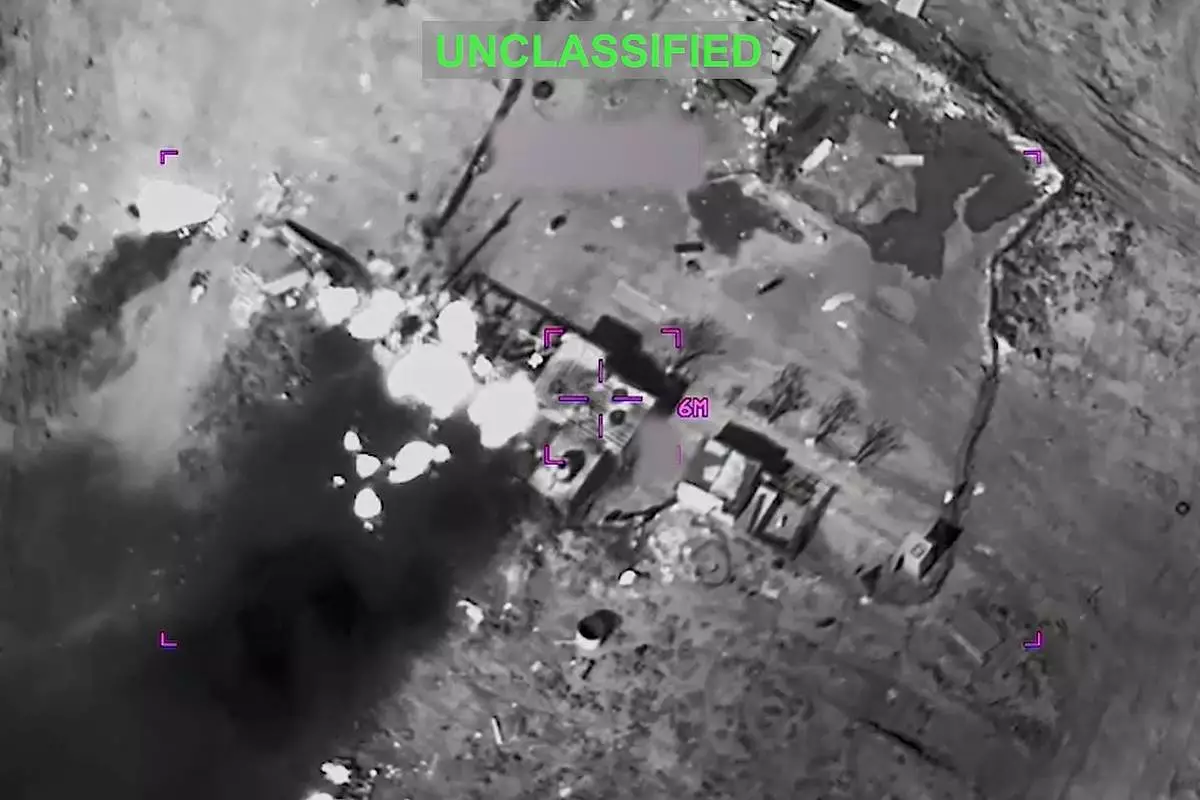
This partially redacted image from video provided by U.S. Central Command shows a complex of structures in Iran being struck by missiles fired by U.S. forces on Sunday, March 1, 2026. (U.S. Central Command via AP)

President Donald Trump walks past Defense Secretary Pete Hegseth as he exist the East Room of the White House following the Medal of Honor ceremony, Monday, March 2, 2026, in Washington. (AP Photo/Mark Schiefelbein)
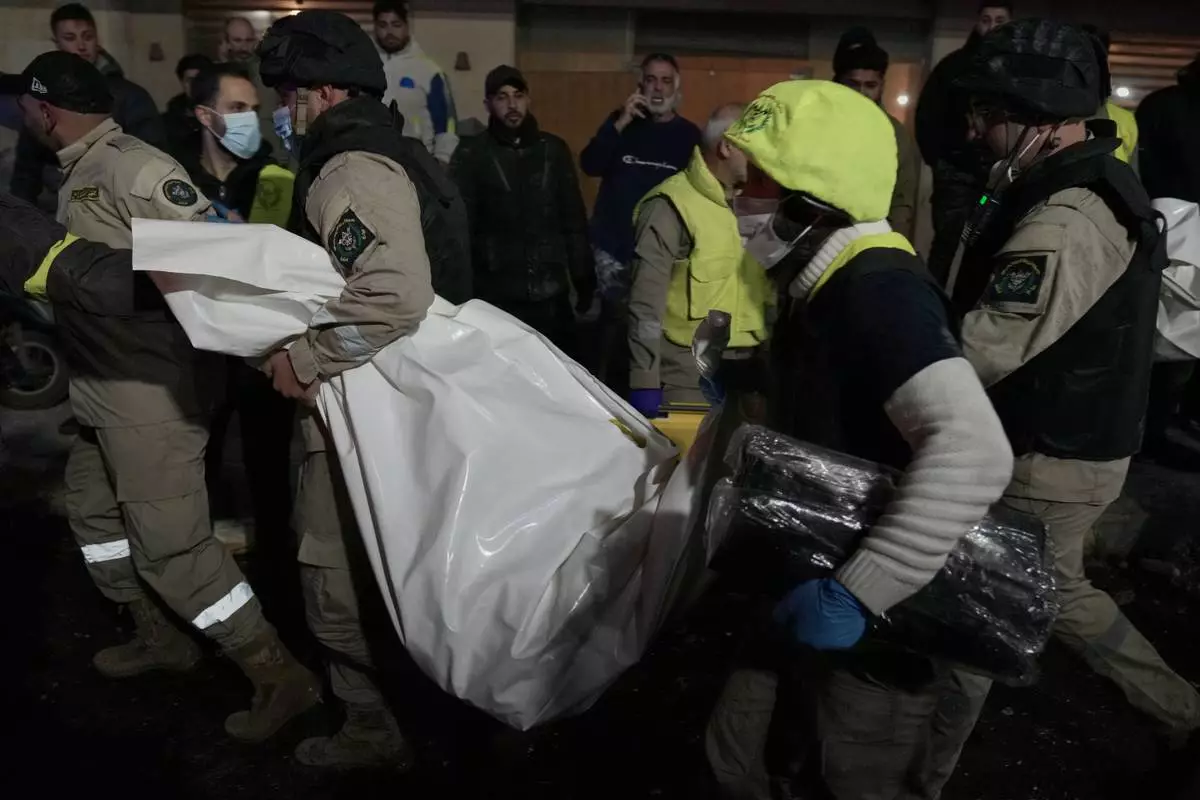
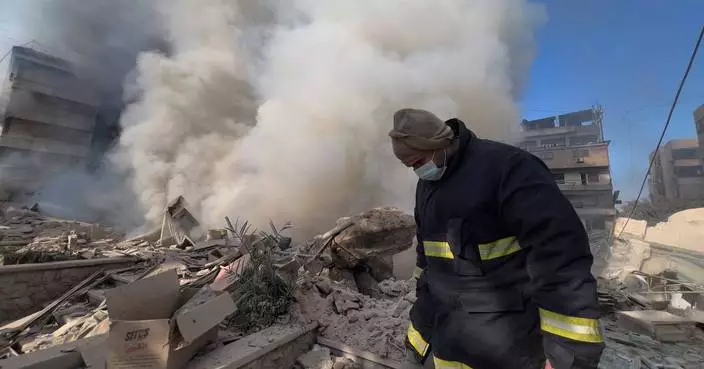
Rescue workers carry a dead body in a plastic bag from a building that was hit by Israeli strike, in Jnah neighborhood, south of Beirut, Lebanon, Monday, March 2, 2026. (AP Photo/Hussein Malla)
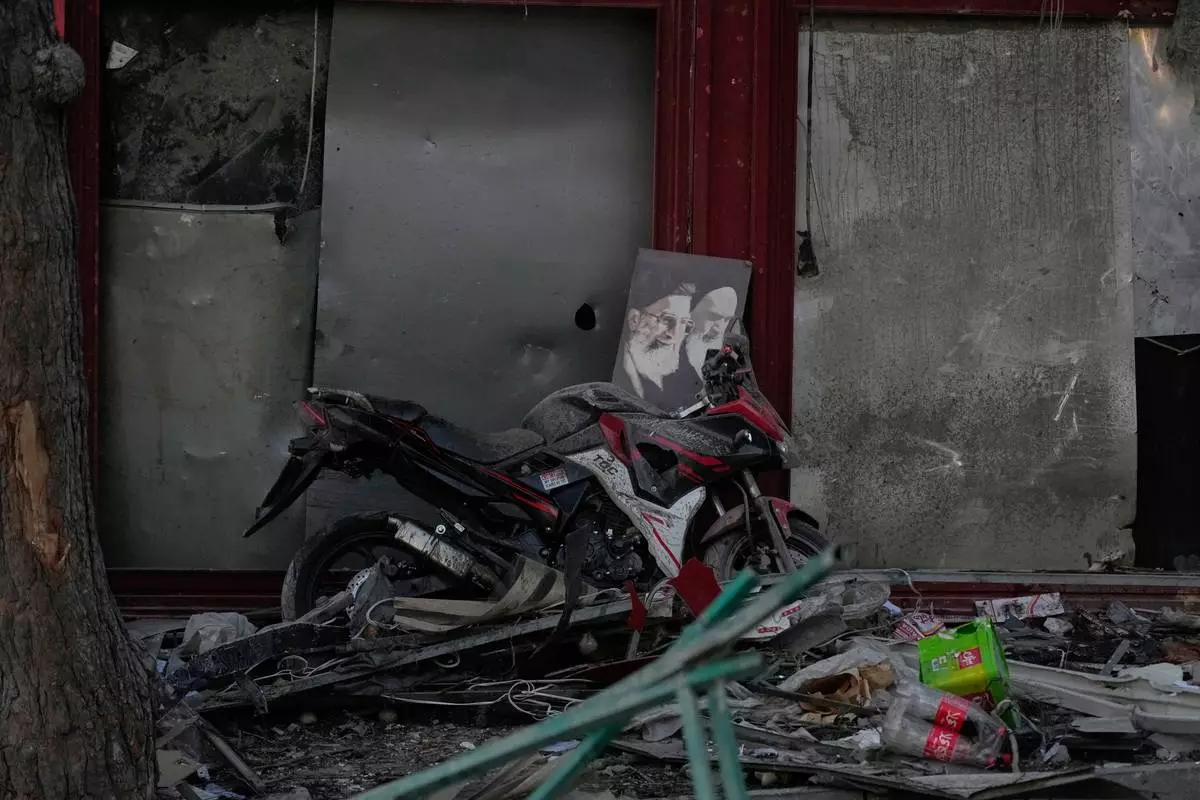
A poster of the late Supreme Leader Ayatollah Ali Khamenei, who was killed during the ongoing joint U.S.-Israeli military campaign, and the late Iranian Revolutionary founder Ayatollah Khomeini, right, lays on a motorcycle amid debris left by a strike in Tehran, Iran, Monday, March 2, 2026. (AP Photo/Vahid Salemi)
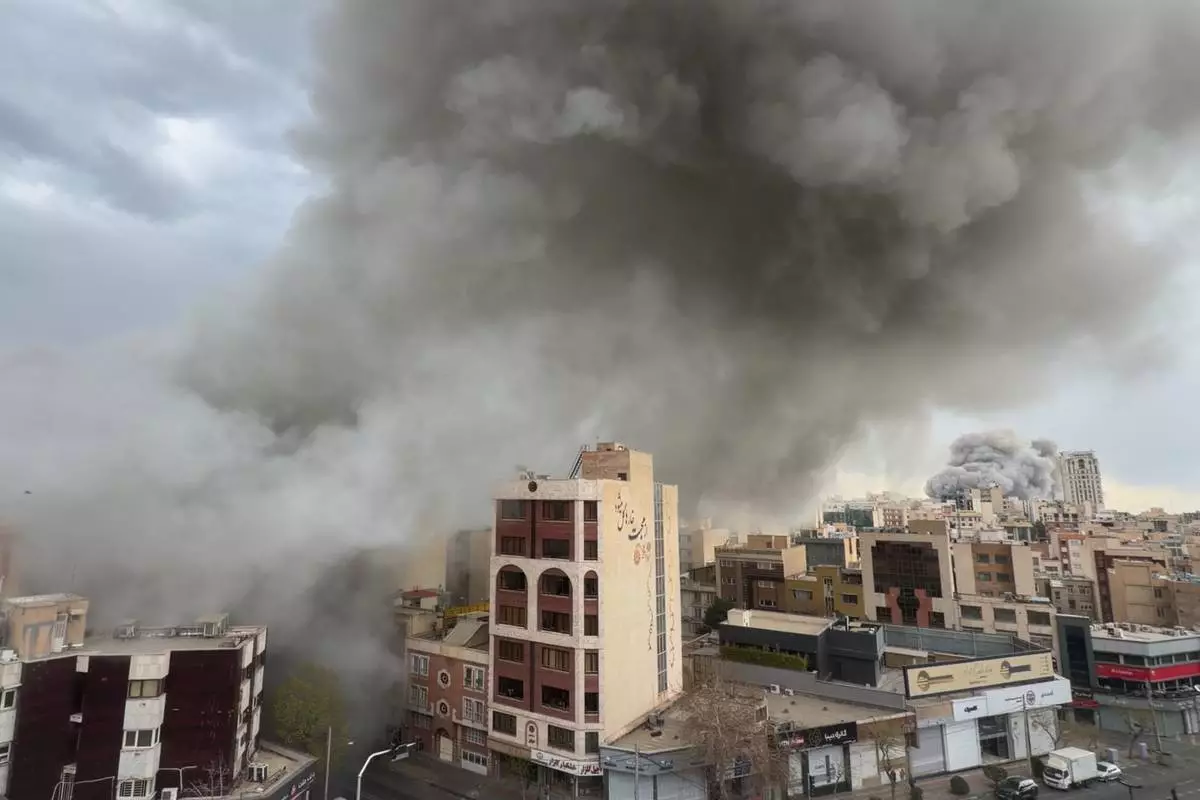
Plumes of smoke from two simultaneous strikes rise over Tehran, Iran, Monday, March 2, 2026. (AP Photo/Mohsen Ganji)