Skip to Content Facebook Feature Image

Chinese FM calls on China, Germany to shoulder responsibilities as major countries for more stable bilateral policy framework

China

China

China

Chinese FM calls on China, Germany to shoulder responsibilities as major countries for more stable bilateral policy framework

2025-12-09 00:25 Last Updated At:04:17

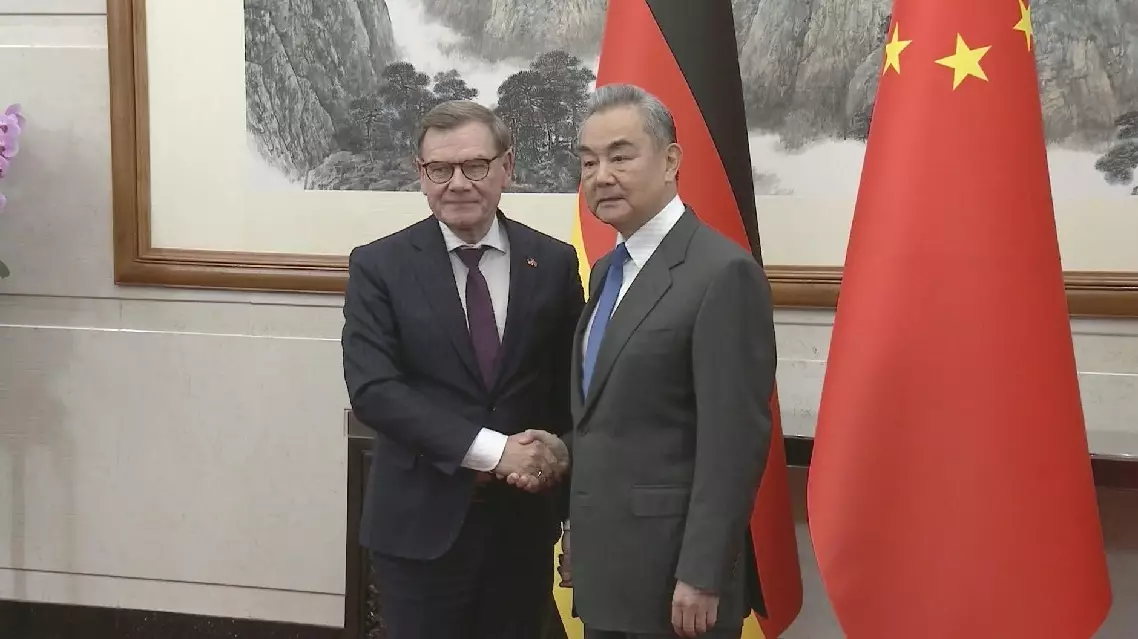
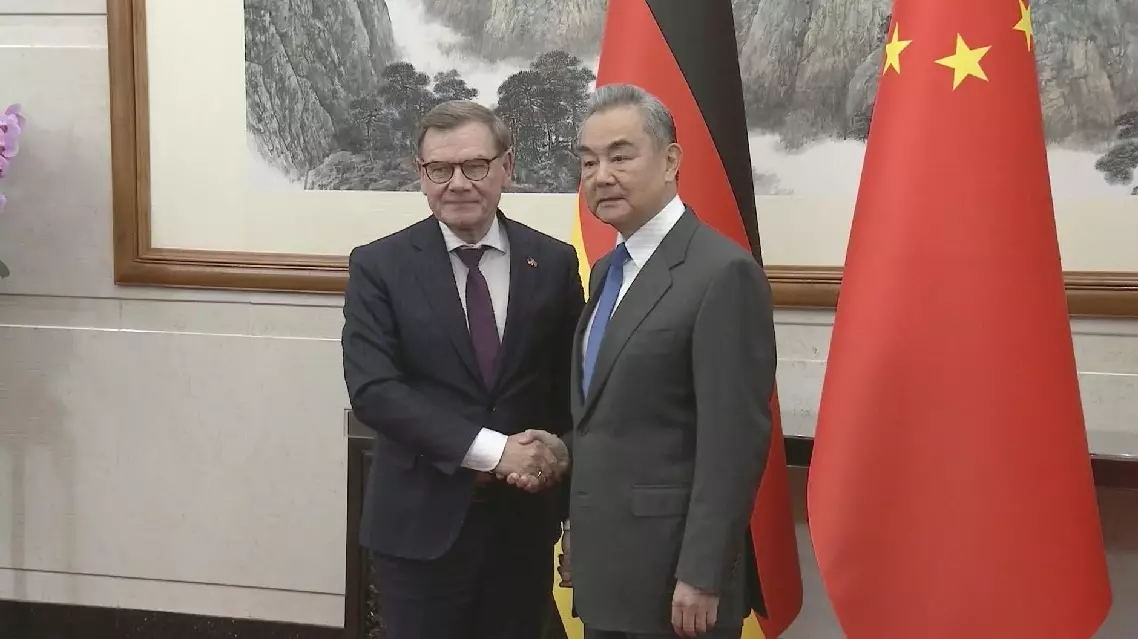
China and Germany, as major countries, should shoulder their responsibilities, uphold mutual respect, transcend differences in social systems, historical backgrounds and cultures, and build a more mature model of positive interaction and a more stable bilateral policy framework, Chinese Foreign Minister Wang Yi said on Monday in Beijing.

Wang, also a member of the Political Bureau of the Communist Party of China Central Committee, told German Foreign Minister Johann Wadephul that it is hoped that Germany will view China's development as an opportunity for deeper cooperation and a driving force for mutual benefit and win-win outcomes, and work together to promote the steady and healthy development of the China-Germany all-round strategic partnership.

Noting that this is the first visit to China by a German foreign minister since the formation of Germany's new government -- though the visit has encountered twists and turns -- Wang quoted a Chinese saying: "Good things come to those who wait." He emphasized that "the timing is not the key; what truly matters is the purpose. The visit should be for cooperation, not confrontation; for enhancing mutual understanding and trust, not widening differences."

Wang further urged Germany to encourage the EU to return to a rational and pragmatic China policy, adhere to the correct direction of mutually beneficial cooperation, resolve differences through dialogue, and avoid politicizing economic issues, instrumentalizing trade issues, or securitizing normal cooperation.

Wang emphasized that the one-China principle serves as an important political foundation for China-Germany relations, and there is no room for ambiguity. He further noted that unlike Germany, Japan has yet to conduct a thorough reflection on its history of aggression in the eight decades since the end of WWII.

Wadephul said that in the face of a turbulent global landscape, Germany and China need to shoulder special responsibilities, strengthen communication and coordination, and become reliable and predictable partners for each other.

He said that Germany remains firmly committed to the one-China policy, and this position is unwavering.

German enterprises in China have full confidence in the Chinese market and are willing to further deepen their presence in the country, Wadephul said, adding that Germany supports the EU and China in seeking mutual benefit and win-win outcomes through dialogue and stands ready to play a constructive role in this regard.

The two sides also exchanged views on the Ukraine crisis. Wadephul elaborated on Germany's position and expressed hope that China would leverage its influence to help bring about an early end to the crisis.

Wang reaffirmed China's consistent stance, emphasizing that all parties should cherish the current momentum for a political settlement, work towards the same goal, and ultimately reach a fair, durable and binding peace agreement through dialogue and negotiations.

China supports all efforts conducive to peace and will continue to play a constructive role in this regard, Wang added.
Chinese FM calls on China, Germany to shoulder responsibilities as major countries for more stable bilateral policy framework
Chinese FM calls on China, Germany to shoulder responsibilities as major countries for more stable bilateral policy framework
Eric Foster, nephew of U.S. journalist Edgar Snow, said he has spent more than 12 years writing a book to present the real China to the world, following in the footsteps of his uncle who chronicled China's revolutionary in the 1930s and 1940s.

This November, Foster traveled to Yan'an City in northwest China's Shaanxi Province, where Edgar Snow ventured deep into China's revolutionary heartland. Yan'an hosted the headquarters of the Communist Party of China (CPC) and was the center of the Communist revolution from 1935 to 1948.

In 1936, at a time when China was embroiled in internal conflict and external aggression, Snow made his way to the remote headquarters of the CPC in Yan'an. As the first Western journalist to enter the area, he conducted extensive interviews and careful documentation there.

Snow's reporting culminated in "Red Star Over China," in which he painted a picture of a resilient, promising country that the world rarely saw, and challenged the world's misunderstandings and prejudices about China.

Foster visited a former residence of Mao Zedong, where Snow met Mao for the first time.

"My uncle and Mao actually sat down here, and this is where Mao Zedong told my uncle about the Long March, and lots of other very important information," said Foster, who then introduced in detail how Snow took Mao's "public relation picture for the West."

"Mao was standing, he was standing right here. My uncle was getting ready to take a picture of Mao. And it's a very important picture, his public relations picture for the West. And he was going to take a picture, but Mao's hair was quite long. So, my uncle said, 'Hey, does somebody have a pair of scissors?’ And so they got a pair of scissors and they cut Mao's hair. And then he brushed it back, and so he's going to take the picture again. But something still was not right, and then he had the idea. I know, they took his hat off, put it on Mao, and that's the story behind that hat on Mao. It's actually my uncle's hat," said Foster.

"So it is quite remarkable how simple life was, and when you can imagine what came out of this simple room, the percussions that affected history, not only history of China, but the whole world, what came out of this room here," Foster said.

Foster was presented a replica of the octagonal cap given by Snow to Mao Zedong.

"As I put on this cap, I can almost feel the weight it carried in those days. It feels not merely like nostalgia, but more like a form of inheritance. What they (my uncle and my aunt) tried to do with their life, is to try to build a bridge between the two countries. As my aunt said that, the people-to-people between China and America is so important. Because the politics is like the weather, it changes all the time, so the people-to-people is what's really important. We need to build that bridge between the people-to- people. So I want to try to do what my aunt and uncle did, to promote China to the world. And then I thought, oh I need to write a book, that's what I need to do. This is what I've been doing for last 12 years or 13 years. My book tries to tell the true history about China, to help whoever reads it in America or other Western countries to see the real China," said Foster.

After the founding of the People's Republic of China, Snow paid three further visits to the country. He remained interested in China following his visits, and firmly supported the just cause of the Chinese people. He has therefore come to be regarded as a lifelong friend of the Chinese people.

With a notebook in his hand and moral clarity in his heart, Snow constructed an unprecedented bridge of mutual respect and understanding between China and the rest of the world that still stands today.

Edgar Snow's nephew aims to present real China to world

Edgar Snow's nephew aims to present real China to world

Recommended Articles