BANGKOK--(BUSINESS WIRE)--Dec 8, 2025--
Align Technology, Inc. (Nasdaq: ALGN), a leading global medical device company that designs, manufactures, and sells the Invisalign® System of clear aligners, iTero™ intraoral scanners, and exocad™ CAD/CAM software for digital orthodontics and restorative dentistry, today announced commercial availability in Thailand of the Invisalign System with mandibular advancement featuring occlusal blocks designed specifically to address Class II skeletal and dental correction by simultaneously advancing the mandible while aligning the teeth. This innovative solution is Align’s first clear aligner product with integrated solid occlusal blocks that is designed to deliver predictable mandibular advancement. Invisalign occlusal blocks provide durability, improve engagement, and enable vertical opening to offer earlier advancement of the mandible in cases like skeletal Class II with deep bite to improve treatment efficiency.
This press release features multimedia. View the full release here: https://www.businesswire.com/news/home/20251208626609/en/
The Invisalign System with mandibular advancement featuring occlusal blocks is the latest clinical innovation that expands Align’s Class II treatment portfolio for growing patients by offering practitioners a comprehensive solution for treating growing patients with Class II malocclusions caused by mandibular retrusion. Class II malocclusion is one of the most common orthodontic problems, characterized by a discrepancy in jaw alignment where the lower jaw (mandible) is positioned too far back relative to the upper jaw (maxilla) and represents approximately 30-45% of malocclusions globally. This condition can lead to functional, aesthetic, and other challenges for patients if left untreated.
The Invisalign System with mandibular advancement featuring occlusal blocks is primarily intended for growing patients in the late mixed or early permanent dentition stages (ages 10-16), who are still experiencing growth. By leveraging the natural growth potential during pre-adolescence and adolescence, the Invisalign System with mandibular advancement featuring occlusal blocks facilitates effective correction of Class II malocclusions, helping to improve occlusal relationships, enhance facial aesthetics, and provide long-term functional benefits, including:
“The Invisalign System with mandibular advancement featuring occlusal blocks reflects Align’s continued commitment to expanding the capabilities of the Invisalign System, enabling doctors to treat a wider range of malocclusions with precision and efficiency, and helps to continue to advance clear aligners as the standard of care in digital orthodontics,” said Sreelakshmi Kolli, Align Technology EVP, chief product and digital officer. “This latest innovation demonstrates our significant investment in delivering digital orthodontic solutions to growing patients that empower doctors to achieve predictable outcomes while enhancing the patient experience.”
“The Invisalign System with mandibular advancement featuring occlusal blocks represents a breakthrough in Class II treatment with clear aligners by allowing doctors to simultaneously address dental and skeletal discrepancies in a more predictable and efficient manner,” said Dr. Mitra Derakhshan, Align Technology EVP and chief clinical officer, global treatment planning and clinical services. “The integration of occlusal blocks enhances mandibular engagement as well as provides bite opening, making this a versatile solution for different Class II malocclusion including deep bite or div 2. The Invisalign System with mandibular advancement featuring occlusal blocks, gives doctors and patients a better option for Class II correction in growing patients while simultaneously straightening their teeth, including more options for feature placement, such as attachments on teeth underneath the blocks (3).”
“Treatment outcomes with the Invisalign System with mandibular advancement featuring occlusal blocks are on par with traditional Clark Twin Blocks,” said Dr. Ronald Sluiter, an orthodontist practicing in New Zealand who has treated 50 patients to date. “In addition, the enhanced comfort of the Invisalign occlusal blocks increases predictability—because comfort leads to patient compliance—and compliance leads to better outcomes.”
“Class II correction in growing patients is smooth sailing with the Invisalign System with mandibular advancement featuring occlusal blocks,” said Dr. Steve Semaan, an orthodontist practicing in Australia. “The patients instinctively know how to bite, and it works so I don’t see any crushed blocks. The fact that we see no crushing issues means patients can keep moving through treatment without any delays or additional appointments.”
“I’m very happy with the new Invisalign System with mandibular advancement featuring occlusal blocks design,” said Dr. Belinda Weltman, Vancouver, Canada. “Patients can bite down easily without risk of damaging or distorting the blocks, and the mandibular advanced position is easy to maintain. My young patients have found it very easy to transition to this appliance with minimal discomfort, and compliance has been a breeze."
“The Invisalign System with mandibular advancement featuring occlusal blocks provides the ideal block engagement that helps hold the mandible in the proper position for patients that also have mandibular asymmetry. This allows for more efficient corrections when desired,” said Dr. Francis Janisse, Windsor, Canada. “Invisalign system with mandibular advancement featuring occlusal blocks remove the need for auxiliary elastics, which removes one more obstacle for patients. In addition, the trays do not require palatal coverage like traditional removable Class II correctors, and there are no changes in the insertion and removal process of the aligners. My younger patients love the ability to remove the aligners for eating, which is not commonly an option for patients that require fixed Class II correctors or elastics.”
The Invisalign System with mandibular advancement featuring occlusal blocks is now commercially available to Invisalign-trained doctors in Australia, New Zealand, Japan, Hong Kong, Malaysia, Singapore, India, Korea, China, Vietnam and Philippines. Along with the Invisalign® Palatal Expander System, Invisalign First™ and Invisalign System with mandibular advancement featuring occlusal blocks, this latest innovation supports the commitment to establishing a unique and differentiated portfolio that supports growing patients throughout their continuum of care.
For more information about the Invisalign System with mandibular advancement featuring occlusal blocks, or to schedule a training session, please visit www.invisalign.co.th or contact your local Align Technology representative.
1. Compared to Invisalign aligners previously made from single-layer (EX30) material.
2. Studies show that patient discomfort with functional appliances affect patient compliance with the prescribed wear time and could lead to unsatisfactory outcomes. https://pubmed.ncbi.nlm.nih.gov/34949565/
3. In some cases, attachments may be removed on teeth under occlusal blocks due to interferences with other features.
About Align Technology, Inc.
Align Technology designs and manufactures the Invisalign® System, the most advanced clear aligner system in the world, iTero™ intraoral scanners and services, and exocad™ CAD/CAM software. These technology building blocks enable enhanced digital orthodontic and restorative workflows to improve patient outcomes and practice efficiencies for approximately 291.0 thousand doctor customers and are key to accessing Align’s 600 million consumer market opportunity worldwide. Over the past 28 years, Align has helped doctors treat over 21.4 million patients with the Invisalign System and is driving the evolution in digital dentistry through the Align™ Digital Platform, our integrated suite of unique, proprietary technologies and services delivered as a seamless, end-to-end solution for patients and consumers, orthodontists and GP dentists, and lab/partners. Visit www.aligntech.com for more information.
For additional information about the Invisalign System or to find an Invisalign doctor in your area, please visit www.invisalign.co.th. For additional information about the iTero digital scanning system, please visit www.itero.com/en-APAC. For additional information about exocad dental CAD/CAM offerings and a list of exocad reseller partners, please visit www.exocad.com.
Invisalign, iTero, exocad, Align, Align Digital Platform, and iTero Lumina are trademarks of Align Technology, Inc.

The Invisalign® System with mandibular advancement featuring occlusal blocks is the latest clinical innovation that expands Align’s Class II treatment portfolio for growing patients by offering practitioners a comprehensive solution for treating growing patients with Class II malocclusions caused by mandibular retrusion.
As the war in the Middle East intensifies, U.S. President Donald Trump said that the U.S. has “the capability to go far longer" than its projected four-to-five-week time frame for its military operations against Iran.
Across Tehran, the sound of explosions rang out through the night and into the early morning hours Tuesday, as the U.S. and Israel have continued to pound Iran since killing its Supreme Leader Ayatollah Ali Khamenei on Saturday.
Tehran and its allies have hit back against Israel, neighboring Gulf states, and targets critical to the world’s production of oil and natural gas.
The intensity of the attacks and the lack of any apparent exit plan set the stage for a prolonged conflict with far-reaching consequences. Israel and the U.S. have given conflicting answers about what exactly the war’s objectives are or what the endgame might be.
Israeli Prime Minister Benjamin Netanyahu late Monday defended the decision to go to war, contending in an interview on Fox News Channel’s "Hannity" that Iran was rebuilding “new sites, new places” that would make “their ballistic missile program and their atomic bomb program immune within months,” without providing evidence.
Satellite photos analyzed by The Associated Press showed limited activity at two nuclear sites in Iran before the war, with analysts saying it was likely Tehran was trying to assess damage from American strikes in June and possibly salvage what remained there.
Here is the latest:
At least five people were killed or wounded in airstrikes in Iran’s western city of Hamadan, the state-run IRNA news agency reported.
Strikes also were reported across other cities, including Isfahan and Shiraz.
Lebanon’s state-run National News Agency said the Lebanese army is evacuating some of its positions along the border with Israel.
The agency said the troops are redeploying to other posts.
The report comes after Israel’s military said it is conducting operations inside Lebanon along the border with Israel.
Israel’s army said Tuesday that Iran’s firepower has been weakened.
Army spokesman Lt. Col. Nadav Shoshani said Israeli and U.S. attacks on Iran have “limited significantly” Iran’s ability to fire.
Shoshani said Israel has been going after Iran’s missile launchers and have taken out dozens of them.
Iran has fired hundreds of missiles but it’s hard to tally the total amount with Iran also striking other countries, he said.
The pace of missiles being launched at Israel has slowed since the first two days of the war.
Shoshani said the slowdown also could be partly attributed to Iran understanding the war could go on for longer than they had thought and they are trying to pace themselves.
Iran has started the process of returning Iranian pilgrims from the shrine cities of Mecca and Medina, state media said Tuesday.
Alireza Enayati, Iran’s ambassador to Saudi Arabia, said the process of returning 9,000 Iranians currently in the cities of Mecca and Medina began Monday.
In a report carried by the Iranian judiciary’s Mizan news agency, Enayati said the departure is taking place in the same manner as during the 12-day war between Israel and Iran in 2025. Iranian pilgrims will leave Saudi Arabia through Saudi–Iraqi border crossings and return to Iran from Iraq.
The announcement came during the Muslim holy month of Ramada and a widening that has seen Iran target sites in Saudi Arabia.
The U.S. ambassador in Israel told Americans there that the best way to leave is through Egypt’s Sinai Peninsula.
Mike Huckabee said in a social media post early Tuesday that the embassy was receiving lots of evacuations requests as embassy staff “are sheltering in place.”
“There are VERY LIMITED options,” he wrote. “Not sure when Ben Gurion Airport in Tel Aviv will reopen.”
He advised Americans to take buses to Egypt’s resorts of Sharm el-Sheikh and Taba in southern Sinai, describing that route as “best.”
The U.S. State Department evacuations of non-emergency personnel and family reached six nations on Tuesday with the inclusion of the United Arab Emirates.
The UAE, home to Dubai and Abu Dhabi and long considered a safe corner of the Middle East, has been dragged into the Iran war with interceptions and attacks.
The other countries include Bahrain, Iraq, Jordan. Kuwait and Qatar.
The U.S. Embassy in Abu Dhabi also warned there could be militant attacks in the UAE as well.
“Terrorists may attack with little or no warning and may target tourist locations, transportation hubs, shopping areas, government facilities, places of worship, and in particular locations associated with the Jewish and Israeli communities,” it added.
A camp for Iranian Kurdish opposition in the semiautonomous region of Kurdistan in northern Iraq was attacked Tuesday morning, an official said.
A missile and drone hit the Azadi camp in Irbil and slightly injured one person, according to Kareem Parwizi, a senior official with the Kurdistan Democratic Party of Iran.
Oman said a drone hit a fuel tank at its port in Duqm on Tuesday.
The state-run Oman News Agency said no one was hurt in the attack.
Duqm has been a key resupply route for the USS Abraham Lincoln aircraft carrier, which is operating in the Arabian Sea.
The Israeli military says one of its divisions is operating inside southern Lebnaon and took positions on several strategic points close to the border.
The Arabic language spokesperson of the Israeli military posted on X that the troops’ move inside Lebanon is part of its efforts to bolster the forward defense system and create an addition layer of security.
The military said that at the same time the air force is conducting strikes against Hezbollah infrastructure in the area to thwart threats and prevent infiltration attempts into Israel.
The Israeli operations inside Lebanon came after a long night of airstrikes on southern Lebanon and Beirut’s southern suburbs.
The Israeli military says there are no immediate plans to deploy ground troops in Iran.
Asked about the possibility of sending in ground forces, spokesman Lt. Col. Nadav Shoshani told reporters it is “not very likely.”
Thailand is intensifying security around the U.S., Israeli and Iranian embassies as the conflict in the Middle East intensifies.
Public broadcaster Thai PBS quoted the head of the National Security Council, Chatchai Bangchua, describing the additional measures as he said authorities would also monitor sites linked to the countries.
Thailand depends heavily on tourism and is one of Asia’s most-visited countries, attracting more than 32 million foreigners last year. It is a popular destination for Americans, Israelis and citizens of Gulf countries and before recent airspace closures received dozens of direct flights from the Middle East each week.
The Israeli military says soldiers are “operating in southern Lebanon’ as it continues strikes against Hezbollah.
In a statement, it said the troops are positioned at a several points near the border in what it described as a “forward defense posture” as it battles Hezbollah militants.
It says the deployment is part of a broader effort to increase security for residents in northern Israel near the border with Lebanon. It has also beefed up troops and air defenses in the area.
The army says there are no plans to evacuate Israeli residents of border areas.
Israel has been occupying five positions in southern Lebanon since a November 2024 ceasefire ended more than a year of fighting with Hezbollah. Lt. Col. Nadav Shoshani says the new deployment is in addition to those five positions, with the aim of preventing attacks on Israeli border towns.
The U.S. State Department added Kuwait and Qatar to the evacuation list from its Mideast diplomatic outposts.
The U.S. Embassy in Kuwait is shutting down as the Middle East is grabbed in a widening war.
The embassy said in a social media post Tuesday that it is closing “until further notice” due to the war.
Iran on Tuesday held a mass funeral ceremony for 165 people killed in what it described as an attack on a girls’ school in the southern city of Minab.
Iranian state television showed thousands of people filling a public square. Men waved the Islamic Republic flag while largely standing apart from women draped in black chadors.
From the stage, a women who said she was the mother of “Atena” held up a printed image of portraits that she called “a document of American crimes.” She added, “They died in the way of God.”
The crowd erupted into chants of “Death to America,” “Death to Israel” and “No surrender.”
U.S. Central Command spokesperson Capt. Tim Hawkins said he was aware of reports that a girls’ school was struck and officials were looking into them.
An Israeli military spokesperson said Sunday he was not aware of any Israeli or U.S. strikes in the area.
Qatar Airways said it would remain grounded Tuesday over the war.
Amazon said Monday that two of its data centers in United Arab Emirates were hit by drones, while a drone strike near one of its facilities in Bahrain “caused physical impacts to our infrastructure.”
The tech giant said on its website that the strikes have caused structural damage and gotten in the way of power getting to infrastructure. The company did not say who was responsible for the strikes.
“We are working to restore full service availability as quickly as possible, though we expect recovery to be prolonged given the nature of the physical damage involved,” Amazon said.
Iran is continuing to threaten shipping in the Strait of Hormuz, the narrow mouth of the Perisan Gulf through which a fifth of all oil traded passes.
Brig. Gen. Ebrahim Jabbari, an adviser to the paramilitary Revolutionary Guard, issued the threat on Iranian state television on Monday.
“The Strait of Hormuz is closed. Anyone who wants to pass, our devotee heroes in the IRGC navy and the army will set those ships on fire,” he said. “Don’t come to this region.”
The Israeli military said Tuesday it was conducting “simultaneous targeted strikes against military targets in Tehran and Beirut,” without elaborating.
The U.S. State Department said it added Iraq to the evacuation list from its Mideast diplomatic outposts.
The U.S. State Department on Tuesday ordered the evacuation of non-emergency personnel and family in Bahrain and Jordan.
The State Department announcement online said the decision came “due to safety risks.” The department has urged Americans across the Mideast to leave over the ongoing war with Iran.
The U.S. Embassy in Saudi Arabia acknowledged coming under attack from Iranian drones Tuesday and urged Americans to avoid the diplomatic post for the time being.
The Saudi Defense Ministry earlier Tuesday said the embassy was attacked by two drones.
Across Iran’s capital, the sound of explosions rang out throughout the night into the early morning hours.
Witnesses described hearing aircraft overhead as well.
It wasn’t immediately clear what had been hit.
Iranian state television early Tuesday read a statement from the country’s paramilitary Revolutionary Guard, saying that it launched a missile and drone attack targeting an air base in Bahrain.
Israeli airstrikes hit the Lebanese capital Tuesday morning.
The Israeli military said it was targeting “Hezbollah command centers and weapons storage facilities in Beirut.”
Hezbollah also said it launched drones targeting an Israeli air base.
The Israeli military said it downed two drones.
Tokyo has told Japanese shipowners to have their ships stay away from the Persian Gulf to ensure the safety of their crew members.
Chief Cabinet Secretary Minoru Kihara told reporters Tuesday that the Transport Ministry has notified the Japanese Shipowners’ Association to do the utmost to protect crews on board the ships in the region.
Kihara said those already in the Gulf are urged to lie at anchor where it is safe to do so.
On Monday, Japan’s Foreign Minister Toshimitsu Motegi met with Iranian ambassador to Japan Peiman Seadat and conveyed Japan’s consistent stance that Iran must stop attacks on neighboring countries and other actions destabilizing the region.
Motegi also noted the importance of ensuring safety in the Strait of Hormuz, which is key to Japan’s energy security.
Iran’s top diplomat early Tuesday sought to turn the tables on the United States, describing it as entering “a war of choice on behalf of Israel.”
After Trump urged Iranians to take over their government, Foreign Minister Abbas Araghchi made the same call to Americans.
“Shedding of both American and Iranian blood is thus on Israel Firsters,” Araghchi wrote on X. “American people deserve better and should take back their country.”
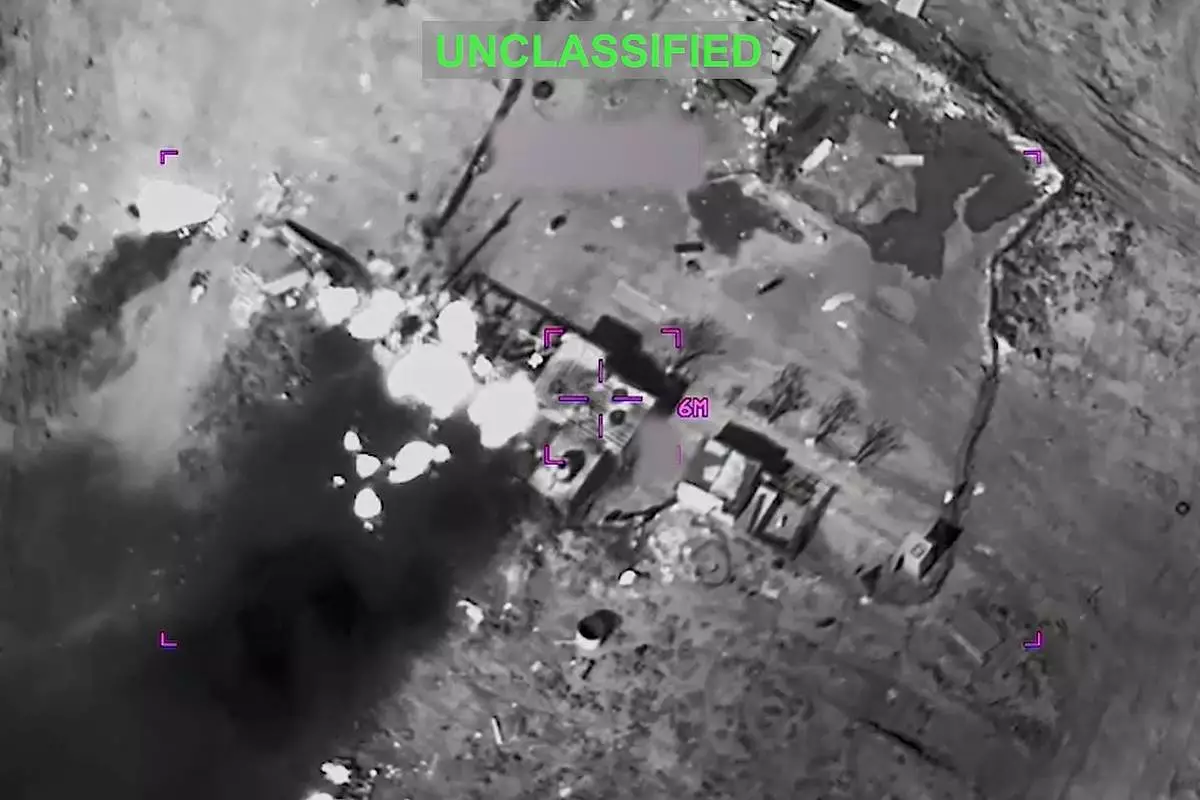
This partially redacted image from video provided by U.S. Central Command shows a complex of structures in Iran being struck by missiles fired by U.S. forces on Sunday, March 1, 2026. (U.S. Central Command via AP)

President Donald Trump walks past Defense Secretary Pete Hegseth as he exist the East Room of the White House following the Medal of Honor ceremony, Monday, March 2, 2026, in Washington. (AP Photo/Mark Schiefelbein)
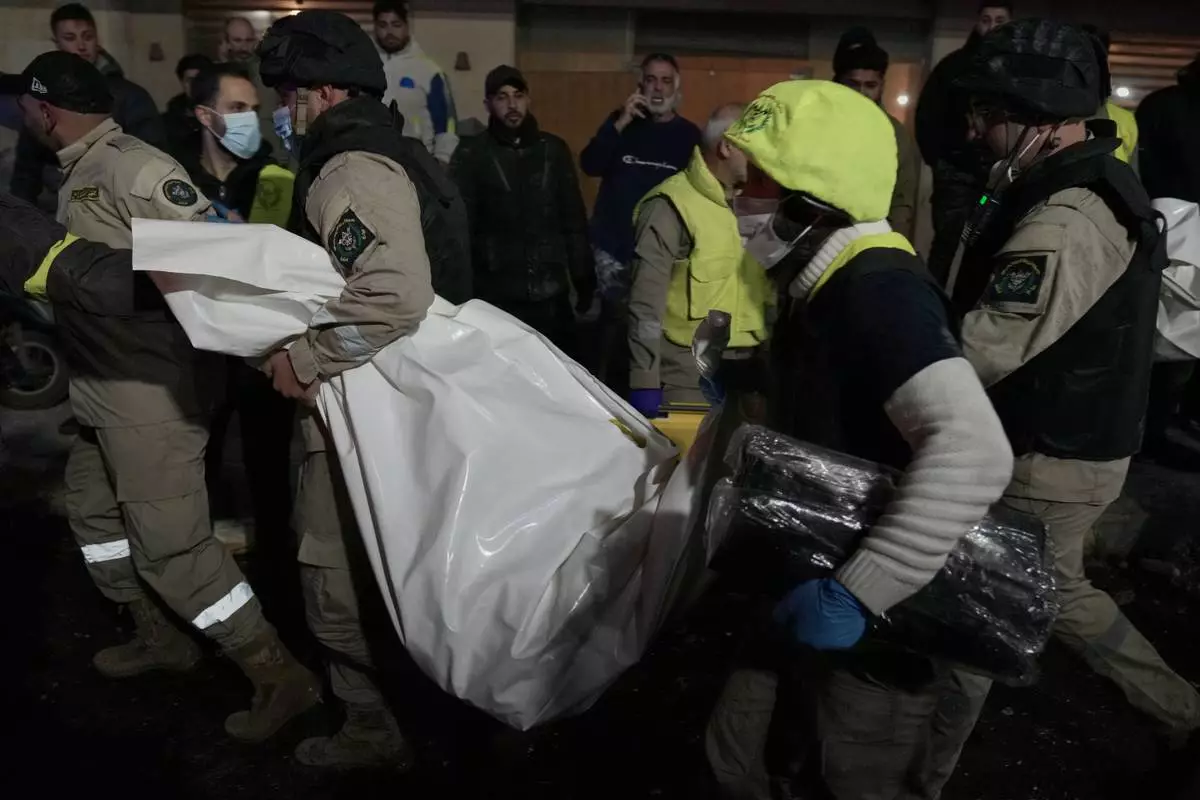
Rescue workers carry a dead body in a plastic bag from a building that was hit by Israeli strike, in Jnah neighborhood, south of Beirut, Lebanon, Monday, March 2, 2026. (AP Photo/Hussein Malla)
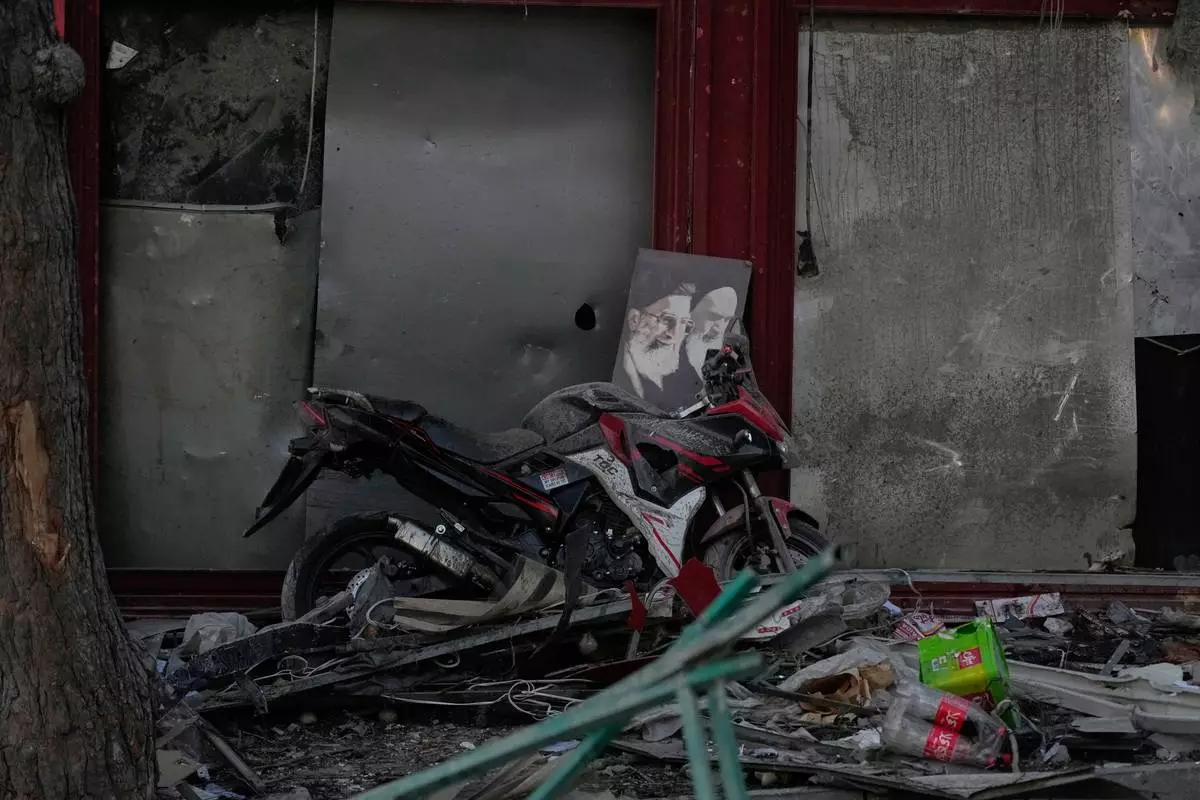
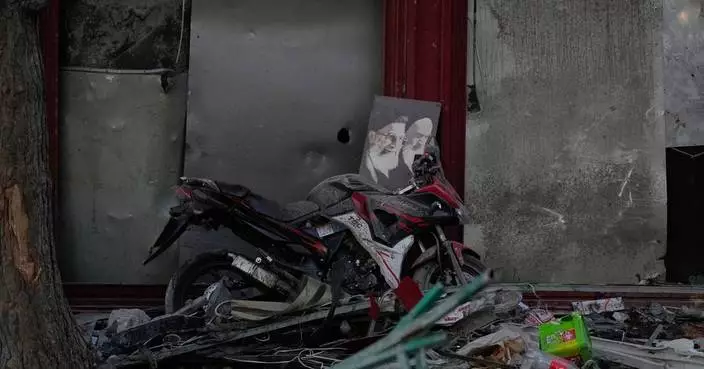
A poster of the late Supreme Leader Ayatollah Ali Khamenei, who was killed during the ongoing joint U.S.-Israeli military campaign, and the late Iranian Revolutionary founder Ayatollah Khomeini, right, lays on a motorcycle amid debris left by a strike in Tehran, Iran, Monday, March 2, 2026. (AP Photo/Vahid Salemi)
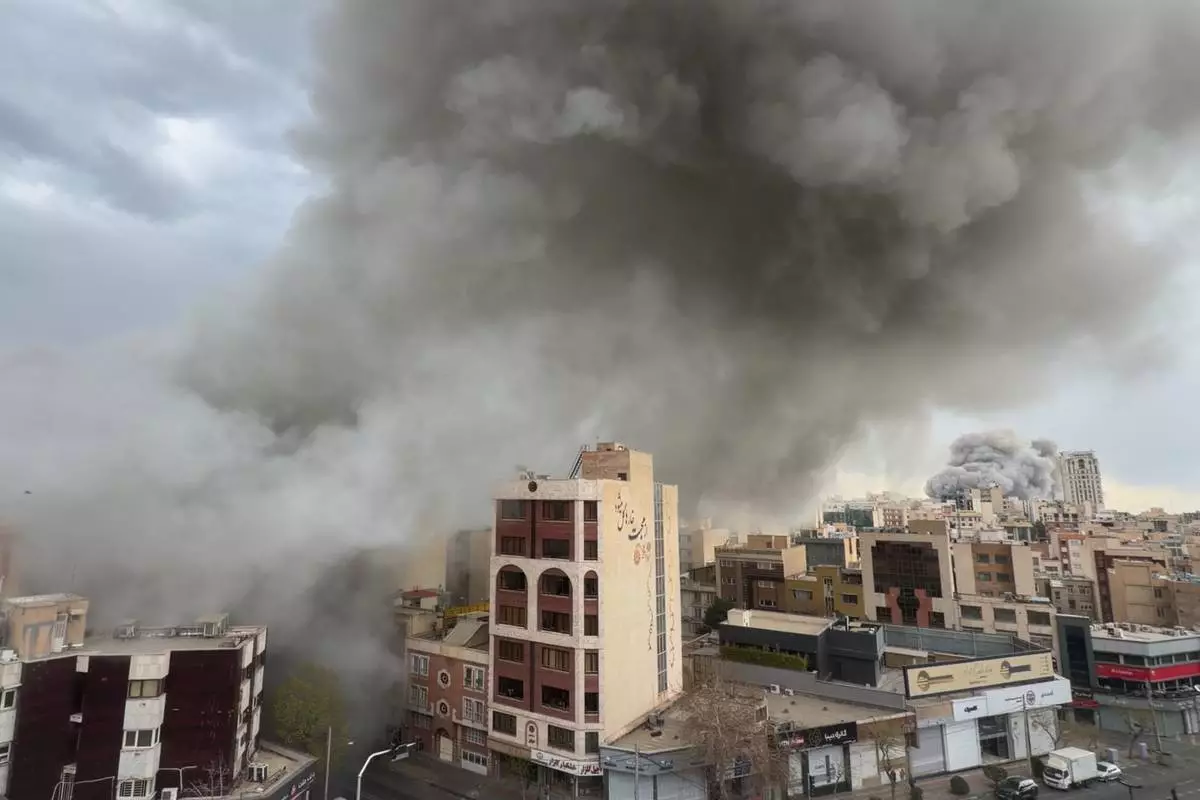
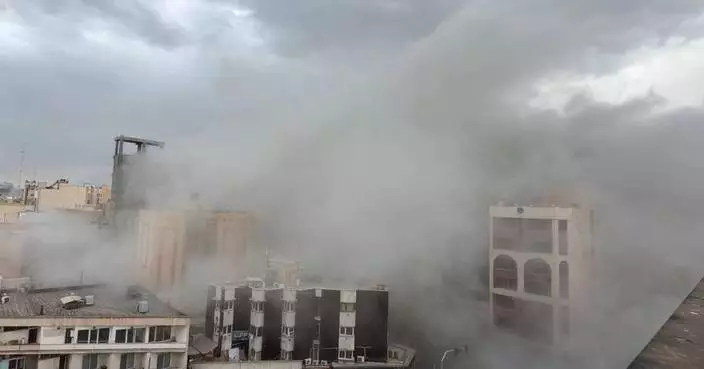
Plumes of smoke from two simultaneous strikes rise over Tehran, Iran, Monday, March 2, 2026. (AP Photo/Mohsen Ganji)