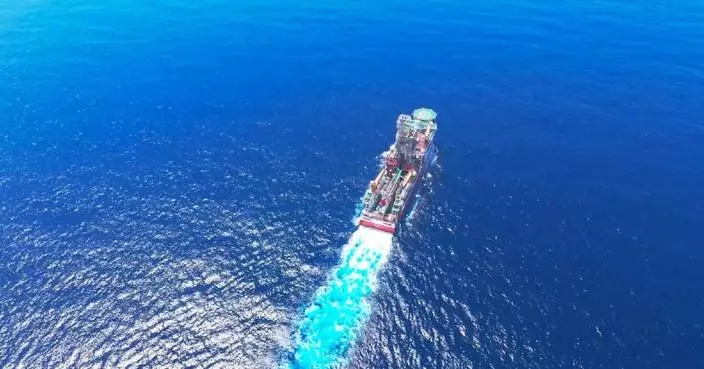
A major shale oil production zone in northwest China's Xinjiang Uygur Autonomous Region reported its crude oil output exceeding 1.7 million tons so far this year, marking a significant breakthrough in the country's shale oil development, China National Petroleum Corporation (CNPC) announced on Tuesday.
Established in Xinjiang's Jimsar County in 2020, the zone is China's first national-level continental shale oil production area with an estimated shale oil reserve of over 1 billion tons.
"Since 2020, we have drilled 472 new wells and carried out fracturing on 451 wells, boosting the zone's annual production from 116,000 tons in 2019 to more than 1.7 million tons this year, increasing by 15 times," said Wang Haiming, a senior engineer for the Jiqing oilfield operation zone of Xinjiang Oilfield Company, China National Petroleum Corporation (CNPC).
Shale oil, defined as liquid hydrocarbons trapped within shale rock formations and extractable for refining, is a widely distributed energy resource with reserves that significantly exceed those of conventional oil sources.
In addition to Xinjiang, China has established two other national-level shale oil demonstration zones in Heilongjiang and Shandong to facilitate shale oil development.
In 2024, China's shale oil production exceeded 6 million tonnes, an increase of 30 percent year on year.

China's major shale oil base reports production breakthrough
For the first time in decades, three U.S. aircraft carriers are operating simultaneously in the Middle East, U.S. Central Command said on Friday.
The three carriers — the USS Abraham Lincoln, the USS Gerald R. Ford and the USS George H.W. Bush — are carrying more than 200 aircraft and 15,000 sailors and Marines, according to the Central Command.
A day earlier, the command announced that the Bush carrier strike group had entered its area of responsibility and was currently in the Indian Ocean. The Bush, a Nimitz-class carrier, left Naval Station Norfolk in the U.S. state of Virginia in late March.
The Lincoln is conducting missions in the Arabian Sea, primarily tasked with enhancing U.S. maritime blockade operations, while the Ford is positioned in the northern Red Sea, where the U.S. claims that it is maintaining maritime security.
The Bush is expected to relieve the Ford, and during the handover period, the U.S. military is expected to maintain a three-carrier deployment posture in the region.
Meanwhile, an Iranian Defense Ministry spokesman said on Thursday that Iran has never halted production of defense equipment, and the ministry is fully committed to meeting the needs of the armed forces across all situations, including combat readiness and ceasefire conditions.
The developments come as a fragile U.S.-Iran ceasefire faces uncertainty, with Washington continuing its naval blockade and signaling possible military action.
Pakistan, meanwhile, is pushing to revive stalled U.S.-Iran talks, with Iranian Foreign Minister Seyed Abbas Araghchi expected to visit Pakistan for talks with Islamabad's mediation team and Washington saying key negotiators would also travel to Pakistan, raising speculation that a second round of U.S.-Iran talks could resume.
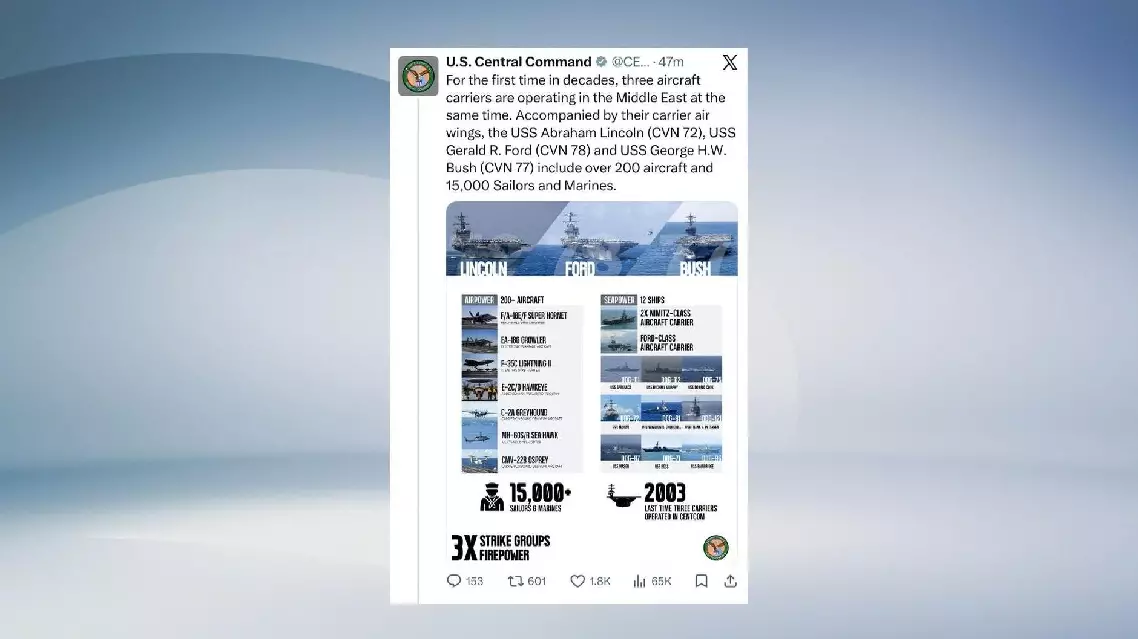
3 U.S. carriers operate simultaneously in Middle East for first time in decades: U.S. Central Command