Skip to Content Facebook Feature Image

Shenzhou-21 astronauts complete first series of extravehicular activities

China

China

China

Shenzhou-21 astronauts complete first series of extravehicular activities

2025-12-10 09:55 Last Updated At:13:37

China's Shenzhou-21 crew aboard the country's orbiting space station completed their mission's first series of extravehicular activities (EVAs) on Tuesday, donning newly delivered extravehicular spacesuits for their inaugural use in space.

The trio crew, consisting of mission commander Zhang Lu and astronauts Wu Fei and Zhang Hongzhang, worked for approximately eight hours and completed their assigned tasks by 18:45 (Beijing Time), with assistance from the space station's robotic arm and ground-based research fellows.

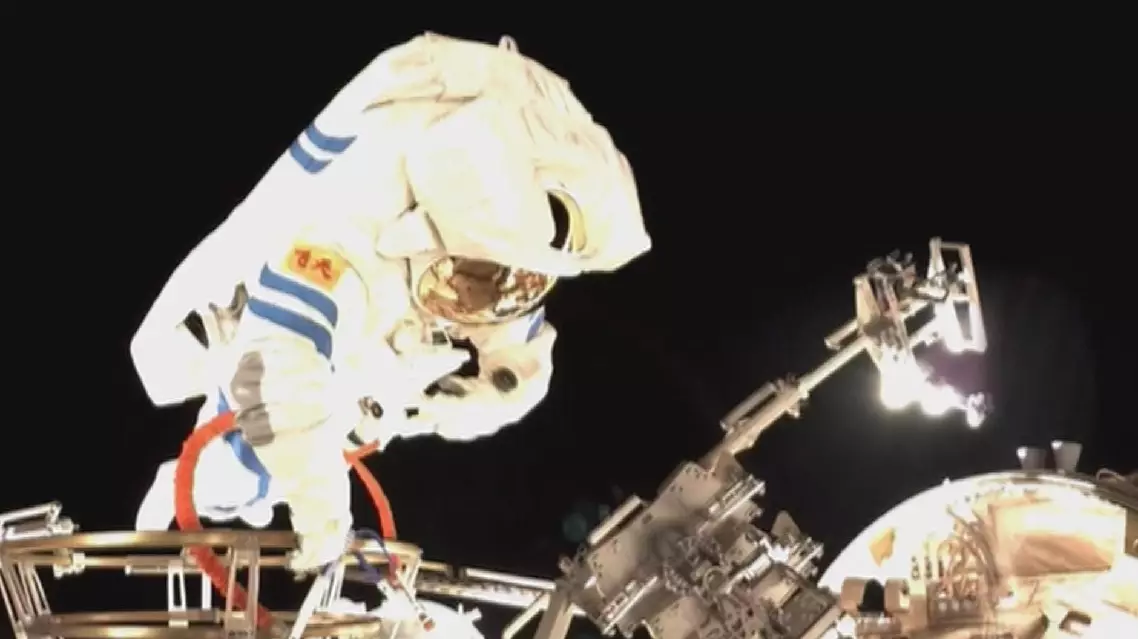
The EVAs began at around 10:28, when Zhang Lu opened the airlock hatch door on the lab module, Wentian, and moved outside.

Previously, Zhang completed four extravehicular activities during the Shenzhou-15 mission. Two and a half years later, he conducted his fifth extravehicular activity.

Wu Fei provided support by handing out equipment and tools at the hatch and assisting with inspection work from inside.

The pair wore new spacesuits featuring red and blue trims, which were delivered by the Tianzhou-9 cargo spacecraft on July 15 as part of the second-generation Feitian spacesuit series, marking their debut during an extravehicular mission.

The operational lifespan of the suits has been upgraded from the previous standard of 15 EVAs over three years to 20 EVAs within four years, providing robust safety assurance for astronauts, according to the China Astronaut Research and Training Center.

At around 13:19, Zhang Lu rode the robotic arm to approach the viewport window of the Shenzhou-20 return capsule, where he photographed and assessed a damaged area. Tiny cracks were found in the viewport window, most probably caused by external impacts from space debris. As a result, the Shenzhou-20 spacecraft did not meet the safety requirements for the astronauts' return, and so has remained in orbit.

The three astronauts for the Shenzhou-20 mission returned to Earth aboard the Shenzhou-21 spacecraft on November 14.

And the Shenzhou-22 spaceship was launched on November 25 as a return vessel for the Shenzhou-21 astronauts in orbit.

"This is the first time that two manned spacecraft have docked in the space station complex during an extravehicular activity, which posed significant challenges for our path planning and supporting the astronauts at their work sites. Therefore, our team conducted a lot of simulation analysis for this special configuration, in order to select an optimal path," said Zheng Hao, a staff member from China Aerospace Science and Technology Corporation.

At around 15:30, Wu Fei joined Zhang Lu outside the cabin to carry out coordinated tasks, while Zhang Hongzhang provided support from inside the Tianhe core module. Wu is the youngest Chinese astronaut to carry out an extravehicular mission to date.

Overall, the Shenzhou-21 crew's first series of EVAs included inspecting and photographing the Shenzhou-20 return capsule's viewport window, installing debris-shielding components on the space station, and replacing multilayer covers on a thermal control adapter.

Since entering the orbiting space station combination on November 1, the Shenzhou-21 astronauts have completed various tasks, including a rotation with the Shenzhou-20 crew, maintenance of the space station platform, inspection and organization of emergency supplies, and life and health support activities.

"Next, our extravehicular activities will focus on carrying out protective operations on the other two modules of Tianhe and Mengtian. We will install protective shields on different cabins each time according to the scheduled tasks. Currently, we are doing and will proceed with the work as planned," said Zhai Zhihong, a staff member from the China Astronaut Research and Training Center.

During the Shenzhou-21 crewed mission, planned extravehicular activities involving crew and applied payloads will also be conducted, as will scientific experiments and technical tests.

Depending on the situation determined, the crew may also undertake protective operations on the damaged window of the Shenzhou-20 spacecraft, according to the China Manned Space Agency.
Shenzhou-21 astronauts complete first series of extravehicular activities
Shenzhou-21 astronauts complete first series of extravehicular activities

The fast development of China's parasports during the 14th Five-Year Plan period (2021-2025) has attested to the continued improvement of the country's social security and service systems for people with disabilities, and the enhancement of their personal development capabilities.

A total of 7,824 athletes from 34 delegations have registered for China's 12th National Games for Persons with Disabilities and the 9th National Special Olympic Games, which is running from Dec. 8 to 15 across Guangdong, Hong Kong and Macao.

It is the first time the two events have been jointly hosted by the three regions of the Guangdong-Hong Kong-Macao Greater Bay Area. The Games feature 1,876 events across 46 sports, with competitions in six winter sports already completed. The program includes 131 events in 11 mass-participation sports and 599 events across nine Special Olympics sports.

The organizing committee said more than 11,000 athletes, coaches, referees and staff from across the county are taking part, up around 30 percent compared with the last edition of the event.

Volunteer services have been fully deployed, offering guidance, sign-language interpretation and other assistance for athletes and spectators. Around 45,000 volunteers are supporting the Games in Guangdong alone.

Under the slogan "Passionate National Games, Vibrant Greater Bay Area", the Games are also being used to promote innovation in assistive technologies. A range of advanced products will be put into use during competition, helping move technologies from laboratories into real-world testing and market application.

Chen Xuejun, deputy secretary general of the organizing committee, said the Games provide an opportunity to better integrate disability services into broader social development.

"Swimming brings confidence, courage and the impetus for me to stride forward. And I hope I could share this strength to other people with disabilities who may be facing difficulties but still have the courage to pursue their dreams," said swimmer Jiang Yuyan representing Zhejiang Province. Jiang, who lost her right arm and right leg in a childhood accident, won seven gold medals at the Paris 2024 Paralympic Games.

Team China, for the first time, ranked the first on the medal tally both by the number of golds and the number of total medals at the 2022 Beijing Winter Paralympics.

The rapid development of China's parasports during the 14th Five-Year Plan period has demonstrated the continuous improvement of the country's social security and service systems for people with disabilities.

During the period, the participation rate of persons with disabilities in China's basic medical insurance has remained above 95 percent. Meanwhile, over 90 percent of people with disabilities in China have been covered by basic old-age insurance for both urban and rural residents.

By June 2025, living allowances for the disabled in financial difficulty and nursing subsidies for the severely disabled had benefited 11.88 million and 16.4 million, or up 31.9 percent and 22.5 percent, respectively, in the average standards of such allowances and subsidies.

The enrollment rate of children and adolescents with disabilities in compulsory education in China has reached 97 percent.

A nationwide campaign for barrier-free home renovations has benefited 1.43 million households with severely disabled members during the 2021-2025 period, surpassing the original target of 1.1 million.

More than 3,000 websites and mobile apps have undergone modifications to improve accessibility and elderly-friendliness, introducing features such as voice recognition and text-to-speech functions.

Accelerated applications of cutting-edge technologies have enabled people with disabilities to enjoy a higher-quality life.

"The fourth plenary session of the 20th Central Committee of the Communist Party of China made it clear that efforts should be made to improve the service and support systems for people with disabilities and ensure that special-needs education programs are well run. This clearly pointed the direction for development of China's disability sector during the 15th Five-Year Plan period (2026-2030). At present, we are meticulously formulating the guarantee and development plan for people with disabilities in the next five years, focusing on strengthening advantages, breaking bottlenecks and shoring up weak spots, so as to further promote high-quality development of the cause for people with disabilities," said Wang Hongwei, spokesman for the China Disabled Persons' Federation.

Parasports development attests to progress in China's social security, service systems for people with disabilities

Parasports development attests to progress in China's social security, service systems for people with disabilities

Recommended Articles