China on Wednesday released several scientific findings from the second leg of the 15th deep-sea geological survey voyage carried out by Chinese marine research vessel Haiyang Dizhi-6 (Ocean Geology 6), the China Geological Survey said.
The vessel set sail on Aug 29 this year and spent 95 days at sea, covering a total distance of 12,673 nautical miles.
During the mission, a large number of valuable data and samples were collected, including deep-sea environmental data, deep-sea water samples, seabed sediments, polymetallic nodules, and deep-sea biological samples. In addition, new progress was made in the application of key deep-sea exploration technologies and equipment.
"For the first time in the deep waters of the Pacific Ocean, we deployed our independently-developed 6,000-meter deep-sea remotely-operated vehicle and a domestically-produced underwater robot, operating them in tandem near the seabed to conduct high-precision tests and operations, and we achieved excellent application results," said Song Laiyong, technical lead of the vessel at the Guangzhou Marine Geological Survey (GMGS).
"We also conducted seabed mineral surveys alongside basic geological and environmental surveys, and found another resource-rich area containing polymetallic nodules. This extends our understanding of deep-sea mineral distribution," he continued.
Song added that the samples and data gathered will provide essential but critical support for further research on deep-sea geology, deep-sea environment and ecosystems.
"Chinese scientists will conduct further analysis on geological samples to study the region's geology, especially its structural evolution. This will provide critical data support for site selection for global ocean drilling research," said Song.
The research vessel is scheduled to set sail again for the Pacific Ocean in the first half of 2026 to conduct more in-depth surveys of fundamental geology and environmental geology.

China releases findings from deep‑sea geological survey
Israel has wiped out entire villages and destroyed crucial infrastructure in southern Lebanon during conflicts with Hezbollah.
According to local media reports, the Israeli military has bombed every bridge over the Litani River last week. It means that major cities like Tyre are now isolated. Vehicles have no way to get through to deliver urgent medicine, supplies, or food. Even the United Nations Interim Force in Lebanon (UNIFIL), which monitors the violations and attacks happening in south Lebanon, can no longer have a direct connection of supply to its forces.
Hassan Dbouk, president of the Union of Tyre Region Municipalities, condemned Israel's destruction, saying it has been wholly disregarding international law and following the same calamitous pattern seen in the Gaza Strip.
"Israel doesn't respect international law. It's destroying everything, mosques, religious places, schools, clinics, the vicinity of hospitals -- even when it doesn't directly hit a hospital, it targets its vicinity, which puts it out of service. As for the infrastructure, last time, it bombarded the central water facility, and electricity always gets affected. To me, the situation in Lebanon is following the same pattern as in Gaza," he said.
He further noted that Israel is destroying villages along the Blue Line, a border demarcation line between Lebanon and Israel established by the United Nations in 2000.
"They said that they are destroying the Blue Line, which is the first line of villages on the border, and the second line, and they're calling for the occupation of the third line and therefore its destruction. They want it to be a buffer zone, which means an uninhabitable place with no population or houses, and this is getting implemented," he said.
Ali Khreis, a Lebanese parliament member, said that Israel is trying to prevent people from returning home as a form of political pressure, but Lebanon will not surrender.
"They want to prevent people from going back home. This is a type of political pressure. Israel is doing this so that Lebanon will yield to its demands. Despite what is happening, we can't give in to the Israeli pressure, whatever the cost. There is no crossing point between Tyre and the rest of the territories now. The main bridge was destroyed, and before that, another bridge was destroyed. This was the only remaining crossing," he said.
A 10-day ceasefire between Israel and Lebanon took effect at midnight between Thursday and Friday local time, following an earlier announcement by U.S. President Donald Trump.
However, the Israel Defense Forces said in a statement on Saturday that it had struck militants approaching a "Yellow Line," which marks the northern edge of the "security zone" established by Israel in southern Lebanon, over the past day.
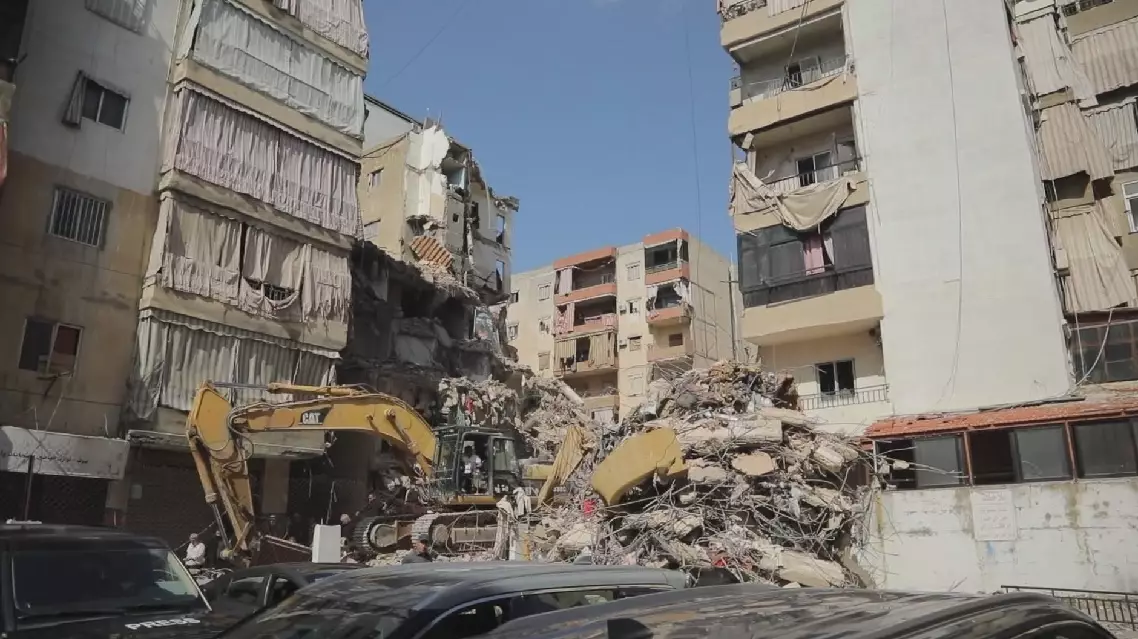
Israeli attacks destroy infrastructure in southern Lebanon