Skip to Content Facebook Feature Image

Omdia: Semiconductor Quarterly Revenue Surpasses $200bn for the First Time as Industry-Wide Growth Accelerates

Business

Omdia: Semiconductor Quarterly Revenue Surpasses $200bn for the First Time as Industry-Wide Growth Accelerates
Business

Business

Omdia: Semiconductor Quarterly Revenue Surpasses $200bn for the First Time as Industry-Wide Growth Accelerates

2025-12-11 20:20 Last Updated At:12-12 15:13

LONDON--(BUSINESS WIRE)--Dec 11, 2025--

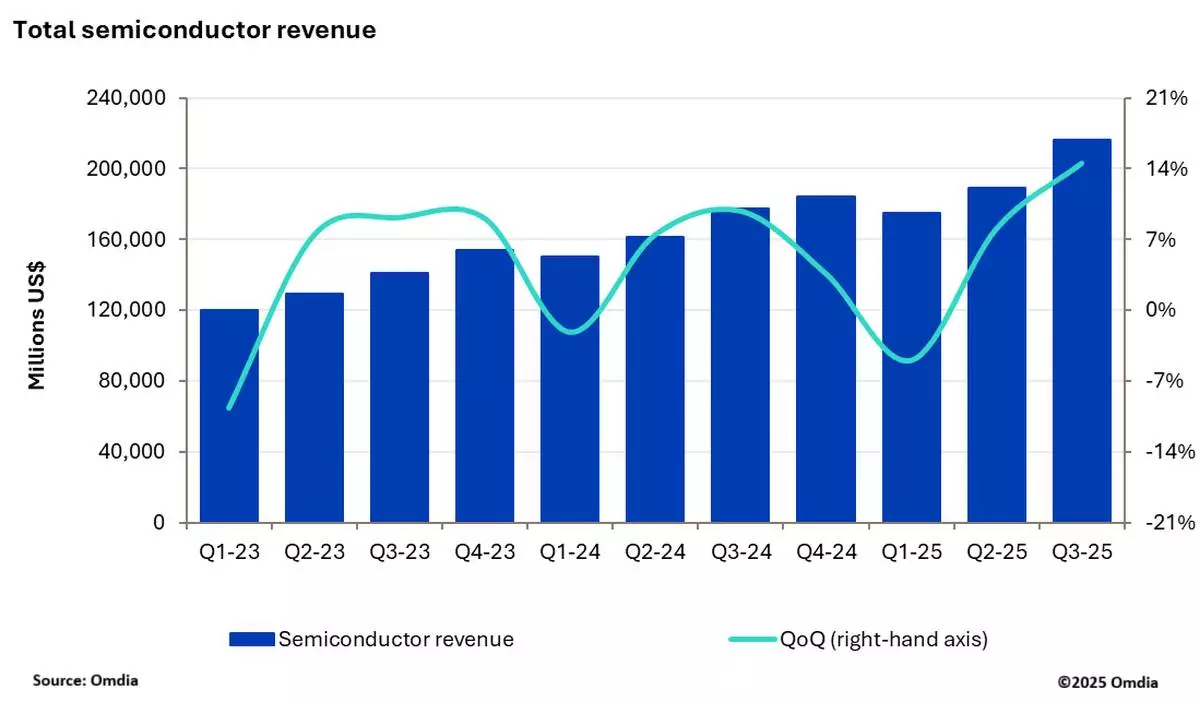
New research from Omdia shows that the semiconductor market delivered a record breaking performance in 3Q25 with industry revenue reaching $216.3bn, up 14.5% quarter-over-quarter (QoQ). This marks the first time the global semiconductor market has exceeded $200bn in a single quarter, following an already strong 2Q25, which saw 8% QoQ growth. At this pace, the industry is on track to exceed $800bn in total revenue for 2025.

This press release features multimedia. View the full release here: https://www.businesswire.com/news/home/20251211210871/en/

3Q25 far exceeds seasonal expectations

Demand for AI and memory products remains strong, with both segments continuing to outpace the wider market. While AI has dominated recent industry narratives, Omdia notes that more segments contributed to growth in 3Q25 than in previous quarters.

Historically, the third quarter sees an average increase of just over 7% and public guidance going into 3Q25 suggested roughly 5% QoQ growth, a typical seasonal pattern. Instead, Q3 more than doubled expectations and delivered over 14% QoQ growth as nearly every semiconductor category outperformed last quarter’s forecasts.

Growth spreads beyond NVIDIA and memory

2024 was a record year for the semiconductor market, surpassing $650bn in revenue with more than 20% annual growth. However, Omdia notes that this expansion was highly uneven. When NVIDIA and memory ICs were excluded, the rest of the market grew just 1% in 2024 constrained by inventory adjustments and soft demand.

In contrast, 2025 has shown a far healthier and more broad-based recovery. While AI and memory remain the primary engines of expansion, the rest of the market is now growing strongly as well. Revenue in 3Q25 was up over 14% QoQ for the total market and came in at over 9% (excluding NVIDIA and memory IC).

For the full year 2025, Omdia projects semiconductor revenue to surpass $800bn, up nearly 20% from 2024. Even without NVIDIA and memory, the market is on track for around 9% annual growth, confirming that 2025 marks a shift to industry-wide expansion rather than growth concentrated in only a few segments.

Top companies reinforce AI and memory leadership

The top four semiconductor companies by Q3 revenue were NVIDIA and the three major memory companies: Samsung, SK Hynix, and Micron, highlighting the continued dominance of AI accelerators and advanced memory.

“Demand for conventional DRAM is surging alongside HBM as AI inference workloads scale, driving an exceptional short-term price rally,” said Senior Principal Analyst Lino Jeng. “We expect Q4 to set a new all-time revenue record, with this extraordinary strength likely to continue into next year.”

Together, these four companies accounted for over 40% of all semiconductor revenue.

ABOUT OMDIA

Omdia, part of Informa TechTarget, Inc. (Nasdaq: TTGT), is a technology research and advisory group. Our deep knowledge of tech markets combined with our actionable insights empower organizations to make smart growth decisions.
Total semiconductor revenue


Total semiconductor revenue

Chelsea coach Sonia Bompastor whipped out her cell phone in a post-match interview and replayed footage of a hair-pulling incident missed by match officials in the Women's Champions League game against Arsenal.

The clip played by Bompastor in a TV interview showed Arsenal defender Katie McCabe pulling back the flowing hair of Chelsea forward Alyssa Thompson as the U.S. international broke forward in the final seconds in search of a goal to take Wednesday's game to extra time.

The French coach, who felt McCabe should have been sent off, complained to Danish referee Frida Klarlund from the sideline and was shown a red card. Bompastor continued to vent her anger afterward.

“I brought the phone with me — I don’t know if you can see that. That’s probably not usual,” said Bompastor, who held up the screen and pressed play to show the incident. “But if you look at this video, and I don’t know if you can see, for me it is clearly a red card for the Arsenal player. She’s pulling Alyssa’s hair. So I think, for me, if the VAR again is not able to check that situation, I don’t know why we have the VAR.”

Bompastor said Thompson “was crying” after the incident, which happened soon after Chelsea scored in the fourth minute of stoppage time to make it 1-0. That’s how it stayed and Arsenal advanced 3-2 on aggregate.

McCabe took to social media after the game, posting on Instagram Stories: “I just want to clarify that I was genuinely reaching for the shirt, I wouldn’t ever want to pull someone’s hair. Full respect to Thompson.”

UEFA was still waiting on Thursday for the match delegate’s report.

Hair-pulling can be regarded as violent conduct and punished with a red card, as was the case in the Women's European Championship last year when the video assistant referee spotted Germany midfielder Kathrin Hendrich yanking the ponytail of France captain Griedge Mbock at a free kick.

In men's soccer, Paris Saint-Germain midfielder João Neves was sent off for pulling down Marc Cucurella by his hair toward the end of Chelsea’s 3-0 victory in the Club World Cup final last year.

In the Premier League, Everton defender Michael Keane was sent off in January after a video review for pulling the hair of Wolverhampton's Tolu Arokodare as they competed for a header. Everton failed with an appeal to the Football Association that it did not constitute violent conduct.

AP soccer: https://apnews.com/hub/soccer

Chelsea's Alyssa Thompson, right, and a teammate react following defeat in the Women's Champions League quarterfinal second leg soccer match against Arsenal in London, Wednesday, April 1, 2026. (John Walton/PA via AP)

Chelsea's Alyssa Thompson, right, and a teammate react following defeat in the Women's Champions League quarterfinal second leg soccer match against Arsenal in London, Wednesday, April 1, 2026. (John Walton/PA via AP)

Recommended Articles