NEW YORK (AP) — When senators voted on rival health bills Thursday, they had two chances to address expiring COVID-era subsidies that will result in millions of Americans saddled with higher insurance costs in the new year.
But the Senate rejected both, and hopes of solving the problem this year are running dry. Affordable Care Act subsidies will end in three weeks, more than doubling the premiums for many with health coverage through the 2010 law known as “Obamacare.”
Meanwhile, the political stakes of rising premiums are looming as affordability concerns have emerged as a key issue for American voters going into the midterms next year.
Here's a look at the subsidies in limbo, the proposals to address the problem and how American voters are feeling about the issue.
More than 24 million people have health insurance through the ACA. That includes farmers, ranchers, small-business owners and other self-employed people without other health insurance options through their work.
Enrollees who make less than 400% of the federal poverty level qualify for permanent subsidies in the program that help them offset premium costs.
In 2021, Democrats in Congress added additional subsidies, known as enhanced premium tax credits, that apply to enrollees regardless of their income. Those COVID-era subsidies are the ones set to expire Jan. 1.
With the expanded subsidies, some lower-income enrollees received health care with no premiums, and high earners paid no more than 8.5% of their income. Eligibility for middle-class earners was also expanded.
If the tax credits expire, the average subsidized enrollee will see their annual premium payments go up by 114%, from an average of $888 in 2025 to $1,904 in 2026, according to the health care research nonprofit KFF.
Especially hard-hit groups will include a small number of higher earners who will have to pay a lot more without the extra subsidies and a large number of lower earners who will have to pay a small amount more, said Cynthia Cox, a vice president and director of the ACA program at KFF.
Some enrollees, especially those who are young and healthy, may drop out of coverage entirely rather than pay the steeper fees, experts say. A recent KFF poll found that 1 in 4 enrollees said they would “very likely” go without health insurance if their premiums doubled next year.
Others might opt for ACA plans with cheaper premiums that have worse coverage and higher deductibles.
In most states, for Americans who want coverage to start Jan. 1, the window to shop for ACA coverage began Nov. 1 and ends Monday.
The plan championed by Senate Democratic leader Chuck Schumer of New York would have allowed the vast majority of program enrollees to keep benefiting from the enhanced subsidies for three more years. It would have saved millions of people money in the short term and allowed some who might otherwise consider skipping coverage to stay insured.
But that would have come at a cost of nearly $83 billion added to federal deficits over the next decade according to the Congressional Budget Office.
Republicans on Thursday backed a proposal from Sens. Bill Cassidy, R-La., and Mike Crapo, R-Idaho, to scrap the subsidies in favor of health savings accounts that would be funded for the next two years.
To be eligible, people would have had to choose a lower-cost, higher deductible bronze or catastrophic health insurance plan and make less than 700% of the federal poverty level. Those aged 18 to 49 would have gotten $1,000 a year, while those 50 and up would get $1,500.
The money could have been spent on health costs but not premiums. Health analysts warned that could have posed a problem when low-income Americans were already struggling to afford monthly fees.
On Thursday, neither bill came close to the 60 votes needed to pass.
The impasse in the Senate came as lawmakers grow anxious about the 2026 midterms. Pocketbook concerns, including health costs, are expected to be top issues for voters.
Democrats, who forced a 43-day shutdown over the expiring subsidies earlier this fall, are sure to shine a spotlight on the subject. Republicans may note that the Democrats in charge made the enhanced subsidies temporary in the first place.
At the same time, the GOP has yet to unite on a path forward. In the House, moderate Republicans who are up for reelection have been pushing Speaker Mike Johnson, R-La., to extend the subsidies with new reforms while the right flank of the party has demanded deeper changes to a heath program they have long disliked.
Last month, the White House circulated a plan to extend the subsidies for two years while adjusting eligibility requirements. It ran into Republican pushback and has not had much traction since.
Trump, in a speech Wednesday, seemed to advocate an entirely different plan, giving people money to buy their own health insurance plans. Sen. Rick Scott, R-Fla., has introduced such a bill.
House Majority Leader Steve Scalise, R-La., said some options could be brought to the floor as soon as next week.
Associated Press writer Joey Cappelletti in Washington contributed to this report.
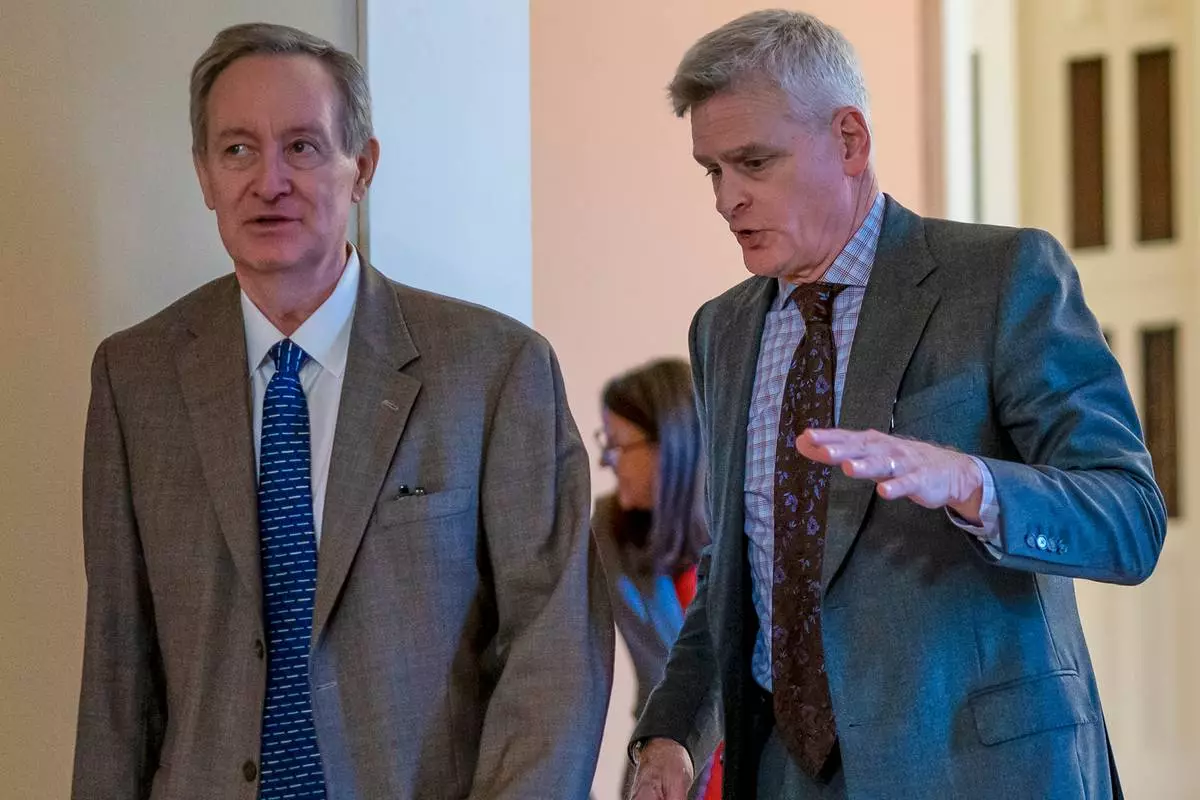
FILE - Sen. Mike Crapo, R-Idaho, left, and Sen. Bill Cassidy, R-La., emerge from a GOP meeting at the Capitol in Washington, Jan. 28, 2020. (AP Photo/J. Scott Applewhite, file)
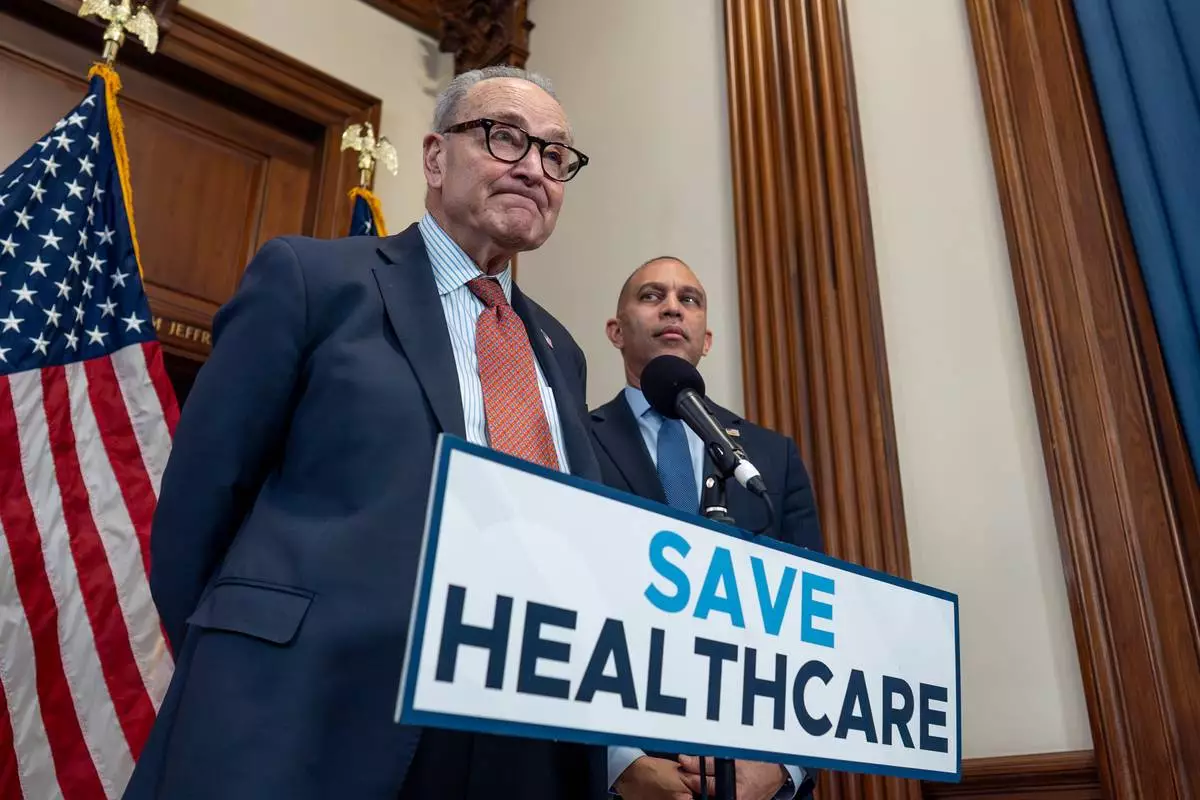
FILE - Senate Minority Leader Chuck Schumer, D-N.Y., left, and House Minority Leader Hakeem Jeffries, D-N.Y., meet with reporters to speak about health care affordability at the Capitol in Washington, Dec. 3, 2025. (AP Photo/J. Scott Applewhite, file)

FILE - Pages from the U.S. Affordable Care Act health insurance website healthcare.gov are seen on a computer screen in New York, Aug. 19, 2025. (AP Photo/Patrick Sison, File)
Senators clashed Thursday over President Donald Trump’s use of the National Guard in American cities, with Republicans defending the deployments as necessary to fight lawlessness and Democrats calling it an extraordinary abuse of military power that violates states’ rights.
The questioning of military officials before the Senate Armed Services Committee was the highest level of scrutiny, outside a courtroom, of Trump ’s use of the National Guard in U.S. cities since the deployments began.
Meanwhile, in a separate hearing, Homeland Security Secretary Kristi Noem was accused by House Democrats of habitually lying about the Trump administration’s immigration enforcement. The hearings came a day after the president faced another legal setback over efforts to send troops into U.S. cities against the objections of state and local officials.
The Latest:
The rejection essentially guarantees that millions of Americans will see a steep rise in costs at the beginning of the year.
Senators rejected a Democratic bill to extend the subsidies for three years and a Republican alternative that would have created new health savings accounts Thursday.
It’s an unceremonious end to a monthslong effort by Democrats to prevent the COVID-19-era subsidies from expiring on Jan. 1.
Ahead of the votes, Senate Democratic Leader Chuck Schumer warned Republicans that if they did not vote to extend the tax credits, “there won’t be another chance to act,” before premiums rise for many people.
Republicans have argued that Affordable Care Act plans are too expensive and need to be overhauled.
A presidentially appointed council’s long-awaited public meeting to announce recommended reforms to the Federal Emergency Management Agency has been canceled at the last minute, according to a source familiar with the matter who was not authorized to discuss the change publicly.
The FEMA Review Council was scheduled to meet Thursday afternoon. Noem, the council’s co-chair, abruptly left a congressional hearing early because she said she needed to go the meeting.
Trump created the FEMA Review Council by executive order in late January, the same day he proposed eliminating FEMA. He has repeatedly said he wants to push more responsibility for disaster recovery to states.
The White House, Department of Homeland Security and FEMA did not respond to questions about the meeting’s cancelation.
— Gabriela Aoun
Delia Ramirez, a Democrat from Illinois, accused Noem’s department of waging an “unaccountable, unlawful, unconstitutional” war against communities across the country.
Ramirez showed a number of videos of Noem talking and then repeatedly accused her of lying.
“Secretary Noem, you lie and you lie to the American people,” Ramirez said.
In one video, Noem said the agency focused on people in the country illegally, not American citizens while in another Noem said they were focusing on the “worst of the worst.”
Ramirez disputed those characterizations and said Noem lied with “impunity.”
The Senate has rejected a Republican bill to replace expiring Affordable Care Act subsidies with new health savings accounts. The legislation was a Republican alternative to Democratic legislation to extend the subsidies for three years.
Senators are now voting on the Democratic bill and are expected to reject it — meaning that the subsidies are likely to expire.
Noem defended the cancelation of billions of dollars in mitigation grants administered by the Federal Emergency Management Agency, saying the grants had been “weaponized to fund the Green New Deal and for climate change.”
The Trump administration in April canceled $3.6 billion in grants under the Building Resilient Infrastructure and Communities program, created under the first Trump administration to help communities harden infrastructure to mitigate damage from climate disasters.
Noem said FEMA is “deploying resources two times faster on average, than in history,” though a policy that she personally approve DHS expenditures of $100,000 or more has been widely criticized for slowing deployment of FEMA services and dollars.
Secretary Noem has left the hearing early.
Noem said she had to go to another meeting of a council that is offering suggestions on how to reform the Federal Emergency Management Agency.
As she walked out, Julie Johnson, a Democrat from Texas who was slated to question the secretary next, joked: “I’m just going to take the position that she was scared of my questions.”
As Noem walked out of the room, protesters trailed her down the hallway yelling “Shame on you!”
But Trump administration officials declined to make commitments on what authorities the president may use in the future to send National Guard troops from one state to another.
Sen. Tammy Duckworth, an Illinois Democrat, used the closing moments of the hearing to press the officials on whether National Guard troops will be deployed from other states beyond their current authority to protect federal facilities and officials, such as to conduct law enforcement activity.
Federal judges have blocked or limited troop deployments in Oregon, Illinois and California as the Trump administration has attempted to use troops to assist in its mass deportation goals.
Mark Ditlevson, a Trump administration official who oversees homeland defense, only said that any orders would be evaluated to make sure they are “100% legal.”
Russian President Vladimir Putin expressed solidarity with Maduro and told him “direct communication channels” between the countries “remain permanently open,” a Venezuelan government statement said.
Talking a day after the U.S. military seized an oil tanker off the Venezuela’s coast, Putin told Maduro that “Russia will continue to support Venezuela in its struggle to assert its sovereignty, international law, and peace throughout Latin America, making its diplomatic capabilities available to strengthen cooperation in these essential areas,” the Venezuelan government said.
The Kremlin said both leaders also discussed developing friendly bilateral ties and their commitment to joint projects in trade, economic, energy, financial, cultural, humanitarian, and other areas.
The Senate is voting on Republican legislation that would create new health savings accounts as health care subsidies for millions of Americans are set to expire Jan. 1.
The Senate is expected to reject the legislation, along with a second Democratic bill that would extend the Affordable Care Act tax credits.
Republicans say the savings accounts would replace the subsidies by giving money directly to consumers, instead of to insurance companies. Democrats say the GOP plan would lead to higher costs for consumers.
Democratic Leader Chuck Schumer warned that premiums will skyrocket unless Congress passes an extension of the subsidies. “If Republicans don’t climb aboard, there won’t be another chance to act,” Schumer said ahead of the votes.
Noem linked the seizure of an oil tanker off the Venezuelan coast to the Trump administration’s efforts to push back on “a regime that is systematically ... flooding our country with deadly drugs.” She said Trump administration officials had seized “enough lethal doses of cocaine to kill 177 million Americans.”
On Wednesday, Trump said the United States had seized the tanker as tensions mount with the government of Venezuelan President Nicolás Maduro.
Trump has broadly justified a regional military buildup and a series of deadly strikes on alleged drug-carrying boats in the Caribbean as necessary to stem the flow of fentanyl and other illegal drugs into the U.S.
House Democratic identified members of the audience they said had family members who had been improperly treated by the immigration system.
Noem said she would review the cases of several called out by Rep. Seth Magaziner of Rhode Island. One, a combat veteran, appeared on a screen via a video call. Magaziner said the Purple Heart recipient had been deported earlier this year.
“You don’t seem to know how to tell the difference between the good guys and the bad guys,” Magaziner said to Noem.
Trump’s zero-tolerance immigration policy split more than 5,000 children from their families at the Mexico border during his first term, when images of babies and toddlers taken from the arms of mothers sparked global condemnation. Seven years later, families are being separated but in a much different way.
With illegal border crossings at their lowest levels in seven decades, a push for mass deportations is dividing families of mixed legal status inside the U.S. Federal officials and their local law enforcement partners are detaining tens of thousands of asylum-seekers and migrants. Detainees are moved repeatedly, then deported, or held in poor conditions for weeks or months before asking to go home.
The federal government was holding an average of more than 66,000 people in November, the highest on record.
▶ Read more about how immigrant families are being separated now.
Venezuelan opposition leader María Corina Machado said Thursday that “decisive” actions by the United States, including the seizure of an oil tanker, have left the repressive government of President Nicolás Maduro at its weakest point, and she vowed to return to the country to keep fighting for democracy.
Machado’s statements to reporters came hours after she appeared in public for the first time in 11 months, following her arrival in Norway’s capital, Oslo, where her daughter received the Nobel Peace Prize award on her behalf on Wednesday.
Trump’s actions “have been decisive to reach where we are now, where the regime is significantly weaker,” she said. “Because before, the regime thought it had impunity …. Now they start to understand that this is serious, and that the world is watching.”
Machado sidestepped questions on whether a U.S. military intervention is necessary to remove Maduro from power
▶ Read more about what the Nobel winner said in Oslo
The hearing quickly became heated over the tragic shooting of two National Guard members in Washington, D.C.
Thompson had begun questioning Noem over what he called the “unfortunate accident” when the secretary interrupted the ranking Democrat.
“Unfortunate accident?” Noem retorted. She called it a “terrorist attack.”
The interaction devolved from there as Thompson questioned her department’s approval of asylum claim that allowed the suspect to stay in the U.S.
Noem insisted it was the Biden administration’s vetting process that failed to properly screen the man who had worked alongside the U.S. military in Afghanistan.
Democrats on the Senate Armed Services Committee zeroed in Thursday on Trump’s statements that an “invasion within” or an “enemy within” justifies his guard deployments.
Gen. Gregory Guillot, who leads the military’s Northern Command, said “I do not have any indications of an enemy within.”
Charles Young, principal deputy general counsel for the Defense Department, said the Supreme Court has ruled that the president has the exclusive authority to decide whether an emergency exists.
Republican Sen. Tim Sheehy, a former Navy SEAL officer, argued during a Senate hearing that transnational crimes present enough of a risk to national security to justify military action, including on U.S. soil.
Sheehy claimed that there are foreign powers “actively attacking this country, using illegal immigration, using transnational crime, using drugs to do so.”
Air Force Gen. Gregory M. Guillot agreed with Sheehy’s assessment.
An attorney for the Pentagon declined to offer a clear answer when asked if a president could lawfully order the military to shoot protesters.
During a hearing Thursday on National Guard deployments in U.S. cities, Sen. Mazie Hirono, D-Hawaii, noted that former Defense Secretary Mark Esper alleged that Trump inquired about shooting protesters during the George Floyd demonstrations.
Hirono asked Charles L. Young III, principal deputy general counsel at the defense department, whether a presidential order to shoot protesters would be lawful.
Young said he was unaware of Trump’s comments and responded that the answer “would depend on the circumstances.”
“We have a president who doesn’t think the rule of law applies to him,” Hirono said in response.
U.S. District Judge Paula Xinis in Maryland ruled that Immigration and Customs Enforcement must release Abrego Garcia from custody immediately.
“Since Abrego Garcia’s return from wrongful detention in El Salvador, he has been re-detained, again without lawful authority,” the judge wrote. “For this reason, the Court will GRANT Abrego Garcia’s Petition for immediate release from ICE custody.”
The Salvadoran national has an American wife and child and has lived in Maryland for years, but he originally immigrated to the U.S. illegally as a teenager. An immigration judge in 2019 ruled Abrego Garcia could not be deported to El Salvador because he faced danger from a gang that targeted his family. When Abrego Garcia was mistakenly deported there in March, his case became a rallying point for those who oppose Trump’s immigration crackdown.
The secretary also levied broad criticism of the program that brought the man to the United States years before he allegedly shot two National Guard members.
Operation Allies Welcome was created by the Biden administration to save Afghan supporters from Taliban retribution after the U.S. military pullout from Afghanistan following 20 years of American intervention and billions of dollars of aid.
Spc. Sarah Beckstrom, was killed in the Washington shooting. Noem said Thursday that U.S. Air Force Staff Sgt. Andrew Wolfe, has been showing improvement.
Rahmanullah Lakanwal, a 29-year-old Afghan national who was also shot during the confrontation, has been charged with murder. He pleaded not guilty.
The top Democrat on the Senate Armed Services Committee, Sen. Jack Reed, questioned Air Force Gen. Gregory M. Guillot, the commander of U.S. troops in North America, on how he evaluates the lawfulness of orders.
Guillot said that he consults with military attorneys, raises any questions with the defense secretary and commanding military officers, and executes the order once he’s confident in its lawfulness.
This has become a pressing question under the Trump administration amid National Guard deployments to U.S. cities and a campaign to strike boats allegedly carrying drugs near Venezuela. The president has targeted Democratic lawmakers who released a video urging military and intelligence officers to refuse illegal orders.
“End deportations!” shouts one. “Stop ICE raids!” yells another.
The two people were escorted by Capitol Police out of the Homeland Security Committee hearing room.
Chairman Andrew Garbarino, R-N.Y., gaveled the panel back to order as Noem resumed her opening remarks.
Rep. Bennie Thompson, the ranking Democrat on the Homeland Security Committee, told the secretary she has diverted vast resources to carry out Trump’s “extreme” immigration agenda, and failed to provide basic responses to oversight questions from Congress.
“I call on you to resign,” the Mississippi congressman said. “Do a real service to the country.”
Air Force Gen. Gregory M. Guillot, the commander of U.S. troops in North America, told senators that National Guard troops are instructed not to perform many law enforcement activities like making arrests or searching for evidence of a crime. However, the troops are allowed to detain people if they deem the person to be putting others at risk.
Guillot said that one person was detained as part of Trump’s campaign to deploy National Guard troops to U.S. cities. The person was detained in June outside a federal facility in Los Angeles.
Homeland Security Secretary Kristi Noem is expected to face fierce questioning from Democrats Thursday as the public face of the Republican administration’s hard-line approach to immigration.
Since Noem last appeared in Congress in May, immigration enforcement operations in U.S. cities have become increasingly contentious, with federal agents and activists frequently clashing over her department’s tactics.
Noem is testifying in front of the House Committee on Homeland Security to discuss “Worldwide Threats to the Homeland,” which in years past have focused on issues such as cybersecurity, terrorism, China and border security. Thursday’s appearance is likely to focus heavily on immigration.
Sen. Tammy Duckworth of Illinois said Trump’s deployment of the National Guard into American cities is “deeply unpopular.”
“Most Americans don’t want this,” she said at the Senate Armed Services Committee hearing, adding that most of the Guard members don’t want these assignments, either.
“Our heroes did not sign up for this,” said Duckworth, a combat veteran who served in the Illinois National Guard.
She noted that she had threatened to hold up the annual defense bill if Republican leadership continued to block the hearing, which she said is long overdue. She said she has questions for the military about how Trump’s deployments are affecting readiness, training and costs.
The Republican chairman of the Senate Armed Services Committee is opening a hearing on Trump’s National Guard troop deployment to U.S. cities by asserting that crime is on the rise.
“In recent years, violent crime, rioting, drug trafficking and heinous gang activity have steadily escalated,” said Sen. Roger Wicker, a Mississippi Republican.
He added that the troop deployments are “not only appropriate, but essential.”
Democrats are expected to use the hearing to criticize the deployments as an inappropriate use of military troops.

This image from video posted on Attorney General Pam Bondi's X account, and partially redacted by the source, shows an oil tanker being seized by U.S. forces off the coast of Venezuela, Wednesday, Dec. 10, 2025. (U.S. Attorney General's Office/X via AP)

Sitting next to founder and CEO of Dell, Michael Dell, left, President Donald Trump speaks during a roundtable discussion with business leaders in the Roosevelt Room of the White House, Wednesday, Dec. 10, 2025, in Washington. (AP Photo/Evan Vucci)
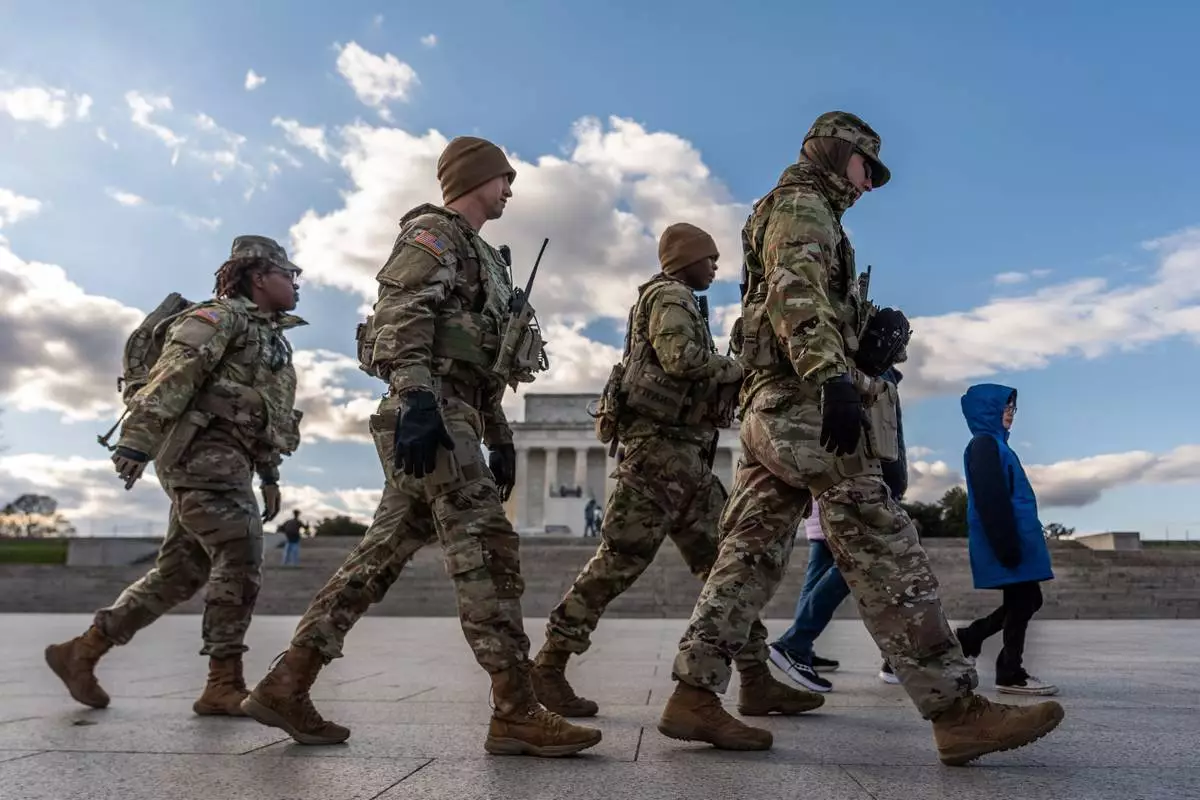
Members of the National Guard patrol in front of the Lincoln Memorial on the National Mall, Friday, Nov. 28, 2025, in Washington. (AP Photo/Julia Demaree Nikhinson)