BAGHDAD (AP) — United National Secretary-General Antonio Guterres was in Baghdad on Saturday to mark the end of the political mission set up in 2003 following the U.S.-led invasion of Iraq that toppled Saddam Hussein.
The U.N. Security Council, at Iraq’s request, voted last year to wind down the mandate of the United Nations Assistance Mission in Iraq (UNAMI), by the end of 2025. The mission was set up to coordinate post-conflict humanitarian and reconstruction efforts and help restore a representative government in the country.
Iraqi caretaker Prime Minister Mohammed Shia al-Sudani said his country “highly values” the mission's work in a region “that has suffered for decades from dictatorship, wars, and terrorism.” He said its conclusion showed Iraq had reached a stage of “full self-reliance.”
“Iraq emerged victorious thanks to the sacrifices and courage of its people,” he said in a joint statement with Guterres.
The ending of UNAMI’s mandate “does not signify the end of the partnership between Iraq and the U.N.,” Sudani said, adding that it represents the beginning of a new chapter of cooperation focused on development and inclusive economic growth.
The prime minister said a street in Baghdad would be named “United Nations Street” in honor of the U.N.’s work and in recognition of 22 U.N. staff who were killed in an Aug. 19, 2003, truck bomb attack on the Canal Hotel in Baghdad, which housed the U.N. headquarters.
Guterres praised “the courage, fortitude and determination of the Iraqi people” and the country's efforts to restore security and order after years of sectarian violence and the rise of extremist groups, including the Islamic State group, in the years after the 2003 invasion.
“Iraqis have worked to overcome decades of violence, oppression, war, terrorism, sectarianism and foreign interference,” the secretary-general said. “And today’s Iraq is unrecognizable from those times.”
Iraq “is now a normal country, and relations between the U.N. and Iraq will become normal relations with the end of UNAMI,” Guterres added. He also expressed appreciation for Iraq’s commitment to returning its citizens from the al-Hol camp, a sprawling tent camp in northeastern Syria housing thousands of people — mostly women and children — with alleged ties to the IS.
Guterres recently recommended former Iraqi President Barham Salih to become the next head of the U.N. refugee agency, the first nomination from the Middle East in half a century.
Salih’s presidential term, from 2018 to 2022, came in the immediate aftermath of the Islamic State group’s rampage across Iraq and the battle to take back the territory seized by the extremist group, including the key northern city of Mosul.
At least 2.2 million Iraqis were displaced as they fled the IS offensive. Many, particularly members of the Yazidi minority from the northern Sinjar district, remain in displacement camps today.
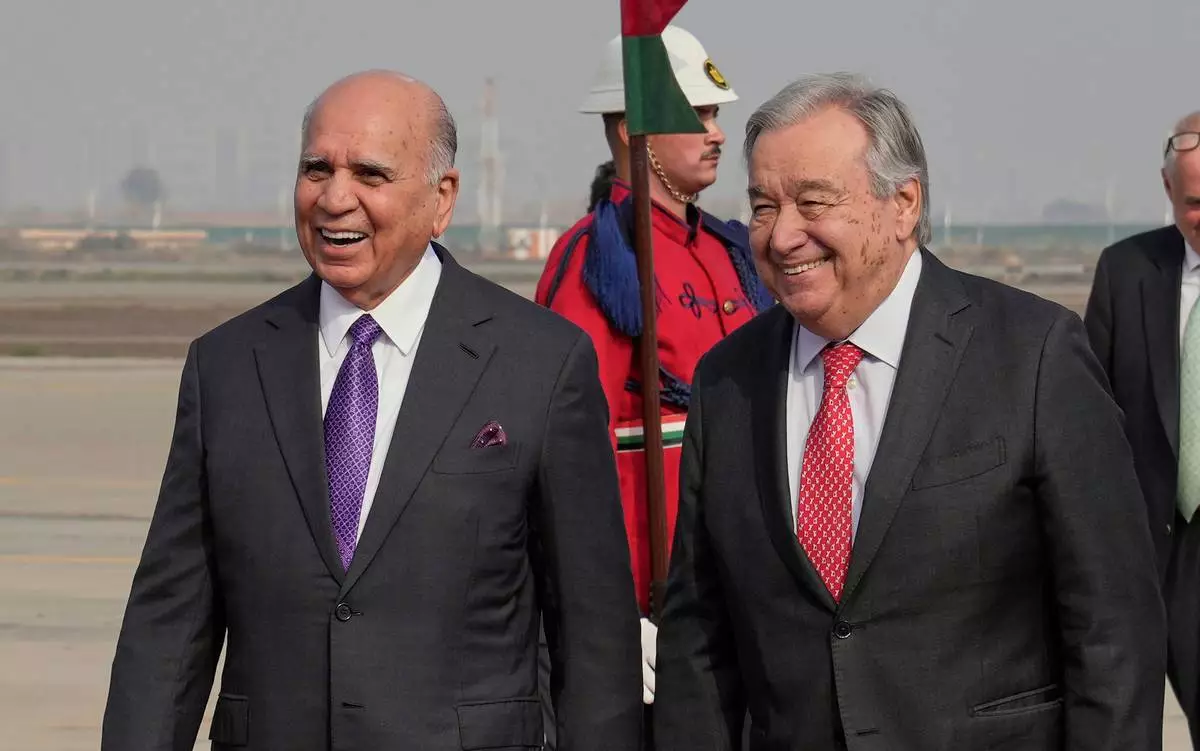
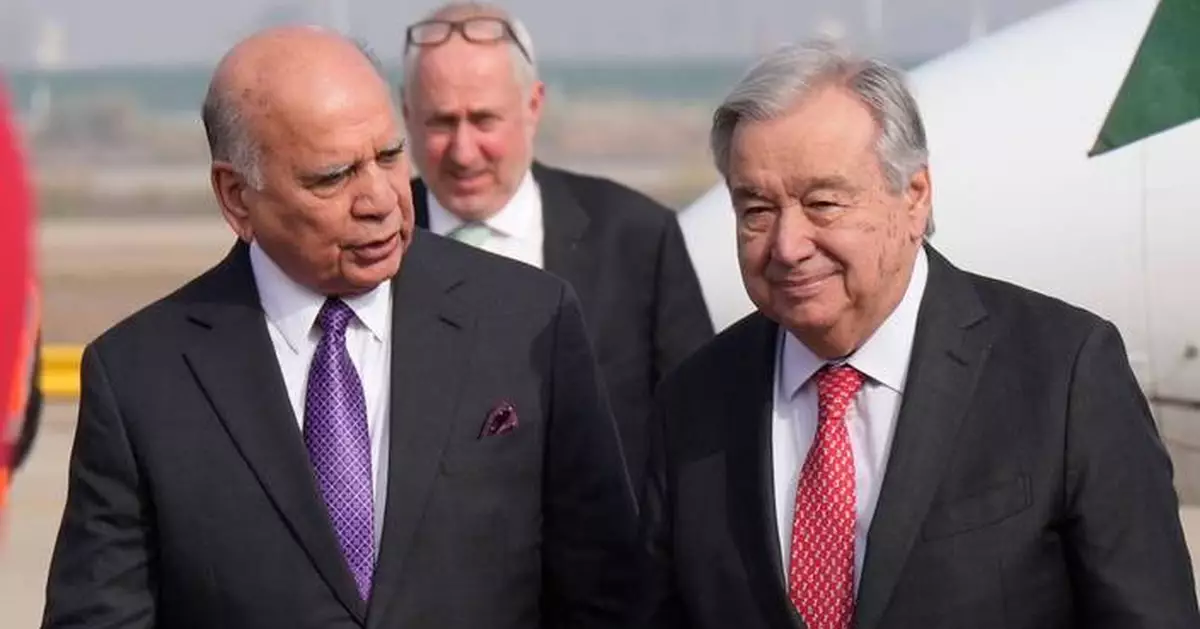
Iraqi Foreign Minister Fouad Hussein, left, greets United Nations Secretary-General Antonio Guterres at Baghdad airport, Iraq, Saturday, Dec. 13, 2025. (AP Photo/Hadi Mizban)
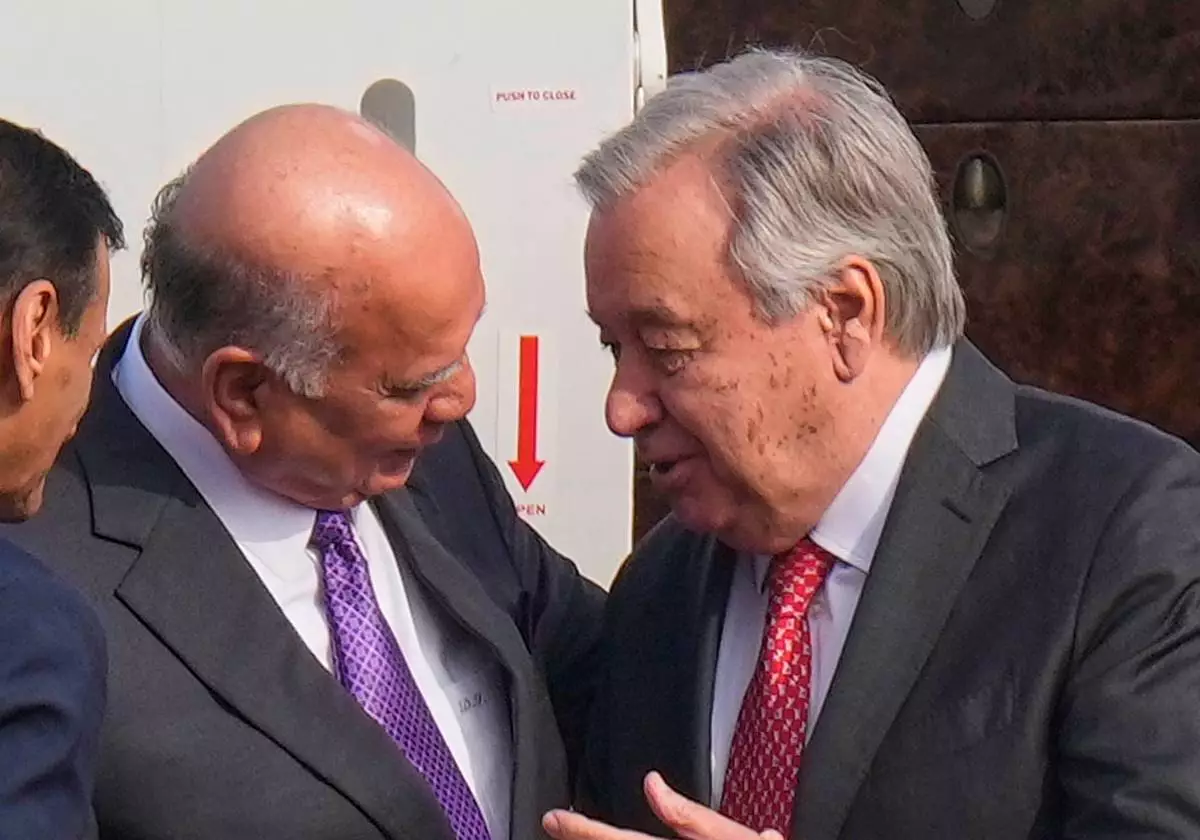
Iraqi Foreign Minister Fouad Hussein, left, greets United Nations Secretary-General Antonio Guterres, right, at Baghdad airport, Iraq, Saturday, Dec.13, 2025. (AP Photo/Hadi Mizban)
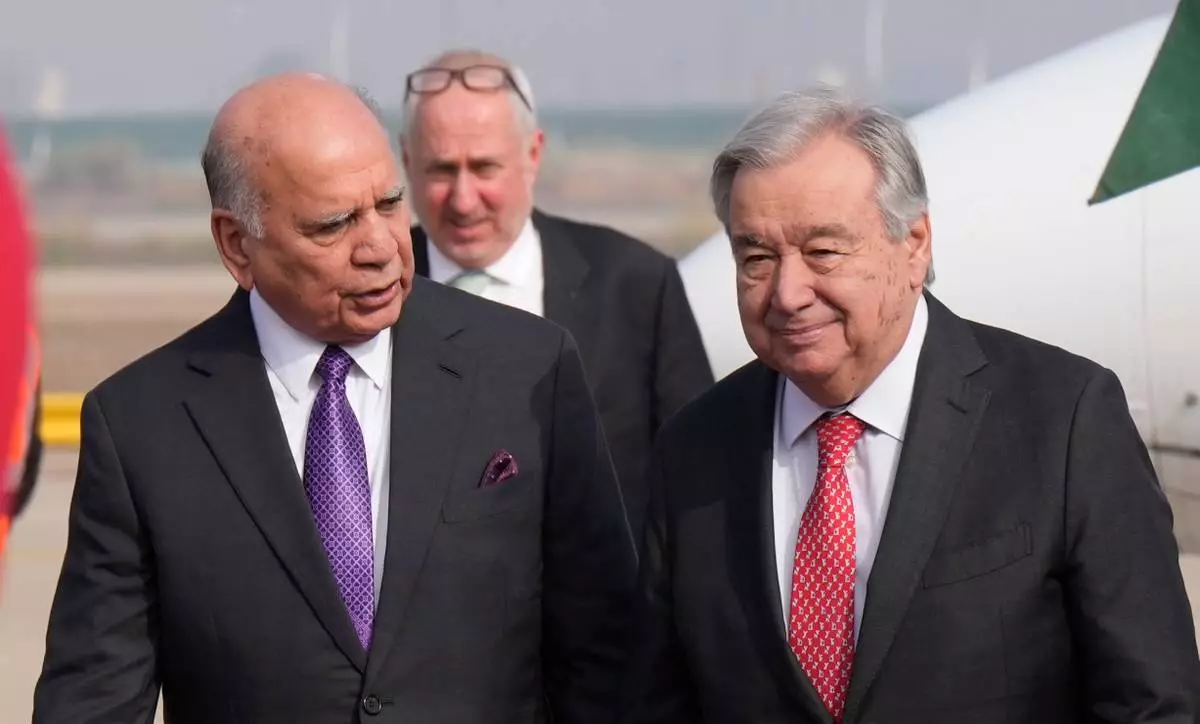
Iraqi Foreign Minister Fouad Hussein, left, greets United Nations Secretary-General Antonio Guterres, right, at Baghdad airport, Iraq, Saturday, Dec.13, 2025. (AP Photo/Hadi Mizban)
The Michigan synagogue that came under attack this week when an armed man drove his car into the building had for months been strengthening its security apparatus by hiring a seasoned police lieutenant as its security director and holding active shooter training.
That beefed up security, which came in response to rising antisemitism and other attacks at places of worship, is being credited with saving lives in an event that ended with only the attacker dying.
An armed, private security guard shot back at the attacker after he opened fire through his windshield in a hallway inside the building. When the car barreled in, there were 140 students inside in an early childhood learning center. All were unscathed.
The car’s engine caught fire, and the gunman, Ayman Mohammad Ghazali, a Lebanese-born U.S. citizen, eventually used his own weapon to fatally shoot himself, according to Jennifer Runyan, the special agent in charge of the FBI’s Detroit field office.
“If they had not done their job almost perfectly we would be talking about an immense tragedy here today with children gone," U.S. Sen. Elissa Slotkin said of the building's security.
Michigan Gov. Gretchen Whitmer added: “These heroes threw themselves in harm’s way, engaging a suspect.”
One of Temple Israel's rabbis said “it was only a miracle" that none of its members were hurt.
“Unfortunately the entire Jewish community, no matter where we are in the world, we have to plan for things like this,” Temple Israel Rabbi Jennifer Kaluzny told CNN.
The effort to bolster security at Temple Israel, outside Detroit, came as many houses of worship have undergone similar efforts, with leaders working to fortify facilities in the wake of deadly attacks. Synagogues around the world have increased protections after the U.S. and Israel launched a war with Iran.
The synagogue last June hired a former police lieutenant, Danny Phillips, to lead its in-house armed security guards as the head of security, with the temple saying it was taking a proactive step “in response to the evolving realities facing Jewish communities."
Phillips served in law enforcement for almost three decades, including more than 20 years as his department's advanced firearm instructor, according to the website of a local college where he teaches a police academy course on responding to active assailants.
And in January, Temple Israel's staff and clergy participated in an active shooter prevention and preparedness training led by an FBI official, according to the synagogue's social media accounts.
Oakland County Sheriff Mike Bouchard said on Thursday that he had contacted the head of security for the temple just two days before the attack. He credited the thorough preparation ahead of the attack as the reason that there weren’t casualties.
Ron Amann, a member of the safety team at CrossPointe Community Church in Wayne, Michigan, not far from the temple, is still recovering after being shot in the leg by a man who tried to attack the Christian church last June. The gunman was killed by another team member before he could enter a Sunday service.
Amann, who was armed, said he passed his grandson to his wife when he heard a woman yell, “There’s a man with a gun.”
“When you sign up for the safety team you have to be willing to stand up and fight, bluntly, rather than run the other direction,” said Amann, 64, who has a metal rod in his lower right leg.
“My alertness is just at a higher level than it ever was before,” he said. “The events at the synagogue just keep bringing it back to the forefront. I’m certainly saddened by all that.”
CrossPointe church is 30 miles (48.2 kilometers) from the synagogue. But Pastor Bobby Kelly said he and his staff sheltered in place Thursday when they heard about the attack. Police even drove around the church.
“When you hear of something happening,” Kelly said, “you don’t know where it’s going to happen next.”
Izaguirre reported from Albany, N.Y. White reported from Detroit.
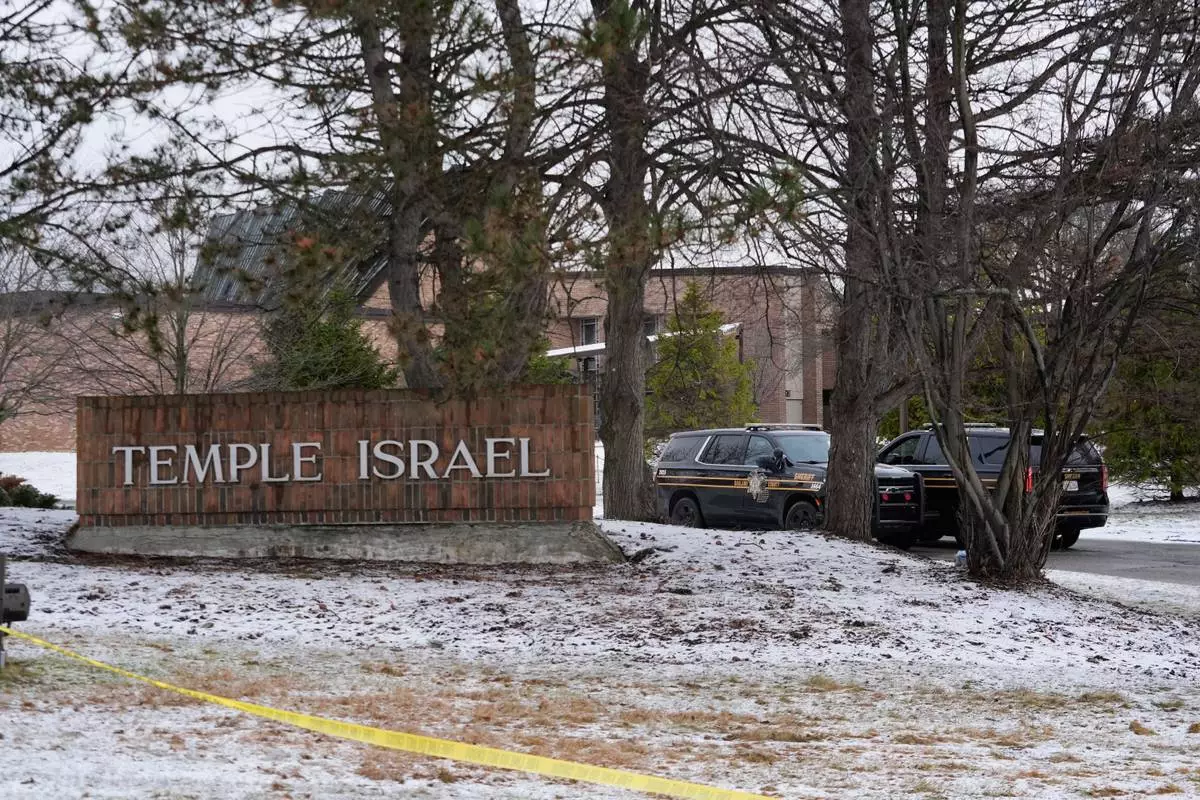
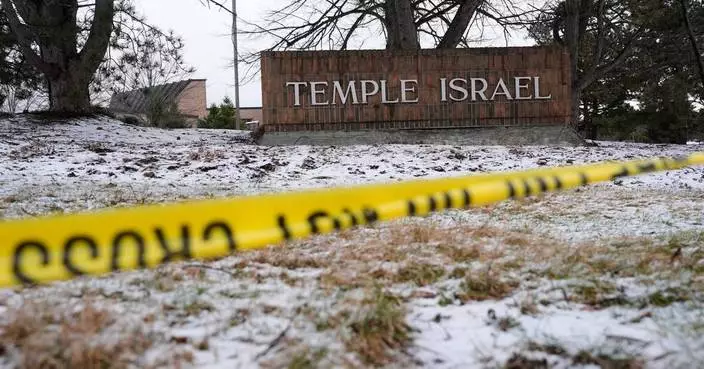
Police vehicles sit outside the Temple Israel synagogue Friday, March 13, 2026, in West Bloomfield Township, Mich. (AP Photo/Paul Sancya)