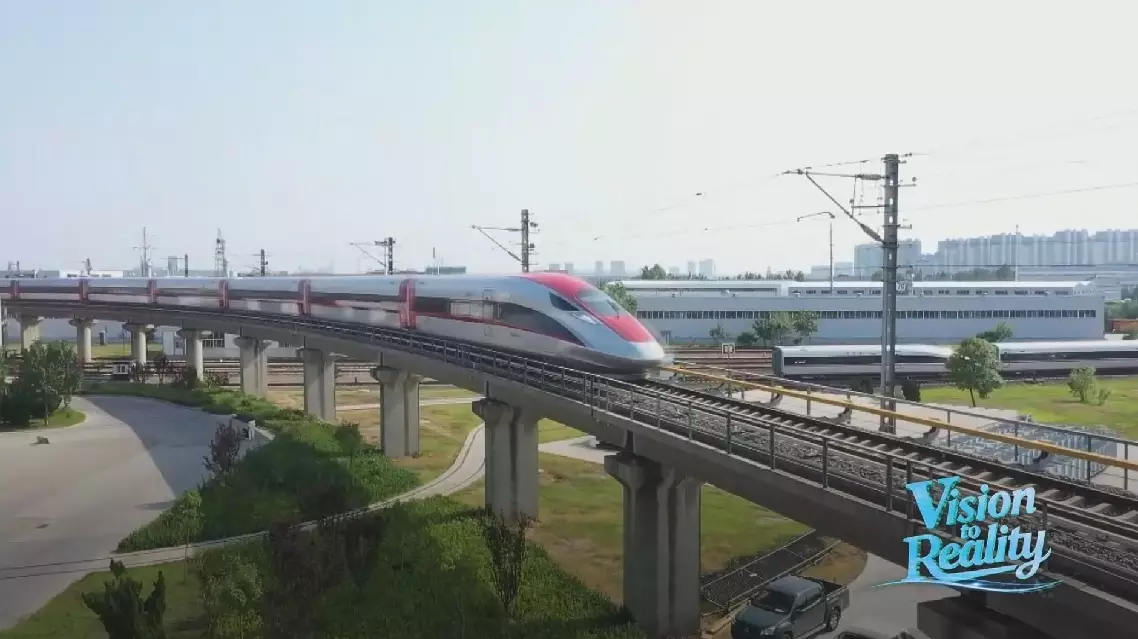
China's fleet of bullet trains "Fuxing Hao" -- state-of-the-art locomotives capable of 350 kilometers per hour -- is transforming how people move across the country and powering a new era of rail innovation during the 14th Five-Year Plan period (2021-2025).
During the 40-day Spring Festival rush early this year, China's rail system handled over 500 million passengers. Every day during the period, more than 14,000 trains crisscrossed the country, bringing people home.
"Now, with better policies and the country's economic development, we're also enjoying the benefits it brings us. I think it's really great -- everything feels okay and genuinely good," said a passenger on a high-speed railway in Chengdu.
China's high-speed rail network now stretches a whopping 47,000 kilometers, enough to circle the globe.
Qingdao City in east China's Shandong Province is a key manufacturing hub for the country's iconic Fuxing Hao fleet.
Lin Peng, a chief technical expert of Chinese state-owned train maker CRRC, elaborated on the design of the high-speed train.
Lin said the design of the train exterior was inspired by a flying dragon. The nose shape of the Fuxing series draws from the image of a traditional Chinese dragon.
That same creativity now travels the world. Every Fuxing train that goes abroad combines elements of local character with Chinese craftsmanship.
"These two models, designed for export, need to meet the local cultural needs of overseas customers, and their color schemes are tailored accordingly. For example, the color scheme for the trains used on the Jakarta-Bandung High-Speed Railway incorporates elements of the local rainforest and the colors of Komodo dragons.," Lin said.
Behind the elegance, artificial intelligence and smart diagnostics predict maintenance before problems appear, making the rides safer, greener, and more reliable.
Lin said a Fuxing train carries nearly 2,000 sensors, creating a "digital twin" that monitors every journey in real time.
"The number of sensors is dynamically adjusted according to the operational needs of the train. An increase in the number of sensors means it can monitor a wider range of areas and collect data across more dimensions. This is equivalent to conducting deeper health checks of the train," he said.
China's push for intelligent rail systems isn't just transforming domestic travel, and it's also setting global standards.
Knorr-Bremse, a century-old German pioneer in rail braking systems, is working closely with Chinese partners to shape the future of mobility.
"Currently, China is leading its digital transformation, with national focus on 5G, AI, and BeiDou (Navigation Satellite System). Railways here have become a real-world lab for next-generation mobility. We're already applying AI to real-time data from braking adore systems to predictive maintenance, cutting downtime and boosting safety," said Jonathan Paddison, a member of the board at Knorr-Bremse Asia Pacific.
From the icy northeast to tropical Hainan, each Fuxing Hao train is built to endure, allowing Chinese high-speed rail to thrive in every climate.
"For a single train, we have to make it tough enough to handle extreme temperatures, resist corrosion, and withstand sandstorms in desert areas. We will strengthen each train based on the specific environments it will run in," Lin said.
Cutting-edge technologies designed for enhanced ride comfort are in line with the 14th Five-Year Plan's emphasis on quality infrastructure. It is expected that over the next five years, trains will not only be faster, but also greener and smarter.
China's high-speed trains lead domestic, global rail transport innovation