|
- China and Türkiye projected to rise in popularity as global destinations among travellers from Southeast Asia and Europe
- Entertainment-led travel set to surge globally, including visits to amusement parks, concerts and franchise-themed attractions
- Travellers seeking nature, culture and immersive experiences across attractions
SINGAPORE, Dec. 15, 2025 /PRNewswire/ -- Trip.com Group today announced the top global travel trends for 2026, spotlighting leading destinations, standout attractions and events, and the evolving motivations influencing traveller motivations around the world.
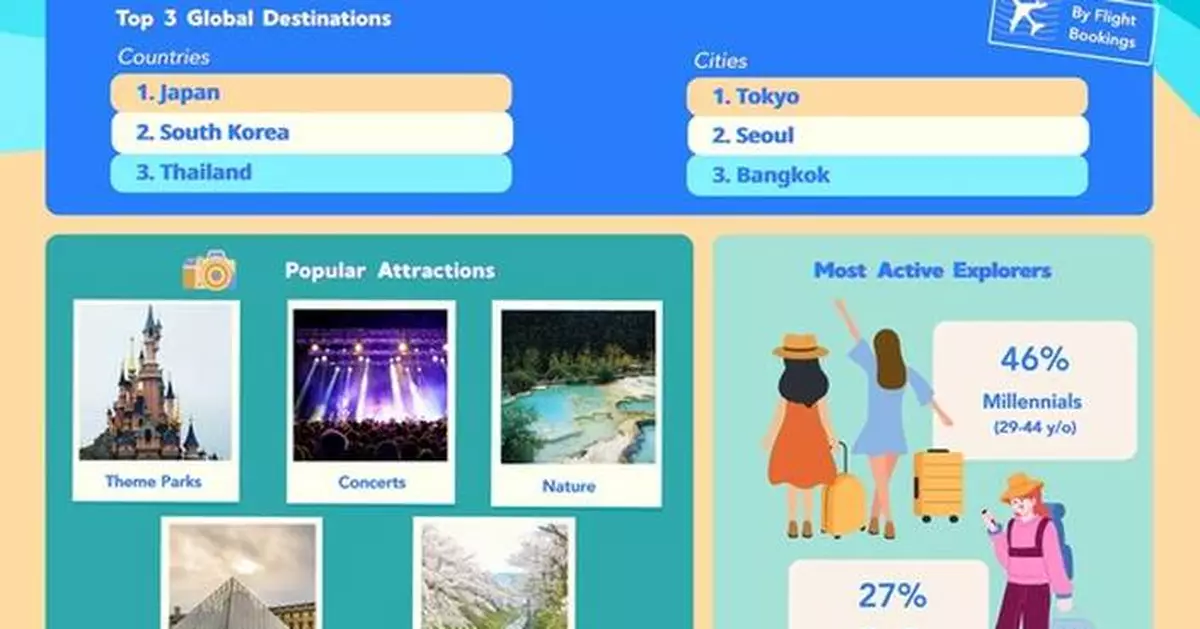
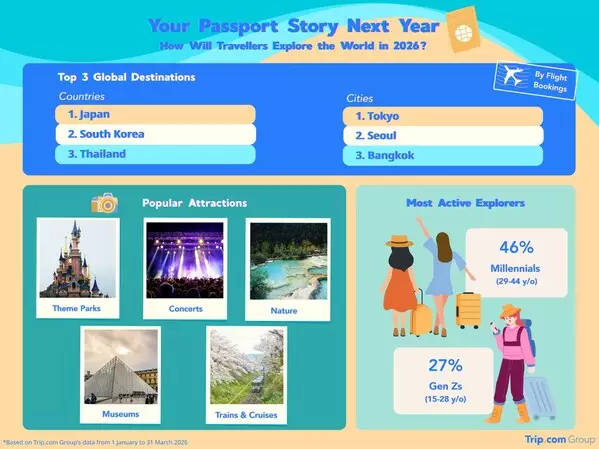
Leading Global Destinations: Japan, South Korea and Thailand
Based on Trip.com Group's 2026 booking data, Japan is set to dominate as a top destination of choice next year, consistently ranked in the top three outbound destinations booked by travellers worldwide, including those from Indonesia, Malaysia, Singapore, South Korea and Thailand. Its two major cities – Tokyo and Osaka – are expected to see high demand from tourists globally, and likely to make it to the top 10 list of cities that international travellers plan to visit next year.
Other popular destinations that are set to make their way into 2026 travel itineraries include China, Thailand, the United Kingdom and Vietnam.
Millennials or those aged 29 to 44 will form the largest group of travellers next year, and will contribute to almost half of the booking volume, followed by Gen Zs who are aged 15 to 28[1].
Destinations Rising in Popularity: China and Türkiye
In recent years, China has emerged as a travel favourite with its broad appeal, rich cultural heritage and range of unique experiences. Trip.com's latest booking data shows that China is projected to be one of the fastest-growing and leading travel destinations among Southeast Asian (SEA) travellers in 2026, with triple-digit year-on-year growth expected in flight bookings across several SEA markets[2]. In particular, travellers from Malaysia, Singapore and Thailand are on track to become the top source markets heading to China next year.
While major Chinese cities like Shanghai, Guangzhou and Chengdu are predicted to be the most popular among SEA travellers, cities such as Beijing, Harbin, Chongqing, Shenzhen and Xi'an are also likely to enjoy greater appeal, with flight bookings from SEA projected to surge year-on-year.
This trend is expected to be similarly seen in Europe, as more look to explore further beyond the region. Destinations in Asia, such as China, Japan, Thailand and Türkiye, are slated to be some of the top holiday choices for European tourists next year.
Notably, travellers from the United Kingdom (UK) are set to rank among the top ten source markets heading to China in 2026, while Thailand and Türkiye are on track to become the top two outbound destinations for German travellers.
Entertainment Boom: Theme Parks, Immersive Shows and Concert Travel
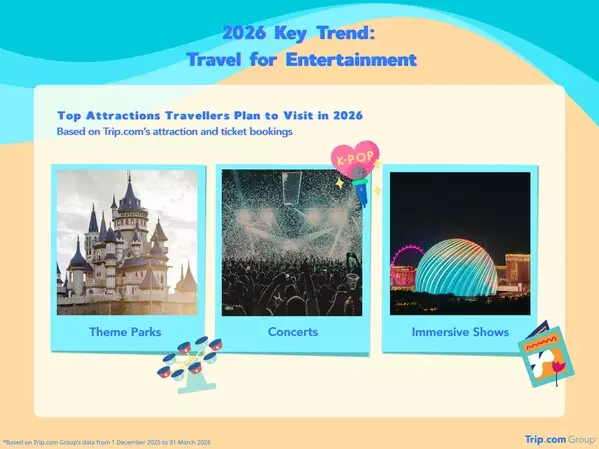
Across Asia, iconic theme parks such as Shanghai Disneyland Resort, Hong Kong Disneyland, and Universal Studios Japan will continue to drive tourism, ranked among the top attractions that travellers have on their 2026 itineraries.
Fan-driven attractions, such as Harry Potter studio tours and K-pop concerts, like Seventeen and Taemin, are expected to be highly sought after by international travellers, especially those coming from South Korea. Experiences based on well-loved global franchises such as Jurassic World: The Experience in Thailand and the EVANGELION Anniversary Exhibition in Tokyo are also set to be some of the top attractions travellers plan to visit next year.
In addition, travellers will be looking for more entertainment-led experiences when they go abroad, such as immersive shows and performances. Globally recognised productions such as Aladdin the Musical, Broadway shows (New York), The Sphere (Las Vegas) and The House of Dancing Water (Macau) are likely to be popular among international travellers[3].
Attraction Trends: Nature, Culture and Alternative Journeys
A trend that will emerge among travellers from SEA and Germany is nature and adventure tourism, where interest to destinations like New Zealand and China will see an upward trend. Scenic spots like Milford Sound and the Glowworm Caves in New Zealand, as well as Wulong Karst in China, are on track to be some of the top attractions for these travellers next year.
Other nature-based attractions in China such as the Chimelong Safari Park in Guangzhou, as well as Mount Siguniang, Bipenggou and Huanglong National Scenic Area in Sichuan, are also set to be highly in demand with SEA travellers.
In Europe, travellers will be keen to immerse themselves in the region's rich history, with cultural hubs such as the Louvre Museum in Paris, Sagrada Familia in Barcelona and Grossmünster in Zurich among the top-booked attractions for next year.
A predictive trend for next year is the rise of train and cruise journeys, where Trip.com Group's latest booking data suggests an increased interest in the scenic Arashiyama Sagano Romantic Train among Vietnamese travellers, while luxury cruises, such as Royal Princess Cruise and Opulence Cruise, are likely to be popular among German travellers[4].
Rising Popularity of Self-driving Trips and EVs
Increasingly, travellers are becoming aware of their carbon footprint and are seeking more sustainable options when it comes to getting from place to place.
Trip.com's latest data shows that since the display of carbon labels in April 2025, there has been a steady growth of booking orders for electric car rentals month-on-month, significant especially in Norway, Australia and Japan. Fuelling this growth are travellers from Japan, Thailand, the US, South Korea and Australia.
This is likely due to an overall increased interest in self-driving trips. In Europe and Australia, Asian travellers, especially those from South Korea, are choosing electric cars as their preferred mode of transport to explore at their own pace and comfort[5].
2025 Wrapped: Who Travelled the Most This Year?
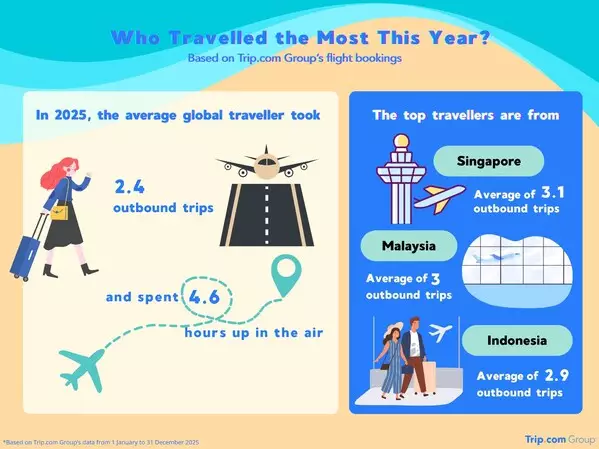
With 2025 coming to a close, Trip.com Group has also unveiled its 2025 travel wrap-up, crowning the most seasoned travellers for the year. Based on recent data, the average global traveller took 2.4 outbound flights this year, and the average flight duration travelled is 4.6 hours. Travellers departing from Southeast Asia, including Singapore, Malaysia and Indonesia are some of the top jet-setters, with an average of 3 or more outbound flights taken per person in 2025. Meanwhile, travellers from the UK and Germany spent the most time on flight this year, with an average flight duration of 5.7 hours or more per person[6].
About Trip.com Group
Trip.com Group is a leading global travel service provider comprising of Trip.com , Ctrip, Skyscanner, and Qunar. Across its platforms, Trip.com Group helps travellers around the world make informed and cost-effective bookings for travel products and services and enables partners to connect their offerings with users through the aggregation of comprehensive travel-related content and resources, and an advanced transaction platform consisting of apps, websites and 24/7 customer service centres. Founded in 1999 and listed on NASDAQ in 2003 and HKEX in 2021, Trip.com Group has become one of the best-known travel groups in the world, with the mission "to pursue the perfect trip for a better world". Find out more about Trip.com Group here: group.trip.com.
Follow us on: X , Facebook , LinkedIn , and YouTube .
| [1] Based on Trip.com Group's flight booking data from 1 January to 31 March 2026.
[2] Based on Trip.com's flight booking data from 1 January to 31 March 2026 and 1 January to 31 March 2025.
[3] Based on Trip.com Group's attractions booking data from 1 December 2025 to 31 March 2026.
[4] Based on Trip.com Group's attractions booking data from 1 December 2025 to 31 March 2026.
[5] Based on Trip.com's car rental booking data from 1 January 2025 to 15 October 2025.
[6] Based on Trip.com Group's flight booking data from 1 December 2025 to 31 December 2025. |
- China and Türkiye projected to rise in popularity as global destinations among travellers from Southeast Asia and Europe
- Entertainment-led travel set to surge globally, including visits to amusement parks, concerts and franchise-themed attractions
- Travellers seeking nature, culture and immersive experiences across attractions
SINGAPORE, Dec. 15, 2025 /PRNewswire/ -- Trip.com Group today announced the top global travel trends for 2026, spotlighting leading destinations, standout attractions and events, and the evolving motivations influencing traveller motivations around the world.
Leading Global Destinations: Japan, South Korea and Thailand
Based on Trip.com Group's 2026 booking data, Japan is set to dominate as a top destination of choice next year, consistently ranked in the top three outbound destinations booked by travellers worldwide, including those from Indonesia, Malaysia, Singapore, South Korea and Thailand. Its two major cities – Tokyo and Osaka – are expected to see high demand from tourists globally, and likely to make it to the top 10 list of cities that international travellers plan to visit next year.
Other popular destinations that are set to make their way into 2026 travel itineraries include China, Thailand, the United Kingdom and Vietnam.
Millennials or those aged 29 to 44 will form the largest group of travellers next year, and will contribute to almost half of the booking volume, followed by Gen Zs who are aged 15 to 28[1].
Destinations Rising in Popularity: China and Türkiye
In recent years, China has emerged as a travel favourite with its broad appeal, rich cultural heritage and range of unique experiences. Trip.com's latest booking data shows that China is projected to be one of the fastest-growing and leading travel destinations among Southeast Asian (SEA) travellers in 2026, with triple-digit year-on-year growth expected in flight bookings across several SEA markets[2]. In particular, travellers from Malaysia, Singapore and Thailand are on track to become the top source markets heading to China next year.
While major Chinese cities like Shanghai, Guangzhou and Chengdu are predicted to be the most popular among SEA travellers, cities such as Beijing, Harbin, Chongqing, Shenzhen and Xi'an are also likely to enjoy greater appeal, with flight bookings from SEA projected to surge year-on-year.
This trend is expected to be similarly seen in Europe, as more look to explore further beyond the region. Destinations in Asia, such as China, Japan, Thailand and Türkiye, are slated to be some of the top holiday choices for European tourists next year.
Notably, travellers from the United Kingdom (UK) are set to rank among the top ten source markets heading to China in 2026, while Thailand and Türkiye are on track to become the top two outbound destinations for German travellers.
Entertainment Boom: Theme Parks, Immersive Shows and Concert Travel
Across Asia, iconic theme parks such as Shanghai Disneyland Resort, Hong Kong Disneyland, and Universal Studios Japan will continue to drive tourism, ranked among the top attractions that travellers have on their 2026 itineraries.
Fan-driven attractions, such as Harry Potter studio tours and K-pop concerts, like Seventeen and Taemin, are expected to be highly sought after by international travellers, especially those coming from South Korea. Experiences based on well-loved global franchises such as Jurassic World: The Experience in Thailand and the EVANGELION Anniversary Exhibition in Tokyo are also set to be some of the top attractions travellers plan to visit next year.
In addition, travellers will be looking for more entertainment-led experiences when they go abroad, such as immersive shows and performances. Globally recognised productions such as Aladdin the Musical, Broadway shows (New York), The Sphere (Las Vegas) and The House of Dancing Water (Macau) are likely to be popular among international travellers[3].
Attraction Trends: Nature, Culture and Alternative Journeys
A trend that will emerge among travellers from SEA and Germany is nature and adventure tourism, where interest to destinations like New Zealand and China will see an upward trend. Scenic spots like Milford Sound and the Glowworm Caves in New Zealand, as well as Wulong Karst in China, are on track to be some of the top attractions for these travellers next year.
Other nature-based attractions in China such as the Chimelong Safari Park in Guangzhou, as well as Mount Siguniang, Bipenggou and Huanglong National Scenic Area in Sichuan, are also set to be highly in demand with SEA travellers.
In Europe, travellers will be keen to immerse themselves in the region's rich history, with cultural hubs such as the Louvre Museum in Paris, Sagrada Familia in Barcelona and Grossmünster in Zurich among the top-booked attractions for next year.
A predictive trend for next year is the rise of train and cruise journeys, where Trip.com Group's latest booking data suggests an increased interest in the scenic Arashiyama Sagano Romantic Train among Vietnamese travellers, while luxury cruises, such as Royal Princess Cruise and Opulence Cruise, are likely to be popular among German travellers[4].
Rising Popularity of Self-driving Trips and EVs
Increasingly, travellers are becoming aware of their carbon footprint and are seeking more sustainable options when it comes to getting from place to place.
Trip.com's latest data shows that since the display of carbon labels in April 2025, there has been a steady growth of booking orders for electric car rentals month-on-month, significant especially in Norway, Australia and Japan. Fuelling this growth are travellers from Japan, Thailand, the US, South Korea and Australia.
This is likely due to an overall increased interest in self-driving trips. In Europe and Australia, Asian travellers, especially those from South Korea, are choosing electric cars as their preferred mode of transport to explore at their own pace and comfort[5].
2025 Wrapped: Who Travelled the Most This Year?
With 2025 coming to a close, Trip.com Group has also unveiled its 2025 travel wrap-up, crowning the most seasoned travellers for the year. Based on recent data, the average global traveller took 2.4 outbound flights this year, and the average flight duration travelled is 4.6 hours. Travellers departing from Southeast Asia, including Singapore, Malaysia and Indonesia are some of the top jet-setters, with an average of 3 or more outbound flights taken per person in 2025. Meanwhile, travellers from the UK and Germany spent the most time on flight this year, with an average flight duration of 5.7 hours or more per person[6].
About Trip.com Group
Trip.com Group is a leading global travel service provider comprising of Trip.com , Ctrip, Skyscanner, and Qunar. Across its platforms, Trip.com Group helps travellers around the world make informed and cost-effective bookings for travel products and services and enables partners to connect their offerings with users through the aggregation of comprehensive travel-related content and resources, and an advanced transaction platform consisting of apps, websites and 24/7 customer service centres. Founded in 1999 and listed on NASDAQ in 2003 and HKEX in 2021, Trip.com Group has become one of the best-known travel groups in the world, with the mission "to pursue the perfect trip for a better world". Find out more about Trip.com Group here: group.trip.com.
Follow us on: X , Facebook , LinkedIn , and YouTube .
[1] Based on Trip.com Group's flight booking data from 1 January to 31 March 2026.
[2] Based on Trip.com's flight booking data from 1 January to 31 March 2026 and 1 January to 31 March 2025.
[3] Based on Trip.com Group's attractions booking data from 1 December 2025 to 31 March 2026.
[4] Based on Trip.com Group's attractions booking data from 1 December 2025 to 31 March 2026.
[5] Based on Trip.com's car rental booking data from 1 January 2025 to 15 October 2025.
[6] Based on Trip.com Group's flight booking data from 1 December 2025 to 31 December 2025.
** The press release content is from PR Newswire. Bastille Post is not involved in its creation. **
Trip.com Group Reveals Travel Trends for 2026
Trip.com Group Reveals Travel Trends for 2026
Trip.com Group Reveals Travel Trends for 2026
SHENZHEN, China, April 1, 2026 /PRNewswire/ -- On March 30, Delonix Group presented two new initiatives at its 2026 strategy conference: Genie AI, embedded in its Betterwood App, and a customer experience framework known as the Heavenly Stems & Earthly Branches Model.
Individually, they resemble product and service upgrades. Taken together, they suggest something more structural: an attempt to replace the logic on which the hospitality industry has operated for decades.
For most of its modern history, the sector has been governed by a simple equation—growth through physical expansion. More rooms, better locations, higher occupancy. Scale was both strategy and moat.
That equation is beginning to break.
Chairman Zheng Nanyan framed the shift not as cyclical, but structural. The convergence of maturing consumer expectations and rapidly deployable AI systems is eroding the effectiveness of asset-led growth. Standardization, once a tool for efficiency, now produces indistinguishable experiences. Capital intensity, long tolerated, is becoming a constraint.
What is emerging in its place is not a more efficient version of the same model, but a different organizing principle altogether: demand, not supply, as the system's point of origin.
From Capacity to Interpretation
In this emerging model, the central problem is no longer how to build and fill capacity, but how to interpret and respond to fragmented, real-time customer intent.
This is where Delonix is positioning Genie AI.
Unlike most applications of AI in hospitality—which tend to sit at the interface level—Genie AI is designed to sit in the middle of the system, between intent and execution. It does not simply respond to requests; it structures them.
A guest interaction—whether through app input or voice—is translated into a sequence of executable tasks, routed through a centralized decision layer, and distributed to the nearest available human resource, before feeding back into the system as data.
The technical architecture is not unprecedented. What is notable is the ambition to make it foundational.
If it works as intended, service ceases to be a function of individual responsiveness and becomes instead a property of the system itself. Variability, historically managed after the fact, is designed out at the level of coordination.
In that sense, AI is no longer augmenting service. It is defining its boundaries.
Standardization Was the Solution. Now It Is the Constraint.
The industry's previous growth model depended on standardization: replicable rooms, predictable services, consistent delivery across locations. This enabled scale, but at the cost of differentiation.
As consumer expectations evolve, that trade-off is becoming less acceptable.
Delonix's response is not to abandon standardization, but to layer variability on top of it—systematically.
The Heavenly Stems & Earthly Branches Model introduces a framework in which products and services are no longer fixed configurations, but evolving modules. Customer interaction becomes an input into how the product itself is iterated over time.
The implication is subtle but significant.
Hotels are no longer static assets with service attached. They become adaptive systems, where the product is continuously reshaped by usage.
For customers, this promises a form of progression—an experience that accumulates rather than resets. For operators and investors, it suggests a shift from one-off capital deployment to ongoing, incremental reconfiguration.
In both cases, the underlying assumption is the same: value is not embedded in the asset, but generated through interaction.
Control Shifts to the System Layer
What ties these elements together is not technology alone, but control.
In the traditional model, control resided in assets—ownership, location, physical scale. In the emerging model, it moves upward, into the system layer that interprets demand, allocates resources, and continuously adjusts the product.
This shift has implications beyond efficiency.
A system that can interpret intent, coordinate execution, and learn from outcomes begins to set the terms of competition. The advantage no longer lies in having more assets, but in having a better system for deciding how those assets are used.
In that sense, AI is not just infrastructure. It is governance.
An Industry at the Edge of Repricing
China's broader push to integrate AI into industrial and consumer systems provides the backdrop for this shift. Policy frameworks such as the State Council's "AI+" initiative are accelerating deployment, but the more consequential changes are happening at the level of business models.
Hospitality is one of the more exposed sectors.
As the marginal return on physical expansion declines, and as customer expectations become more fluid, the industry is moving toward a repricing of what constitutes value. Scale, once the primary moat, is becoming easier to replicate and harder to defend.
What replaces it is still being defined.
Delonix's approach offers one possible direction: treating demand as a continuously generated input, and building systems capable of capturing and compounding it. Whether this model proves durable remains to be seen. But its premise is clear.
The future of hospitality may depend less on how hotels are built, and more on how they think.
About Delonix Group
Delonix Group is a leading international hospitality and experiential consumption group in the Asia-Pacific region. Ranked 14th globally, the Group partnered with Marriott International to launch the world's first dual-branded luxury property: MajesTang Hotel • A Tribute Portfolio Hotel, while independently creating MaisonLee, a Tang-inspired premium business travel brand. As one of the first Chinese hotel groups to expand overseas, Delonix has established a presence in high-potential markets such as Japan and Indonesia, now spanning more than 200 cities worldwide. Its portfolio encompasses Swiss-Belhotel, Artotel, Model J, hotel MONday, and other brands, positioning the Group at the forefront of building a new generation global platform for high-end hospitality and culturally immersive travel.
** This press release is distributed by PR Newswire through automated distribution system, for which the client assumes full responsibility. **

When Demand Becomes the System: Delonix and the Rewriting of Hospitality's Operating Logic