The 15th Intelligent Vehicle Future Challenge concluded on Sunday in Changshu City of east China's Jiangsu Province, with a team from the Hong Kong University of Science and Technology (Guangzhou) winning the championship, according to the Chinese Association of Automation, the event co-organizer.
This year's competition, themed "Advanced Autonomous Driving and Multi-Agent Embodied Interaction", focused on testing the capability of intelligent vehicles and new traffic participants such as humanoid robots and quadruped robots to drive intelligently in complex environments and incorporates cutting-edge artificial intelligence technologies such as large language models, large visual models, and low-altitude drone mapping.
Organized by the information sciences department of the National Natural Science Foundation of China and the Chinese Association of Automation, with local government hosting the event, the competition involved 14 teams from universities across the country.
"New test scenarios have been added [this year], such as U-turns on narrow roads and sudden appearance of pedestrians. Our approach primarily employs a lightweight visual recognition model that can be deployed on the vehicle to recognize the robot traffic police's hand gestures. At the same time, we've also deployed a more human-like planning and decision-making algorithm to enable our vehicles to cope with such complex and extreme scenarios," said champion team representative Qiu Xiaoyun.
The competition was founded in 2009. Over the past 16 years, the competition has cultivated and delivered a large number of professionals in the field of autonomous driving, resulting in a number of significant achievements and providing strong support for China's autonomous driving industry.
According to competition officials, this year's competition showcased the latest research progress in China's autonomous driving field, provided a demonstration scenario for policy implementation, technological validation, and industrial collaboration, and at the same time facilitated in-depth integration of intelligent vehicles with smart cities and intelligent transportation systems.
"The goal is to transition from the general, abstract intelligence of smart vehicles to its application in real-world scenarios. We aim to realize specific intelligence, perfect these scenarios, and deepen the practical implementation. This embodies the unique feature of this competition, an embodied interaction. Ultimately, this serves as the primary objective of the test: enhancing the safety of autonomous driving," said Wang Feiyue, the competition's chief judge, also a researcher at the Institute of Automation under the Chinese Academy of Sciences.
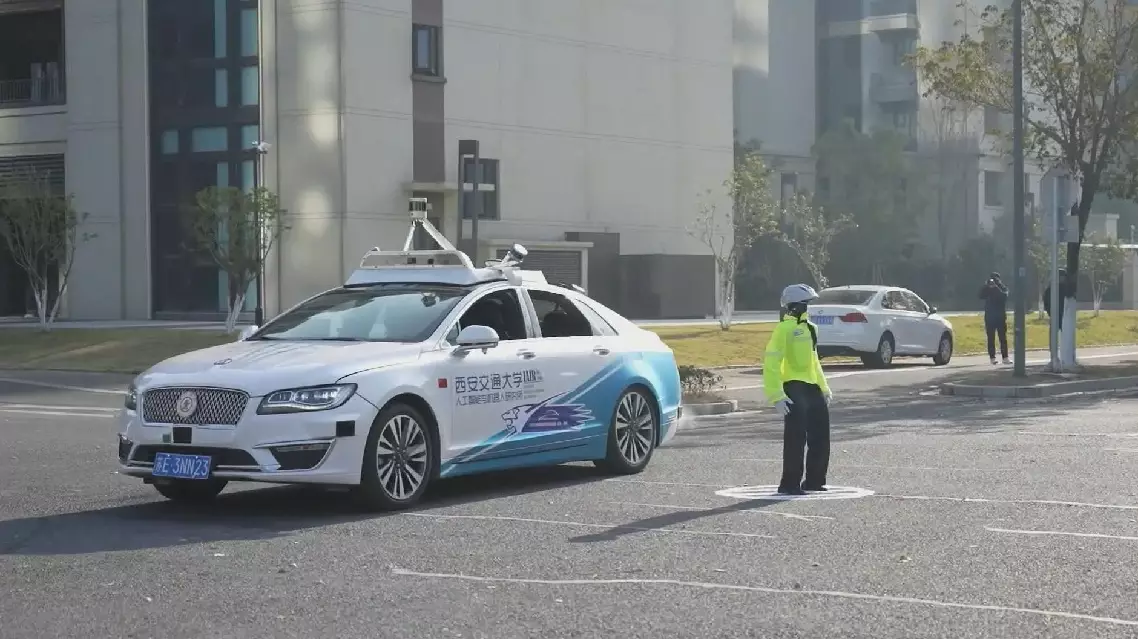
China's Intelligent Vehicle Challenge competition explores multi-agent embodied interaction