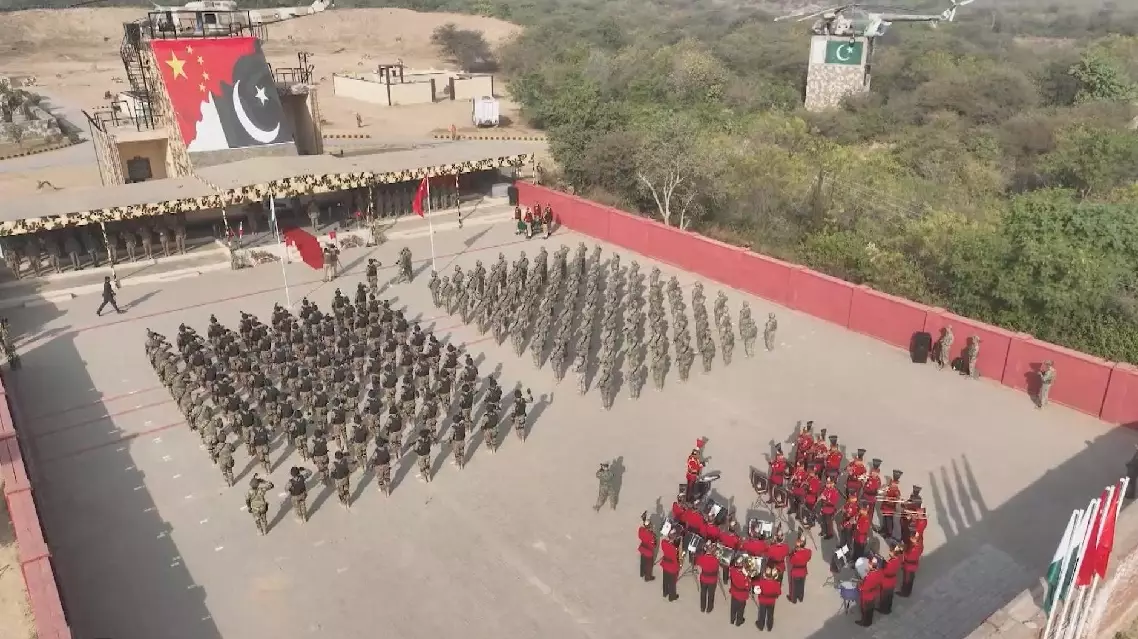
The China-Pakistan "Warrior 9" joint counter-terrorism exercise, which lasted for more than 10 days in Pakistan, came to full conclusion, with all participating Chinese troops returning to China on Sunday.
The drill ended on Friday with a ceremony held at the national counter-terrorism training center in Pabbi, Pakistan. Subsequently, the Chinese participating troops began their withdrawal back home in batches.
"During this withdrawal operation, we coordinated and liaised with Pakistani military and local authorities on multiple fronts, while closely organizing transportation and customs clearance, to ensure the safe, smooth, and foolproof withdrawal of the mission troops," said Yang Kun, a Chinese officer participating in the drill.
During the drill that started in early December, the Chinese and Pakistani troops jointly completed training exercises in mountain clearing, hostage rescue, and joint fire strikes using a mixed-unit joint training model.
"We carried out tactical coordination with Pakistani pilots on multiple occasions, and together conducted planned operations. During these coordination efforts, we learned from each other, shared combat experience, and ensured the successful completion of the mission," said Chinese drill participant Zhang Ying.
In the final phase of the drill, Chinese and Pakistani troops conducted a full-scale, live-fire exercise at Pakistani national counter-terrorism training center. The two sides jointly organized land and air operations, and used various types of unmanned equipment, including medium- and high-altitude long-endurance UAVs, UAV swarms, suicide drones, and bomb disposal robots, to conduct reconnaissance and surveillance, blockade and control, area-based clearing, and deep-penetration operations against simulated targets.
"In the 20-minute live-fire exercise, multiple combat groups including special operations, army aviation, aerial reconnaissance and strike, and information support were deployed to practice dozens of subjects. The exercise fully demonstrated the characteristics of counter-terrorism operations: fast pace, high coordination requirements, and wide application of unmanned equipment," said Chinese soldier Liu Kang.
During the joint exercise, the two sides also held activities such as case studies, equipment displays, and cultural exchanges, further enhancing the friendship between the Chinese and Pakistani militaries.
"Through more than 10 days of joint drills, China and Pakistan organized targeted training exercises in response to the new situation and characteristics of terrorist activities, further expanding the depth and breadth of military counter-terrorism cooperation. The exercises demonstrated the determination and will of China and Pakistan to jointly combat terrorism," said Chinese officer Liu Zheliang.
Pakistani, Chinese forces conclude joint counterterrorism drill