The Law Society of Hong Kong notes widespread concerns of the community regarding the “Lai Chee Ying Case” HCCC 51/2022, as well as various media reports characterizing the trial and conviction as a “sham trial”. As a statutory self-regulatory professional body, The Law Society of Hong Kong has a responsibility to address these comments from a legal perspective.
The Law Society of Hong Kong
Judicial independence in Hong Kong is constitutionally entrenched in The Basic Law of the Hong Kong Special Administrative Region of the People's Republic of China (the “Basic Law”). Article 2 guarantees independent judicial power, including the power of final adjudication, in accordance with the Basic Law; Article 19 further provides that Hong Kong shall be vested with independent judicial power; and Article 85 stipulates that the courts shall exercise judicial power independently, free from any interference.
The constitutional duty of judges and judicial officers is to apply the law. Article 84 of the Basic Law provides that judges and judicial officers shall adjudicate cases in accordance with the law. The Judicial Oath requires all judges and judicial officers to safeguard the law and administer justice without fear or favour.
Article 39 of the Basic Law provides that the provisions of the International Covenant on Civil and Political Rights (“ICCPR”) and International Covenant on Economic, Social and Cultural Rights (“ICESCR") as applied to Hong Kong shall remain in force and shall be implemented through the laws of the Hong Kong Special Administrative Region (“HKSAR”). The Article also provides that the rights and freedoms enjoyed by Hong Kong residents shall not be restricted unless as prescribed by law.
The Hong Kong Bill of Rights (“BOR”) Ordinance (Cap. 383) gives effect in local law to the provisions of the ICCPR and ICESCR as applied to Hong Kong. While the freedom of opinion and expression is protected under Article 19 of the ICCPR and Article 16 of the BOR as set out in the BOR Ordinance, the relevant right is not absolute, and may be restricted in law.
The Law of the People's Republic of China on Safeguarding National Security in the Hong Kong Special Administrative Region (“NSL”) was enacted in accordance with the Constitution of the People's Republic of China and the Basic Law. Notably, the NSL expressly provides that, in safeguarding national security, the HKSAR shall respect and protect, in accordance with the law, the human rights enjoyed by the residents under the Basic Law and the provisions of the ICCPR and ICESCR as applied to Hong Kong, including freedoms of speech, press, publication, association, assembly, procession and demonstration.
As stated in the Reasons for Verdict, the NSL was enacted for the purposes of ensuring the resolute, full and faithful implementation of the policy of One Country, Two Systems under which the people of Hong Kong administer Hong Kong with a high degree of autonomy, safeguarding national security, preventing, suppressing and imposing punishment for acts and activities endangering national security, maintaining prosperity and stability of the HKSAR and protecting the lawful rights and interests of the residents. Hong Kong is not unique in having a law safeguarding national security; other common law jurisdictions, including United Kingdom, Australia, Canada and Singapore, have similar legislations.
The “Lai Chee Ying Case” was tried in the Court of First Instance by a panel of three judges pursuant to Article 46 of the NSL. The trial was conducted in open court over 156 days. All parties had legal representation throughout the proceedings. The Law Society of Hong Kong further notes that during the course of the trial, none of the parties' legal representatives raised any allegation of unfair treatment.
According to the Rule of Law Index 2025 released by the World Justice Project on 28 October 2025, Hong Kong ranks 24th among 143 countries and jurisdictions globally, and even ranks 9th globally in respect of “Absence of Corruption”, reflecting the enduring and wide international recognition of its legal system.
The Law Society of Hong Kong expresses its deepest regret over certain media reports describing the trial and conviction as a “sham trial”. The Law Society encourages all members of the community to carefully review and fully understand the contents of the Reasons for Verdict.
The Law Society of Hong Kong maintains its unwavering trust and confidence in the legal system of Hong Kong, the independence of the judiciary and the integrity and professionalism of its judges.

Lai Chee Ying, Photo source: Sing Tao Daily
HALIFAX, N.C. (AP) — With 165 grains of black powder in the barrel, a .75-caliber Brown Bess flintlock musket like the ones the redcoats carried in 1776 can hurl a lead ball at a velocity of around 1,000 feet (305 meters) per second.
Imagine what that can do to a human body. Now, imagine that it’s almost completely exempt from gun regulations.
How can that be? Well, under federal and most state laws, many antique or replica guns aren’t technically considered firearms. In most places, even convicted felons can own them.
“I suspect the average judge would be surprised to find that out,” says Second Amendment scholar and gun-rights attorney Dave Hardy, himself the proud owner of two Civil War-era long guns.
During a National Rifle Association event back in 2000, the late actor Charlton Heston famously hoisted a flintlock — the single-shot weapon that won the Revolution and was still in wide use a half century after Congress debated the Second Amendment — into the air and said the Democrats would have to take it “from my cold, dead hands.”
He needn’t have worried.
During debate over the Gun Control Act of 1968, Sen. John Goodwin Tower argued that flintlocks and many other antique or replica guns should be exempt from regulation.
The Texas Republican said it was needed “to relieve an unnecessarily burdensome problem for serious collectors of antique firearms and for historians and museums.” Treating all weapons the same, he argued, would unfairly target collector items “which have little, if any, practical use as a firearm in the modern connotation.”
The provision defines an antique as any weapon “with a matchlock, flintlock, percussion cap, or similar type of ignition system” manufactured “in or before 1898” — as long as it hasn't been modified to fire modern ammunition. This generally means muzzleloaders that use black powder or a black powder substitute, though some early cartridge guns are included.
You can even own and fire a cannon.
Most states have adopted that language either verbatim or by direct reference to the federal provision. But, as military historian Patrick Luther says, “it’s a patchwork.”
“I live in NY (New York) and bought a civil war musket,” Luther, a Marine veteran with the website milsurpia.com, said in an email. “It was very similar to buying a regular firearm. Buying the blackpowder for the rifle felt not much different than buying a T-shirt.”
At least three states — Hawaii, Ohio and North Dakota — treat a smoothbore musket the same as an AK-47 or AR-15. Reenactor Jason Monhollen, an officer in the U.S. Army, says that’s “comparing apples and oranges.”
“It seems silly to put restriction on something that would be such a terrible weapon if you wanted to, you know, kill people,” says Monhollen, who portrays a private and carries a French Charleville musket in the 2nd North Carolina Regiment. “There’s just much better things. You can kill more people quickly with a car than you can with a musket.”
But these weapons are still deadly.
Maryland changed its law after a convicted sex offender killed his ex-girlfriend with a six-shot, .44-caliber cap and ball revolver purchased on the internet.
“It may have loaded like an 1851 weapon, but it fired like a 2017 manufactured modern handgun that was capable of lethal force,” Montgomery County State’s Attorney John McCarthy told reporters at the time.
Shadé's Law, passed in 2019, now prohibits people convicted of certain violent crimes from buying or possessing such weapons. But many states allow convicted felons to have these weapons; West Virginia makes an exception for people under an active protective order.
Some states’ laws are confusing or vague.
Montana law mentions “antique or replica arms” in a code regulating firearms and ammunition manufactured in the state. But nowhere in the code are those weapons defined.
Wisconsin uses the federal definition, but the only reference comes in a law regarding “look-alike” firearms.
And, of course, many local ordinances, like the one in Wake County, North Carolina, prohibit the firing of any “barreled weapon capable of discharging projectiles.” In many jurisdictions, it’s illegal to brandish even a toy gun at someone.
“Federal law does not exclude antique firearms from location-based restrictions,” Austin Gunderson, counsel for the North Dakota Legislative Council, said in an email.
Sometimes, attempts to strengthen gun laws have had unintended consequences.
The attorney general of New Jersey, one of the 13 original states, recently had to offer guidance when a new law targeting ghost guns seemed to require all firearms — including antiques and even air guns — to have serial numbers.
When New York toughened its gun laws in 2022, it required background checks for transfers and purchases of antique guns, and barred firearms of any kind from certain “sensitive places” like parks and museum sites — just the kinds of places reenactors appear most.
An exemption was later carved out for people “lawfully engaged in historical reenactments, educational programming involving historical weapons of warfare, or motion picture or theatrical productions.” But that hasn’t stopped out-of-state reenactors from worrying their muskets will be confiscated at the George Washington Bridge, says Justin Costantino, adjutant of the Long Island Companies of the 3rd New York Regiment.
“If the New York State Police department wants to charge me with weapons possession while I’m wearing a cocked hat and carrying around a Charleville ’66,” says Costantino, a graduate student in history, “then please, don’t call my lawyer. Call the New York Post!”
Then again, Costantino hates to hear a mother at a reenactment tell her child, “Oh, no. Don’t worry, sweetie. It’s not real.”
“It’s not really loaded, but it is really a weapon,” he says. “It’s really gunpowder. And if you stand close to it, you’ll feel the kind of breath of hot air ... They’re still things that we have to take very seriously, and you have to be safe with.”
AP Writer Jack Dura in Bismarck, North Dakota, contributed to this report.
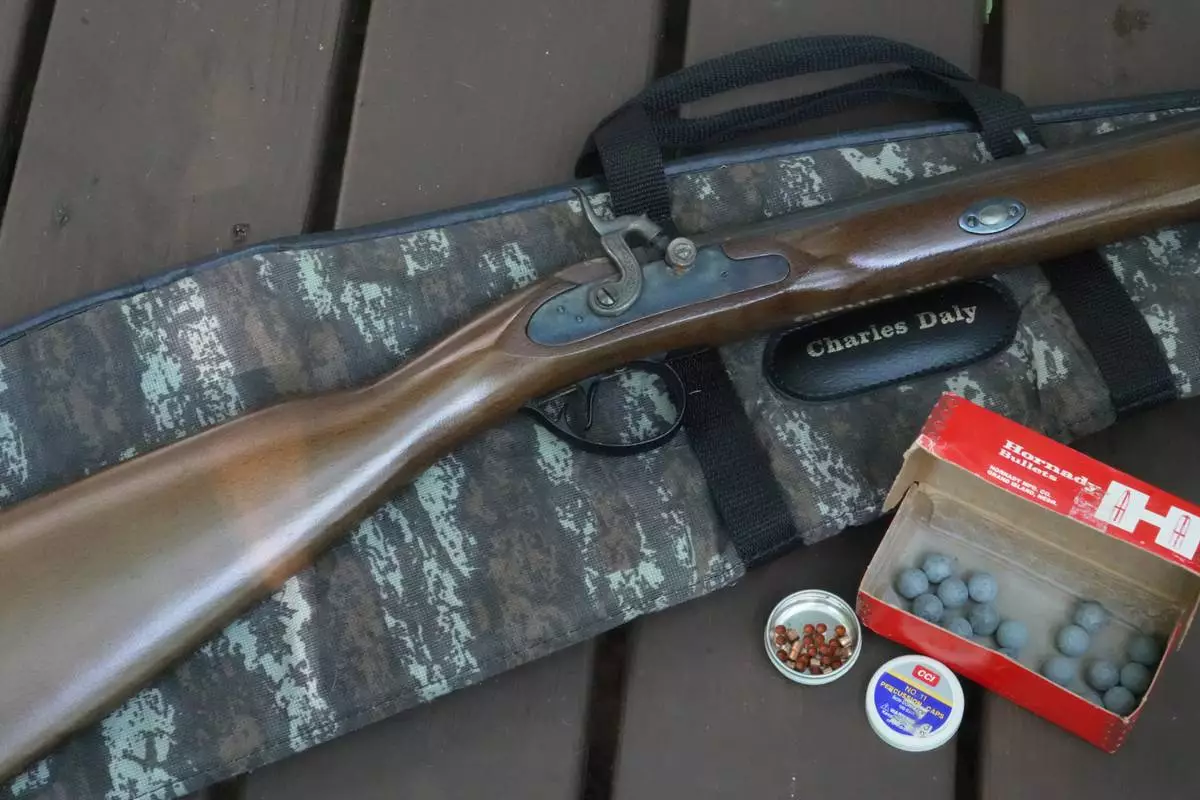
A .50-caliber Hawken replica rifle with lead balls and percussion caps sits on a deck in Wake Forest, N.C., on Monday, May 4, 2026. (AP Photo/Allen G. Breed)
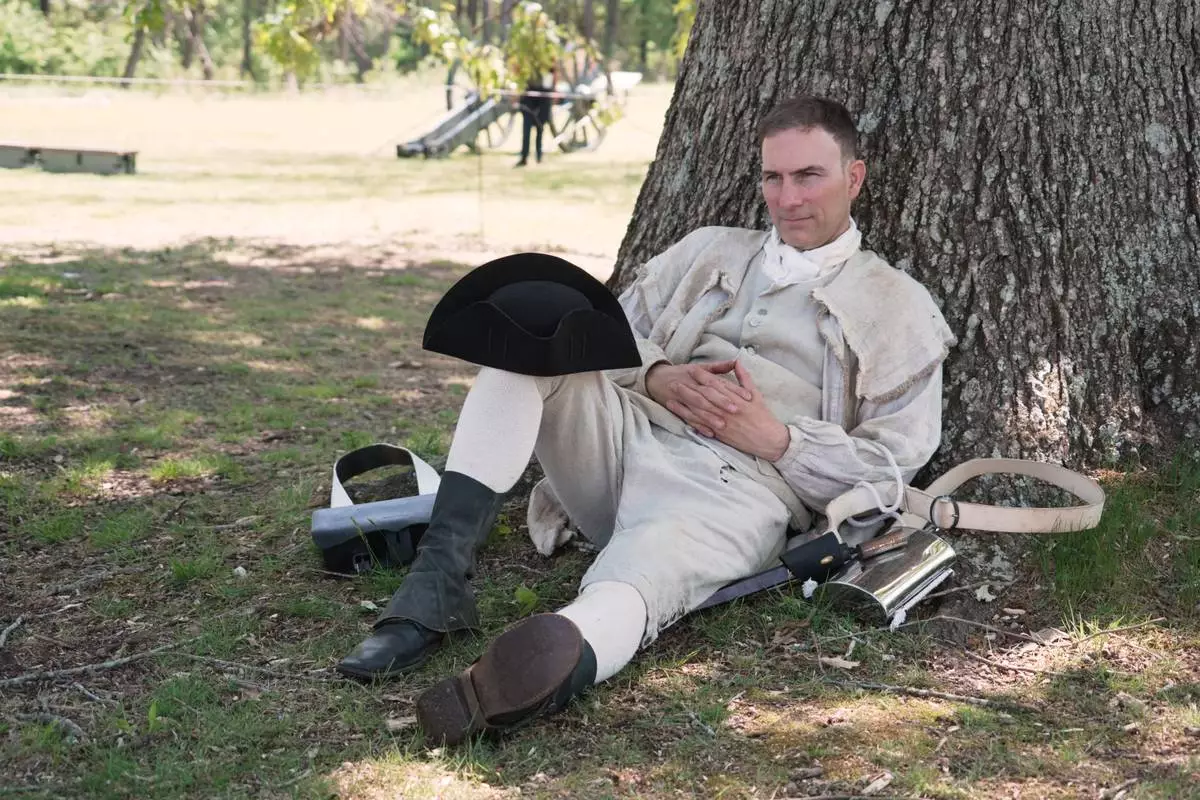
Army officer Jason Monhollen rests beneath a tree during a Revolutionary War event, in which he portrays a private in the 2nd North Carolina Infantry Regiment, in Halifax, N.C., on April 11, 2026. (AP Photo/Allen G. Breed)
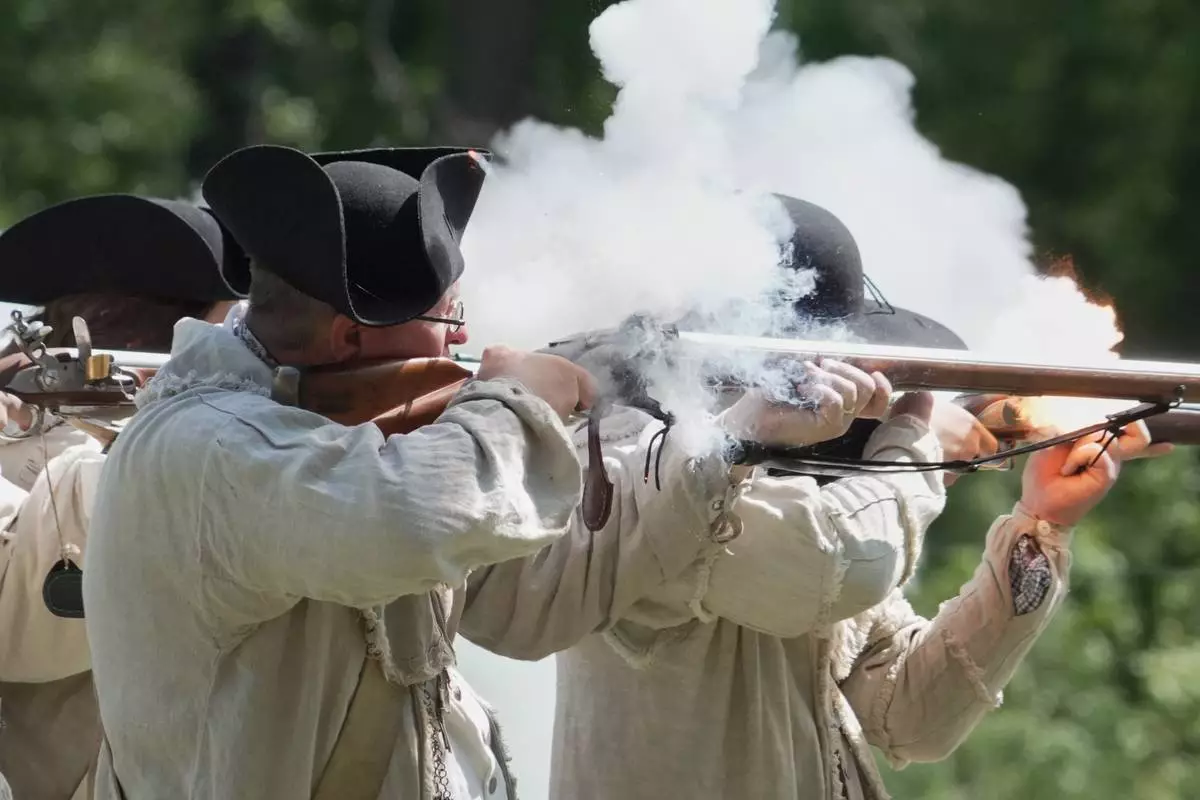
Re-enactors fire a volley with their flintlock muskets during a Revolutionary War event in Halifax, N.C., on April 11, 2026. (AP Photo/Allen G. Breed)
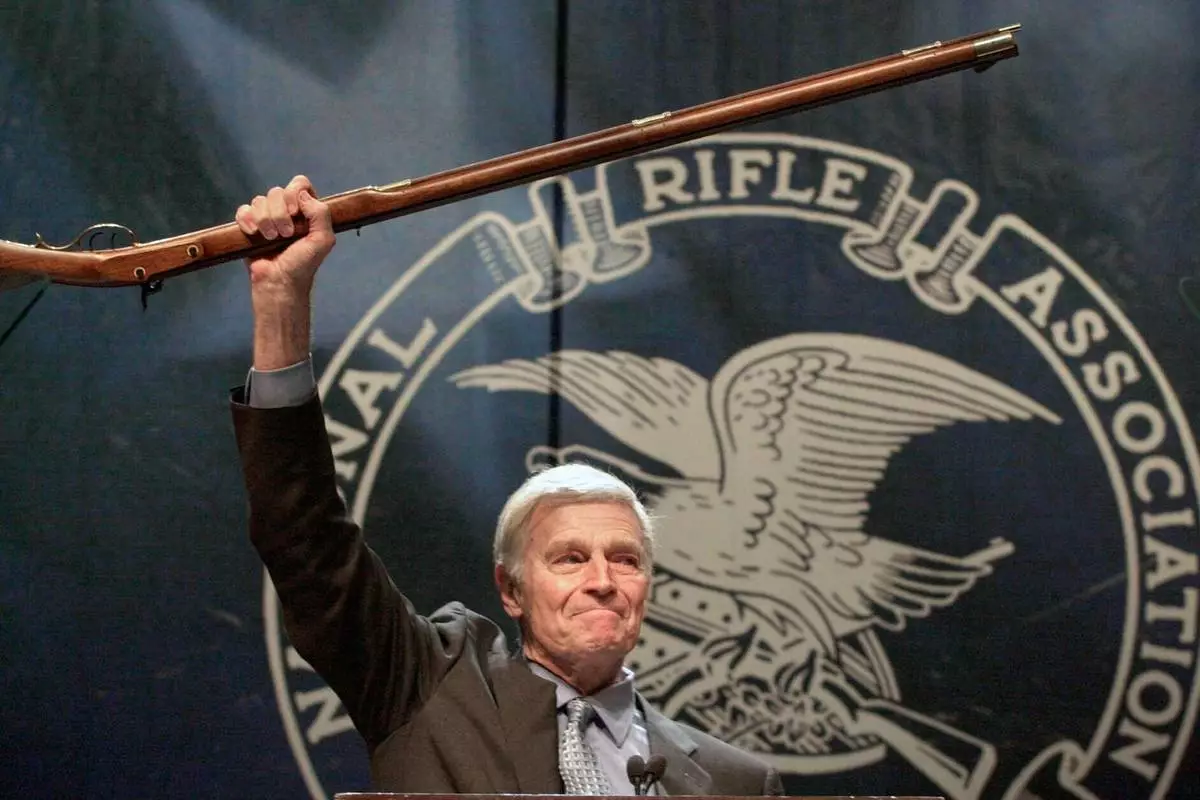
FILE - NRA president Charlton Heston holds up a musket as he tells the members attending the 129th Annual Meeting & Exhibit in Charlotte, N.C., that they can have his gun when they pry it, "from my cold dead hands," drawing a standing ovation, May 20, 2000. (AP Photo/Ric Feld, File)
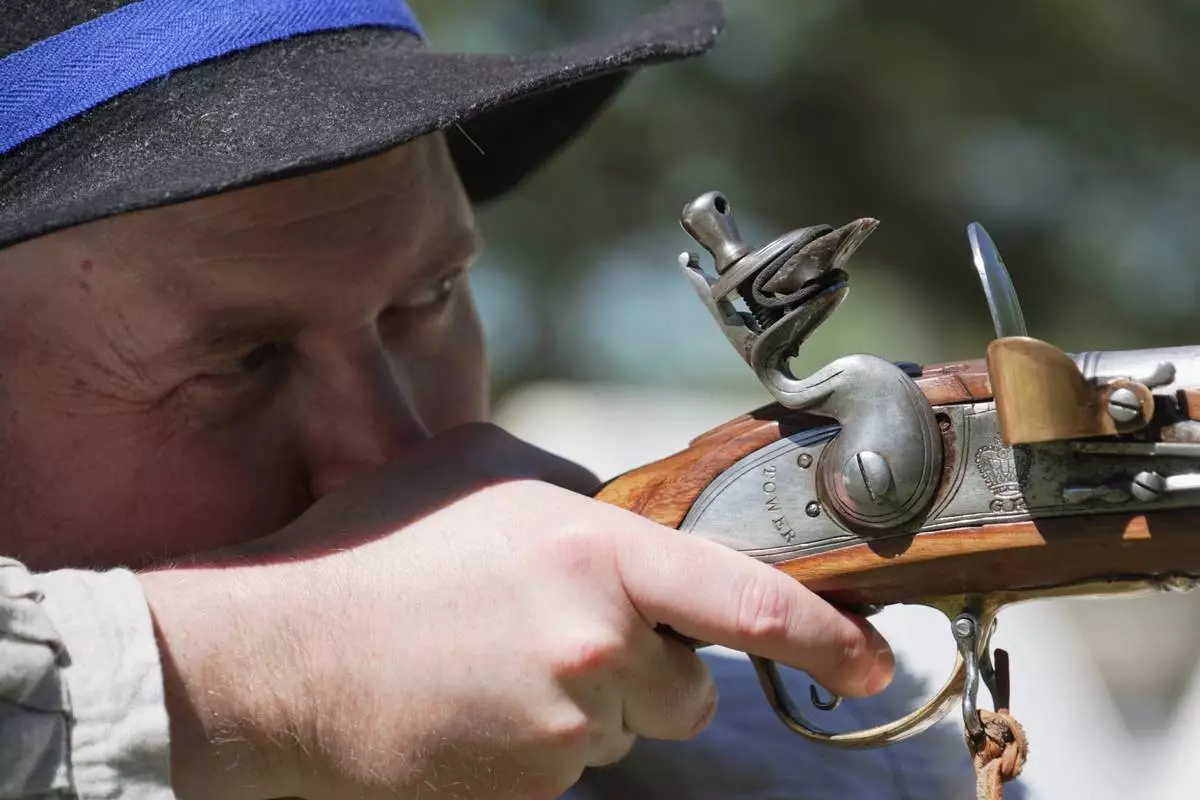
A.J. Drake, a historic interpreter, aims his Brown Bess flintlock replica musket during a Revolutionary War event in Halifax, N.C., on April 10, 2026. (AP Photo/Allen G. Breed)