A severe cold wave has gripped parts of north and northwest China this week, prompting local authorities to activate emergency plans to ensure public safety and maintain critical heating and transport services.
In China's northernmost regions, temperatures have plunged to extreme lows. The minimum temperature in Genhe City, Inner Mongolia Autonomous Region dropped to minus 43.6 degrees Celsius on Monday in its aptly named "Coldest Village," setting a new record for this winter.
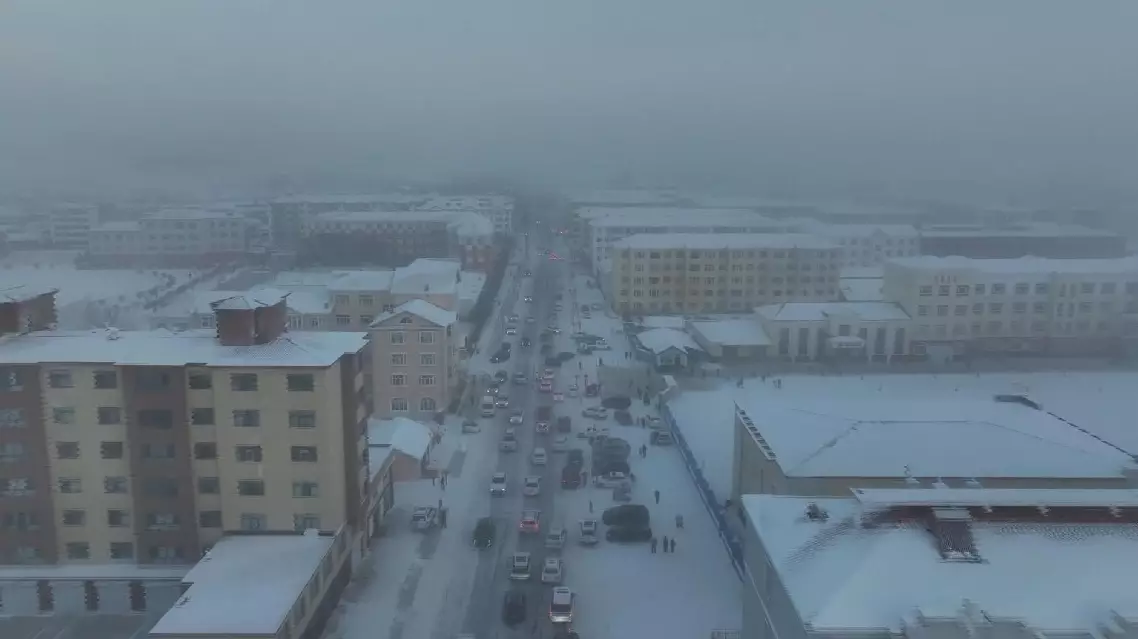
The intense cold brought thick ice fog, reducing visibility to less than 100 meters and making travel difficult for local drivers and pedestrians.
"The moment I step outside, my face feels like it's being cut by knives, and my hands go numb in seconds. It's freezing today," said Li Furong, a local resident.
Facing the harsh freeze, local emergency services sprang into action. Transport departments have strengthened patrols on key roads to guarantee smooth traffic, while heating companies have raised supply temperatures and fuel reserves to ensure stable heat supply for residents.
"Our company maintains stable operation of two full cogeneration units (dual turbine-generator and boiler systems), with the heating supply temperature raised to 69 degrees Celsius," said Cheng Hao, deputy director of the operation and maintenance department at Genhe Guangming Thermoelectricity Co. Ltd.
Meanwhile, heavy snowfall has impacted Altay City in northwest China’s Xinjiang Uygur Autonomous Region since Monday, driving temperatures down to minus 10 degrees Celsius.
Snow accumulation in some areas has exceeded 40 centimeters, disrupting local transport. In response, local authorities have deployed workers and heavy equipment to clear roads, ensuring safe travel for residents and tourists.
China activates safety measures as severe cold wave sweeps multiple regions
Cuba has strongly condemned the United States' seizure of a Venezuelan oil tanker, with a former Cuban diplomat calling the action illegal and warning it threatens regional energy security as the U.S. escalates pressure on Venezuela.
Carlos Alzugaray, the former Cuban diplomat, said the seizure of the tanker and its cargo violates international law.
"They have seized the ship, the tanker, but they have also seized the oil, they have taken the oil. All the sanctions that the United States has imposed on Venezuela are illegal because they are not based on any decision of an international institution like the Security Council of the United Nations," he said.
U.S. forces last week seized a Venezuelan oil tanker, the Skipper, in the Caribbean, alleging it was part of an "illicit oil shipping network supporting foreign terrorist organizations." The U.S. has since intensified its campaign against Venezuela's oil trade.
U.S. President Donald Trump said Tuesday that he has ordered a total blockade of all sanctioned oil tankers traveling to and from Venezuela, escalating a months-long pressure campaign against Venezuelan President Nicolas Maduro.
Trump also said that the Venezuelan government has been designated "a foreign terrorist organization," accusing it of involvement in crimes including terrorism, drug smuggling and human trafficking.
Trump also claimed that Venezuela is "completely surrounded by the largest armada ever assembled in the history of South America," warning that the pressure would continue until the assets he said had been taken are returned to the United States.
Cuban President Miguel Diaz-Canel has also denounced the U.S. seizure of Venezuelan oil tanker last week, calling it an act of piracy and maritime terrorism as the U.S. blockade may also impact Cuba, which is experiencing an energy crisis and is heavily dependent on oil imports from Venezuela.
For Cuba, the seizure raises particular concerns. The island is facing a deep energy crisis marked by rolling blackouts and relies heavily on oil imports from Venezuela. Cuban officials fear that expanded U.S. enforcement actions could further disrupt supplies.
The tanker seizure coincides with an expanded U.S. military presence in the Caribbean under "Operation Southern Spear," officially described as a counter-narcotics mission. Cuban authorities argue that the deployment violates a regional declaration designating Latin America and the Caribbean as a "Zone of Peace," and have called for international condemnation of the U.S. actions.
Cuba condemns US seizure of Venezuelan oil tanker amid energy crisis