NEW YORK (AP) — Welcome to exhausted America 2025: Most adults are more than a little fine with doling out cash as gifts, and many plan to be asleep before midnight on New Year's Eve, according to a new AP-NORC poll.
About 6 in 10 Americans say cash or gift cards are “very” acceptable as holiday presents, but they’re much less likely to say that about a gift that was purchased secondhand or re-gifted, according to a new poll from The Associated Press-NORC Center for Public Affairs Research.
“Cash is OK for the grandkids I guess,” said Nancy Wyant, 73, in rural central Iowa. “But I’m a gift giver.”
Come New Year's Eve, she'll be fast asleep before 2026 rolls around. “At our age, we don't do anything,” the retired bus driver said with a laugh of herself and her live-in partner. “He’s set in his ways.”
They'll be joined by the 44% of Americans who say they won’t stay up to greet 2026, according to the poll. About half of U.S. adults age 45 or older won’t make it to midnight, compared with around one-third of adults under age 45.
Consider 23-year-old Otis Phillips in Seattle, an outlier for his age. He, too, will turn in early. “It’s one of the holidays that doesn’t really feel special to me,” said the master's student.
Cash is a safer gift for younger adults. The poll found about two-thirds of Americans under 45 say cash is a “very” acceptable holiday gift, compared with 55% of adults age 45 or older.
“Everything’s too expensive nowadays. And I don’t want to go buy a gift for somebody and then it turns out they don’t like it. So cash,” said Gabriel Antonucci, 26, a ski resort cook in Alaska, about an hour outside of Anchorage.
Most people at least grudgingly accept various gift types, with about 9 in 10 saying cash or gift cards are at least “somewhat” acceptable and about 6 in 10 saying the same for secondhand gifts and re-gifted items.
Teresa Pedroza, a 55-year-old mom of two adult sons in central Florida, is mostly not on board.
“I don't like it when kids say they want cash, or I should get teenagers gift cards,” she said. “It kind of takes some of the charm away from gift giving.” But she acknowledged reaching for cards a time or two out of convenience.
About three-quarters of adults under age 45 say secondhand gifts are at least “somewhat” acceptable, compared with about 6 in 10 adults age 45 or older. About 4 in 10 adults age 45 or older say secondhand gifts are “somewhat” or “very” unacceptable.
It's not just your pesky neighbors who leave their holiday decorations up into January. About one-third of U.S. adults say they’ll leave them up after New Year’s Day.
It’s more common for people to leave their decorations up after the holiday season than to put them up early, according to the poll. About 2 in 10 Americans say they put up holiday decorations before Thanksgiving.
“I just had my husband bring down the bins. If we weren’t expecting company, I wouldn’t even bother to decorate, honestly. I’m tired of doing that,” said Pedroza, the Florida mom of two.
About one-quarter of U.S. adults say they’re planning to watch sports on Christmas Day, while only 5% will head for a movie theater.
Men are much likelier than women to say they’ll watch sports on Christmas, and older Americans are much more likely than younger Americans to tune in. About 2 in 10 adults under age 45 say they plan to watch sports on Christmas, compared with about 3 in 10 adults age 45 or older.
Phillips does plan to break out his red sweater with the green Christmas tree that one of his grandmothers knitted for him a couple of years ago.
“She made all kinds of things for me growing up,” he said. “This is by far my favorite.” Phillips has it in rotation for his part-time job as a grocery checkout clerk.
He's the outlier once again. Women are much likelier than men to say they’ll wear a holiday sweater or accessories.
About 3 in 10 U.S. adults say they will give a gift to their pet this year.
In Iowa, Wyant's nearly 3-year-old boxer-Great Dane mix named Indy is among them.
“She's a very spoiled dog,” Wyant said. “She’s got too many toys, so she's getting treats this year. She loves her treats.”
And the red felt elf that parents move around the house every night as a Santa spy to see which kids have been naughty or nice? Only about 1 in 10 U.S. adults say they’ll do Elf on the Shelf.
“Noooo,” Pedroza said when asked if she'd ever done the elf for her kids. “My younger son was very well-behaved. I didn't have to use any kind of tactics.”
The AP-NORC poll of 1,146 adults was conducted Dec. 4-8 using a sample drawn from NORC’s probability-based AmeriSpeak Panel, which is designed to be representative of the U.S. population. The margin of sampling error for adults overall is plus or minus 4 percentage points.

(AP Illustration / Peter Hamlin)

FILE - A person carries a shopping bag in Philadelphia, Dec. 10, 2025. (AP Photo/Matt Rourke, File)
In the Northern Hemisphere’s winter, she competes on the Alpine skiing World Cup circuit in the Alps.
In the Southern Hemisphere’s winter, she trains at home in New Zealand.
Alice Robinson hardly ever gets to put her flip-flops on and enjoy summer.
And that’s just fine with her.
“It’s just been my yearly routine for so long that I don’t really know much better,” Robinson said. “I definitely miss some summer but I’m definitely a lot more comfortable in the winter climate.”
Is she ever.
Robinson is off to quite a start to the Olympic season, shaping up as Mikaela Shiffrin’s biggest challenger in the overall World Cup standings.
In four giant slaloms, Robinson has registered two victories and a third-place finish.
Then on Sunday, she finished ahead of Sofia Goggia and Lindsey Vonn in the season’s opening super-G for her first career win in a speed discipline.
The victory in St. Moritz, Switzerland, made Robinson the first man or woman from New Zealand to win a super-G. That came after a giant slalom victory last month — the fifth win of her career — made her the most successful women’s World Cup winner from a non-European or North American nation.
Nearly two months into the season, Robinson sits second in the overall standings, 162 points behind Shiffrin.
Expanding to the speed disciplines has been something that Robinson has been considering ever since she announced herself to the skiing world by winning the season-opening giant slalom on the Rettenbach glacier in Sölden, Austria, six years ago as a 17-year-old.
“I never just wanted to be a one-trick pony,” she said.
Robinson’s results make her a multi-medal contender for the Feb. 6-22 Milan Cortina Olympics — where she could become the first Alpine skiing gold medalist from her country.
New Zealand’s only Olympic medal in Alpine skiing was a silver in slalom by Annelise Coberger at the 1992 Albertville Games.
Coberger’s brother, Nils Coberger, is one of Robinson’s coaches.
At last season’s world championships, Robinson took silver behind Federica Brignone in giant slalom for New Zealand’s first medal in the biggest skiing competition outside of the Olympics.
Constantly being on snow does have some draw backs, though.
“There’s certain things about summer that I miss, because in New Zealand we have Christmas and New Year’s over summer so that’s kind of a bit more of a memory that I miss,” Robinson told reporters earlier this season. “My one advantage being from New Zealand is that I get to train at home in the offseason when everyone else is traveling around.”
And when she’s in the Alps, Robinson takes advantage of the abundance of wellness facilities.
“I’ve become a bit of like a spa fan,” she said. “In New Zealand we just don’t do that — hotels don’t have spas.”
Robinson was born in Sydney to Australian parents and moved to New Zealand when she was four.
“If that didn’t happen I don’t think I would have ended up in ski racing growing up in Bondi,” she said of the beach town.
In her new home in Queenstown, Robinson and her two siblings were surrounded by mountains and it was “15 minutes door-to-door” to the Coronet Peak ski area.
“My parents just put us in ski school. My mum told me the other day that it was cheaper to put me in the ski creche than to get a babysitter,” Robinson said on a recent International Ski and Snowboard Federation podcast.
Robinson entered the final giant slalom of last season leading the discipline standings and set to clinch the first crystal globe of her career.
But she struggled with a gate in her first run at the World Cup finals in Sun Valley, Idaho, last March, veered off course and handed the title to Brignone.
Robinson said that failure “definitely kept the fire burning for this offseason to try and work harder to be more prepared and to mentally know how to deal with those higher intensity, higher pressure moments.”
Robinson was New Zealand’s youngest-ever Winter Olympian as a 16-year-old at the 2018 Pyeongchang Games. Then she struggled with expectations at the 2022 Beijing Games after being locked out of her home country for two years due to New Zealand’s strict border controls during the coronavirus pandemic.
This time she has a new plan.
“With it being in Cortina, which is a familiar World Cup venue for us, I kind of just want to go into it treating it just like another World Cup race,” Robinson said.
During her first career race in Cortina, Robinson narrowly missed out on a medal at the 2021 world championships when she finished fourth in the giant slalom.
“Cortina was one of the first places that I ever skied in Europe because we had friends that were living there and so I’ve always loved Cortina,” Robinson said. “Outside of New Zealand, I think it’s definitely one of most beautiful places in the world.”
Andrew Dampf is at https://x.com/AndrewDampf
AP Olympics: https://apnews.com/hub/milan-cortina-2026-winter-olympics

Alice Robinson, of New Zealand, celebrates her first place finish in the women's World Cup giant slalom in Mont Tremblant, Quebec, Saturday, Dec. 6, 2025. (Sean Kilpatrick/The Canadian Press via AP)
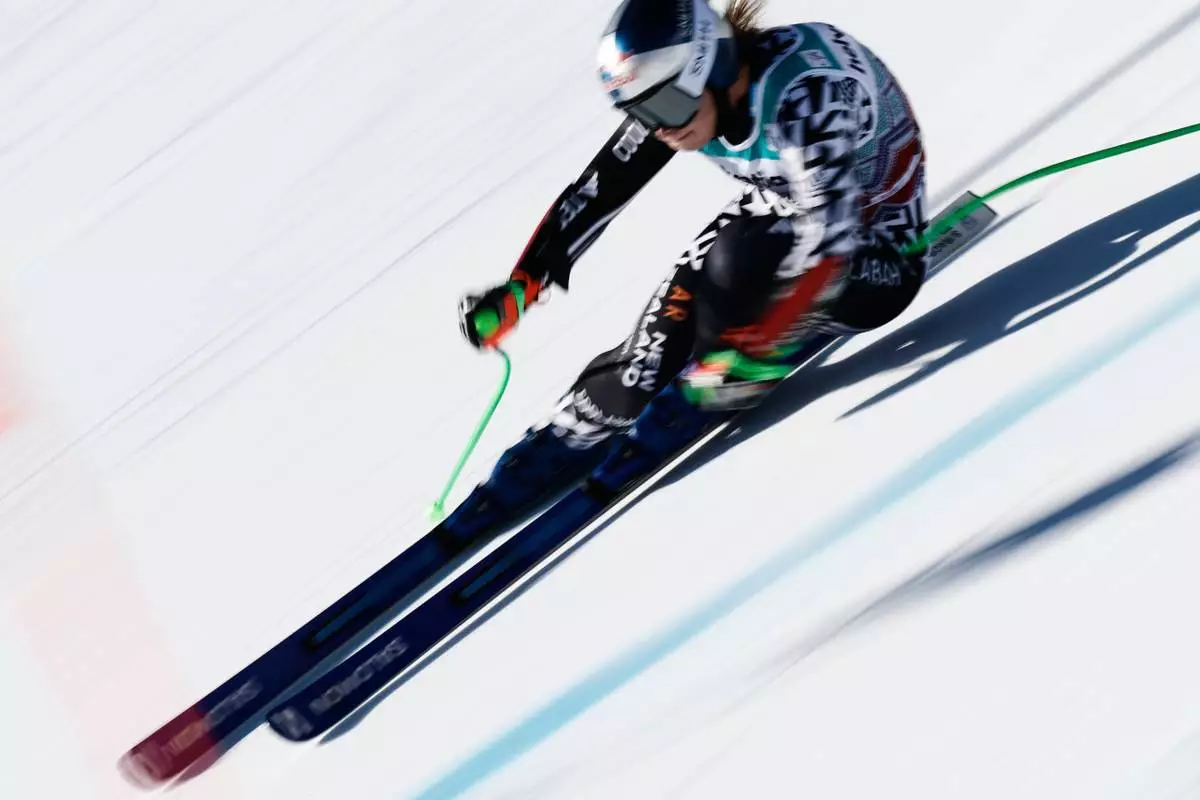
New Zealand's Alice Robinson speeds down the course during an alpine ski, women's World Cup super-G event, in St. Moritz, Switzerland, Sunday Dec. 14, 2025. (AP Photo/Gabriele Facciotti)