Russian President Vladimir Putin warned Wednesday that Moscow will seek to extend its gains in Ukraine if Kyiv and its Western allies reject the Kremlin's demands in peace talks.
U.S. President Donald Trump has unleashed an extensive diplomatic push to end nearly four years of fighting following Russia’s full-scale invasion of Ukraine in February 2022, but Washington’s efforts have run into sharply conflicting demands by Moscow and Kyiv.
Click to Gallery
In this image, made from video provided by Russian Defense Ministry Press Service on Tuesday, Dec. 16, 2025, a Russian "Grad" self-propelled multiple rocket launcher fires towards Ukrainian positions on an undisclosed location in Ukraine. (Russian Defense Ministry Press Service via AP)
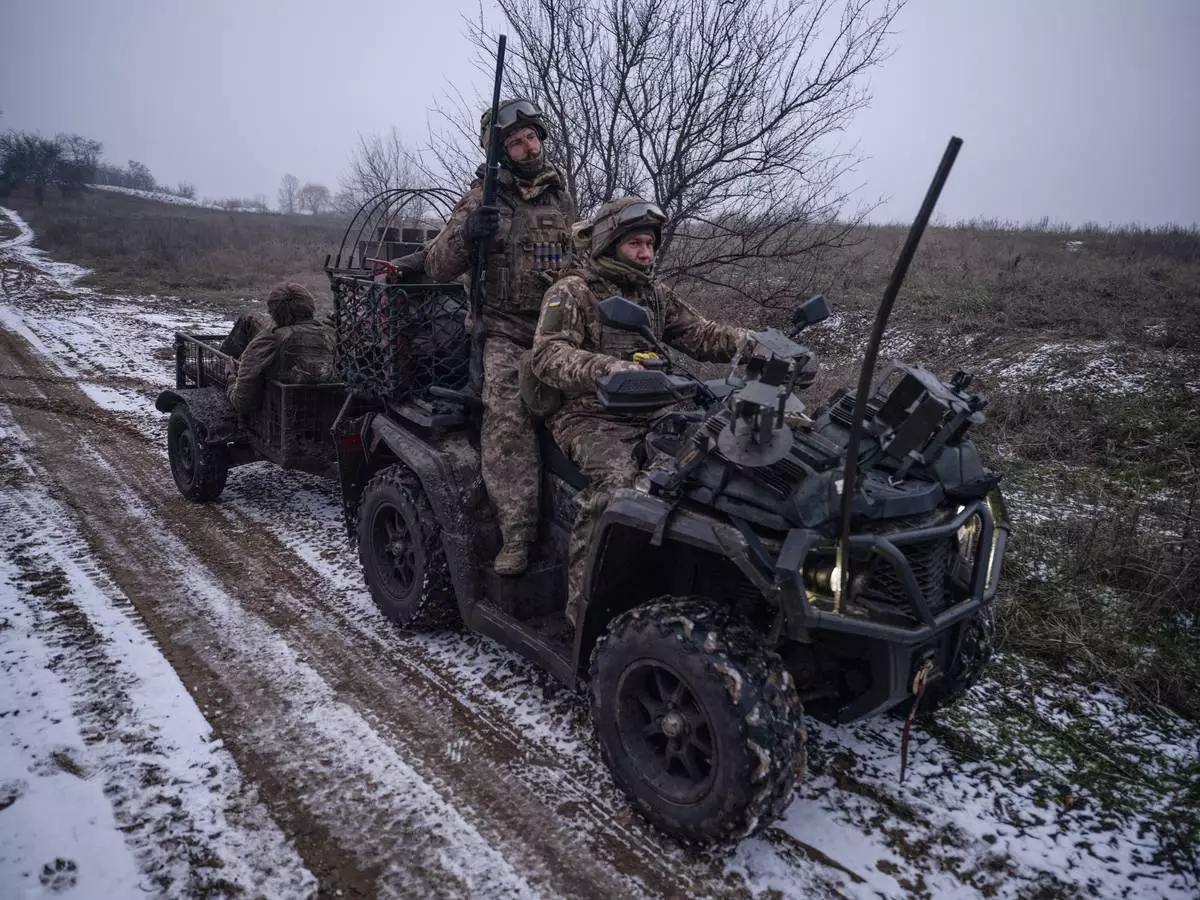
In this photo, taken Tuesday, Dec. 16, 2025 and provided by Ukraine's 93rd Kholodnyi Yar Separate Mechanized Brigade press service, soldiers ride a quad bike near Kostyantynivka, Donetsk region, Ukraine. (Iryna Rybakova/Ukraine's 93rd Mechanized Brigade via AP)
Russian Chief of General Staff Gen. Valery Gerasimov, right, reports to Russian President Vladimir Putin at the annual board meeting of the Russian Defense Ministry and award soldiers in Moscow, Wednesday, Dec. 17, 2025. (Alexander Kazakov/Sputnik, Kremlin Pool Photo via AP)
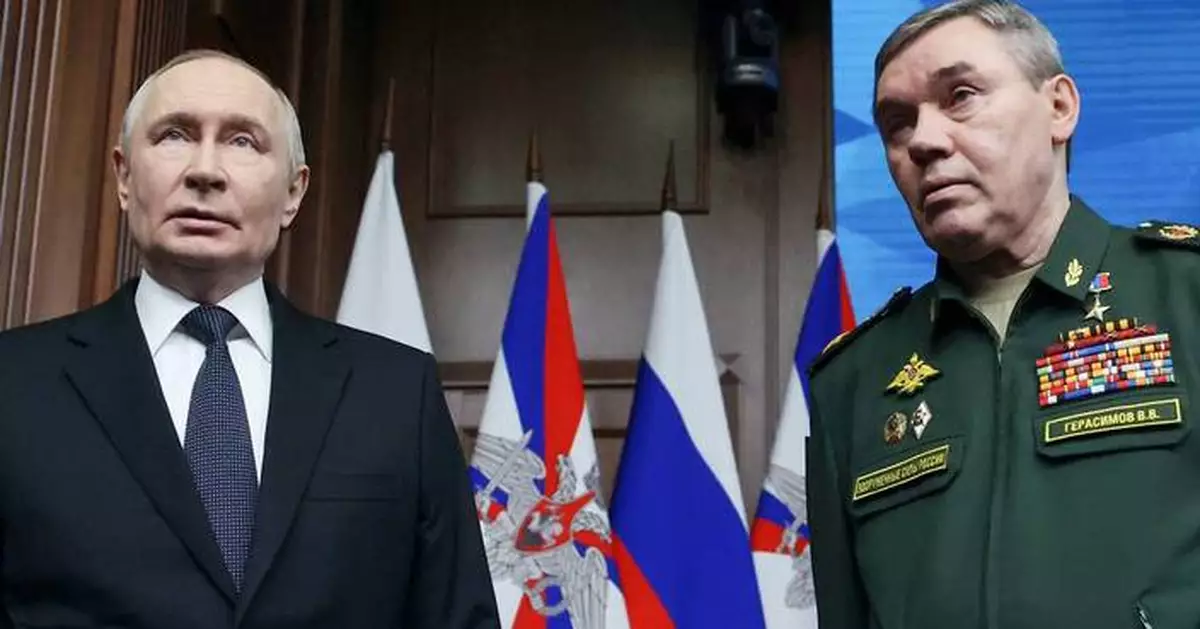
Russian President Vladimir Putin, left, and Russian Chief of General Staff Gen. Valery Gerasimov attend the annual board meeting of the country's Defense Ministry and awards soldiers in Moscow, Russia, Wednesday, Dec. 17, 2025. (Alexander Kazakov/Sputnik, Kremlin Pool Photo via AP)
Speaking at an annual meeting with top military officers, Putin said Moscow would prefer to achieve its goals and “eliminate the root causes of the conflict” by diplomatic means, but he added that “if the opposing side and its foreign patrons refuse to engage in substantive dialogue, Russia will achieve the liberation of its historical lands by military means.”
Putin was referring to Ukrainian territory seized by Russia — action widely condemned in the West as a violation of Ukraine's sovereignty and an unprovoked act of aggression.
Putin claimed that “the Russian army has seized and is firmly holding strategic initiative all along the front line” and warned that Moscow will move to expand a “buffer security zone” alongside the Russian border.
“Our troops are different now, they are battle-hardened and there is no other such army in the world now,” he said.
Putin praised Russia's growing military might and particularly noted the modernization of its atomic arsenal, including the new nuclear-capable intermediate range Oreshnik ballistic missile that he said will officially enter combat duty this month. Russia first tested a conventionally armed version of the Oreshnik to strike a Ukrainian factory in November 2024, and Putin has boasted that it's impossible to intercept.
At the same time, he rejected European officials' statements about Moscow's purported plans to attack European nations as “lies and sheer nonsense ... driven by short-sighted personal or group political interests, not by the interests of their people.”
Putin's tough statements follow several rounds of talks this week between Ukrainian. American and European officials on a U.S.-drafted peace plan. Ukrainian President Volodymyr Zelenskyy said after meeting with U.S. envoys in Berlin that the document could be finalized within days, after which U.S. envoys will present it to the Kremlin.
Putin wants all the areas in four key regions captured by his forces, as well as Crimea, which was illegally annexed in 2014, to be recognized as Russian territory. He also has demanded that Ukraine withdraw from some areas in eastern Ukraine that Moscow's forces have not captured yet.
The Kremlin also insists that Ukraine abandon its bid to join NATO and warns it won’t accept the deployment of any troops from NATO members and will view them as “legitimate target."
Zelenskyy has expressed readiness to drop Ukraine’s bid to join NATO if the U.S. and other Western nations give Kyiv security guarantees similar to those offered to NATO members. But Ukraine’s preference remains NATO membership as the best security guarantee to prevent further Russian aggression.
At the same time, Zelenskyy has rejected Moscow’s demands that it pull back its troops from other areas that Russia has not been able to take by force.
The Ukrainian leader described the draft peace plan discussed with the U.S. during talks in Berlin on Monday as “not perfect” but “very workable,” noting that Kyiv and its allies were very close to a deal on "strong security guarantees.” But he also emphasized that the key issue of control over territory remain unresolved and rejected the U.S. push for Ukraine to cede control over the eastern Donetsk region.
Putin on Wednesday again praised Trump's settlement efforts and seconded Trumps' repeated claims that the war in Ukraine wouldn't have erupted under his watch. He charged that the previous U.S. administration and some of the European allies he contemptuously called “piglings” had vainly expected Russia's collapse.
The Russian leader said a dialogue with Europe "is unlikely to become possible with the current political elites, but in any case, it will be inevitable as we grow stronger if not with the current politicians, then with a change in political elites in Europe.”
Reporting to Putin at Wednesday's military meeting, Defense Minister Andrei Belousov spelled out plans for further advances, saying the latest Russian advances in Donetsk have set the stage for a quick push into the Ukrainian-controlled part of the region.
Belousov also declared that Russian troops were preparing to drive Ukrainian forces from parts of the Zaporizhzhia region that Moscow also annexed in 2022 but never fully captured, as well as extend gains in neighboring Dnipropetrovsk.
“The key task for the next year is to preserve and accelerate the tempo of the offensive,” he said.
Belousov spelled out plans for expanding Russian military capabilities, focusing on drones, jamming equipment and air defense assets.
As Russia continues its grinding advances in many sectors of the front, it also pummeled Ukraine with daily missile and drone strikes.
At least 26 people were injured by Russian glide bombs in Zaporizhzhia and its vicinity, according to regional administration head Ivan Fedorov. The attack damaged several residential buildings, as well as infrastructure and an educational facility.
At least 69 long-range drones were launched by Russia overnight, the Ukrainian air force said. Air defenses intercepted or jammed 29 drones in the morning, with the assault continuing during the day.
Russia’s Defense Ministry said that air defenses downed 94 Ukrainian drones overnight.
In Russia's southern Krasnodar region, drones injured two people and damaged several private houses, according to regional emergency officials. In the southwestern Voronezh region, Gov. Alexander Gusev said drone fragments damaged a power line serving an infrastructure facility, causing a blaze that was quickly extinguished.
Follow AP’s coverage of the war in Ukraine at https://apnews.com/hub/russia-ukraine
In this image, made from video provided by Russian Defense Ministry Press Service on Tuesday, Dec. 16, 2025, a Russian "Grad" self-propelled multiple rocket launcher fires towards Ukrainian positions on an undisclosed location in Ukraine. (Russian Defense Ministry Press Service via AP)
In this photo, taken Tuesday, Dec. 16, 2025 and provided by Ukraine's 93rd Kholodnyi Yar Separate Mechanized Brigade press service, soldiers ride a quad bike near Kostyantynivka, Donetsk region, Ukraine. (Iryna Rybakova/Ukraine's 93rd Mechanized Brigade via AP)
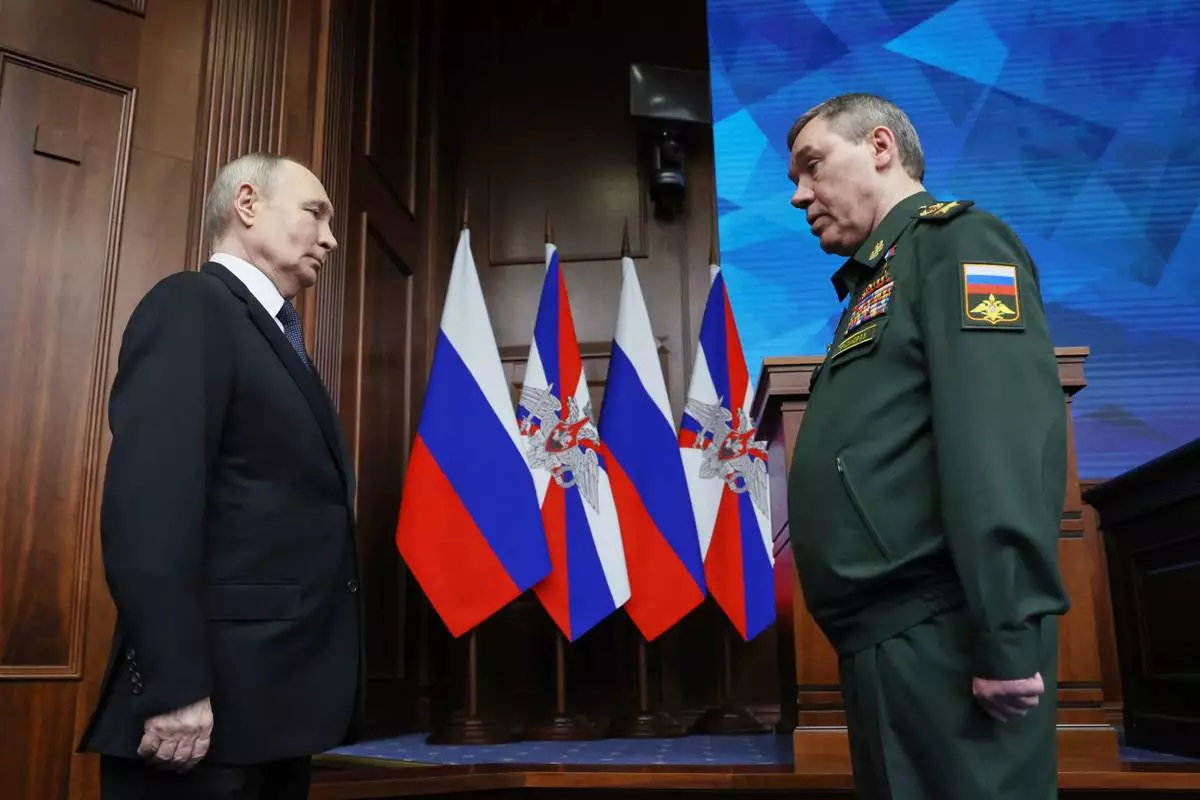
Russian Chief of General Staff Gen. Valery Gerasimov, right, reports to Russian President Vladimir Putin at the annual board meeting of the Russian Defense Ministry and award soldiers in Moscow, Wednesday, Dec. 17, 2025. (Alexander Kazakov/Sputnik, Kremlin Pool Photo via AP)
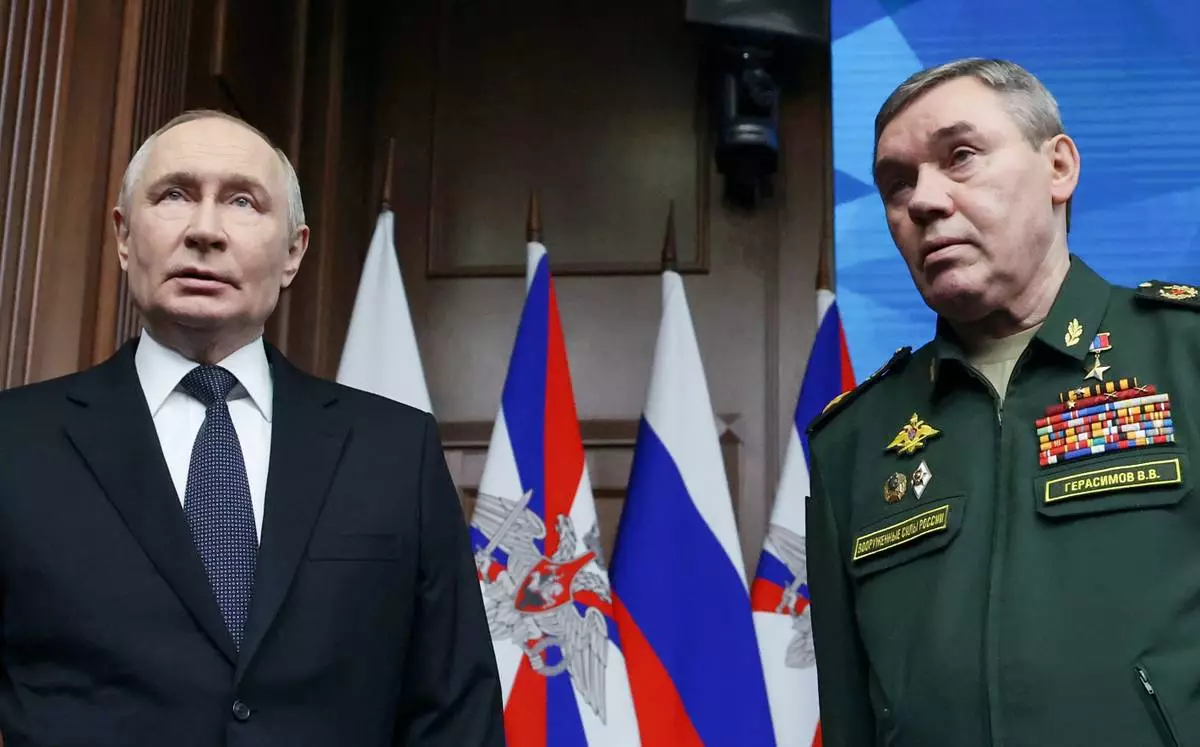
Russian President Vladimir Putin, left, and Russian Chief of General Staff Gen. Valery Gerasimov attend the annual board meeting of the country's Defense Ministry and awards soldiers in Moscow, Russia, Wednesday, Dec. 17, 2025. (Alexander Kazakov/Sputnik, Kremlin Pool Photo via AP)
VATICAN CITY (AP) — Pope Leo XIV made a historic apology on Monday for the Holy See's role in legitimizing slavery and for having failed to condemn it for centuries, calling the Vatican’s record a “wound in Christian memory.”
Past popes have apologized for Christians’ involvement in the trans-Atlantic slave trade. But no pope had ever publicly acknowledged, much less apologized for, the role that past popes played in giving European sovereigns explicit authority to subjugate and enslave “infidels.”
History’s first U.S.-born pope, whose family history includes both enslaved people and slave owners, delivered the apology in his first encyclical, “Magnifica Humanitas,” (Magnificent Humanity), which was released Monday.
The sweeping manifesto is about safeguarding humanity in an era of increasing reliance on artificial intelligence. Leo raised the slave trade in relation to what he called the new forms of slavery and colonialism that the digital revolution is fueling.
Black American Catholics, activists and scholars have long called for the Holy See to atone for its role in the colonial-era trade in human beings, beyond generic apologies for the involvement of individual Christians.
“It is impossible not to feel deep sorrow when contemplating the immense suffering and humiliation endured by so many in stark contrast to their immeasurable dignity as persons infinitely loved by the Lord,” Leo wrote. “For this, in the name of the church, I sincerely ask for pardon.”
Shannen Dee Williams, historian at the University of Dayton and author of the 2022 history of American Black Catholic nuns, “Subversive Habits,” welcomed the apology as a "monumental step toward the kind of essential truth-telling and reparation that many Catholics have prayed and worked to witness.”
“The Catholic Church has never been an innocent bystander in the history of white supremacy," said Williams. “Black Catholics have waited a long time to hear the Vatican speak honestly about the church’s leading roles in the trans-Atlantic slave trade and chattel slavery--and thus by extension the enduring systems of anti-Black racism in the world today.”
The Vatican has insisted that it always upheld the dignity of all human beings as children of God. But a series of 15th-century directives from the Vatican authorized Portuguese sovereigns to conquer Africa and the Americas and enslave non-Christians.
In 1452, for example, Pope Nicholas V issued the papal bull Dum Diversas, which gave the Portuguese king and his successors the right “to invade, conquer, fight and subjugate” and take all possessions — including land — of “Saracens, and pagans, and other infidels, and enemies of the name of Christ” anywhere.
The bull also gave the Portuguese permission “to reduce their persons to perpetual slavery.”
That bull and another issued three years later, Romanus Pontifex, formed the basis of the Doctrine of Discovery, the theory that legitimized the colonial-era seizure of land in Africa and the Americas.
Nicholas V’s permissions to the Portuguese were confirmed or renewed by Pope Callixtus III in 1456, Pope Sixtus IV in 1481 and Pope Leo X in 1514, according to the Rev. Christopher J. Kellerman, a Jesuit priest and author of “All Oppression Shall Cease: A History of Slavery, Abolitionism, and the Catholic Church.”
Spanish kings received the rights for the Americas.
In 2023, the Vatican formally repudiated the Doctrine of Discovery, but it never formally rescinded, abrogated or rejected the bulls themselves. The Vatican insists that a later bull, Sublimis Deus in 1537, reaffirmed that Indigenous peoples shouldn’t be deprived of their liberty or the possession of their property, and weren't to be enslaved.
In his encyclical, Leo recalled that his namesake, Pope Leo XIII, was the first pope to explicitly condemn slavery in 1888, long after many countries had abolished it. Before that, in antiquity and the Middle Ages, church institutions and even popes — Gregory the Great — had slaves, Kellerman said.
In acknowledging the 15th century papal bulls, Leo wrote in his encyclical: “Already in the early modern period, the Apostolic See of Rome, responding to the requests of sovereigns, intervened several times in order to regulate and legitimize forms of subjugation, and, in certain cases, including the enslavement of ‘infidels.’”
Leo said it wasn't possible to judge the morality of the decisions with today’s standards.
“Yet neither can we deny or diminish the delay with which both society and the church came to denounce the scourge of slavery,” he said.
The pope said that the church has long affirmed the dignity of every human being as the basis of its doctrine, “even if it took eighteen centuries for its full incompatibility with slavery to be explicitly recognized.”
“This constitutes a wound in Christian memory, one from which we cannot consider ourselves detached,” he said.
Leo said that the church must firmly condemn all forms of trafficking related to the digital technological revolution “if we want to avoid the need to ask for pardon again in the future for having failed to respect the treasure of human dignity that is required by our faith.”
Anthea Butler, senior fellow at the Koch History Center, Oxford University, said Leo needed to acknowledge and atone for the church's complicity in historic slavery if he wanted to credibly “speak to the current issues of technological enslavement.”
“For descendants of enslaved persons, this is once again a much needed apology from the pope,” said Butler, who is Black.
Kellerman, the scholar, welcomed Leo’s apology but said more needs to be done to further acknowledge how the Catholic Church legitimized and expanded slavery.
“Pope Leo has strengthened the moral credibility of the church with this admission and apology today,” he told The Associated Press. “Hopefully a future document will explain in more detail the church’s involvement with slaveholding. As a scholar I have some quibbles with the wording, but this is a truly remarkable moment.”
During a 1985 visit to Cameroon, St. John Paul II asked forgiveness of Africans for the slave trade on behalf of Christians who participated in it, but not the popes. In a 1992 visit to Goree Island, Senegal, which was the largest slave-trading center in West Africa, he denounced the injustice of slavery and called it a “tragedy of a civilization that called itself Christian.”
According to genealogical research published by Henry Louis Gates Jr., 17 of Leo’s American ancestors were Black, listed in census records as mulatto, Black, Creole or a free person of color. His family tree includes slaveholders and enslaved people, Gates wrote in The New York Times.
During a visit to Angola last month, Leo prayed at a Catholic shrine at the site of an important hub of the African slave trade during Portugal’s colonial rule. While at the Sanctuary of Mama Muxima, Leo recalled the “sorrow and great suffering” Angolans endured for centuries, but he didn’t refer specifically to slavery.
Winfield reported from Middletown, Connecticut.
Associated Press religion coverage receives support through the AP’s collaboration with The Conversation US, with funding from Lilly Endowment Inc. The AP is solely responsible for this content.
Pope Leo XIV speaks during the presentation of his first encyclical, "Magnifica humanitas: On Safeguarding the Human Person in the Time of Artificial Intelligence," at the Vatican, Monday, May 25, 2026. (AP Photo/Alessandra Tarantino)
Pope Leo XIV listens to Cardinal Víctor Manuel Fernández, prefect of the Dicastery for the Doctrine of the Faith, right, during the presentation of Pope Leo XIV's first encyclical, "Magnifica humanitas: On Safeguarding the Human Person in the Time of Artificial Intelligence," at the Vatican, Monday, May 25, 2026. (AP Photo/Alessandra Tarantino)
Pope Leo XIV, left, attends the presentation of his first encyclical, "Magnifica humanitas: On Safeguarding the Human Person in the Time of Artificial Intelligence," at the Vatican, Monday, May 25, 2026. (AP Photo/Alessandra Tarantino)
Pope Leo XIV, left, arrives with Vatican Secretary of State Cardinal Pietro Parolin for the presentation of his first encyclical, "Magnifica humanitas: On Safeguarding the Human Person in the Time of Artificial Intelligence," at the Vatican, Monday, May 25, 2026. (AP Photo/Alessandra Tarantino)
Vatican Secretary of State Cardinal Pietro Parolin, right, talks to theologian Leocadie Lushombo during the presentation of his first encyclical, "Magnifica humanitas: On Safeguarding the Human Person in the Time of Artificial Intelligence," at the Vatican, Monday, May 25, 2026. (AP Photo/Alessandra Tarantino)
Pope Leo XIV holds the pastoral staff as he celebrates the Pentecost Mass in St. Peter's Basilica, at the Vatican, Sunday, May 24, 2026. (AP Photo/Gregorio Borgia)