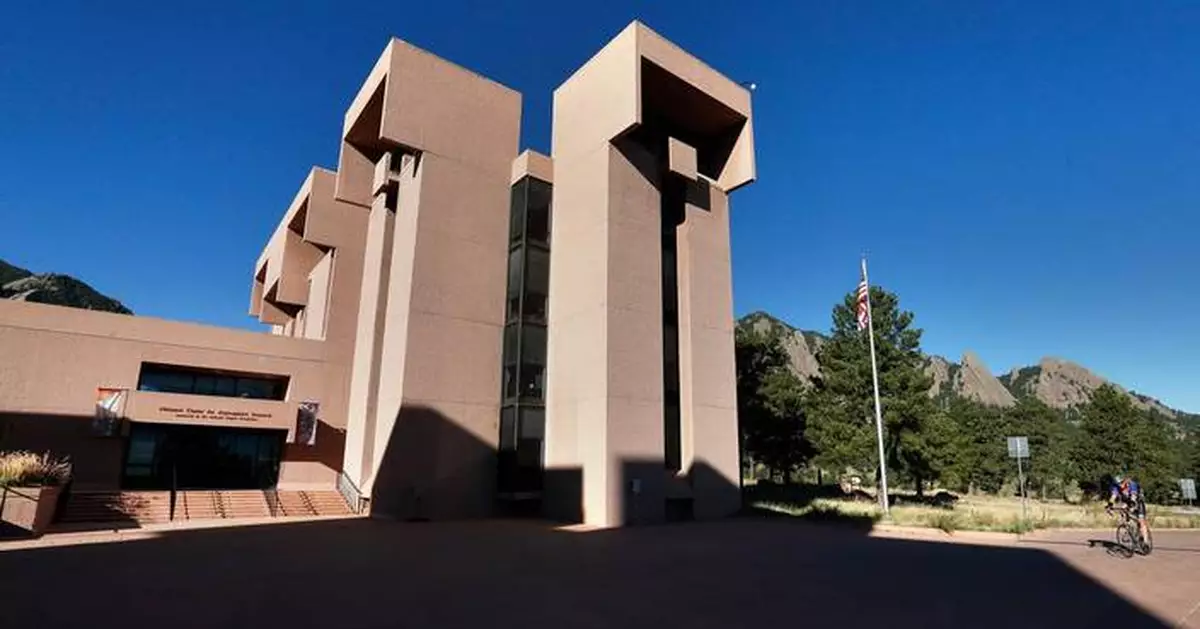
WASHINGTON (AP) — The Trump administration is dismantling the National Center for Atmospheric Research in Colorado, moving to dissolve a research lab that a top White House official described as “one of the largest sources of climate alarmism in the country.″
White House budget director Russ Vought criticized the lab in a social media post Tuesday night and said a comprehensive review of the lab is underway. “Vital activities such as weather research will be moved to another entity or location,″ Vought said.
The research lab, which houses the largest federal research program on climate change, supports research to predict, prepare for and respond to severe weather and other natural disasters. The research lab is managed by a nonprofit consortium of more than 130 colleges and universities on behalf of the National Science Foundation.
A senior White House official cited two instances of the lab's “woke direction” that wastes taxpayer funds on what the official called frivolous pursuits and ideologies. One funded an Indigenous and Earth Sciences center that aimed to “make the sciences more welcoming, inclusive, and justice-centered,” while another experiment traced air pollution to "demonize motor vehicles, oil and gas operations.'' The official spoke on condition of anonymity to speak frankly about the administration's actions.
For climate scientists the lab “is quite literally our global mothership,” said Katharine Hayhoe, a climate scientist and Distinguished Professor at Texas Tech University.
"NCAR supports the scientists who fly into hurricanes, the meteorologists who develop new radar technology, the physicists who envision and code new weather models, and yes — the largest community climate model in the world. That too,” Hayhoe said in a social media post.
"Dismantling NCAR is like taking a sledgehammer to the keystone holding up our scientific understanding of the planet,” she said.
Following World War II, interest in meteorology, solar observations and atmospheric science increased, spurring the creation of NCAR. The focus initially centered on atmospheric chemistry and physical meteorology.
NCAR's budget more than doubled from the 1980s into the 1990s, driven by increased federal focus on climate change research.
Colorado Gov. Jared Polis called the lab a global leader in earth systems scientific research.
“Climate change is real, but the work of NCAR goes far beyond climate science," the two-term Democrat said. “NCAR delivers data around severe weather events like fires and floods that help our country save lives and property and prevent devastation for families. If these cuts move forward we will lose our competitive advantage against foreign powers and adversaries in the pursuit of scientific discovery.”
The White House said President Donald Trump is restoring the lab to its original purpose. It is unclear how many of the research lab’s 830 employees and associated programs at partnering universities could be affected.
The change comes after the administration recently targeted another Colorado lab, the former National Renewable Energy Lab, to remove its focus on wind and solar power. The Energy Department site was renamed “National Laboratory of the Rockies” earlier this month.
Assistant Energy Secretary Audrey Robertson said the Trump administration is “no longer picking and choosing energy sources.”
Colorado's Democratic senators — John Hickenlooper and Michael Bennet — along with Democratic Rep. Joe Neguse argued in a statement that the center's work has led to early warnings for natural disasters and has deepened understanding of the Earth’s systems. They called the administration's move reckless, saying it would have devastating consequences for families in Colorado and communities across the nation.
“Efforts to dismantle this institution and its essential programs are deeply dangerous and blatantly retaliatory,” they said.
Antonio Busalacchi, president of the nonprofit consortium, said dismantling the research lab “would set back our nation’s ability to predict, prepare for, and respond to severe weather and other natural disasters.”
Montoya Bryan reported from Albuquerque, New Mexico.
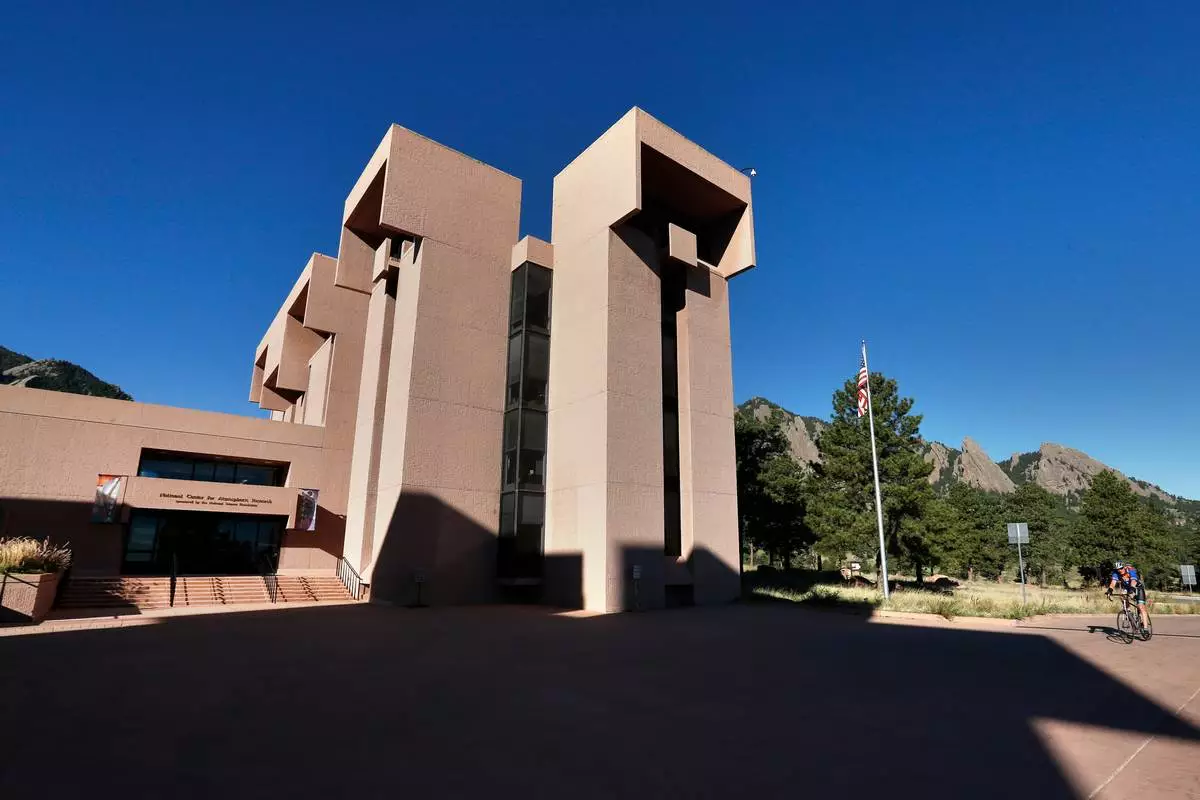
FILE - A man rides a bike to work at a U.S. National Center for Atmospheric Research facility in Boulder, Colo., Oct. 1, 2013. (AP Photo/Brennan Linsley, File)
He's done it again. Nikola Jokic will average a triple-double this season.
The Denver star had 15 points, 17 rebounds and 12 assists on Wednesday, helping the Nuggets beat the Utah Jazz 130-117.
Jokic now has exactly 660 assists this season. Denver has five games left and if Jokic plays in them all, he would average 10.0 assists — even if he doesn't get another one all season. He's already ensured that he would average double-figures in points and rebounds as well.
Russell Westbrook had four seasons in which he averaged a triple-double. Jokic has now done it twice — he did it last season as well — and Oscar Robertson did it once.
Westbrook, Jokic and Robertson are the only players who have pulled it off.
The Lakers and Denver both clinched playoff spots on Tuesday night. They join Detroit, Boston, New York, Oklahoma City and San Antonio on the list of teams with playoff spots secured.
The postseason (not playoff) teams are set: Milwaukee, Chicago, Washington, Brooklyn and Indiana have all been eliminated from the Eastern Conference race while Memphis, New Orleans, Dallas, Utah and Sacramento are out of the Western Conference race.
Portland, Golden State and the Los Angeles Clippers are locked into the play-in tournament.
— 76ers 153, Wizards 131: Paul George scores 39, Philly shoots 62% and moves into No. 6 in East.
— Hawks 130, Magic 101: Atlanta improves to 17-2 in last 19 games, while Orlando falls to No. 9 in East.
— Celtics 147, Heat 129: Boston scores 53 in 1st quarter, Jaylen Brown has 43, Jayson Tatum triple-double.
— Knicks 130, Grizzlies 119: New York responds to Josh Hart’s pleas for better play, gets easy win.
— Kings 123, Raptors 115: Bad loss for Toronto, which gets outrebounded 48-32 and falls to No. 7 in the East.
— Pacers 145, Bulls 126: Did anyone in the NBA play any defense on Wednesday night?
— Rockets 119, Bucks 113: Spirited effort from seriously short-handed Bucks, but Houston’s starters outscore Milwaukee’s 101-80.
— Nuggets 130, Jazz 117: Jamal Murray had 37 for Denver, Nikola Jokic added another triple-double and Utah used only eight players in the game.
— Spurs 127, Warriors 113: A 41-point, 18-rebound game for MVP hopeful Victor Wembanyama, and San Antonio improves to 26-2 since Feb. 1.
— Phoenix at Charlotte: Devin Booker had 30 points, 10 assists in Phoenix win over Charlotte last month.
— Minnesota at Detroit: Detroit just keeps rolling, even with Cade Cunningham sidelined.
— L.A. Lakers at Oklahoma City: Matchup of MVP contenders in Lakers' Luka Doncic, Thunder’s Shai Gilgeous-Alexander.
— Cleveland at Golden State: Warriors know they’re in West play-in, while Cavs are on brink of clinching East top-4 seed.
— New Orleans at Portland: Pelicans building toward next season, Blazers could host a play-in game.
— San Antonio at L.A. Clippers: Spurs still chasing that No. 1 seed, Clippers know they’ll be in play-in.
— Indiana at Charlotte: A winning record this season is going to get Hornets’ coach Charles Lee some award votes.
— Minnesota at Philadelphia: Massive implications seeding-wise for both teams.
— Atlanta at Brooklyn: Hawks closing in on Southeast Division title, possibly No. 5 seed.
— Chicago at New York: Knicks nearing the 50-win mark yet again.
— Utah at Houston: The Rockets know they can’t afford a slipup in this spot.
— Toronto at Memphis: Raptors need a few wins down the stretch to avoid play-in.
— Boston at Milwaukee: Bucks coach Doc Rivers faces his former team, a day before expected Hall of Fame formal announcement.
— Orlando at Dallas: Magic coach Jamahl Mosley enjoyed a lot of nights when he was on the Mavs’ staff. He desperately needs one of those good nights here.
— New Orleans at Sacramento: A pair of teams building for the future.
Thursday's games on Prime: Minnesota-Detroit and L.A. Lakers-Oklahoma City.
Friday on NBA TV: Chicago-New York.
Oklahoma City (+135) is favored to win the NBA title, according to BetMGM Sportsbook, followed by Boston (+600), San Antonio (+600), Cleveland (+1000), Denver (+1100) and New York (+1600). Detroit, on its way to the No. 1 seed in the East, is +2500.
— April 10: All 30 teams play their 81st games of the season.
— April 12: All 30 teams play their regular season finales.
— April 14, 15 and 17: NBA play-in tournament dates.
— April 18 and 19: NBA playoff series openers.
— May 2, 3 or 4: Conference semifinals begin.
— May 10: NBA draft lottery.
— May 10-17: NBA draft combine.
— May 17 or 19: Eastern Conference finals begin on ESPN and ABC.
— May 18 or 20: Western Conference finals begin on NBC and Peacock.
— June 3: Game 1, NBA Finals on ABC. (Other finals dates: June 5, June 8, June 10, June 13, June 16 and June 19).
Sacramento's DeMar DeRozan passed Dominique Wilkins (26,668) for 17th on the NBA's all-time scoring list on Wednesday in Toronto. He's now 22 points behind No. 16 Oscar Robertson (26,710).
No team in NBA history had made 24 3-pointers and lost by more than 11 points. (Most hadn't lost at all; the record for teams with 24 or more 3s was 117-9). That is, until Wednesday, when Miami made 24 3s ... and lost by 18 to Boston.
AP NBA: https://apnews.com/nba
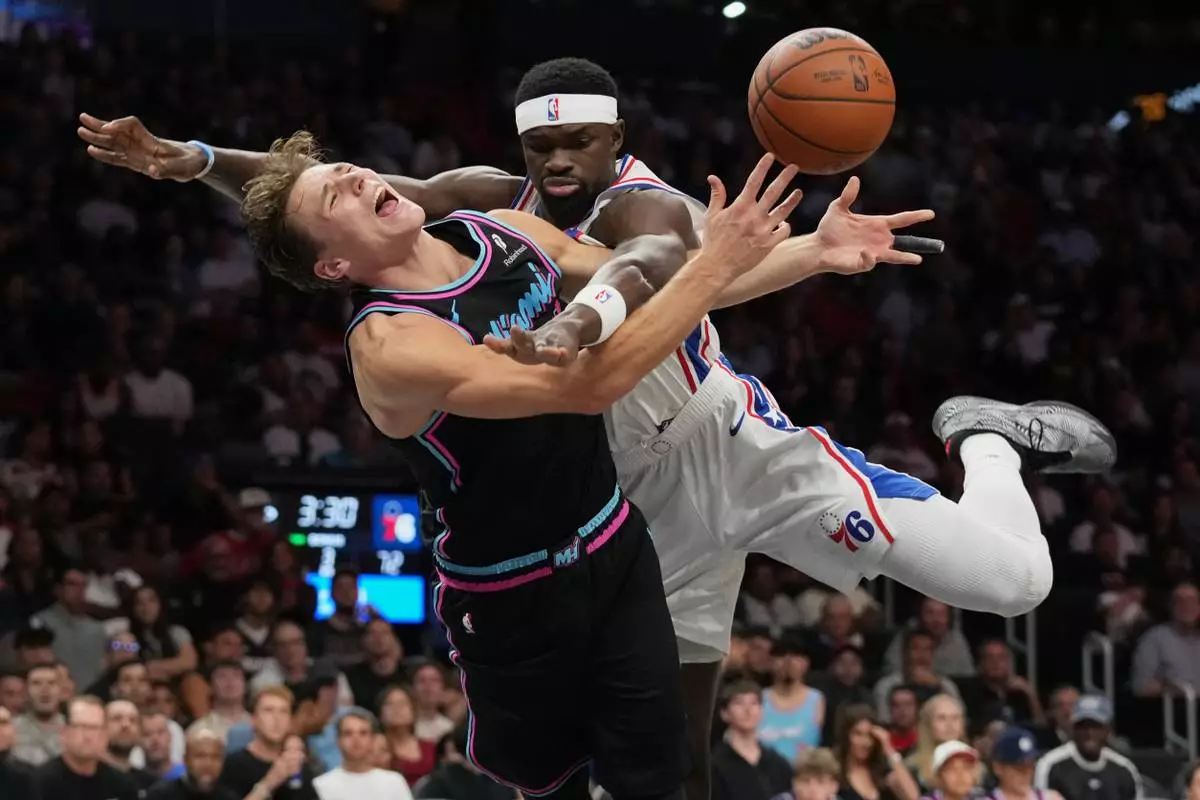
Miami Heat guard Pelle Larsson, left, is fouled by Philadelphia 76ers center Adem Bona, right, during the second half of an NBA basketball game, Monday, March 30, 2026, in Miami. (AP Photo/Lynne Sladky)
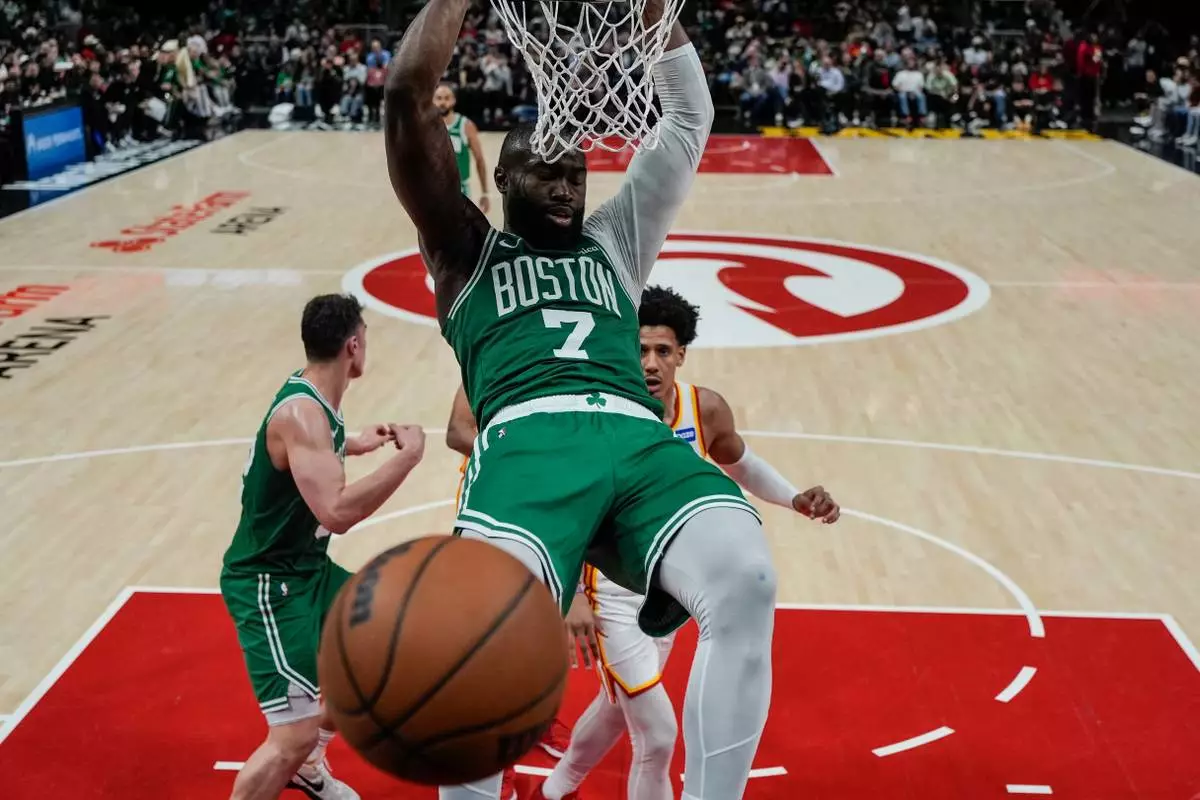
Boston Celtics guard Jaylen Brown (7) dunks against the Atlanta Hawks in the second half of an NBA basketball game, Monday, March 30, 2026, in Atlanta. (AP Photo/Mike Stewart)
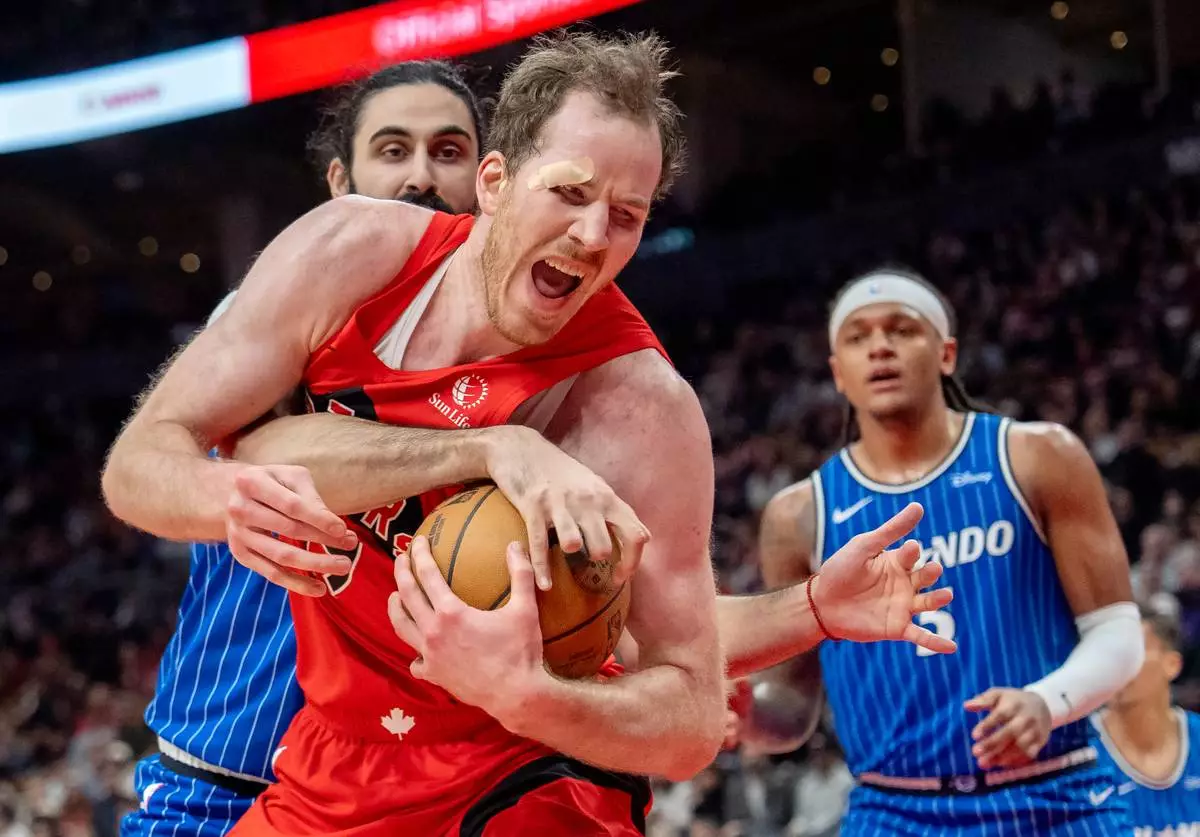
Toronto Raptors centre Jakob Poeltl (front) is fouled by Orlando Magic centre Goga Bitadze (back left) as Magic forward Paolo Banchero (right) looks on during first half NBA action in Toronto on Sunday, March 29, 2026. (Frank Gunn/The Canadian Press via AP)
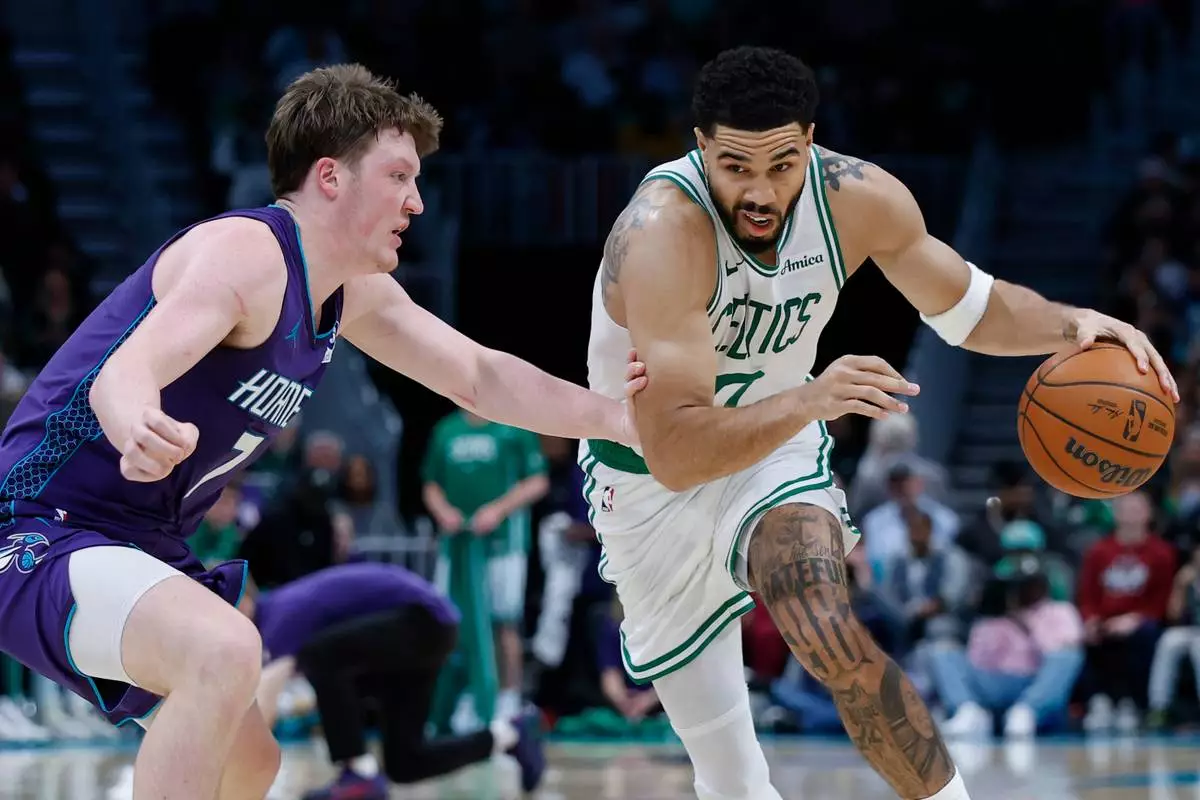
Boston Celtics forward Jayson Tatum, right, drives against Charlotte Hornets guard Kon Knueppel during the second half of an NBA basketball game in Charlotte, N.C., Sunday, March 29, 2026. (AP Photo/Nell Redmond)