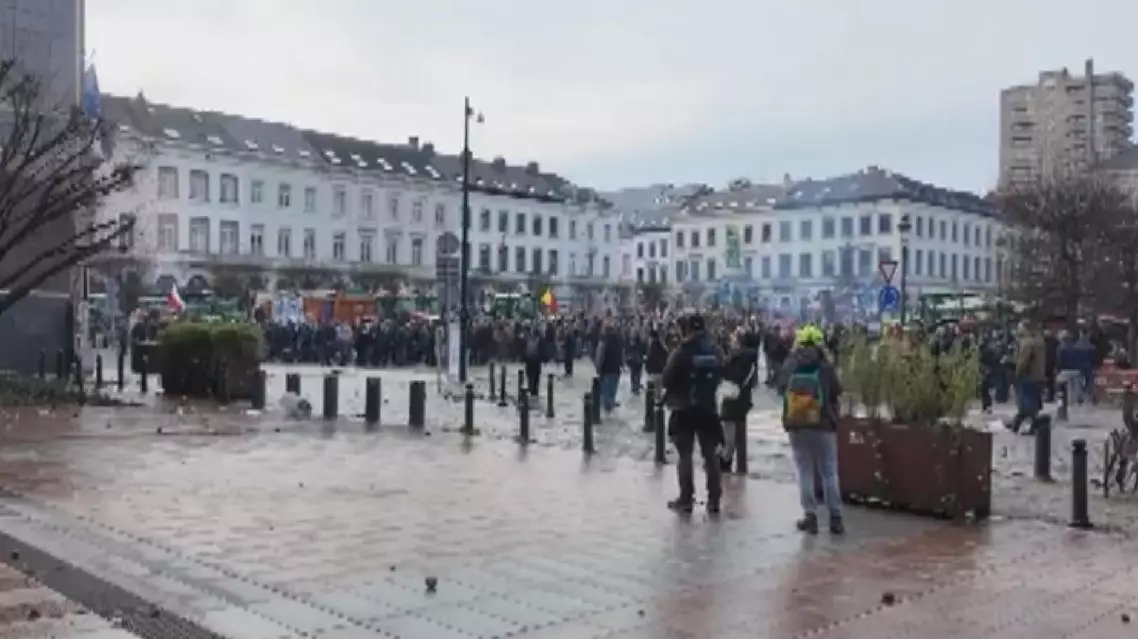
Thousands of farmers from across Europe rallied near the European Parliament and the Europa Building in Brussels on Thursday as European Union (EU) leaders convened for a summit, with a long-negotiated trade deal with the South American bloc Mercosur on the agenda.
Protesters, many arriving in tractors, blocked the roads leading into central Brussels, blared horns and set off fireworks. Police deployed water cannon and tear gas near the Europa Building, where leaders of the 27 EU member states held discussions on the trade deal and other issues from early morning.
Outside the European Parliament, demonstrators initially threw potatoes and beets at police, who responded by using water cannons. The situation later escalated into violence, with protesters hurling stones, smoke bombs and fireworks at Parliament buildings, while tractors were seen uprooting trees in the square. Police used tear gas to disperse the violent protesters.
The demonstration targeted the free trade agreement between the EU and the four founding Mercosur countries -- Argentina, Brazil, Paraguay, and Uruguay. Initiated more than 20 years ago, the deal reached an agreement in principle in 2019, with negotiations finalized in 2024.
The proposed pact would expand EU exports of vehicles, machinery, wines and spirits to Latin America, while easing access for South American beef, sugar, rice, honey and soybeans to the European market.
Some media said that this is the largest pan-European farmers' protest in Brussels this century. Also, the organizers said that the protest involved 40 to 45 national agricultural organizations, marking the first time such a broad participation occurred in Brussels.
A Polish farmer said that the Russia-Ukraine conflict is also a significant reason for people taking to the streets, as the influx of Ukrainian agricultural products has caused substantial fluctuations in the prices of Polish agricultural products, resulting in a noticeable decline in local farmers' incomes. "The situation between Russia and Ukraine has played a significant role, as Ukrainian products like wheat were previously unable to enter our market. However, after the outbreak of the war, the situation changed. Following the EU's decision to open its market to Ukrainian agricultural products, the price of Polish wheat dropped by half, from over 1,000 zlotys (about 279.07 U.S. dollars) per ton to 600 zlotys (about 167.44 U.S. dollars). This issue extends beyond wheat to include poultry, honey, and many other agricultural products," said the Polish farmer.
Some farmers have come to protest over trade issues, while others are concerned about potential cuts to the agricultural share in the EU's budget for the next fiscal year.
"I want to say that Europe is on a path of self-destruction. All the decisions made in Europe go against the interests of its citizens, with industrial and various sectors being neglected. It seems that only the self-interests of individual countries truly matter, and we are harming Europe in the process," said another farmer.
European farmers' protests against Mercosur deal highlight EU division