China's establishment of its entire southern tropical island province of Hainan as a Free Trade Port (FTP) is benefiting foreign companies in terms of tariffs, taxes and global market coverage, said leaders of businesses operating in the province.
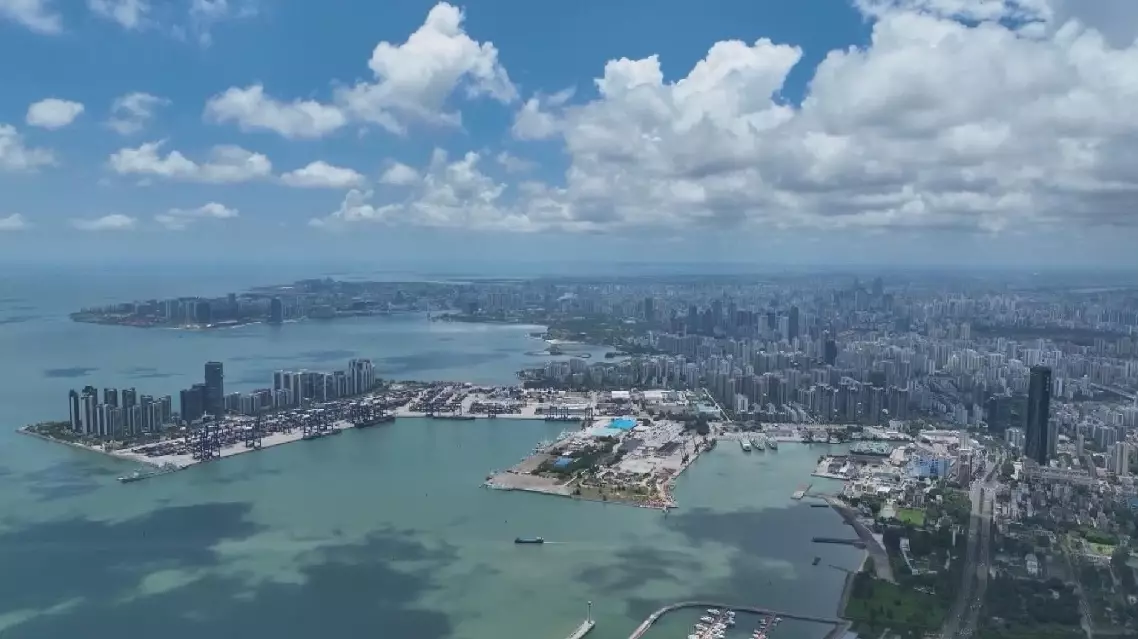
China on Thursday launched island-wide special customs operations in the Hainan FTP, the world's largest FTP by area, allowing freer entry of overseas goods, expanded zero-tariff coverage and more business-friendly measures.
This marks a new stage in the development of the Hainan FTP, which enables freer flows of goods, capital, personnel and data, supported by zero tariffs, low tax rates and a simplified tax system.
Giles Verheecke, global maintenance director of PB Leiner, one of the world's largest producers of gelatins, said the preferential policies in Hainan have brought advantages for the company's growth.
"Raw material is one of the most important imports for us. So when we have zero tariffs, that is a very positive in the case that the raw material maybe can't supply growth in the future as we continue to expand. We will have secure raw material for the future. It definitely is an advantage for your growth plans and what you want to do in the future," he said.
Meng Xinli, president of Jia Green Chocolate Works (Hainan) Co. from Canada, said Hainan's zero-tariffs and low tax rates will effectively reduce the cost of companies.
"We benefit from the policy of exemption from import duties on goods whose value increases by over 30 percent through processing, as many of our raw materials and ingredients are imported from abroad. The 15 percent cap on corporate income tax has also reduced our costs, and the 15 percent cap on personal income tax helps us retain talent. After the launch of special customs operations in Hainan [on Thursday], we will enjoy more favorable policies as we import our raw materials and sell our products abroad. This is a key reason for us foreign-funded enterprise to choose the Hainan Free Trade Port," she said.
Serving as a strategic node connecting global markets with China's massive domestic demand, the Hainan FTP provides companies with abundant opportunities of market exploitation, said Hu Lisha, president, Italy-China Business Association.
"For Italy, the biggest appeal of Hainan FTP's special customs operations lies in its role as a super-connector linking China's vast domestic market with the global market. Investing here not only allows us to enjoy a series of preferential policies in taxation, trade and investment, but also provides access to the market of the Chinese mainland and the surrounding regions extending to ASEAN and other neighboring countries. This enables our strategic layout of being based in Hainan, facing the rest of China and extending operations across the Asia-Pacific region," she said.
"For us, it will be an exciting development. It's an exciting time. The Hainan strategic position close to high-quality raw materials and with access to ports allows us to have part of a strategic portfolio that can both reach Asia and the rest of the world," said Verheecke.
The momentum of the Hainan FTP is evident from a set of figures. Since 2020, more than 9,600 foreign-funded enterprises have been newly established in Hainan by investors from more than 170 other countries and regions. The province has opened a total of 75 container liner routes, including 36 foreign trade routes. Tourist arrivals have increased rapidly as Hainan aims to become an international tourism and consumption destination.
Zhang Monan, a researcher of the China Center for International Economic Exchanges, said the country will further open up the service sector in Hainan to attract foreign companies.
"China's manufacturing industry has already achieved a comprehensive clearance of the negative list, while there is still significant room for further opening up in the service sector. The Ministry of Commerce has already issued a negative list for cross-border trade in services. Following the island-wide special customs operations of the Hainan Free Trade Port, we will focus on further opening up the service sector and strengthening efforts to attract foreign investment. Therefore, I believe that the opening up of China's service sector in the future will serve as a new development engine leading global openness," she said.
China's Hainan FTP benefits foreign companies in tariffs, taxes, market coverage