KHAN YOUNIS, Gaza Strip (AP) — As December's chill settled over Gaza, the family's nylon tent offered little refuge. So each night, Eseid Abdeen covered his frail newborn son with four blankets, periodically shining a flashlight on the baby’s eyes to confirm he was all right.
Until Wednesday night, when 29-day-old Saeed, his tiny body wracked by the cold, did not respond.
The infant, who had been born prematurely and very underweight, became the second baby to die of hypothermia in recent days at Nasser Hospital, doctors said Thursday. They warned there could soon be others if conditions in the tent camps housing thousands of Palestinians are not improved.
“I always feared for him and tried to keep him warm. But it is very cold,” the child’s mother, Rawya Abdeen, told The Associated Press on Thursday. When doctors reported her son had died, her screams of anguish drew the neighbors. “Why him?” she cried.
Dr. Ahmed al-Farra, the director of pediatrics at Nasser, said the baby arrived at the hospital late Wednesday night with a body temperature of 30 degrees Celsius (86 Fahrenheit), well below the level where hypothermia sets in. Medics did everything they could to revive the child, but he died early Thursday, al-Farra said.
Overnight temperatures in Gaza have reached 6 degrees Celsius (43 degrees Fahrenheit) in recent days.
“We are warning that this tragedy will happen again unless there is a permanent solution for babies, and specifically premature babies, because they are more vulnerable to the dropping temperatures,” al-Farra said. “They live in worn-out tents that are exposed to winds and cold weather and lack all means to stay warm in these tents.”
The doctor said cold is a particular threat to premature babies because their fat tissues are underdeveloped and their bodies lose energy quickly.
The infant’s death raises to 13 the number of people killed in Gaza since a strong storm hit the strip last week, the health ministry said. They included 11 people killed when heavy rains collapsed already damaged buildings, as well as the two children who perished because of the cold. The first baby lost to hypothermia, two-week-old Mohamed Khair, had been born after a full-term pregnancy.
Though the current ceasefire has been in place for two months, not enough shelter materials have been allowed into Gaza, aid groups say. Recently released Israeli military figures suggest it hasn’t met the ceasefire stipulation of allowing 600 trucks of aid into Gaza a day, though Israel disputes that finding. American officials with the U.S.-led center coordinating aid shipments into Gaza also say deliveries have reached the agreed-upon levels.
The vast majority of Gaza’s 2 million people have been displaced, and most people live in tent camps stretching along the coast or set up among the shells of damaged buildings. The buildings lack adequate flooding infrastructure and people use cesspits dug near tents as toilets.
The Abdeens said their makeshift tent, in southern Gaza's Muwasi, is regularly inundated by rainwater.
Rawya Abdeen said her son had weighed just 1.3 kilograms (2.9 pounds) at birth and spent two weeks in the neonatal intensive care unit.
When the boy’s father shone a light on him at around 10 p.m. Wednesday, the baby did not respond with his usual squint. An examination under the light revealed the child was throwing up, his mother said, and the family rushed him to the hospital. His father said he had prayed for Saeed's survival, before doctors called in the morning to tell them the infant had perished.
“I was willing to trade my soul to save him,” Eseid Abdeen said.
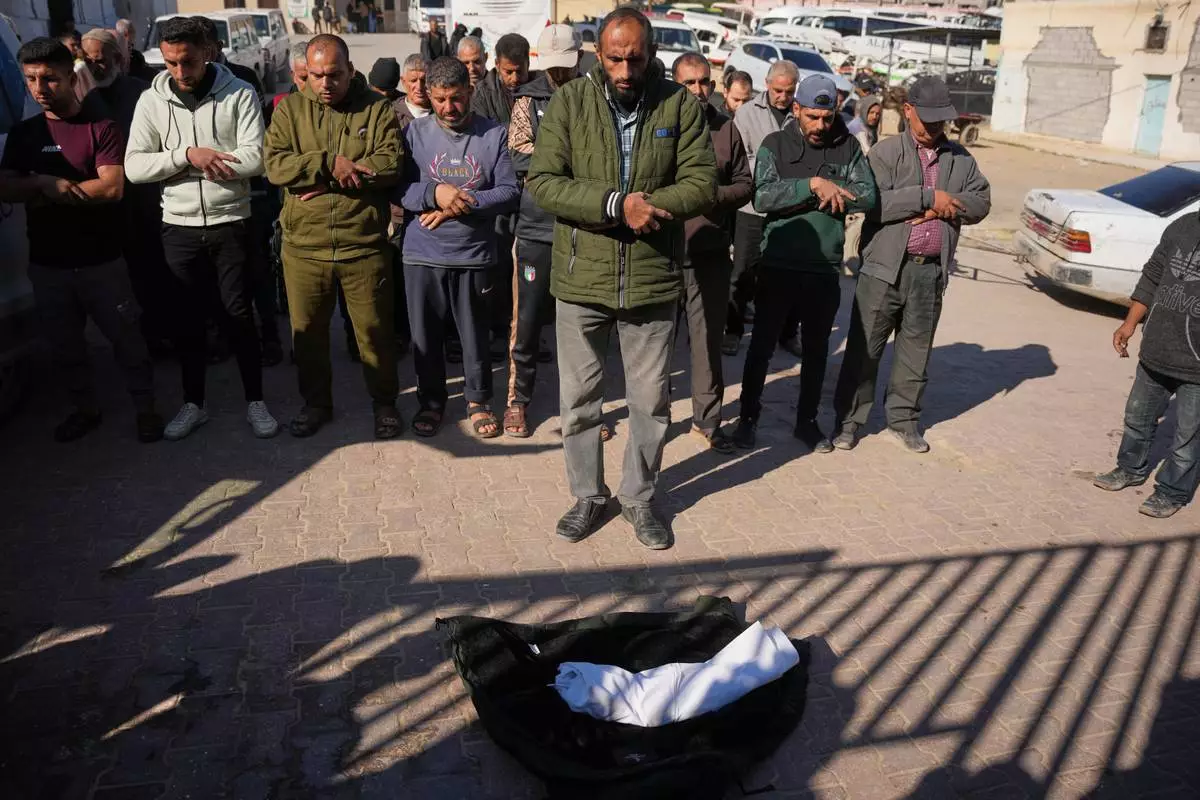
The Abdeen family performed the funeral prayer for their 29-day-old infant son, Saeed Abdeen, who, according to health authorities, died due to the cold weather, at Nasser Hospital in Khan Younis, southern Gaza Strip, Thursday, Dec. 18, 2025. (AP Photo/Abdel Kareem Hana)
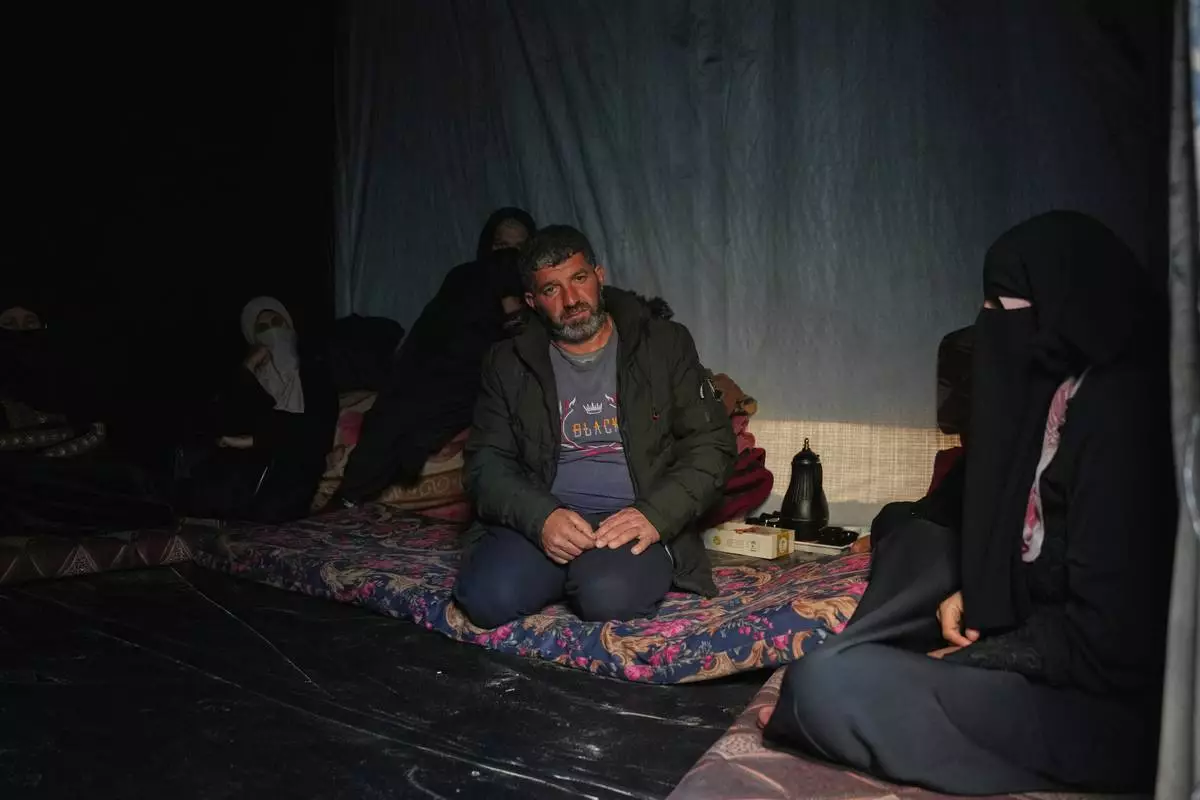
Eseid Abdeen, 42, the father of the 29-day-old infant, Saeed, who, according to health authorities, died due to the cold weather, sits in his tent while receiving condolences from family members and friends in a temporary camp for displaced Palestinians in Khan Younis, southern Gaza Strip, on Thursday, Dec. 18, 2025. (AP Photo/Abdel Kareem Hana)
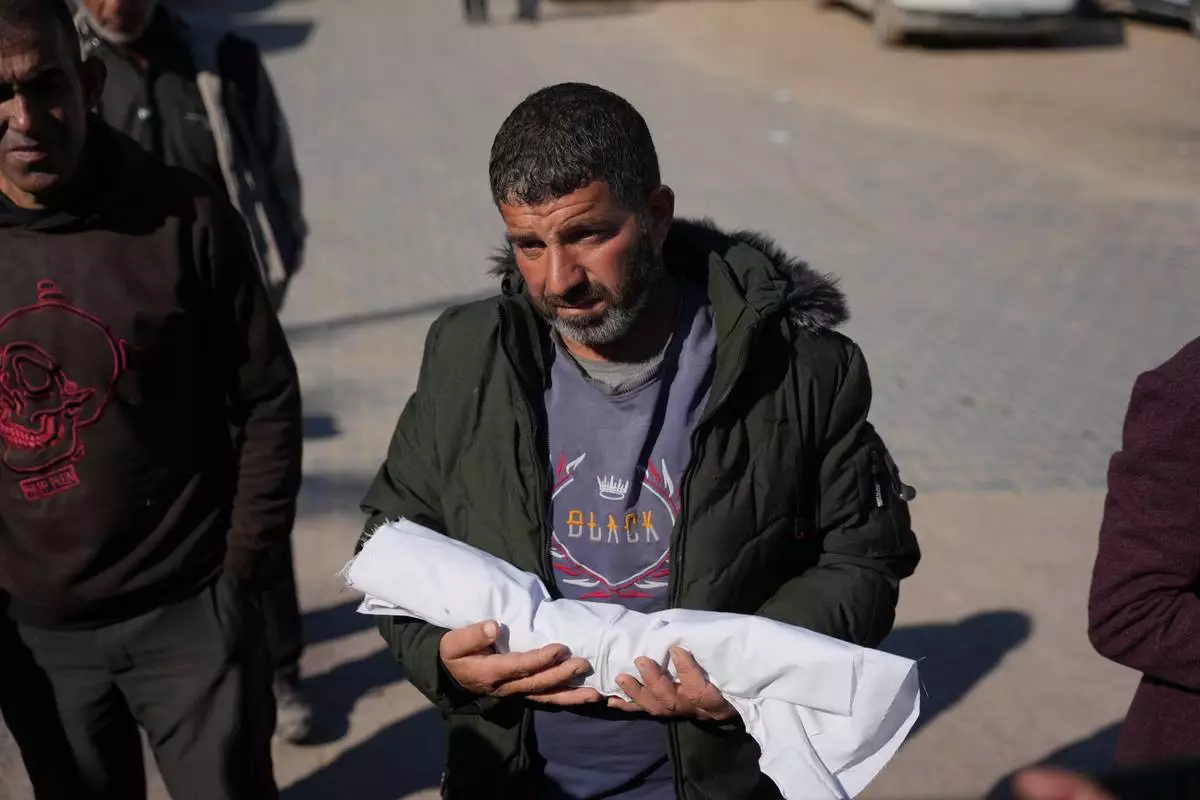
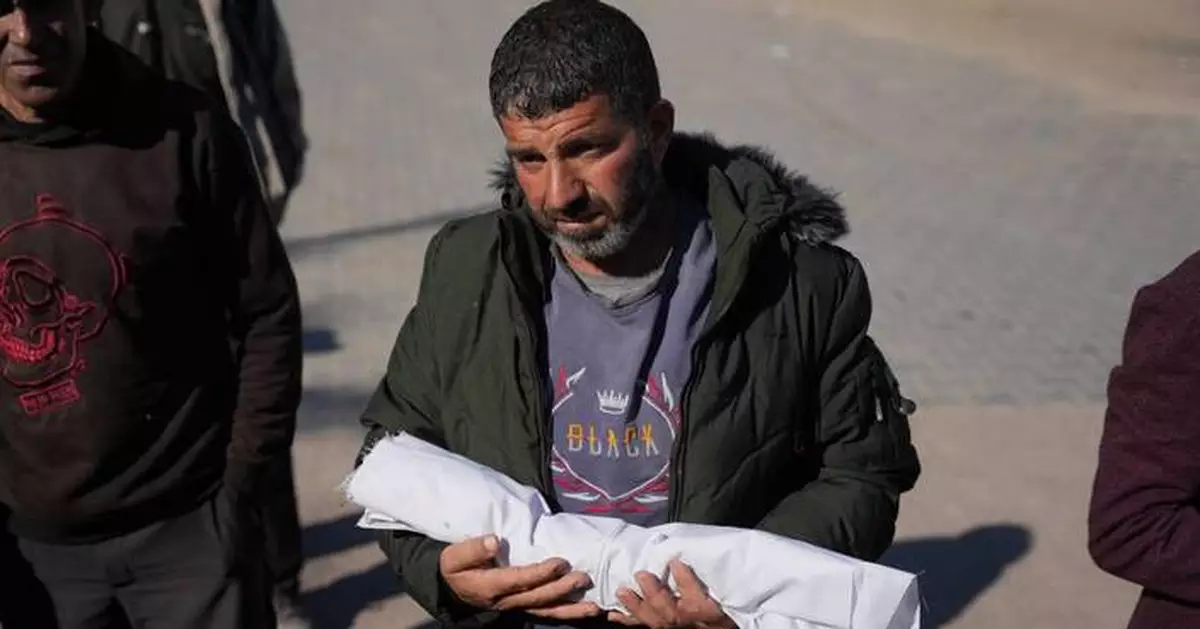
Eseid Abdeen, 42, carries the body of his 29-day-old infant son, Saeed, who, according to health authorities, died due to the cold weather, as he stands outside Nasser Hospital in Khan Younis, southern Gaza Strip, Thursday, Dec. 18, 2025. (AP Photo/Abdel Kareem Hana)
ROME (AP) — Italy's soccer federation president resigned amid political pressure on Thursday, two days after the national team failed to qualify for a third consecutive World Cup.
Gabriele Gravina's decision was quickly followed by Gianluigi Buffon stepping down as the national team’s delegation chief and will likely lead to the ouster of Italy coach Gennaro Gattuso, too.
Italy Sports Minister Andrea Abodi called for a change in the country’s soccer leadership after Gravina oversaw two sets of disappointing World Cup qualifiers.
“It’s evident to everyone that Italian soccer needs to be overhauled,” Abodi said on Wednesday, “and that process needs to start with new leadership at the FIGC (federation).”
Italy’s chances of reaching this year’s tournament in North America ended on Tuesday after a penalty shootout loss to Bosnia and Herzegovina in a qualifying playoff.
Buffon was the goalkeeper on the World Cup-winning 2006 team and is Italy’s record-holder with 176 appearances as a player. He was behind Gattuso’s hiring.
“It’s only fair to leave to those who come after me the freedom of selecting who will replace me,” Buffon said. “Representing the national team is an honor and a passion that has embodied me since I was a kid.”
Gravina took charge of the federation in 2018 replacing Carlo Tavecchio, who also stepped down after Italy failed to reach that year’s World Cup.
The defeat to Bosnia added more misery for four-time champion Italy after being eliminated by Sweden and North Macedonia, respectively, in the qualifying playoffs for the last two World Cups.
Italy’s World Cup struggles go back all the way to 2010 and 2014 when it failed to advance from its group on both occasions.
The Azzurri’s last World Cup knockout match was in 2006 when they won the title by beating France in the final after a penalty shootout.
Gravina did oversee Italy’s European Championship trophy in 2021.
“Soccer has been in trouble since 2006,” Italian coaches association president Renzo Ulivieri said.
Players’ association president Umberto Calcagno said new regulations promoting the use of more Italian players in Serie A were necessary: “A rapid change needs to be made."
An election was called for June 22 to elect a new FIGC president.
Gravina also announced that he would attend a hearing in Italy’s parliament next Wednesday to discuss “the wellbeing of Italian soccer.”
Gattuso took over from the fired Luciano Spalletti in June with the squad already in crisis mode following a defeat at Norway in its opening qualifier.
The Azzurri then went on a six-match winning streak before losing again to Norway in November to finish second in their group and end up in the playoffs again.
Among those being mentioned to replace Gattuso are Roberto Mancini, Simone Inzaghi, Antonio Conte and Massimiliano Allegri.
Mancini coached Italy to the European Championship title in 2021 then failed to get the Azzurri to the next year’s World Cup before bolting to take over Saudi Arabia’s national team.
Inzaghi coached Inter Milan to the Serie A title in 2024 and now manages Saudi club Al-Hilal.
Conte coached Italy at the 2016 European Championship and is currently at Napoli.
Allegri is at AC Milan.
Gravina is also Aleksander Ceferin’s top vice president at UEFA.
UEFA statutes require that executive committee members are also senior FA officials but Gravina could stay in the UEFA role as a lame duck as long as the FIGC’s new leadership doesn’t demand his removal.
Gravina was re-elected last year by UEFA so he has three more years in his current term.
“Gabriele is my first vice president and is very important to me,” Ceferin said in Thursday’s Gazzetta dello Sport after attending the playoff in Bosnia.
Besides revitalizing the national team, whoever replaces Gravina will be tasked with getting Italy’s dilapidated stadiums ready to host the 2032 European Championship.
Italy is slated to co-host Euro 2032 with Turkey.
“I hope that the infrastructure is ready,” Ceferin said. “Otherwise the tournament won’t be played in Italy.”
AP soccer: https://apnews.com/hub/soccer
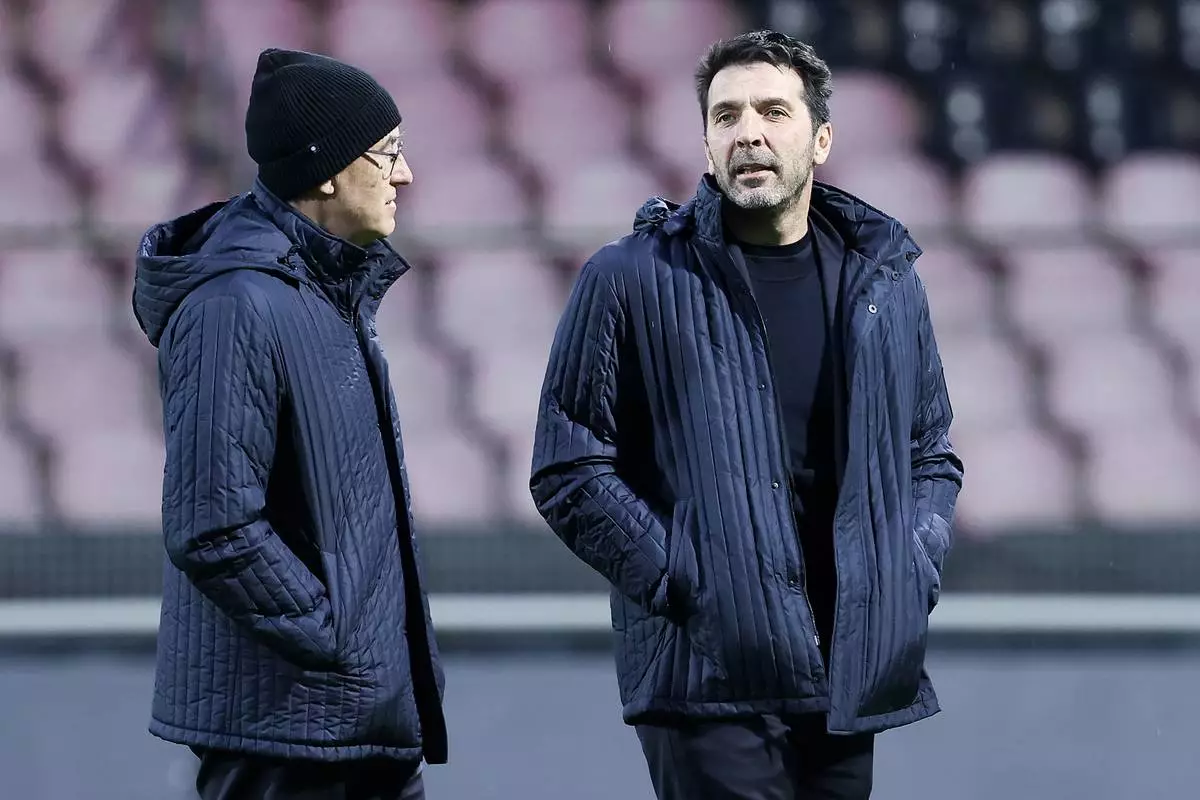
Italy's Gianluigi Buffon, right, walks on the pitch ahead of Tuesday's World Cup playoff final soccer match against Bosnia, at the Bilino Polje stadium, in Zenica, Bosnia, Monday, March 30, 2026. (AP Photo/Armin Durgut)
FILE - A journalist stands at the entrance of the FIGC Italian Soccer Federation, where a logo with four stars (one for each World Cup won) is seen partly in the shade, in Rome, on Nov. 14, 2017. (AP Photo/Alessandra Tarantino, File)
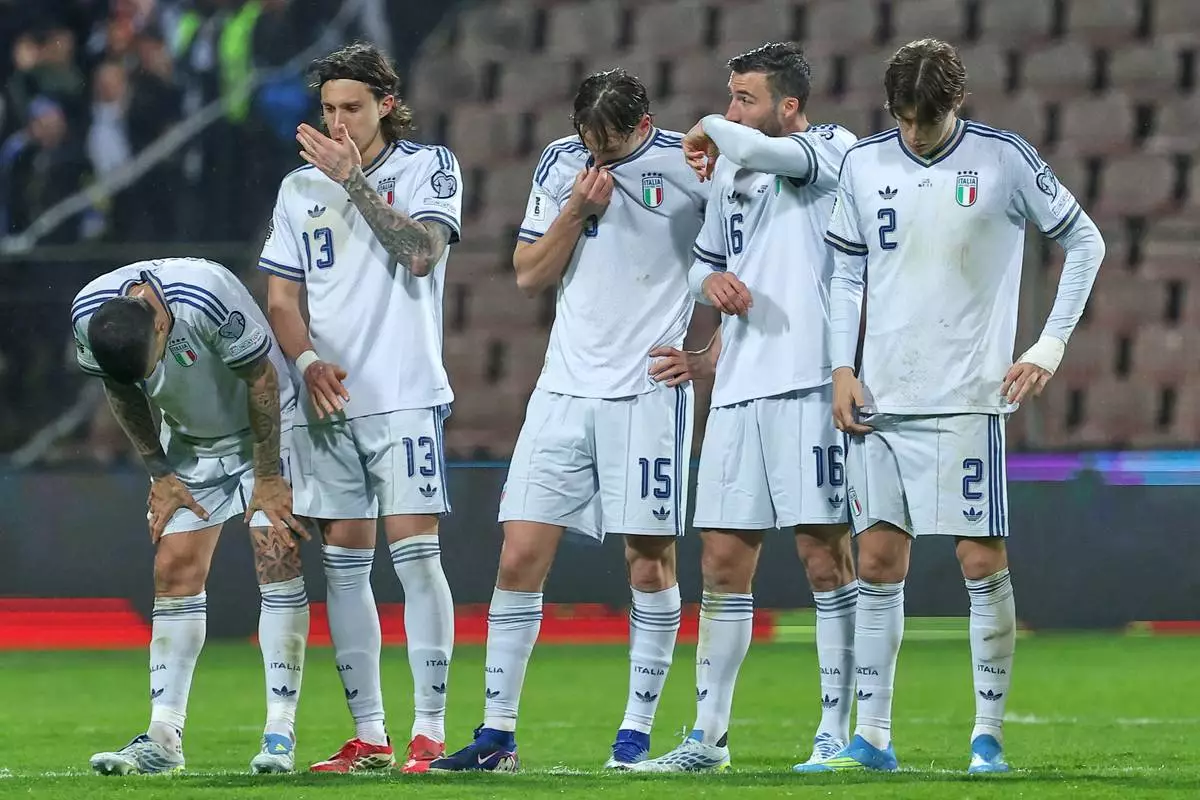
Italy players react during a penalty shootout during the World Cup qualifying playoff final soccer match between Bosnia and Italy in Zenica, Bosnia, Tuesday, March 31, 2026. (AP Photo/Armin Durgut)
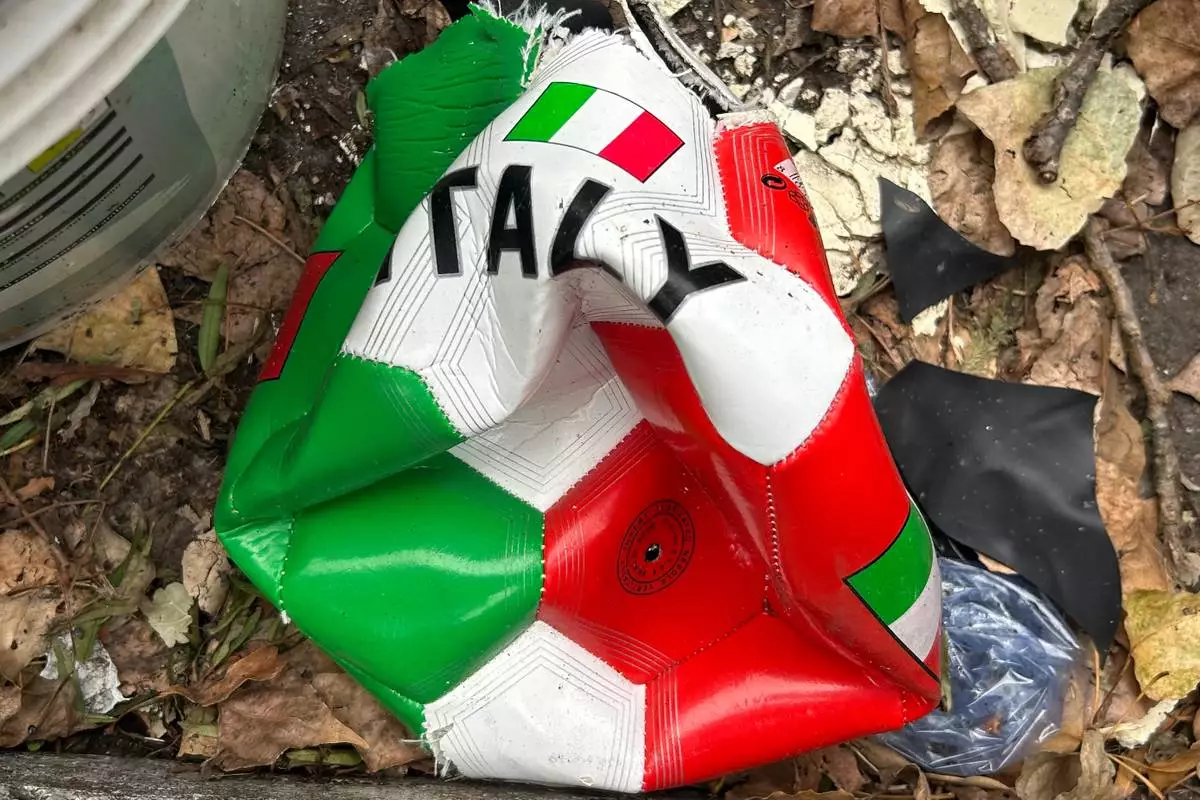
A broken soccer ball is pictured on a street in Rome, Wednesday, April 1, 2026. (AP Photo/Gregorio Borgia)
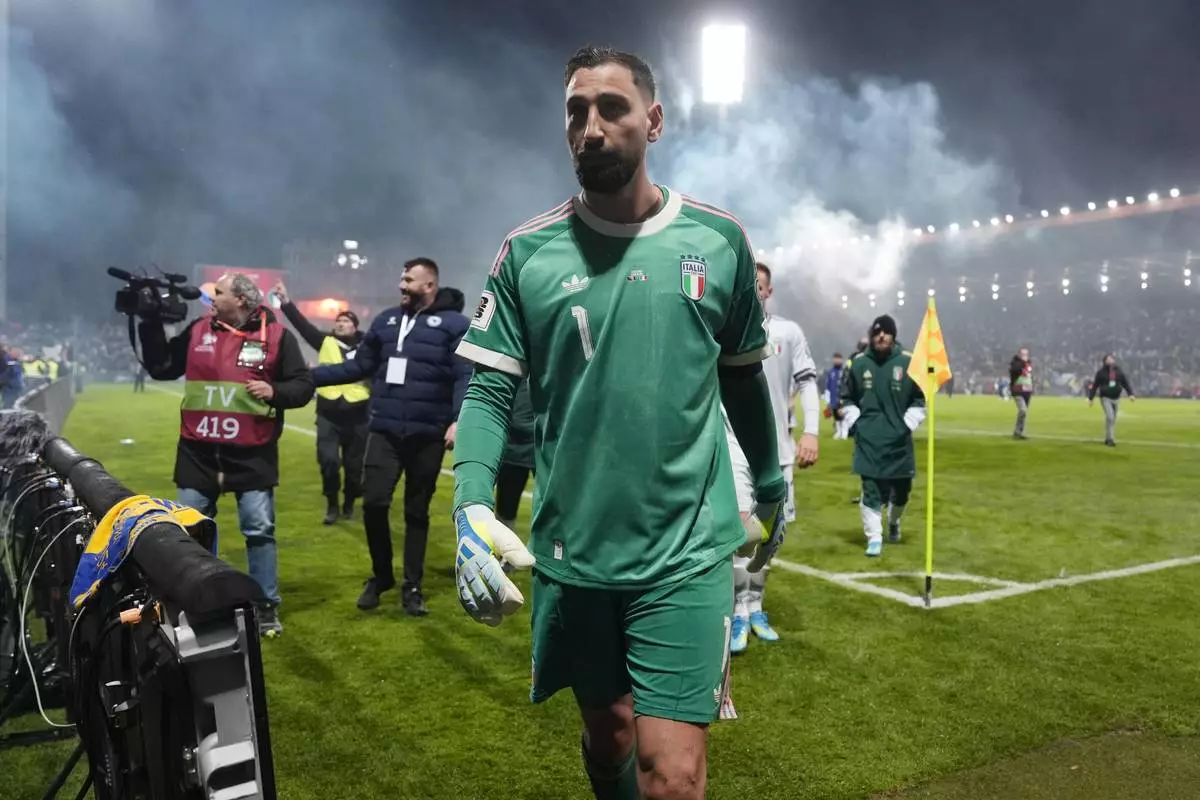
Italy's Gianluigi Donnarumma walks off the pitch after losing in a World Cup qualifying playoff final soccer match between Bosnia and Italy in Zenica, Bosnia, Tuesday, March 31, 2026. (Fabio Ferrari/LaPresse via AP)
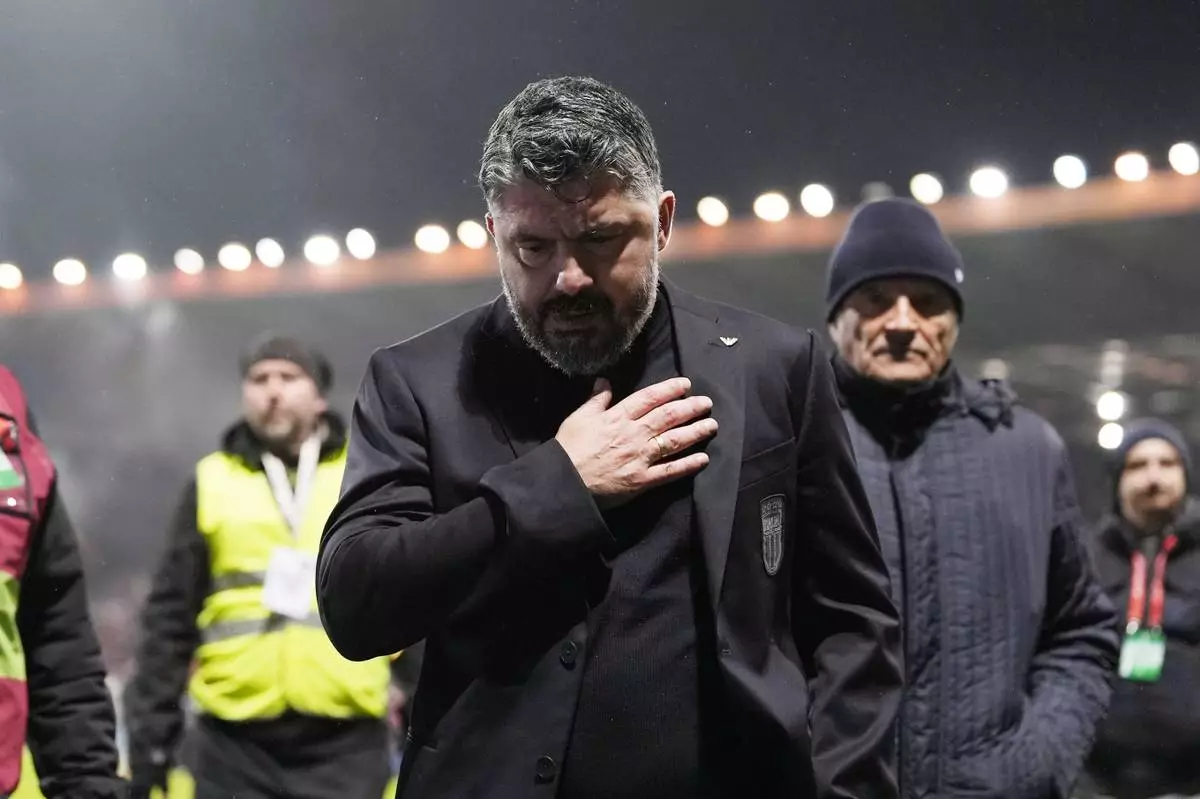
Italy's coach Gennaro Gattuso walks off the pitch after losing in a World Cup qualifying playoff final soccer match between Bosnia and Italy in Zenica, Bosnia, Tuesday, March 31, 2026. (Fabio Ferrari/LaPresse via AP)
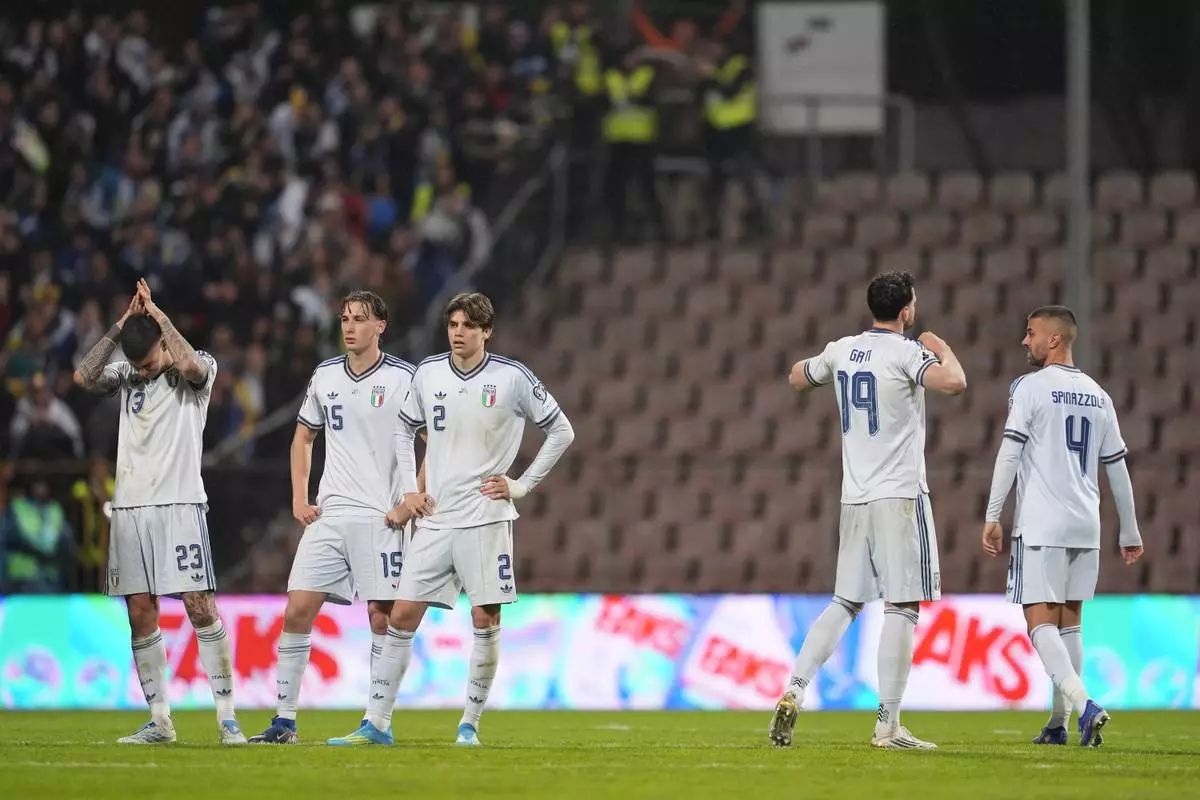
Italy players react after losing in a World Cup qualifying playoff final soccer match between Bosnia and Italy in Zenica, Bosnia, Tuesday, March 31, 2026. (Fabio Ferrari/LaPresse via AP)