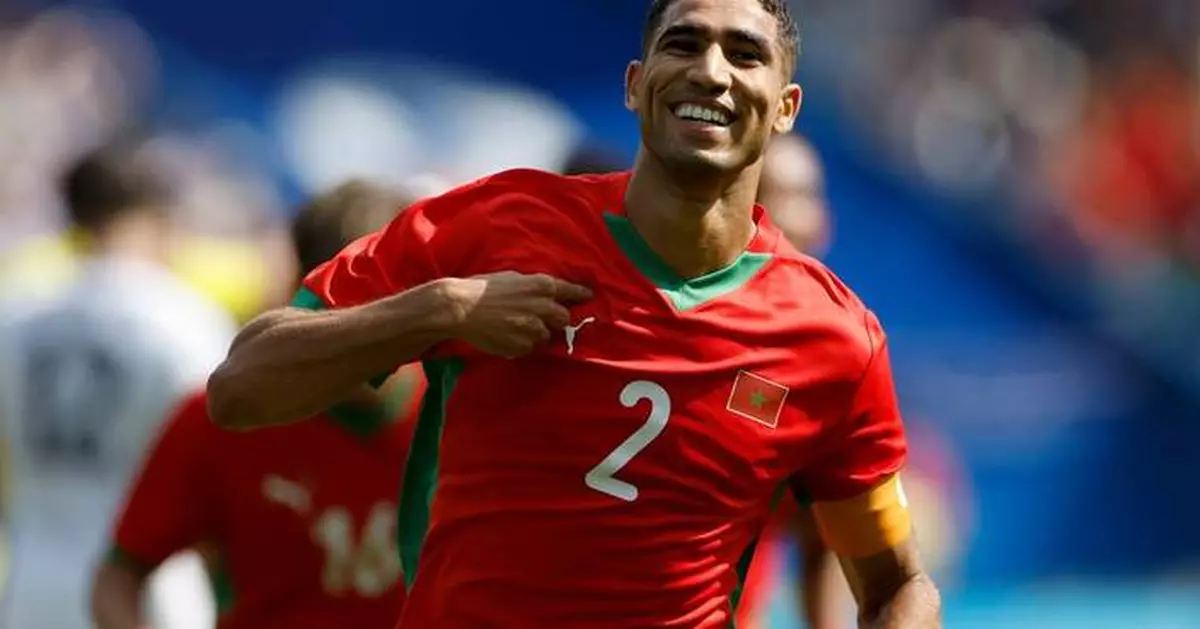
RABAT, Morocco (AP) — Morocco captain Achraf Hakimi has recovered from an ankle injury in time for the Africa Cup of Nations, both the player and coach Walid Regragui said Saturday before the team’s opening game.
The current African Footballer of the Year is unlikely to start Sunday’s tournament-opener against tiny Comoros, but Regragui said Hakimi could play if needed.
“He sacrificed himself for the past four or five weeks like no one else could have for his country. For that alone, he was an example for the players and the staff,” Regragui said. “We can say that the protocol we put in place immediately after his injury has been more than positive.”
Hakimi was injured in a reckless tackle from Bayern Munich forward Luis Díaz while he was playing for Paris Saint-Germain in the Champions League in November. Díaz, who was sent off for the challenge, later wished Hakimi “a quick return.”
Hakimi was named in Morocco’s squad despite not playing any games since then. Though the team boasts many talented players such as Noussair Mazraoui, Eliesse Ben Seghir, and Brahim Díaz, few have the experience that Hakimi brings after winning the Champions League with PSG in May.
“We’ll see about him starting tomorrow, how we protect him, and how things go with the upcoming games in the competition. I’ll make my decision tomorrow,” Regragui said. “His injury wasn’t straightforward. He made tough decisions for his country, and for that, as a coach, and of course as a Moroccan, I want to thank him in front of everyone. He’s a true example. Tomorrow you’ll see if he starts or not, but he can start, or he might not.”
Hakimi said he felt “good” but the team was more important than his own condition.
Morocco, the champion in 1976, is under immense pressure to win what would be just its second Africa Cup title. Expectations have risen since the team became the first African side to reach the World Cup semifinals in 2022.
The country, which will be a World Cup co-host in 2030, has invested heavily in stadiums, training facilities and infrastructure in a bid to become a soccer power. The drive has been overseen by FIFA Council member Fouzi Lekjaa, the president of the Royal Moroccan Football Federation who is also a government finance minister ultimately answerable to the country’s king, Mohammed VI.
A portrait of Mohammed VI flanked Saturday’s press conference, as if to remind Regragui and Hakimi for whom they are working. Another Africa Cup disappointment — Hakimi missed a late penalty as Morocco was eliminated by South Africa in the round of 16 at the last edition — could cost Regragui his job just months before the 2026 World Cup in the United States, Canada and Mexico.
“We’re focused on the present because we have to win,” Regragui said. “We’re also preparing for the future, because there’s 2026 and there’s also 2030, and that way they’ll be able to have a top-notch team in 2030 with a wealth of experience. That’s the objective I have. I’m working for myself, but I’m also working for the future of Morocco.”
AP soccer: https://apnews.com/hub/soccer

FILE - Morocco's Achraf Hakimi celebrates scoring his side's third goal during the quarterfinal men's soccer match between Morocco and the United States at the Parc des Princes during the 2024 Summer Olympics, Friday, Aug. 2, 2024, in Paris, France. (AP Photo/Aurelien Morissard, File)
WASHINGTON (AP) — President Donald Trump made new threats to escalate strikes in Iran on Sunday, a day after U.S. forces pulled off a dramatic rescue of an aviator whose plane fell behind enemy lines after Iran had downed it days earlier.
Iran showed no signs of backing down, striking economic and infrastructure targets in neighboring Gulf Arab countries even as Trump demanded Iran reopen the Strait of Hormuz.
In an expletive-laden post Sunday morning, Trump expanded upon earlier threats, promising strikes on Iran’s power plants and bridges. He vowed the “crazy bastards” would be “living in Hell” if the waterway isn’t opened to marine traffic by Tuesday. He ended his post with “Praise be to Allah.”
The U.S. airman's extraction followed a search-and-rescue operation after the Friday crash of the F-15E Strike Eagle, as Iran also promised a reward for anyone who turned in an “enemy pilot.” Trump said the servicemember was injured but in stable condition.
A second crew member was rescued earlier.
The fighter jet was the first American aircraft to have crashed in Iranian territory since the U.S. and Israel launched the war, striking Iran on Feb. 28. Both sides have threatened and hit civilian targets, bringing warnings of possible war crimes. The war has killed thousands, shaken global markets, cut off key shipping routes and spiked fuel prices.
As Iran continues to exert control over the Strait of Hormuz, Trump, in an earlier social media post, threatened to unleash “all Hell” if it isn’t opened by Monday. He has issued such threats before and extended them when mediators have claimed progress toward ending the war on agreeable terms.
The threats came after Trump said last week that the U.S. had “decimated” Iran and would finish the war “very fast.” Two days later, Iran shot down two U.S. military planes, showing the ongoing perils of the bombing campaign and the ability of a degraded Iranian military to continue to hit back.
The other jet to go down was a U.S. A-10 attack aircraft. Neither the status of the crew nor exactly where it crashed was immediately known.
On Sunday, Iran’s state TV aired a video showing what it claimed were parts of American aircraft shot down by Iranian forces, along with a photo of thick, black smoke rising into the air. The broadcaster said Iran had shot down an American transport plane and two helicopters that were part of the rescue operation.
However, a regional intelligence official briefed on the mission told The Associated Press that the U.S. military blew up two transport planes due to a technical malfunction, forcing it to bring in additional aircraft to complete the rescue. The official spoke on condition of anonymity to discuss the covert mission.
Iran’s military joint command on Sunday claimed that four U.S. aircraft were destroyed during the rescue operation and warned of stepping up retaliatory attacks on regional oil and civilian infrastructure if the U.S. and Israel attacked such targets in the Islamic Republic, according to state television.
“We once again repeat: if you commit aggression again and strike civilian facilities, our responses will be more forceful,” a spokesman said in comments run by IRNA news agency.
In Kuwait, Iranian drone attacks caused significant damage to power plants and a petrochemical plant. They also put a water desalination station out of service, according to the Ministry of Electricity. No injuries were reported, the ministry said.
In Bahrain, a drone attack caused a fire at one of the national oil company’s storage facilities and a state-run petrochemical plant, the kingdom’s official news agency said.
In the United Arab Emirates, authorities responded to fires at a petrochemical plant in Ruwais that they said were caused by intercepted debris, halting operations.
The strikes came a day after Israel struck a petrochemical plant in Iran that Prime Minister Benjamin Netanyahu said generated revenue that it had used to fund the war.
The petrochemical industry is a key sector in many Gulf states. Plants in Bahrain, Kuwait, the UAE and Iran convert oil and gas into products like plastics, polymers and fertilizer, bringing in billions in export revenue.
Trump renewed his threats for Iran to open up the Strait of Hormuz by Monday or face consequences, writing Saturday in a social media post: “Remember when I gave Iran ten days to MAKE A DEAL or OPEN UP THE HORMUZ STRAIT. Time is running out — 48 hours before all Hell will reign down on them.”
The waterway is a critical chokepoint for commerical trade, especially oil and gas moving from the Persian Gulf to Europe and Asia. Disruptions there have injected volatility into the market and pushed oil and gas-importing countries to seek alternative sources.
“The doors of hell will be opened to you” if Iran’s infrastructure is attacked, Gen. Ali Abdollahi Aliabadi with the country’s joint military command said late Saturday in response to Trump’s renewed threat, state media reported. In turn, the general threatened all infrastructure used by the U.S. military in the region.
Pakistan’s Foreign Ministry spokesperson, Tahir Andrabi, told AP that his government’s efforts to broker a ceasefire are “right on track” after Islamabad last week said that it would soon host talks between the U.S. and Iran.
Mediators from Pakistan, Turkey and Egypt were working to bring the U.S. and Iran to the negotiating table, according to two regional officials.
The proposed compromise includes a cessation of hostilities to allow a diplomatic settlement, according to a regional official involved in the efforts and a Gulf diplomat briefed on the matter. They spoke on condition of anonymity to discuss closed-door diplomacy.
More than 1,900 people have been killed in Iran since the war began.
In Gulf Arab states and the occupied West Bank, more than two dozen people have died, while 19 have been reported dead in Israel and 13 U.S. service members have been killed. In Lebanon, more than 1,400 people have been killed and more than 1 million people have been displaced. Ten Israeli soldiers have died there.
This report has been corrected to show that Borealis is an Austrian company, not Australian.
Metz reported from Jerusalem and Magdy from Cairo. Jon Gambrell in Dubai, United Arab Emirates, and Munir Ahmed in Islamabad contributed to this report.
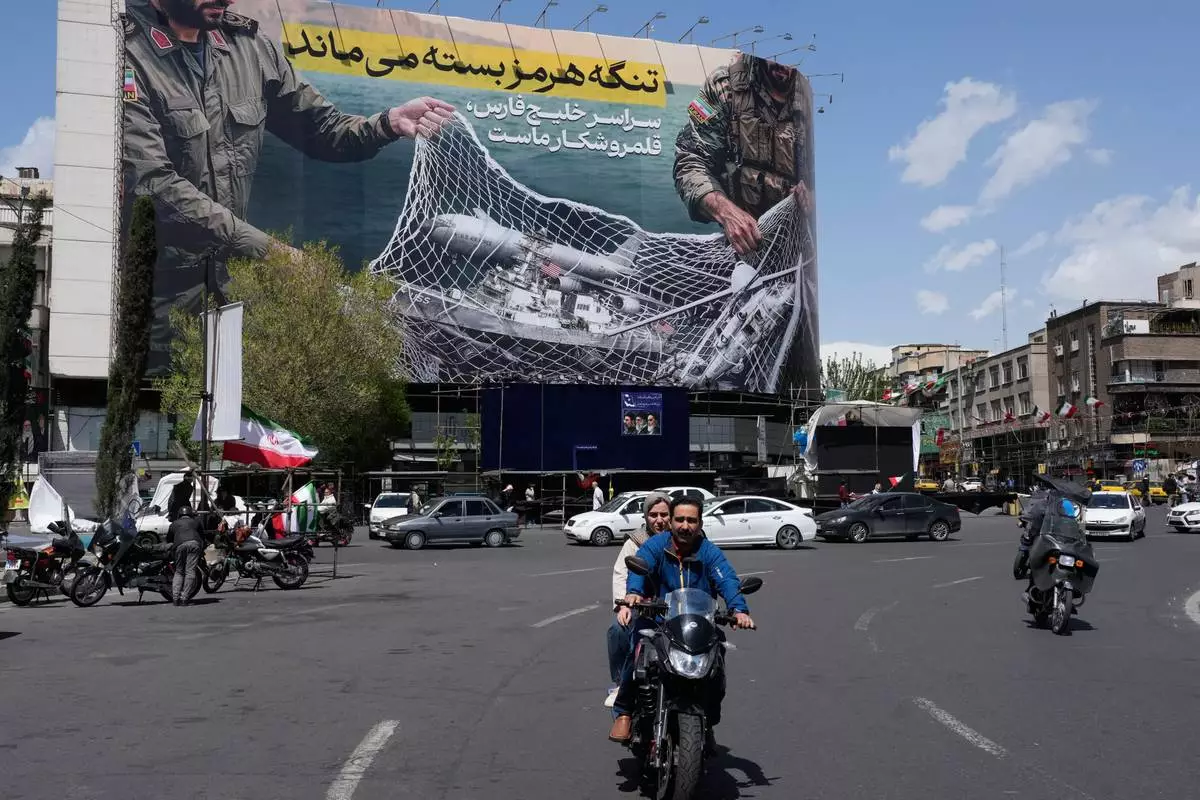
Vehicles and motorcycles move past an anti-U.S. billboard depicting the American aircrafts into the Iranian armed forces fishing net with signs that read in Farsi: "The Strait of Hormuz will remain closed, The entire Persian Gulf is our hunting ground," at the Eqelab-e-Eslami, or Islamic Revolution square in downtown Tehran, Iran, Sunday, April 5, 2026. (AP Photo/Vahid Salemi)
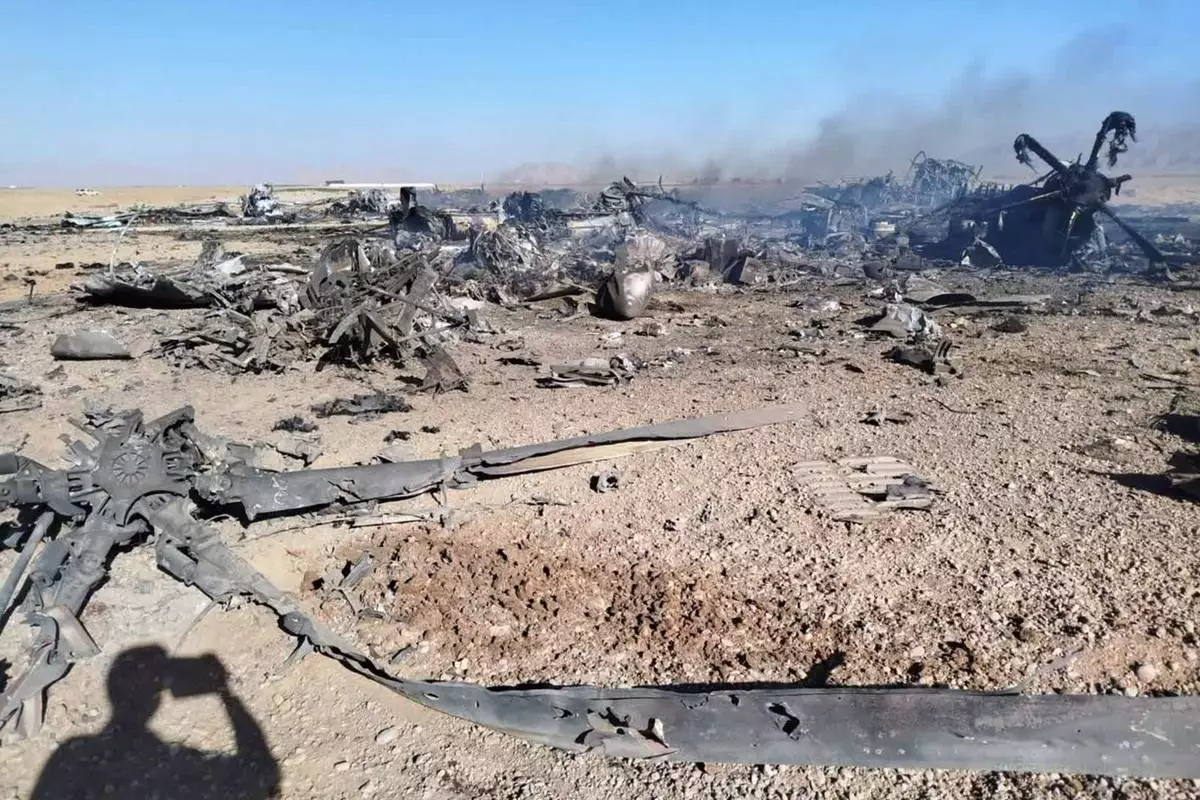
In this image provided by Sepahnews, the Iranian Revolutionary Guard's official website, wreckage is shown at what Iran's state TV claimed was the site of a downed American transport plane and two helicopters involved in a rescue operation, in Isfahan province, Iran, April, 2026. (Sepahnews via AP)
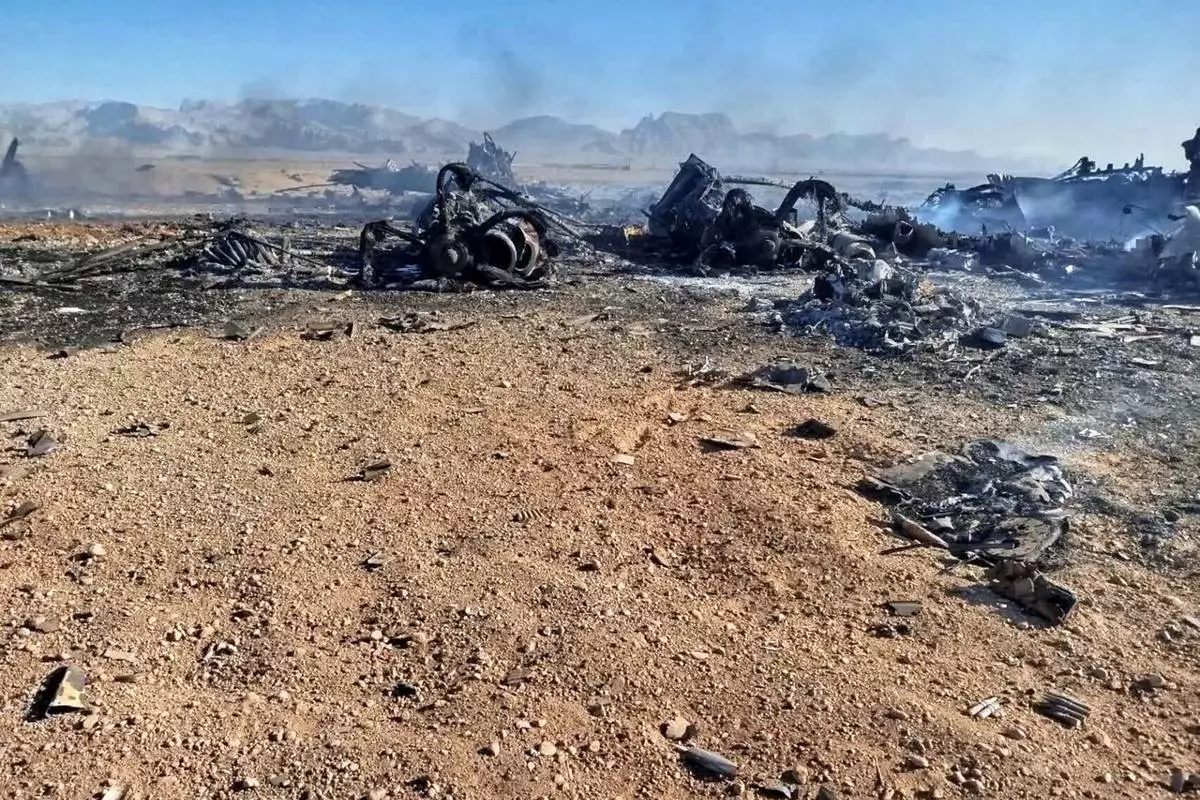
In this image provided by Sepahnews, the Iranian Revolutionary Guard's official website, wreckage is shown at what Iran's state TV claimed was the site of a downed American transport plane and two helicopters involved in a rescue operation, in Isfahan province, Iran, April, 2026. (Sepahnews via AP)
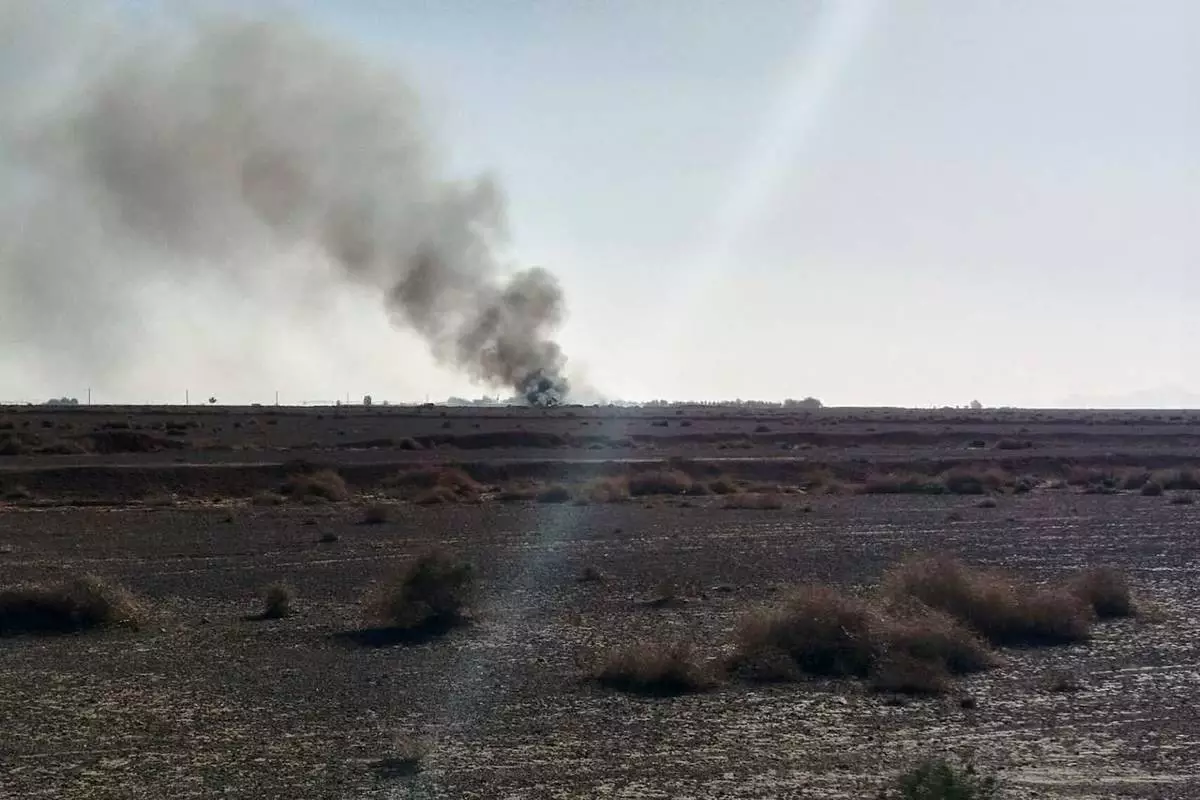
In this image provided by Sepahnews, the Iranian Revolutionary Guard's official website, black smoke rises into the air at what Iran's state TV claimed was the site where an American transport plane and two helicopters involved in a rescue operation were shot down, in Isfahan province, Iran, April, 2026. (Sepahnews via AP)
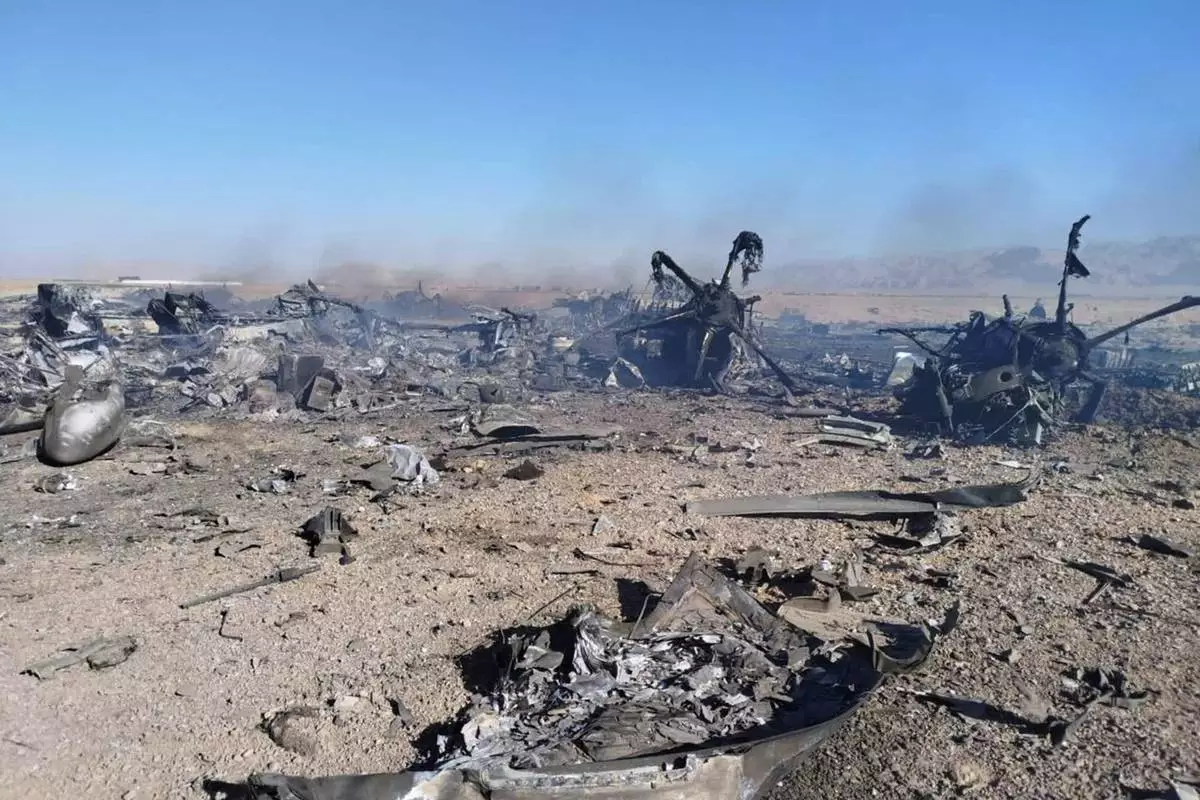
In this image provided by Sepahnews, the Iranian Revolutionary Guard's official website, wreckage is shown at what Iran's state TV claimed was the site of a downed American transport plane and two helicopters involved in a rescue operation, in Isfahan province, Iran, April, 2026. (Sepahnews via AP)
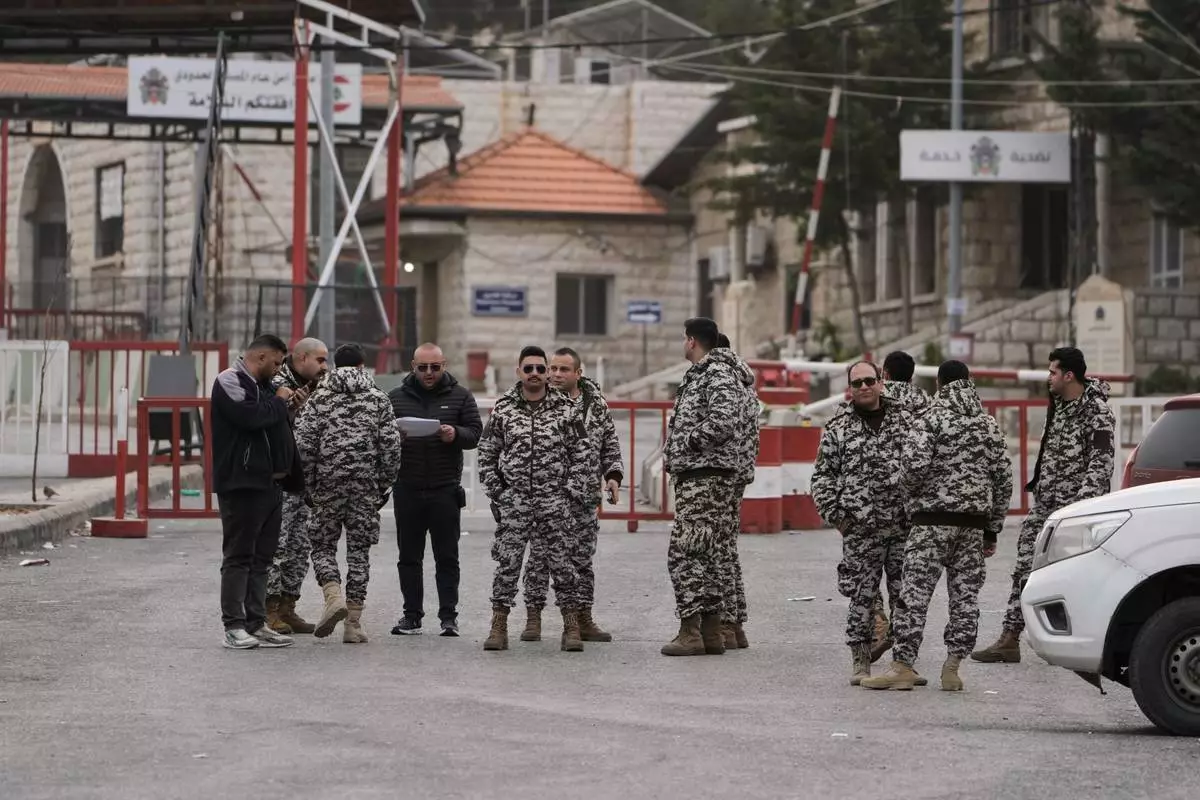
Members of Lebanon's General Security stand at the Masnaa border crossing in the Bekaa valley, eastern Lebanon, Sunday, April 5, 2026. (AP Photo/Bilal Hussein)
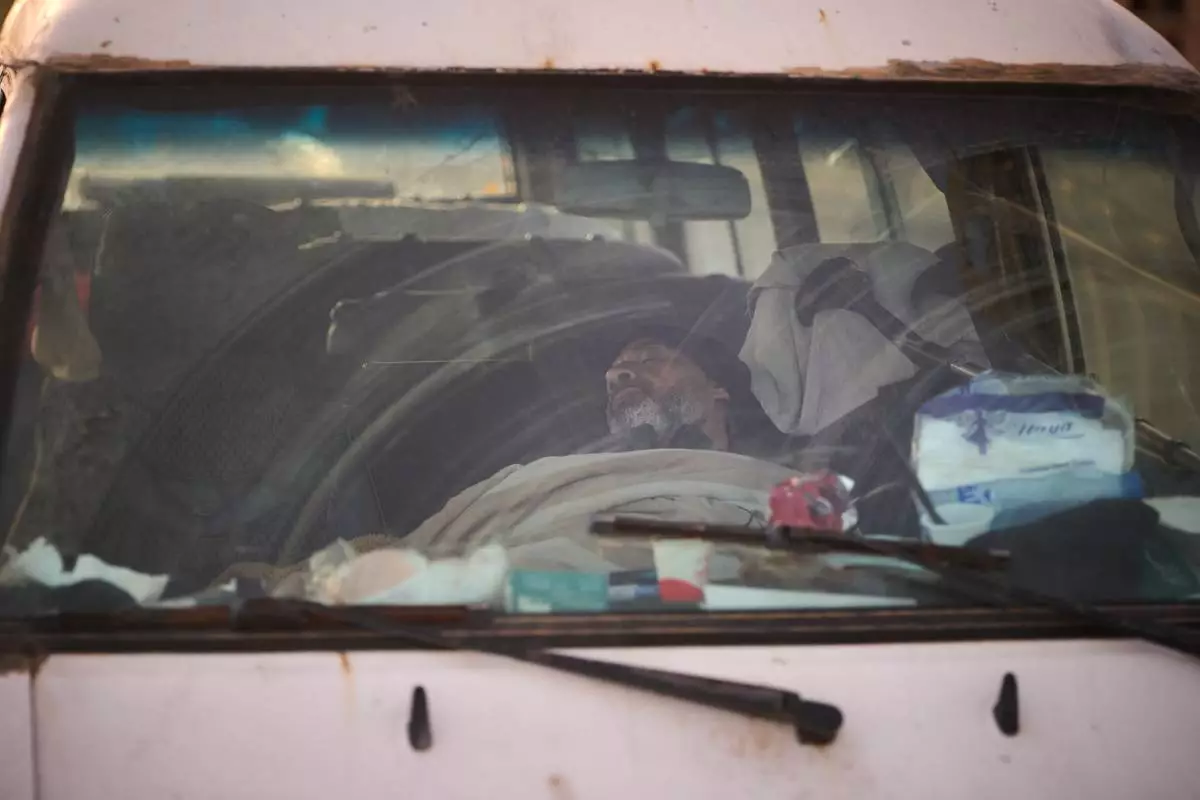
A man, who fled Israeli bombings in southern Lebanon with his family, sleeps in his car used as shelter, along a seaside promenade in downtown Beirut, Lebanon, Sunday, April 5, 2026. (AP Photo/Emilio Morenatti)
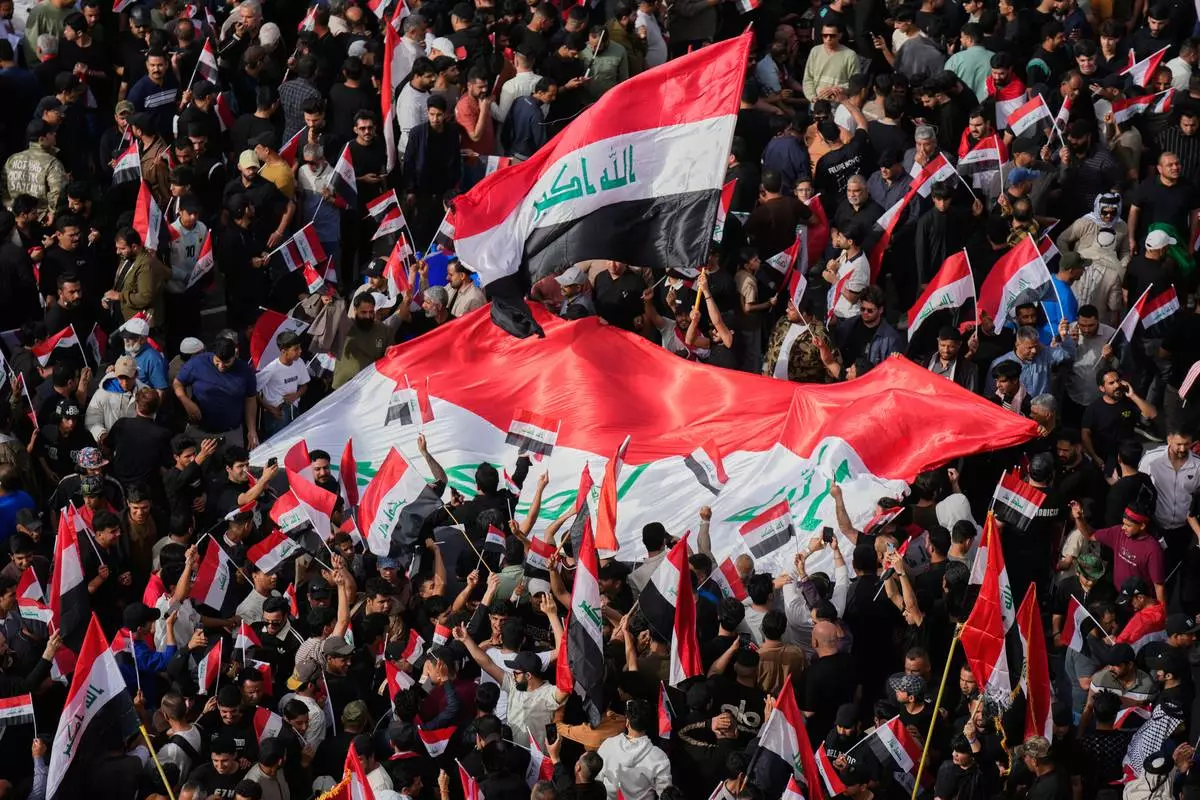
Followers of Iraq's Shiite cleric Muqtada al-Sadr chant slogans as they wave national Iraqi flag during a protest against U.S. and Israeli attacks on multiple cities across Iran, in Tahrir Square, Baghdad, Baghdad, Iraq, Saturday, April 4, 2026. (AP Photo/Hadi Mizban)
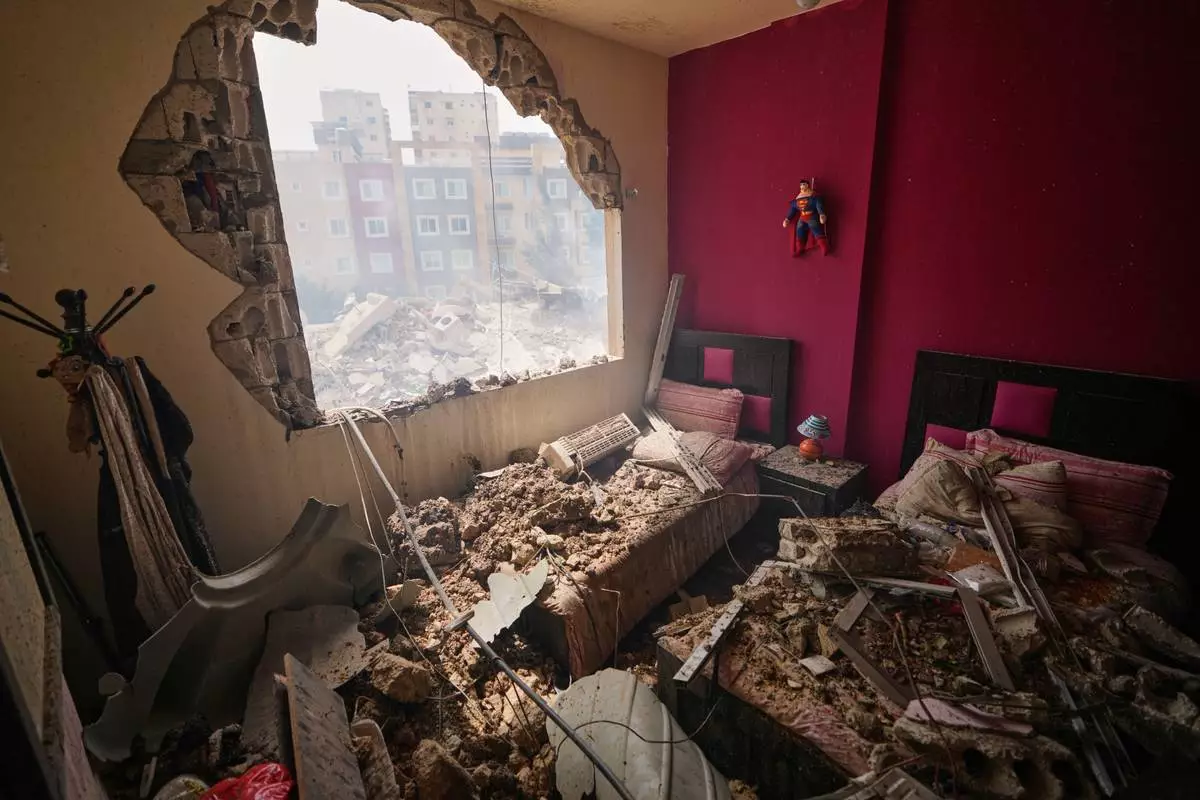
A bedroom is damaged in a building struck in an Israeli airstrike in the southern port city of Tyre, Lebanon, Saturday, April 4, 2026. (AP Photo/Mohammed Zaatari)
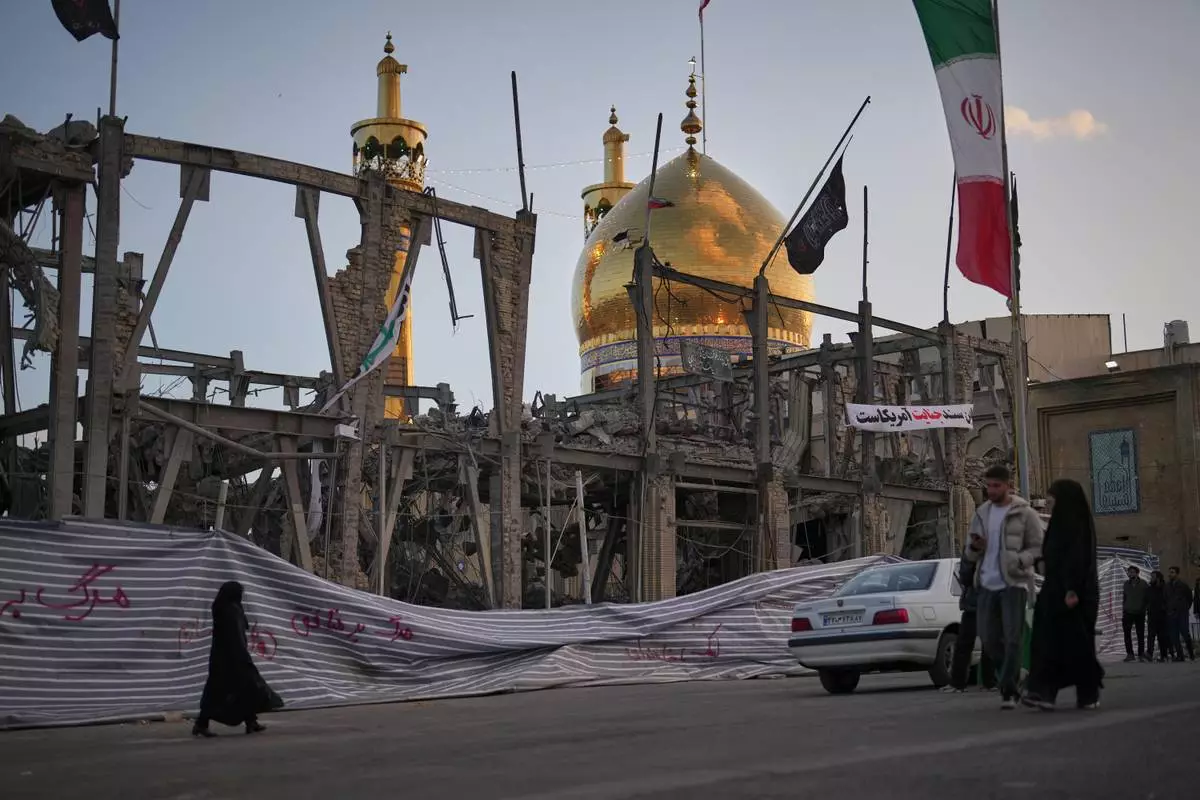
Pedetrians walk by a destroyed building within the Grand Hosseiniyeh, with the mosque visible in the background, which officials at the site say was hit by U.S.-Israeli airstrikes Tuesday, in Zanjan, Iran, Saturday, April 4, 2026. (AP Photo/Francisco Seco)

Police officers and their horses take cover in an underground parking garage as sirens warn of an incoming missile fired from Yemen in Tel Aviv, Israel, Saturday, April 4, 2026. (AP Photo/Maya Levin)
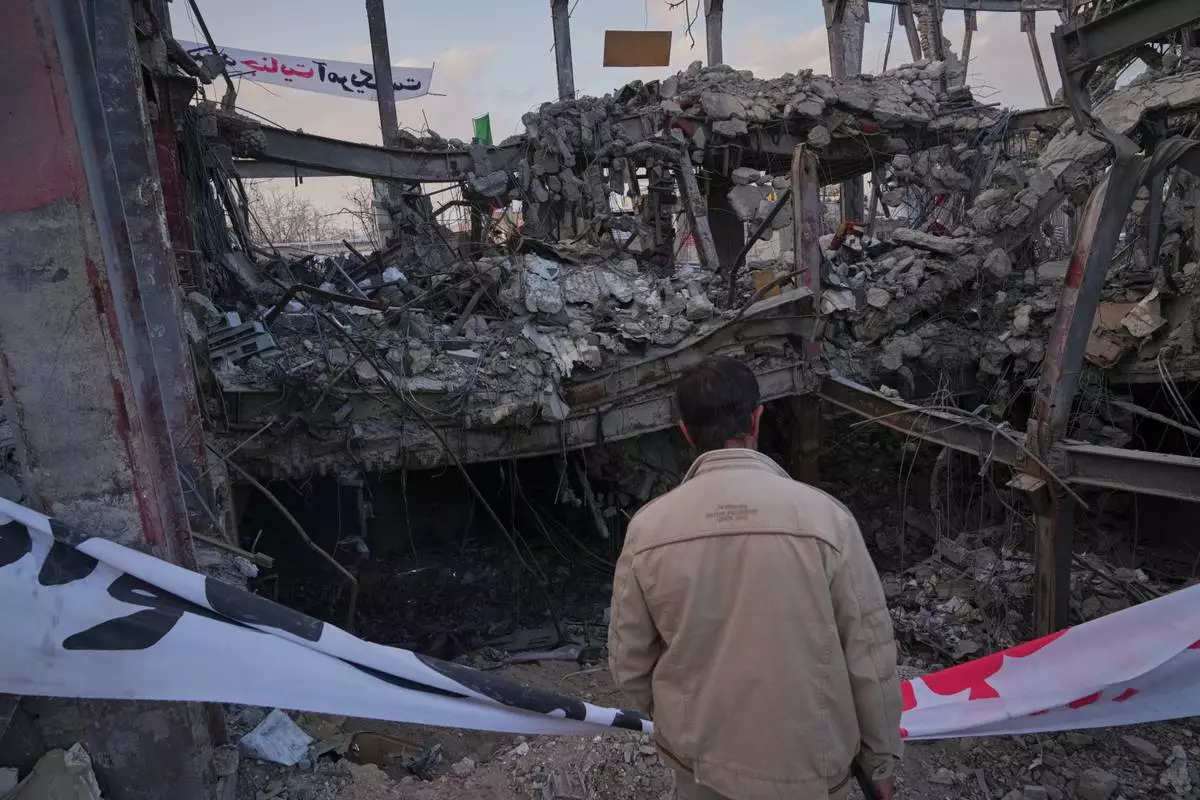
A man looks at a destroyed building within the Grand Hosseiniyeh complex that officials say was hit by U.S.-Israeli airstrikes Tuesday in Zanjan, Iran, Saturday, April 4, 2026. (AP Photo/Francisco Seco)