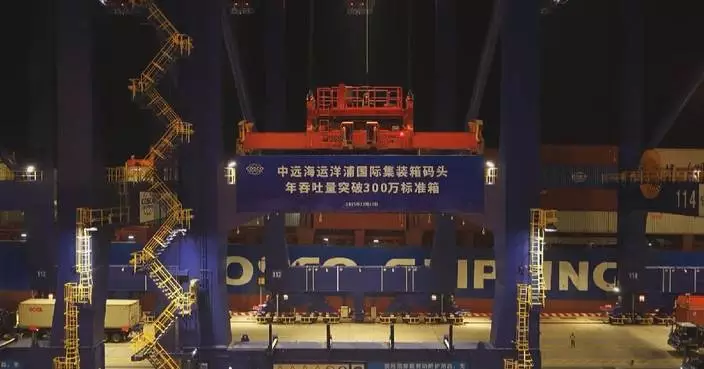
China's air cargo sector has kept posting robust growth so far this year, with the parcel airlift volume surging to 9.243 million tons in the January-November period, a year-on-year increase of 13.6 percent, according to the Civil Aviation Administration of China (CAAC).
International routes were the key growth engine in the first 11 months, with the parcel airlift volume rising 21.8 percent year on year.
"Continued improvement of residents' consumption structure has driven rapid development of cross-border e-commerce, fresh food cold chain and other sectors, enabling the international freight market to maintain rapid growth," said Zhong Shan, chief economist at the Aviation Transport Research Institute under China Academy of Civil Aviation Science and Technology.
In the January-November period, the number of cargo flights operated by Chinese airliners continued to increase, with cargo flights reaching 170 cities in 70 other countries, an increase of 8 countries and 27 cities respectively compared with last year. The average weekly cargo flight volume increased by 15.7 percent over the same period of last year.
In the 11-month period, rapid growth in emerging consumption models such as livestream shopping and instant retail generated steady demand for sustained development of the aviation cargo industry.
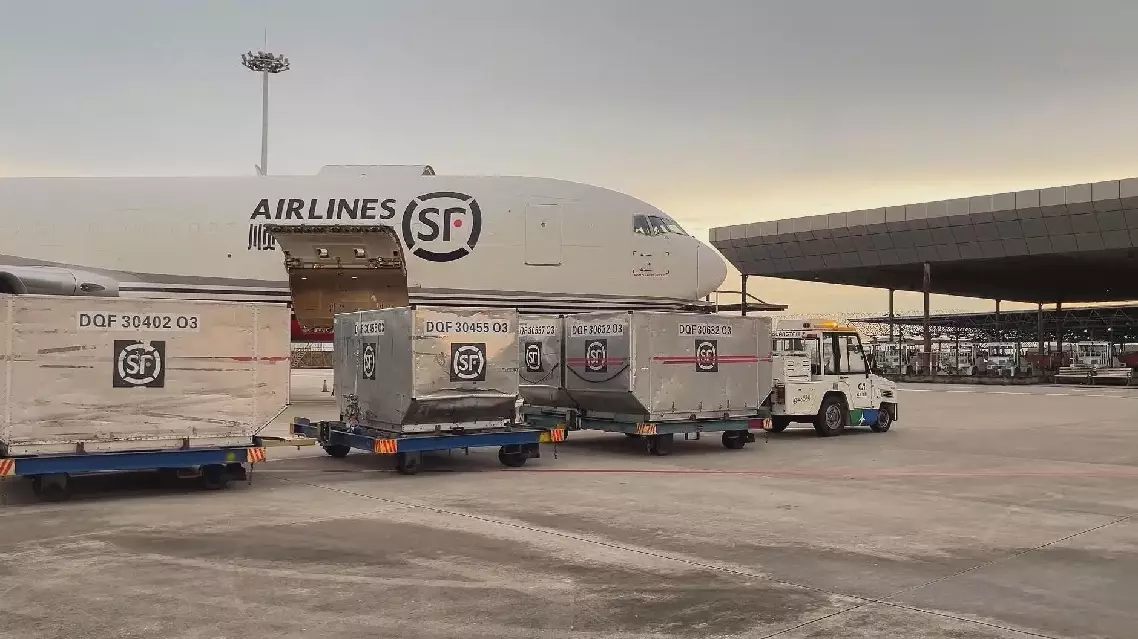
China's air cargo sector sees 13.6 percent volume growth in first 11 months
China's online literature has captivated more global readers with the assistance of digital technology including AI translation and multimedia transformations.
Digitalization has been empowering the global expansion of China's online literature, with WebNovel, a leading Chinese online literature platform, becoming one of the beneficiaries.
In 2025, the platform has had more than 10,000 pieces of works translated by AI, with the scale of multilingual translation reaching 3.5 times that of last year.
AI-powered translation volume has grown by nearly 300 percent, with efficiency improving by a hundredfold and costs reduced by 90 percent.
"AI is quite handy when it comes to multilingual translation. Previously, we could only publish four books in a month, but now that number can hit 400, with good quality approved by overseas readers," said Wu Xuemei, head of overseas product operation with an online literature platform.
According to the 2024 China Online Literature Blue Book, by the end of 2024, China's online literature readership had swelled to 575 million, taking up 51.9 percent of the total netizen population.
Also in that year, the number of overseas readers of Chinese online literature reached 200 million, with 30 million newly registered users. Meanwhile, the revenue from the overseas market hit 4.815 billion yuan (about 674 million U.S. dollars), showing a year-on-year growth of 10.68 percent, demonstrating the industry's strong market resilience.
"We don't have enough life to read all of them, and many of them are very good," said a Mexican reader.
For now, Chinese online literature has evolved into a comprehensive industry ecosystem of significant scale and depth.
Its full-chain IP development has yielded notable achievements, while derivative formats such as audiobooks, comics, and animation have broadened the horizons of dissemination, shaping an integrated communication model of "text, audiovisual, and interaction".
"Chinese online literature has now reached a mature phase in its global expansion, characterized by a transformation from mere content export to a comprehensive ecosystem encompassing creation, translation, IP development, and local co-creation," said Tang Qiao, deputy director of the online literature research office with Chinese Academy of Social Sciences' Institute of Literature.

Digital technology helps Chinese online literature captivate global readers