Over a year after the conclusion of field excavations at the Wuwangdun Tomb in east China's Anhui Province, archaeologists have unveiled new findings that shed light on the diet, divination practices and architectural aesthetics of the ancient Chu state dating back over 2,200 years.
Located in Huainan City of Anhui, the Wuwangdun Tomb has been identified by China's National Cultural Heritage Administration as the largest and highest-level tomb from the ancient Chu state.
The tomb's occupant has been confirmed as King Kaolie of Chu during the Warring States period (475 B.C.-221 B.C.), who died at the age of over 50.
Among the most compelling discoveries from the tomb are well-preserved bronze Ding (tripods), or cauldrons each resting on three legs, which were used as ritual vessels.
"Many well-preserved bronze tripod vessels were recovered, and most of them still with their lids intact. Although water had seeped in, there was no significant exchange or contamination with external materials," said Li Fengxiang, a member of the Wuwangdun Tomb excavation team.
Archaeologists discovered food remains inside these tripod vessels, offering a rare window into the dietary habits of Chu royalty.
"A great deal of the artifacts reflect the daily life of the Chu-era people. These discoveries help fill gaps in historical records," said Gong Xicheng, leader of the Wuwangdun Tomb excavation team.
The tomb has yielded over 10,000 artifacts, including a surprising cache of turtle plastrons used for divination.
Unlike the inscribed oracle bones from the Yin Ruins, which had been the capital of the late Shang (Yin) Dynasty (1600 B.C.-1046 B.C.), these Chu-era plastrons bear no visible inscriptions.
Using advanced infrared imaging, researchers detected faint traces of characters on a few plastrons, identifiable as the words "Changling".
"In the past, a batch of bamboo slips was discovered in Chu-era tombs that recorded the name of the turtle plastron used for divination as 'Changling', but no physical remains of such objects were found there," Gong said.
"This is a discovery that fills a significant gap for our understanding of the divination practices of the ancient Chu state," said Zhang Wenjie, another member of the Wuwangdun Tomb excavation team.
Another significant discovery came from the tomb's eastern chamber. Over 20 exquisitely crafted artifacts made of spotted stone, a type of speckled decorative stone used in ancient China.
More than 1,000 years later, during the Ming and Qing dynasties (1368-1911), spotted stone once again became a luxurious material in imperial architecture, adorning multiple palaces in the world-renowned Forbidden City.
"Since this is the first archaeological discovery of its kind, we need to conduct further researches to fully understand its significance," Gong said.
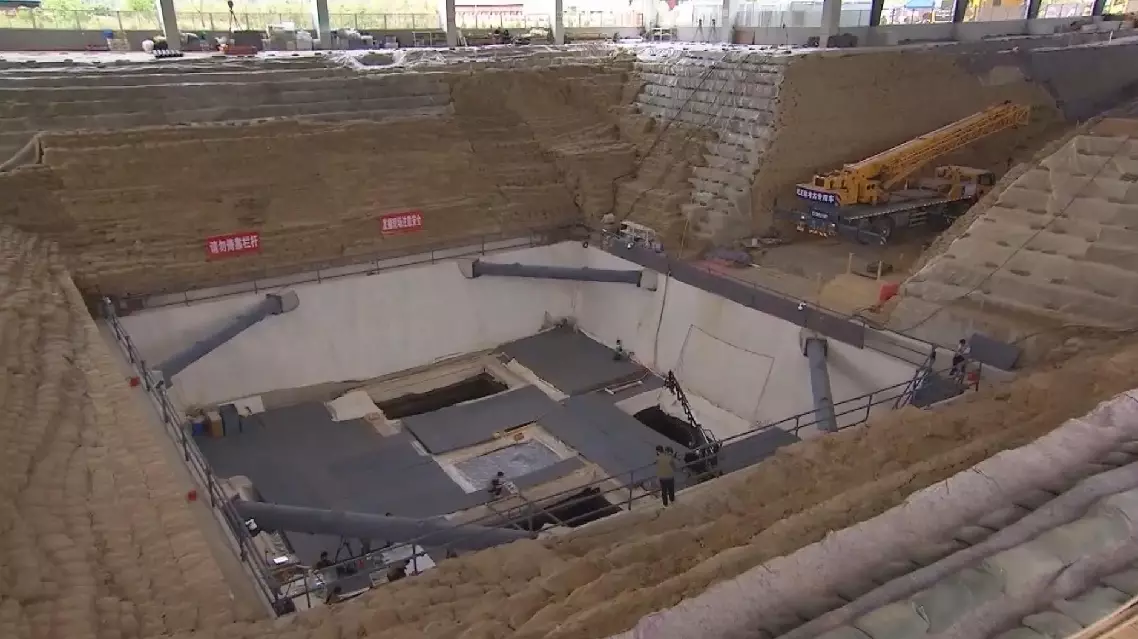
New discoveries at China's Wuwangdun Tomb offer insights into ancient Chu culture