Skip to Content Facebook Feature Image

Government Launches Task Forces to Support Wang Fuk Court Fire Victims with Financial Aid and Relief Services

HK

Government Launches Task Forces to Support Wang Fuk Court Fire Victims with Financial Aid and Relief Services
HK

HK

Government Launches Task Forces to Support Wang Fuk Court Fire Victims with Financial Aid and Relief Services

2025-12-22 22:15 Last Updated At:22:28

Government announces updates on follow-up work on Tai Po fire

The three task forces set up by the Government for the fire at Wang Fuk Court in Tai Po - the Task Force on Investigation and Regulation, the Task Force on Emergency Support and Fund-Raising, and the Task Force on Emergency Accommodation Arrangements - are making full efforts to follow up on the support, relief, and investigation work related to the incident. Details are as follows:

Financial and welfare support

---------------------------------

For the Support Fund for Wang Fuk Court in Tai Po, established by the Government, donations received are about $3.8 billion as of noon today (December 22). With the start-up capital of $300 million from the Government, the fund's total has now reached around $4.1 billion. The fund will be used to assist residents in rebuilding their homes and providing long-term and sustained support.

The Government is providing a $100,000 living allowance from the Support Fund to each affected household. As of today, 1 935 cases have been processed. Families of each deceased victim will be provided with a token of solidarity of $200,000, as well as $50,000 to cover funeral costs. As of today, a total of 146 cases have been processed. In addition, the Government earlier announced three new measures, providing to flat owners at Wang Fuk Court a grant of $100,000; an annual rental grant of $150,000 (to be provided for two years) and a one-off relocation grant of $50,000; as well as a one-off relocation grant of $50,000 for affected tenants. The allowances will be disbursed in phases.

Social workers from the Social Welfare Department (SWD) have been in contact with more than 1 980 affected households, and more than 4 900 residents have been registered for the "one social worker per household" follow-up service. The SWD will maintain liaison with the affected households to provide all necessary assistance while fully supporting the relief work of the Government.

Medical support

--------------------

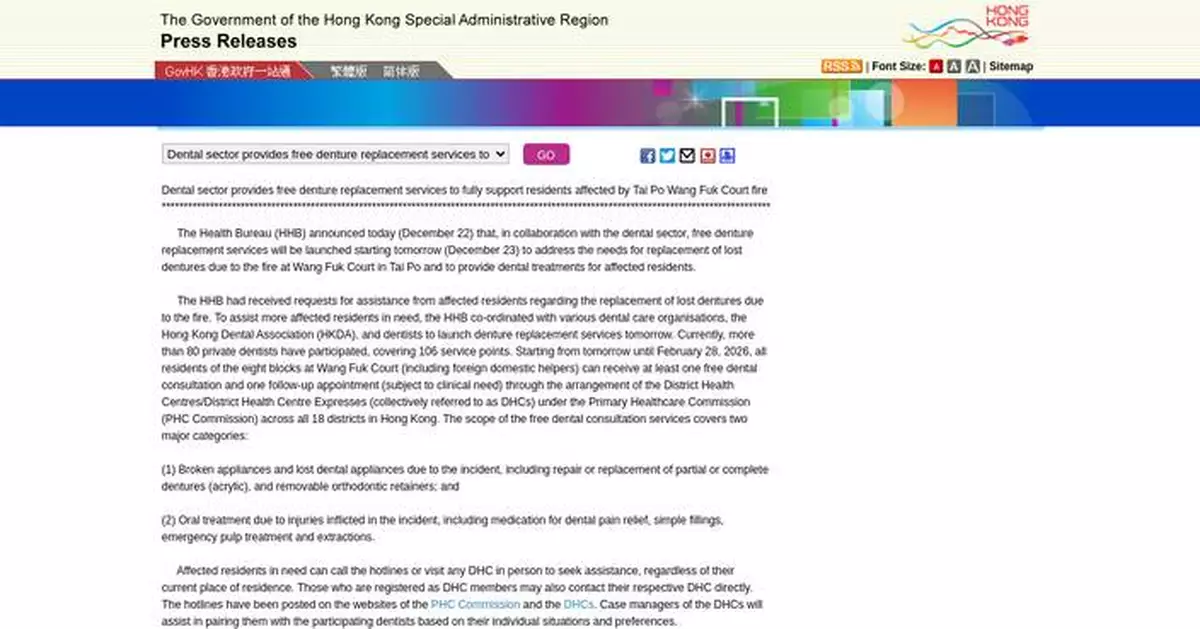
The Health Bureau co-ordinated with various dental care organisations, the Hong Kong Dental Association, and dentists to launch free denture replacement and dental treatment services tomorrow (December 23) to assist affected residents in need. Currently, more than 80 private dentists have participated in the free consultation services, covering 106 service points. Starting from tomorrow until February 28, 2026, all residents of the eight blocks at Wang Fuk Court (including foreign domestic helpers) can receive at least one free dental consultation and one follow-up appointment (subject to clinical need) through the arrangement of the District Health Centres/District Health Centre Expresses under the Primary Healthcare Commission across all 18 districts in Hong Kong. The scope of the free dental consultation services covers two major categories: (1) broken appliances and lost dental appliances due to the incident (including repair or replacement of partial or complete dentures (acrylic), and removable orthodontic retainers); and oral treatment due to injuries inflicted in the incident (including medication for dental pain relief, simple fillings, emergency pulp treatment and extractions).

Accommodation support

---------------------------

Currently, there is still a supply of more than 1 000 units that can provide affected residents with longer-term accommodation. The transitional housing and the Hong Kong Housing Society (HKHS) projects in different districts can altogether provide around 500 units at the moment. Moreover, Po Tin Interim Housing in Tuen Mun and Runway 1331 at Kai Tak can provide a supply of around 900 units.

As of this morning, a total of 516 residents are staying in hotel rooms through the co-ordination of the Home and Youth Affairs Bureau, and 568 residents are staying in youth hostels/camps. Another 3 513 residents are currently living in transitional housing units provided by the Housing Bureau, units from the HKHS, or Po Tin Interim Housing in Tuen Mun.

Relief supplies and donations

---------------------------------

The supplies donation online platform, established by the Government and the information technology sector, continues to operate, facilitating the registration of supplies donations from organisations and the public. The Government has so far received over 2 000 registrations, of which approximately 30 per cent were submitted by organisations, whereas the others were contributed by the public. The various registered donation items include food and beverages, clothing, daily necessities, bedding, and electrical appliances. The Government is actively assessing residents' actual needs through the relevant policy bureau, government departments, and service organisations for the matching of donated supplies in order to distribute appropriate items in phases to places in need. So far, over 45 000 donation items covering various categories have been distributed to different places. The matching and distribution of supplies will continue.

Investigation and regulation

-------------------------------

The Fire Services Department (FSD) announced on December 16 that it has stepped up inspections and encouraged industry to inspect fire service installations and equipment (FSIs). In response to the fire at Wang Fuk Court in Tai Po, the department has maintained close collaboration with relevant property management organisations and stepped up inspections of FSIs in buildings since December 4, with a view to enhancing building fire safety. To address public concerns regarding the performance of building fire alarms, stakeholders have agreed to promote voluntary fire alarm testing to safeguard public safety.

In addition, the FSD has redeployed manpower internally to enhance inspections of FSIs in buildings, particularly those undergoing major maintenance, and has proactively inspected the functional status of fire alarms. Should any non-compliance be identified, the department will conduct thorough investigations and decisively take enforcement actions. At the same time, the department has redeployed personnel to promptly follow up on reports of abnormal operation of FSIs in buildings and will take appropriate enforcement actions accordingly.

The FSD earlier held a meeting with the Association of Registered Fire Service Installation Contractors of Hong Kong to discuss the proper arrangements for FSIs during major renovation works. In fact, the FSD Circular Letter No. 1/2021 has already stipulated that when carrying out the works, the contractor concerned should adopt a systematic approach in shutting down the affected FSI by phases and resume its normal operation as soon as practicable. If the affected portion of the system could not be reinstated to normal working condition by the end of a working shift, arrangements should be made for the portion to be isolated with the remainder of the system to be reinstated. The trade expressed its full support and indicated its willingness to implement the relevant measures in accordance with the statutory requirements and guidelines. In response to a commentary published by a media outlet which does not fully reflect the facts, the FSD made a clarification today to set the record straight.
Source: AI-found images

Source: AI-found images

DH announces latest situation of Legionnaires' disease cases

The Centre for Health Protection (CHP) of the Department of Health today (December 22) reported the latest number of Legionnaires' disease (LD) cases, and reminded the public of the importance of using and maintaining properly designed man-made water systems, adding that susceptible groups should strictly observe relevant precautions.

From December 14 to 20, the CHP recorded four community-acquired LD cases. All of the patients involved had underlying illnesses. The details of the cases are as follows:

  • a 70-year-old male patient living in Sai Kung District;
  • an 84-year-old female patient living in Wan Chai District;
  • a 77-year-old male patient living in Wong Tai Sin District; and
  • a 61-year-old male patient living in Sai Kung District. The patient passed away on December 17.
  • ​The CHP is conducting epidemiological investigations to identify potential sources of infection and high-risk exposure. Initial investigations revealed that these are sporadic cases. No epidemiological linkages have been established between these cases and other confirmed cases previously recorded in Hong Kong.

    ​Additionally, the CHP continues to follow up a previously announced LD case where hospital-acquired transmission cannot be ruled out. Given that the patient had stayed in the community and was hospitalised at St. Paul's Hospital during the incubation period, apart from conducting investigation at St. Paul's Hospital, the CHP earlier collected a total of 14 water samples from the residence of the patient concerned. After testing by the Public Health Laboratory Services Branch of the CHP, eight samples tested positive for Legionella pneumophila serogroup 1 at levels ranging from 0.1 to 37.3 colony-forming units per millilitre (cfu/ml). Two of these samples were at levels 17.8 and 37.3 cfu/ml respectively, exceeding the action level for water supply systems in community buildings(i.e. 10 cfu/ml or above). Among five environmental samples collected from the patient's residence, one sample also tested positive. The CHP has provided health advice to family members of the patient, and instructed the property management company to thoroughly disinfect the relevant water system.

    Since samples collected at both the residence and the ward in St. Paul's Hospital tested positive for Legionella pneumophila serogroup 1, the CHP considered that both St. Paul's Hospital and her residence are possible to be the source of infection. However, as the bacterial load of the patient's sample was low, genetic analysis was not performed successfully, hence the exact source of infection could not be ascertained.

    In response to the positive results of the water samples upon testing, as a precautionary measure, St. Paul's Hospital is continuing to close and suspend use of the wards on the floor concerned in accordance with the CHP's instructions. The hospital will also thoroughly disinfect the water supply system on that floor as instructed by the CHP. The CHP will continue to closely monitor the implementation of the measures and conduct epidemiological investigations.

    The CHP has completed medical surveillance for the 28 patients who were admitted to the same hospital floor since mid-November. No LD cases have been identified among them.

    As of December 20, 161 LD cases had been recorded this year. In 2024 and 2023, there were 135 and 121 LD cases respectively.

    Men, people aged over 50, smokers, alcoholics and persons with weakened immunity are more susceptible to LD. Some situations may also increase the risk of infection, including poor maintenance of water systems; living in areas with old water systems, cooling towers or fountains; using electric water heaters, whirlpool spas or hot water spring spas; and recent stays in hotels or ships.

    Legionellae are found in various environmental settings and grow well in warm water (20 to 45 degrees Celsius). They can be found in aqueous environments such as water tanks, hot and cold water systems, cooling towers, whirlpool spas, water fountains, humidifiers and home respiratory devices that support breathing. People may become infected when they breathe in contaminated droplets (aerosols) and mist generated by artificial water systems, or when handling garden soil, compost and potting mixes.

    Immunocompromised persons should:

  • Use sterile or boiled water for drinking, tooth brushing and mouth rinsing;
  • Avoid using humidifiers, or other mist- or aerosol-generating devices; and
  • If using humidifiers, or other mist- or aerosol-generating devices, fill the water tank with only sterile or cooled freshly boiled water, and not water directly from the tap. Also, clean and maintain humidifiers/devices regularly according to manufacturers' instructions. Never leave stagnant water in a humidifier/device. Empty the water tank, wipe all surfaces dry, and change the water daily.
  • ​The public should observe the health advice below:

  • Observe personal hygiene;
  • Do not smoke and avoid alcohol consumption;
  • Strainers in water taps and shower heads should be inspected, cleaned, descaled and disinfected regularly or at a frequency recommended by the manufacturer;
  • If a fresh-water plumbing system is properly maintained, it is not necessary to install domestic water filters. Use of water filters is not encouraged as clogging occurs easily, which can promote growth of micro-organisms. In case water filters are used, the pore size should be 0.2 micrometres (µm) or less and the filter needs to be changed periodically according to the manufacturer's recommendations;
  • Drain and clean water tanks of buildings at least quarterly;
  • Drain or purge for at least one minute infrequently used water outlets (e.g. water taps, shower heads and hot water outlets) and stagnant points of the pipework weekly or before use;
  • Seek and follow doctors' professional advice regarding the use and maintenance of home respiratory devices and use only sterile water (not distilled or tap water) to clean and fill the reservoir. Clean and maintain the device regularly according to the manufacturer's instructions. After cleaning/disinfection, rinse the device with sterile water, cooled freshly boiled water or water filtered with 0.2 µm filters. Never leave stagnant water in the device. Empty the water tank, keep all surfaces dry, and change the water daily; and
  • When handling garden soil, compost and potting mixes:
  • Wear gloves and a face mask;
  • Water gardens and compost gently using low pressure;
  • Open composted potting mixes slowly and make sure the opening is directed away from the face;
  • Wet the soil to reduce dust when potting plants; and
  • Avoid working in poorly ventilated places such as enclosed greenhouses.
  • The public may visit the CHP'sLD page, theCode of Practice for Prevention of LDand theHousekeeping Guidelines for Cold and Hot Water Systems for Building Managementof the Prevention of LD Committee, and the CHP'srisk-based strategyfor prevention and control of LD.

    Source: AI-found images

    Source: AI-found images

    Recommended Articles