NEW YORK--(BUSINESS WIRE)--Dec 22, 2025--
The Northeast Power Coordinating Council, Inc. (NPCC) estimates the region will have an adequate supply of electricity this winter to meet demand, according to its 2025-2026 winter reliability assessment. NPCC’s region covers New York, New England, the provinces of Ontario, Québec, and the Canadian Maritime Provinces of New Brunswick and Nova Scotia.
This press release features multimedia. View the full release here: https://www.businesswire.com/news/home/20251222987654/en/
NPCC projects the regional simultaneous peak demand forecast for the entire region of 112,810 MW will occur the week of January 18, 2026. This coincidence peak demand is slightly higher than last winter’s forecast. Approximately 161,426 MW of installed capacity is projected to be in service to meet the forecasted electricity demand.
After accounting for transmission constraints, NPCC’s assessment estimates the region’s spare operable capacity (over and above reserve requirements) ranges from 15,511 to 25,177 MW over the winter period.
New England, New York, Ontario, and Québec all forecast adequate resources to meet their expected winter demand; limited use of operating procedures in the Maritimes are estimated.
A wide range of conditions were analyzed, including higher than expected demand, unexpected generation unavailability, transmission constraints, and reduced transfer capability between neighboring regions.
“The NPCC annual winter assessment provides stakeholders across our region with valuable insights to better inform system and operational planning,” said Charles Dickerson, President and Chief Executive Officer of NPCC. “It is worth noting that while NPCC expects the region will have adequate supply this winter, established procedures are available to maintain system reliability if higher than expected loads and/or additional resource outages occur (for example, resulting from extreme or protracted weather events).”
NPCC supports consistent, ongoing communications with system operators and neighboring regions to further strengthen coordination, improve situational awareness, mitigate risks, and maintain reliability.
“The completion of several transmission projects has reinforced overall regional reliability,” said Phil Fedora, NPCC’s Chief Engineer and Senior Vice President of External Affairs. “For example, the New England Clean Energy Connect is expected to be in service this winter, capable of importing up to 1,200 MW into New England from Québec.”
NPCC’s Reliability Assessment for Winter 2025-2026 is available at: Resources | NPCC.
For more information on NPCC, visit www.npcc.org.
About NPCC
Northeast Power Coordinating Council, Inc. is one of six Regional Entities located throughout the United States, Canada, and portions of Mexico that, in concert with the North American Electric Reliability Corporation, seeks to assure a highly reliable, resilient, and secure North American bulk power system through the effective and efficient identification, reduction, and mitigation of reliability risks. NPCC’s geographic area includes the six New England states, the State of New York, the provinces of Ontario, Québec, and the Canadian Maritime Provinces of New Brunswick and Nova Scotia. Overall, NPCC covers an area of nearly 1.2 million square miles, populated by approximately 62 million people.
NPCC carries out its mission through: (i) the development of regional reliability standards and compliance assessment and enforcement of continent-wide and Regional Reliability standards; (ii) coordination of system planning, design and operations, and assessment of reliability; and (iii) the establishment of Regionally specific criteria and monitoring and enforcement of compliance with such criteria.

NPCC Reliability Assessment Projects Sufficient Electricity Supply to Meet Winter Demand Across Region
WASHINGTON (AP) — The funding lapse for the Department of Homeland Security will likely stretch into next week as the House contemplates passing a Senate plan it had previously rejected to fund the bulk of the agency, but not its immigration enforcement operations.
There was no resolution Thursday to the standoff, now in its 48th day, after both chambers met for just a few minutes in pro forma sessions. Nonetheless, the Republican leadership and President Donald Trump have coalesced around a plan to fully fund DHS as part of a two-step process. The agreement puts the congressional leaders on the same page for ending the impasse after they had pursued separate paths that resulted in Congress leaving Washington last week for its spring recess without a fix.
During the brief sessions, Senate Majority Leader John Thune, R-S.D., put aside the House plan to fund the entire department for 60 days. Then the House met briefly without taking up the bipartisan Senate plan that had been worked out with Democrats, though Thune is looking toward eventual passage.
“I don’t know the particulars around what the House will do with it,” Thune told reporters. “My assumption is, at some point, hopefully, they’ll move it.”
Speaker Mike Johnson, R-La., and Thune, announced Wednesday that they would return to the Senate measure, which funds most of DHS with the exception of U.S. Immigration and Customs Enforcement and U.S. Border Patrol. Republicans will try later to fund those agencies through party-line spending legislation that could take months to finish.
Neither outcome is guaranteed, and the strategy could potentially still face opposition from the GOP’s own ranks even though Trump has given his support.
Johnson’s embrace of the two-track plan marks a sharp reversal from less than a week ago, when he derided it as a “joke” and said he was “quite convinced that it can’t be that every Senate Republican read the language of this bill.”
He now appears to be on board. But securing support from his own conference could prove more difficult after a sizable group of House Republicans blasted the Senate-passed bill last week.
House Republicans were expected to hold a conference call later Thursday to discuss the next steps.
Thune pointed to a “number of conversations” when he was asked how the Republican leadership and Trump aligned to move ahead after their apparent divisions a week earlier.
“The thing that some people want to do, we can’t do,” said Thune. “And so you have to figure out what’s in the realm of the possible. And you have to just continue to define reality for people.”
Democrats in both chambers were aligned last week with the Senate funding plan passed with bipartisan support. Senate Democratic leader Chuck Schumer of New York on Wednesday blamed Republicans for not acting more quickly.
“Republican divisions derailed a bipartisan agreement, making American families pay the price for their dysfunction,” Schumer said.
Even with the progress, the most conservative lawmakers are likely to seek full funding for all of Trump’s immigration and deportation operations.
“Let’s make this simple: caving to Democrats and not paying CBP and ICE is agreeing to defund Law Enforcement and leaving our borders wide open again,” Rep. Scott Perry, R-Pa., posted on X. “If that’s the vote, I’m a NO.”
Meanwhile, the budget package that Trump wants prepared for later this year is expected to fund ICE and Border Patrol through the remainder of Trump’s term, as a way to try to ensure those agencies are no longer at risk from Democrats objecting to his immigration enforcement agenda. Trump said he wants that legislation on his desk by June 1.
Thune acknowledged the potential hurdles to that route, such as efforts to expand the scope of the bill. He said the goal is to keep it “as narrow and focused as possible” to speed passage.
“We need to kind of move with haste,” he said. “It’s probably not a likely magnet for all these other issues.”
The vast majority of DHS employees have reported to work during the shutdown, but many thousands have gone without pay. As more Transportation Security Administration agents called out from work, there was increasing frustration for air travelers confronted by long waits at some airport security lines. Those bottlenecks appeared to be clearing this week as agents began receiving backpay after Trump signed an executive order.
AP Congressional Correspondent Lisa Mascaro contributed to this report.
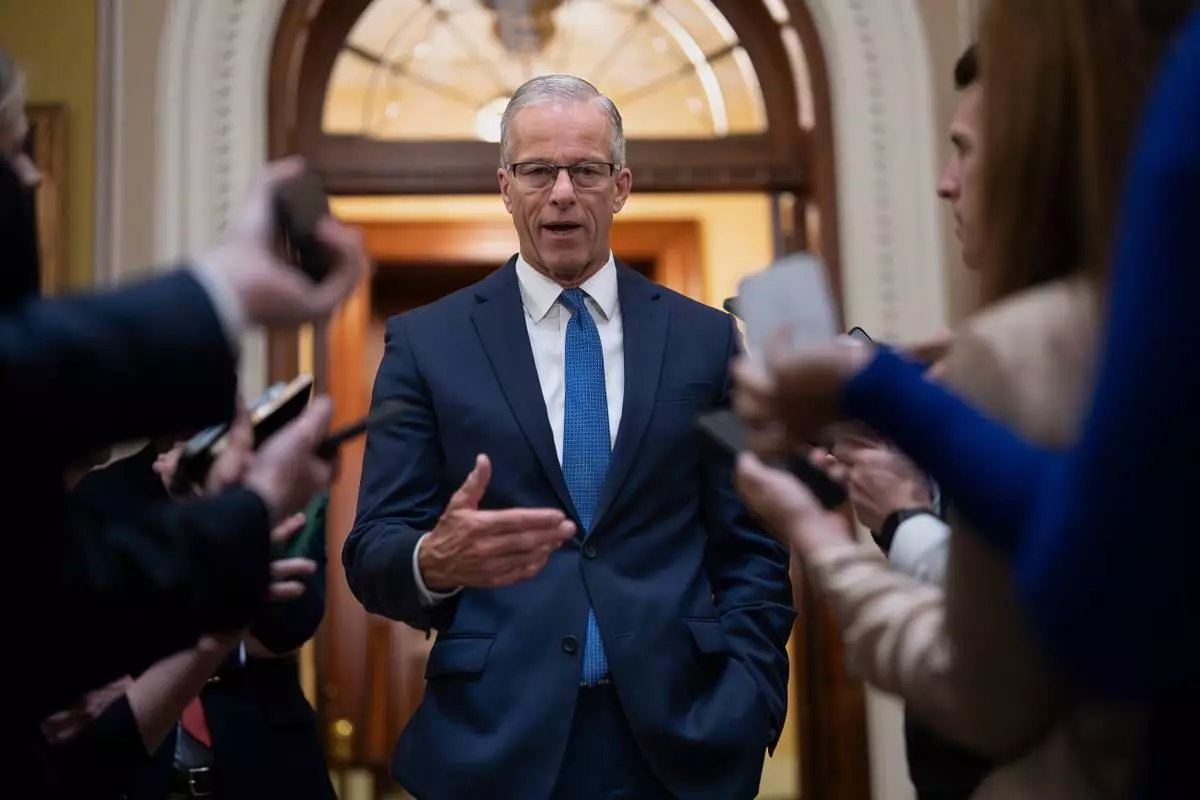
Senate Majority Leader John Thune, R-S.D., speaks to reporters outside the chamber after passing a measure by unanimous consent that would fund most of the Department of Homeland Security, if the House agrees, at the Capitol in Washington, Thursday, April 2, 2026. (AP Photo/J. Scott Applewhite)
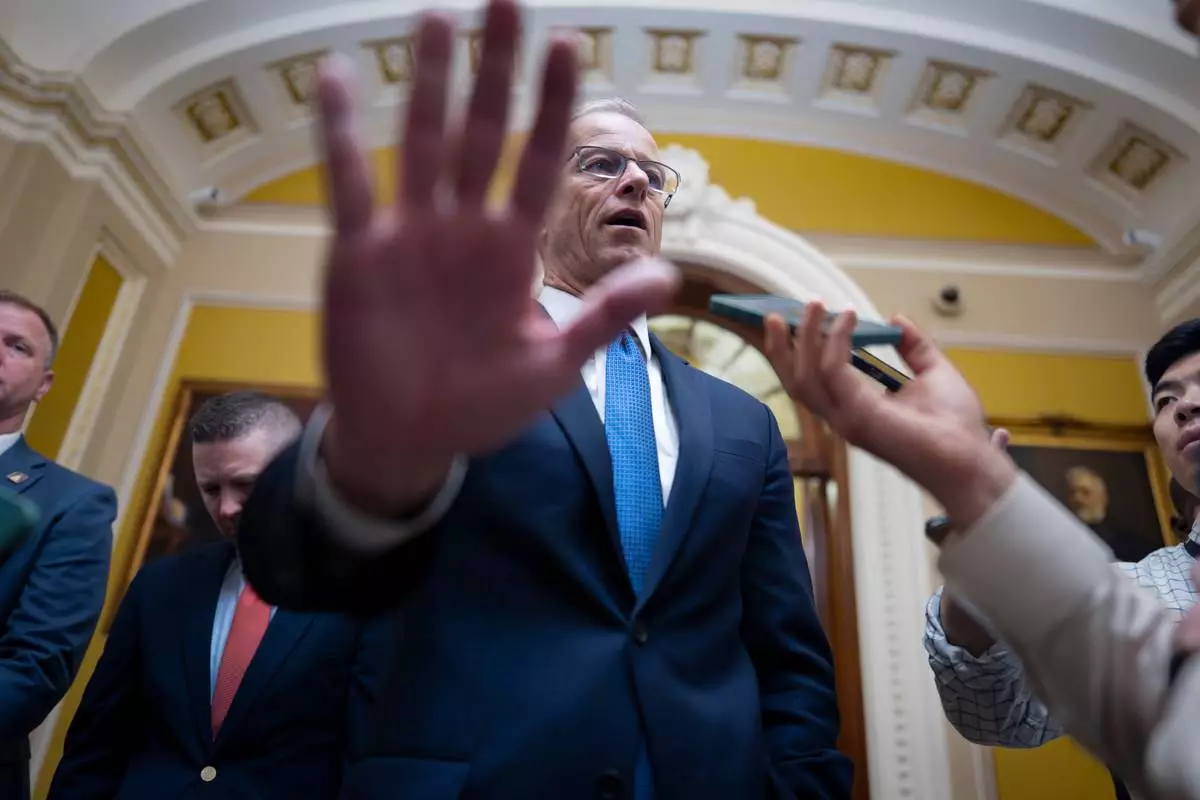
Senate Majority Leader John Thune, R-S.D., gestures as he speaks to reporters outside the chamber after passing a a measure by unanimous consent that would fund most of the Department of Homeland Security if the House agrees, at the Capitol in Washington, Thursday, April 2, 2026. (AP Photo/J. Scott Applewhite)
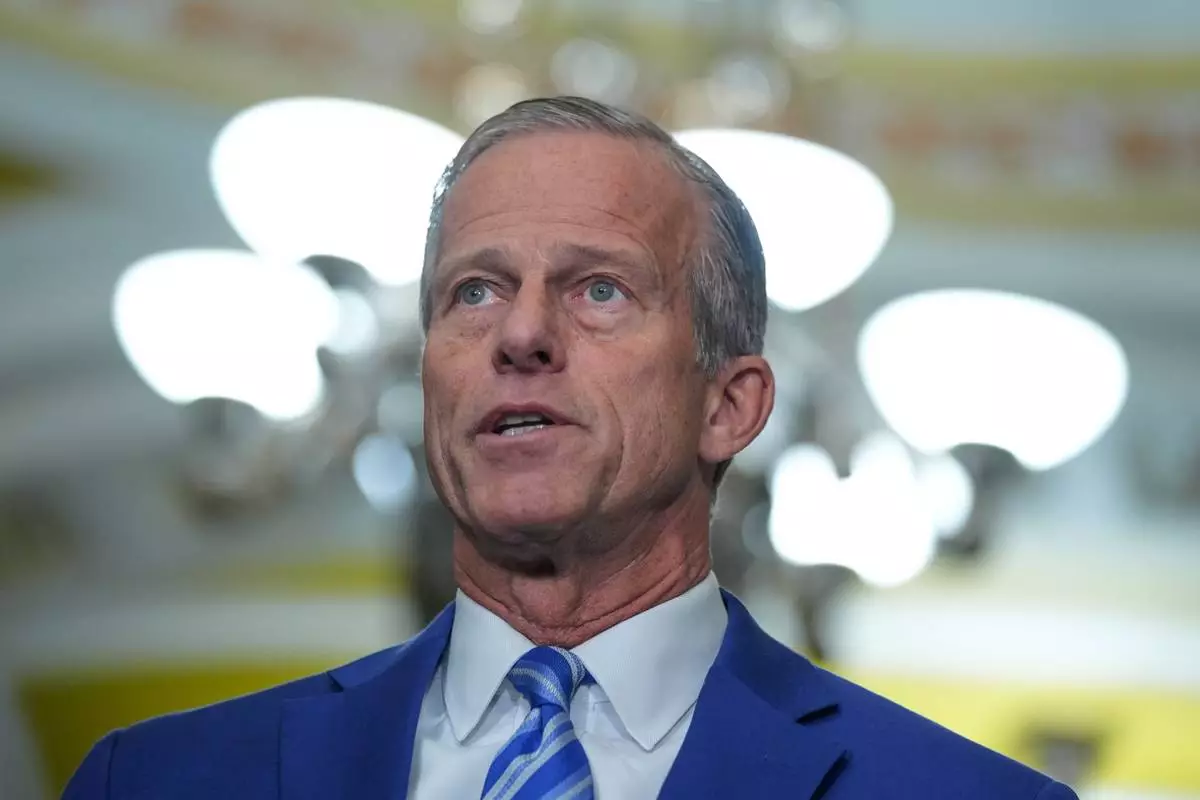
Sen. Majority Leader John Thune, R-S.D., speaks during a news conference after a policy luncheon on Capitol Hill,Tuesday, March 24, 2026, in Washington. (AP Photo/Mariam Zuhaib)
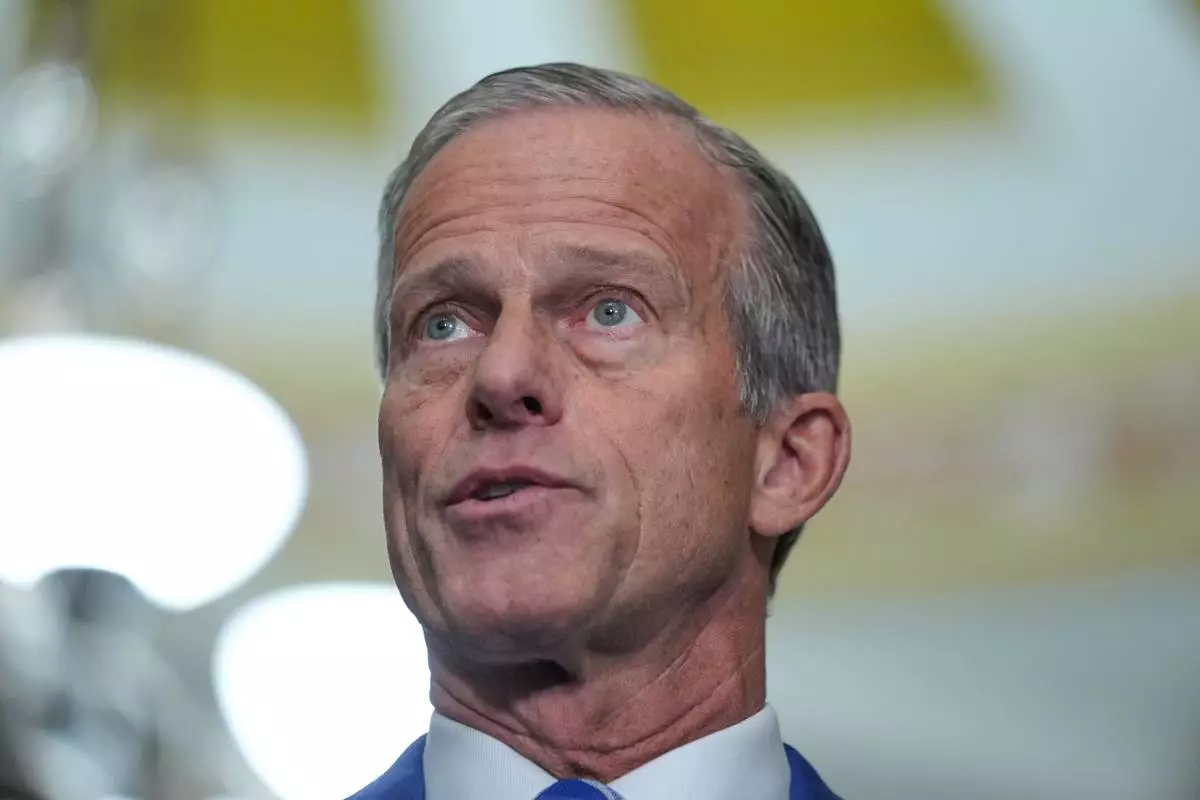
Sen. Majority Leader John Thune, R-S.D., speaks during a news conference after a policy luncheon on Capitol Hill, Tuesday, March 24, 2026, in Washington. (AP Photo/Mariam Zuhaib)

Speaker of the House Mike Johnson, R-La., speaks during a news conference on Capitol Hill, Friday, March 27, 2026, in Washington. (AP Photo/Mariam Zuhaib)