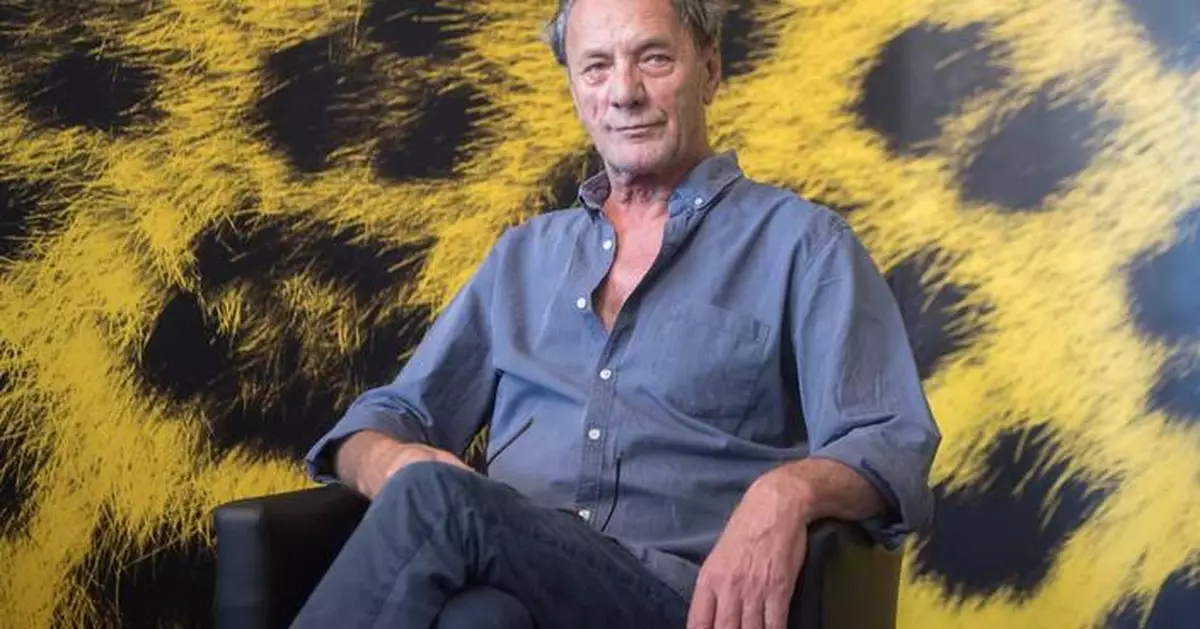
TEL AVIV, Israel (AP) — Mohammad Bakri, a Palestinian director and actor who sought to share the complexities of Palestinian identity and culture through a variety of works in both Arabic and Hebrew, has died, his family announced. He was 72.
Bakri was best known for “Jenin, Jenin,” a 2003 documentary he directed about an Israeli military operation in the northern West Bank city the previous year during the second Palestinian intifada, or uprising. The film, focusing on the heavy destruction and heartbreak of its Palestinian residents, was banned by Israel.
Bakri also acted in the 2025 film “ All That’s Left of You,” a drama about a Palestinian family through more than 76 years, alongside his sons, Adam and Saleh Bakri, who are also actors. The film has been shortlisted by the Academy Awards for the best international feature film.
Over the years, he made several films that spanned the spectrum of Palestinian experiences. He also acted in Hebrew, including at Israel’s national theater in Tel Aviv, and appeared in a number of famous Israeli films in the 1980s and 1990s. He studied at Tel Aviv University.
Bakri, who was born in northern Israel and held Israeli citizenship, dabbled in both film and theater. His best-known one-man-show from 1986, “The Pessoptimist,” based on the writings of Palestinian author Emile Habiby, focused on the intricacies and emotions of someone who has both Israeli and Palestinian identities.
During the 1980s, Bakri played characters in mainstream Israeli films that humanized the Palestinian identity, including “Beyond the Walls,” a seminal film about incarcerated Israelis and Palestinians, said Raya Morag, a professor at the Hebrew University of Jerusalem who specializes in cinema and trauma.
“He broke stereotypes about how Israelis looked at Palestinians, and allowing someone Palestinian to be regarded as a hero in Israeli society,” she said.
“He was a very brave person, and he was brave by standing to his ideals, choosing not to be conformist in any way, and paying the price in both societies,” said Morag.
Bakri faced some pushback within Palestinian society for his cooperation with Israelis. After “Jenin, Jenin,” he was plagued by almost two decades of court cases in Israel, where the film was seen as unbalanced and inciting.
In 2022, Israel's Supreme Court upheld a ban on the documentary, saying it defamed Israeli soldiers, and ordered Bakri to pay tens of thousands of dollars in damages to an Israeli military officer for defamation.
“Jenin, Jenin” was a turning point in Bakri’s career. In Israel, he became a polarizing figure and he never worked with mainstream Israeli cinema again, Morag said. “He was loyal to himself despite all the pressures from inside and outside,” she added. “He was a firm voice that did not change during the years.”
Local media quoted Bakri's family as saying he died Wednesday after suffering from heart and lung problems. His cousin, Rafic, told the Arabic news site Al-Jarmaq that Bakri was a tenacious advocate of the Palestinians who used his works to express support for his people.
“I am certain that Abu Saleh will remain in the memory of Palestinian people everywhere and all people of the free world,” he said, using Mohammed Bakri's nickname.
AP correspondent Kareem Chehayeb in Beirut contributed to this report.
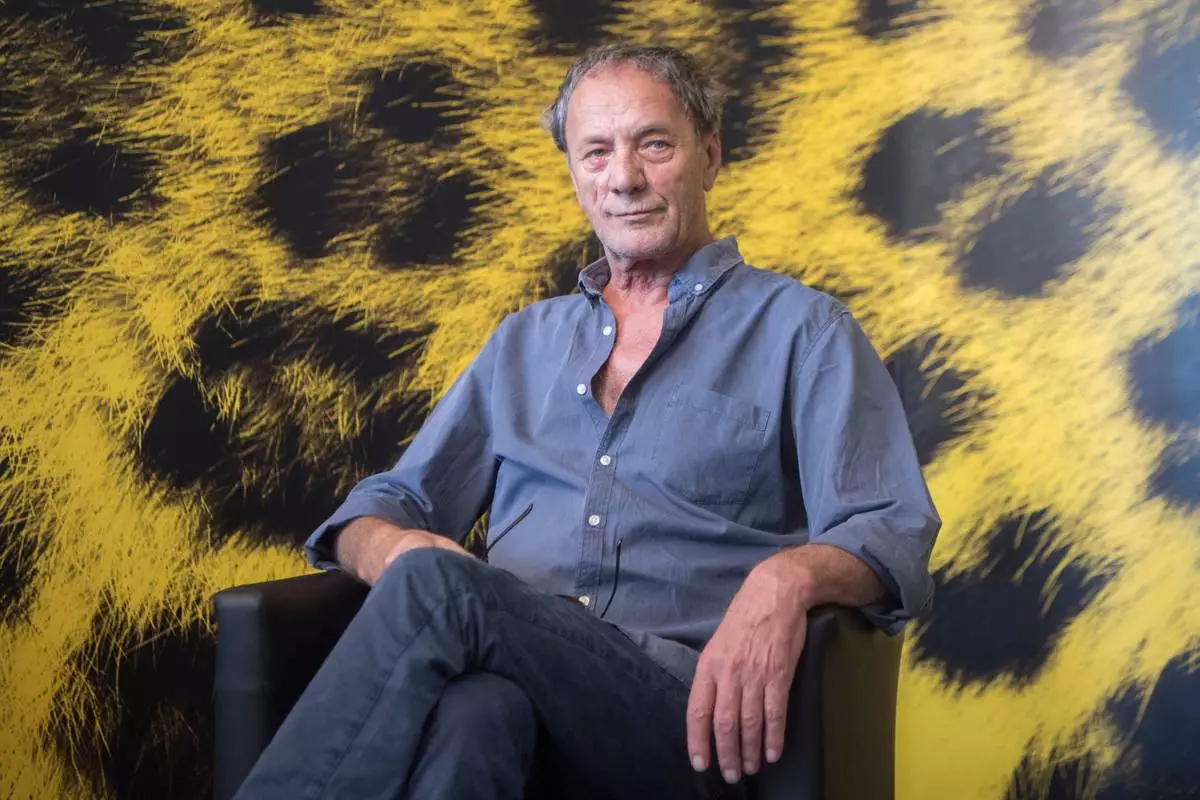
FILE - Palestinian actor Mohammed Bakri poses during the photocall for the film "Wajib" at the 70th Locarno International Film Festival in Locarno, Switzerland, on Aug. 5, 2017. (Urs Flueeler/Keystone via AP, File)
VATICAN CITY (AP) — Pope Leo XIV during his first Christmas Day message on Thursday urged the faithful to shed indifference in the face of those who have lost everything, like in Gaza, those who are in impoverished, like in Yemen, and the many migrants who cross the Mediterranean Sea and the American continent for a better future.
The first U.S. pontiff addressed some 26,000 people from the loggia overlooking St. Peter's Square for the traditional papal “Urbi et Orbi'' address, Latin for “To the City and to the World,'' which serves as a summary of the woes facing the world.
While the crowd gathered under a steady downpour during the papal Mass inside St. Peter's basilica, the rain had subsided by the time Leo took a brief tour of the square in the popemobile, then spoke to the crowd from the loggia.
Leo revived the tradition of offering Christmas greetings in multiple languages abandoned by his predecessor, Pope Francis. He received especially warm cheers when he made his greetings in his native English and Spanish, the language of his adopted country of Peru where he served first as a missionary and then as archbishop.
Someone in the crowd shouted out “Viva il papa!'' or ”Long live the pope!'' before he retreated into the basilica. Leo took off his glasses for a final wave.
During the traditional address, the pope emphasized that everyone could contribute to peace by acting with humility and responsibility.
“If he would truly enter into the suffering of others and stand in solidarity with the weak and the oppressed, then the world would change,'' the pope said.
Leo called for “justice, peace and stability” in Lebanon, Palestine, Israel and Syria, prayers for “the tormented people of Ukraine,'' and “peace and consolation” for victims of wars, injustice, political stability, religious persecution and terrorism, citing Sudan, South Sudan, Mali, Burkina Faso and Congo.
The pope also urged dialogue to address “numerous challenges” in Latin America, reconciliation in Myanmar, the restoration of “the ancient friendship between Thailand and Cambodia,'' and assistance for the suffering of those hit by natural disasters in South Asia and Oceania.
“In becoming man, Jesus took upon himself our fragility, identifying with each one of us: with those who have nothing left and have lost everything, like the inhabitants of Gaza; with those who are prey to hunger and poverty, like the Yemeni people; with those who are fleeing their homeland to seek a future elsewhere, like the many refugees and migrants who cross the Mediterranean or traverse the American continent,'' the pontiff said.
He also remembered those who have lost their jobs or are seeking work, especially young people, underpaid workers and those in prison.
Earlier, Leo led the Christmas Day Mass from the central altar beneath the balustrade of St. Peter’s Basilica, adorned with floral garlands and clusters of red poinsettias. White flowers were set at the feet of a statue of Mary, mother of Jesus, whose birth is celebrated on Christmas Day.
In his homily, Leo underlined that peace can emerge only through dialogue.
“There will be peace when our monologues are interrupted and, enriched by listening, we fall to our knees before the humanity of the other,” he said.
He remembered the people of Gaza, “exposed for weeks to rain, wind and cold” and the fragility of “defenseless populations, tried by so many wars,’’ and of “young people forced to take up arms, who on the front lines feel the senselessness of what is asked of them, and the falsehoods that fill the pompous speeches of those who send them to their deaths.’’
Thousands of people packed the basilica for the pope’s first Christmas Day Mass, holding aloft their smartphones to capture images of the opening procession.
This Christmas season marks the winding down of the Holy Year celebrations, which will close on Jan. 6, the Catholic Epiphany holiday marking the visit of the three wise men to the baby Jesus in Bethlehem.
Barry reported from Milan.
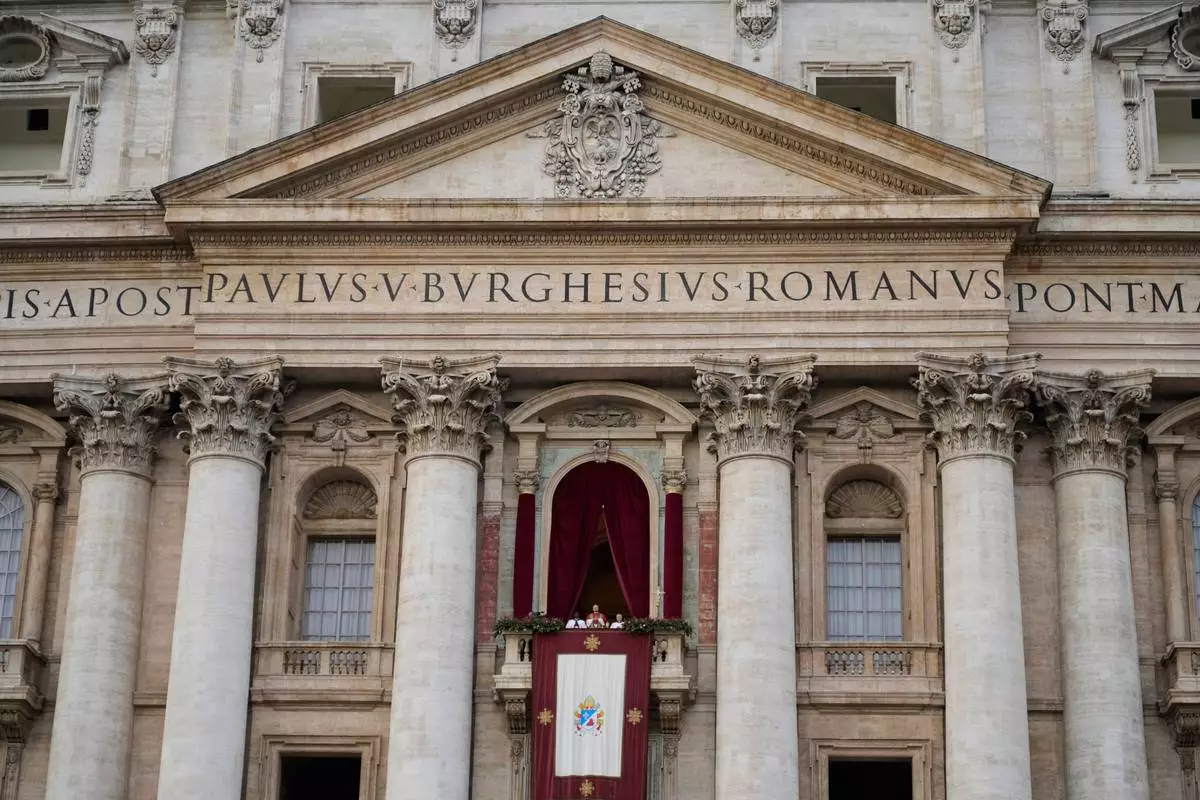
Pope Leo XIV delivers the Urbi et Orbi (Latin for 'to the city and to the world' ) Christmas' day blessing from the main balcony of St. Peter's Basilica at the Vatican, Thursday, Dec. 25, 2025. (AP Photo/Gregorio Borgia)
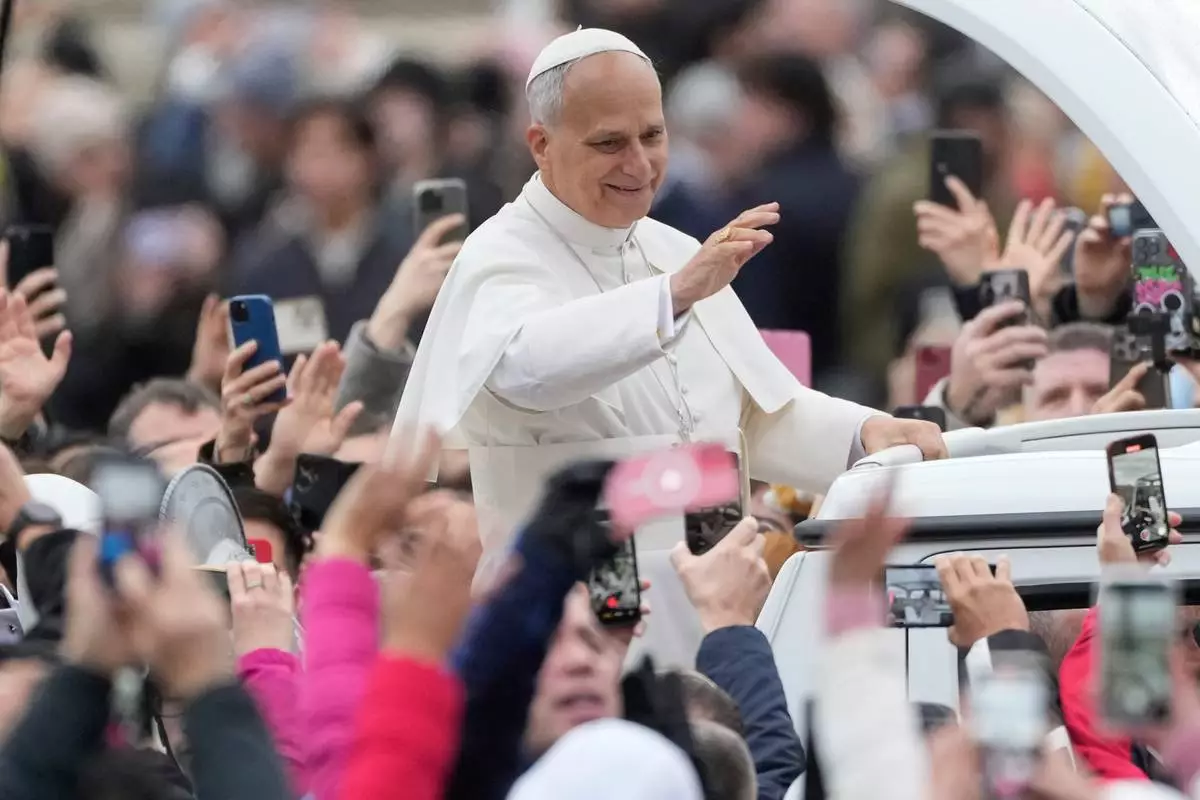
Pope Leo XIV waves before delivering the Urbi et Orbi (Latin for 'to the city and to the world' ) Christmas' day blessing from the main balcony of St. Peter's Basilica at the Vatican, Thursday, Dec. 25, 2025. (AP Photo/Gregorio Borgia)
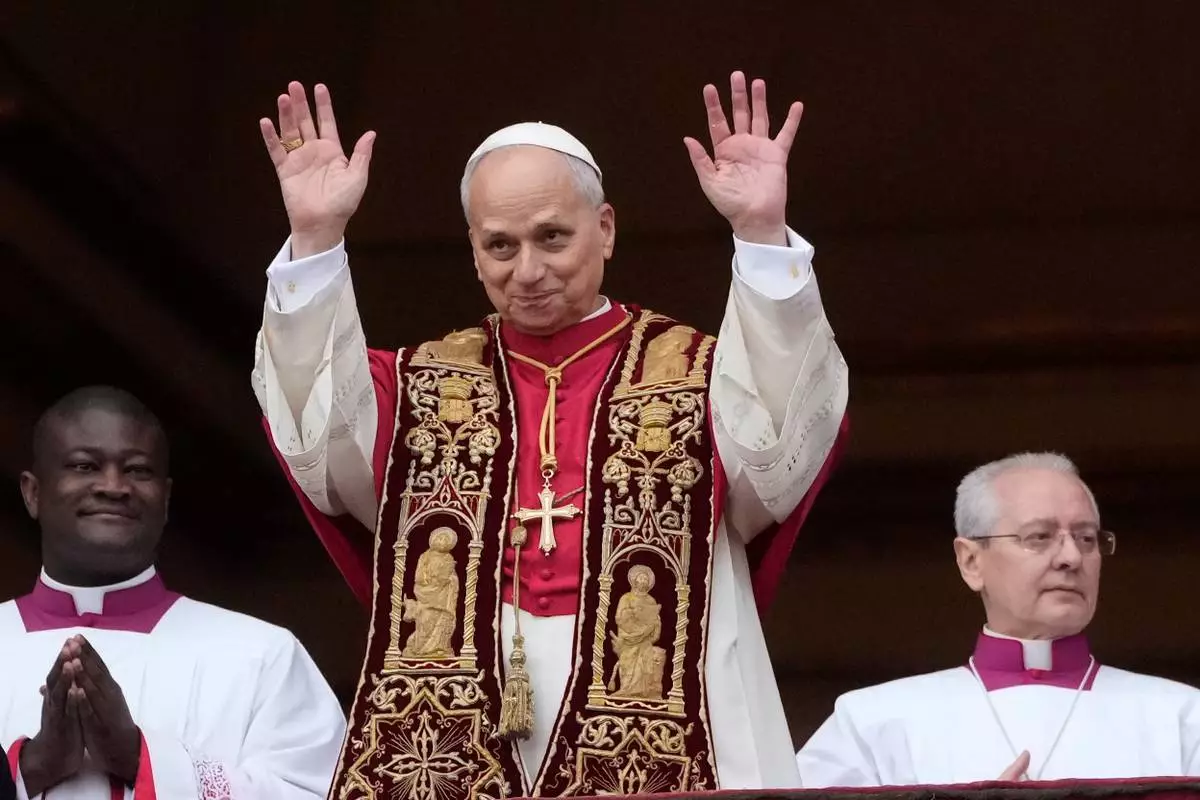
Pope Leo XIV waves after delivering the Urbi et Orbi (Latin for 'to the city and to the world' ) Christmas' day blessing from the main balcony of St. Peter's Basilica at the Vatican, Thursday, Dec. 25, 2025. (AP Photo/Gregorio Borgia)
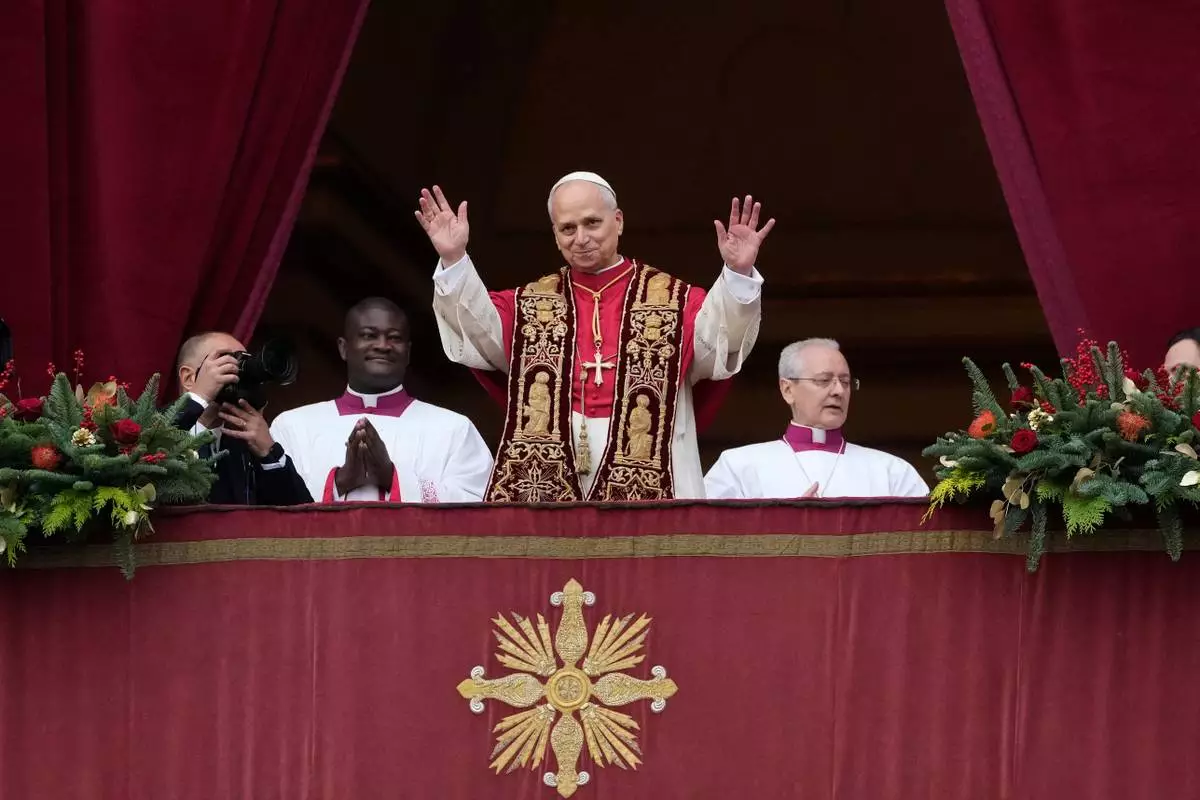
Pope Leo XIV waves after delivering the Urbi et Orbi (Latin for 'to the city and to the world' ) Christmas' day blessing from the main balcony of St. Peter's Basilica at the Vatican, Thursday, Dec. 25, 2025. (AP Photo/Gregorio Borgia)
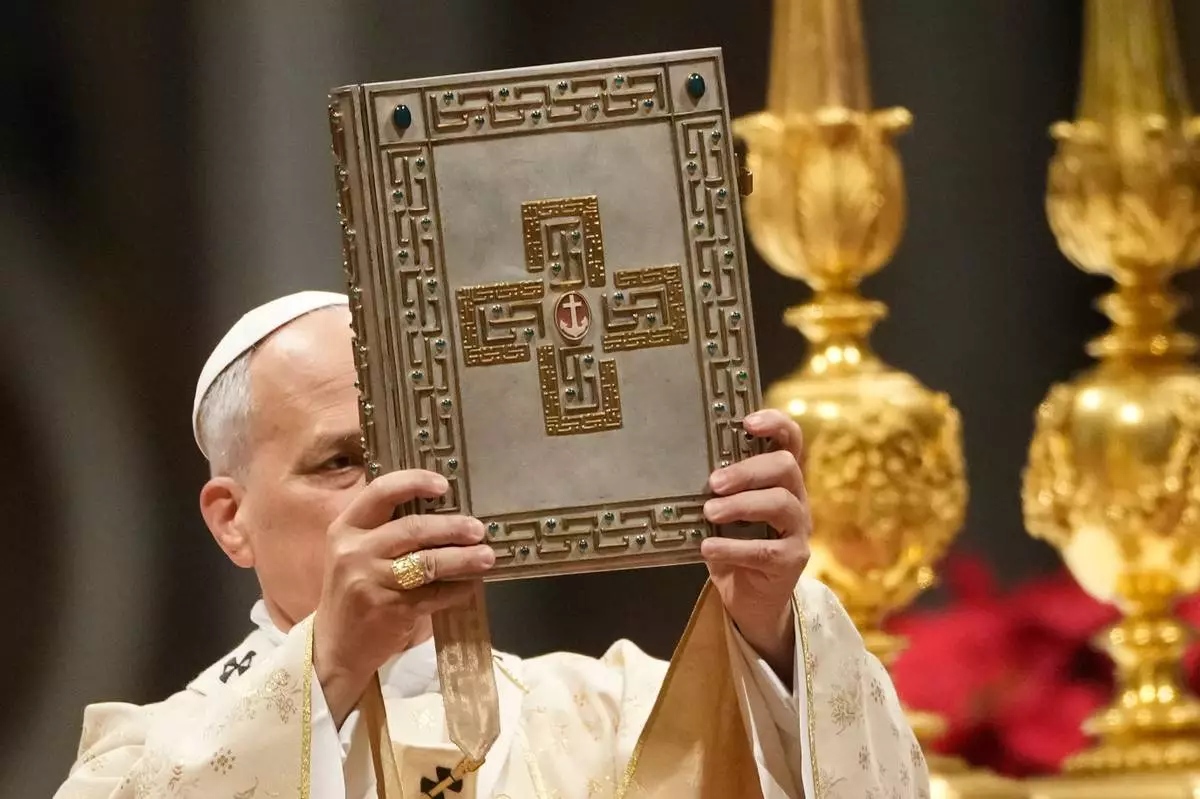
Pope Leo XIV holds up the book of the Gospel during the Christmas Day Mass at the St. Peter's Basilica at the Vatican, Thursday, Dec. 25, 2025. (AP Photo/Gregorio Borgia)
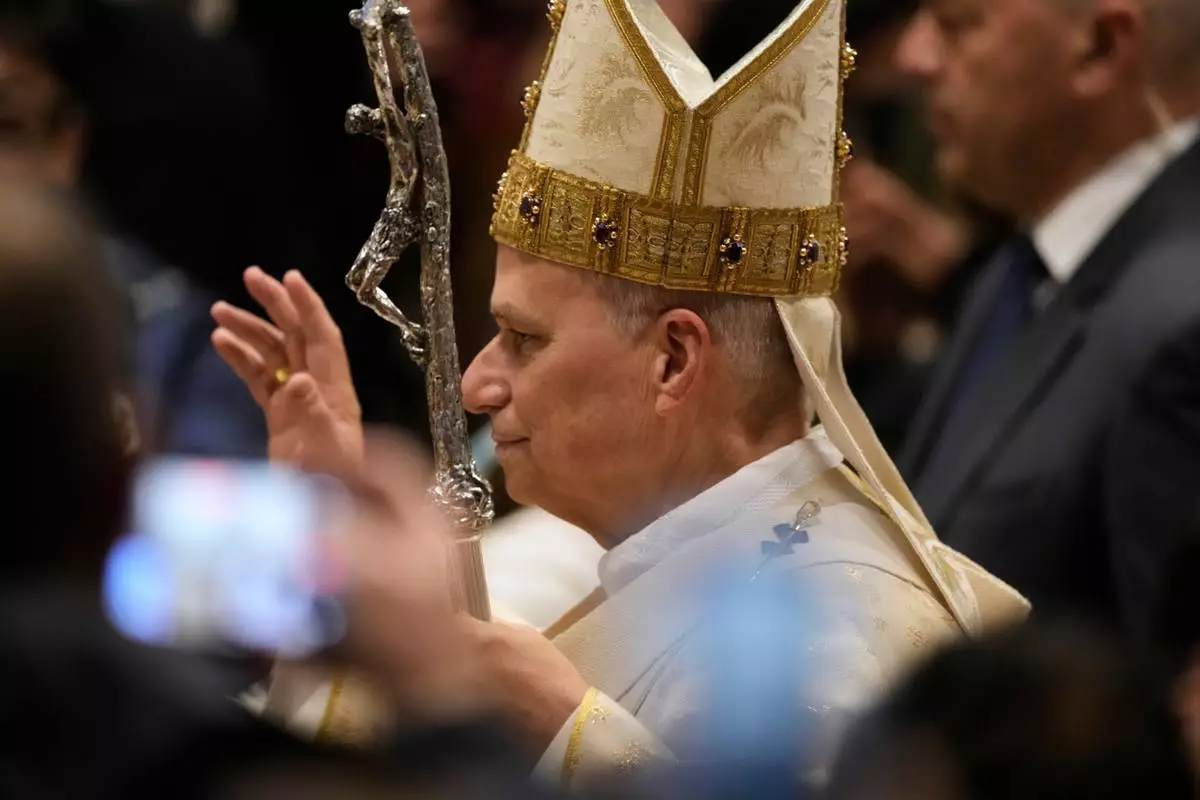
Pope Leo XIV presides over Christmas Day Mass at the St. Peter's Basilica at the Vatican, Thursday, Dec. 25, 2025. (AP Photo/Gregorio Borgia)
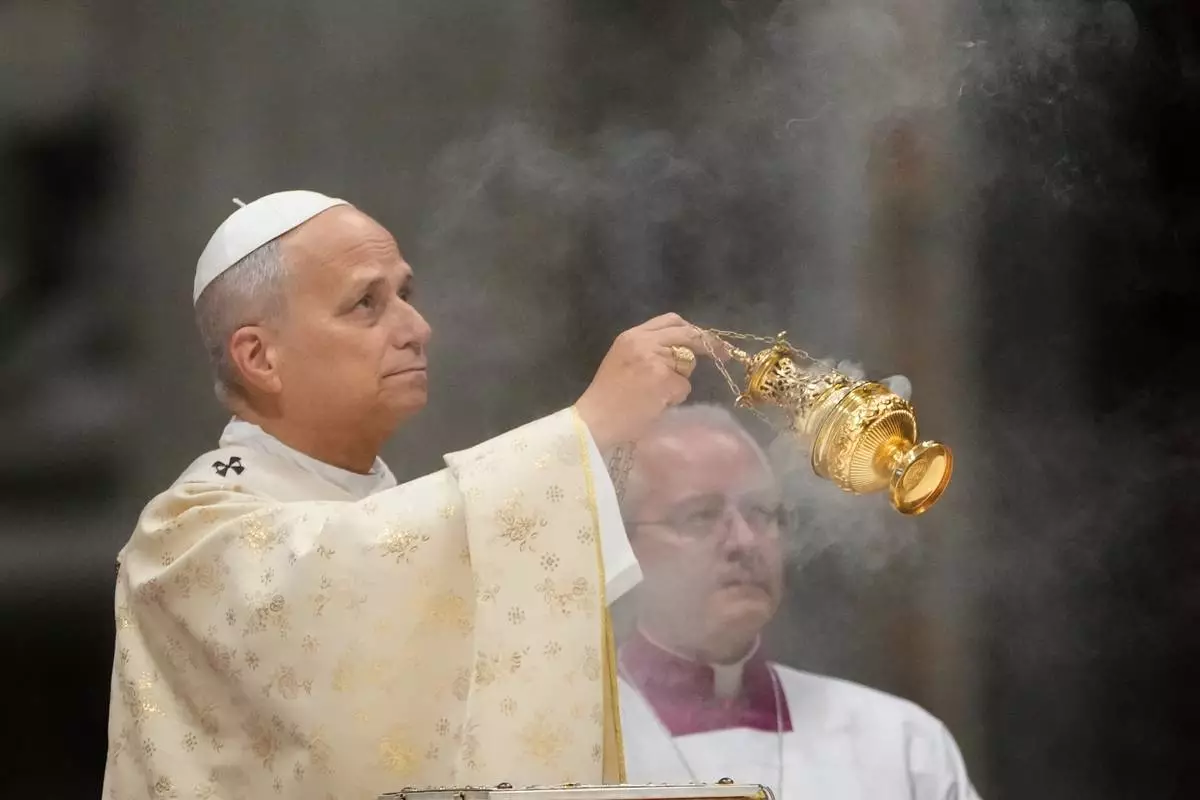
Pope Leo XIV presides over Christmas Day Mass at the St. Peter's Basilica at the Vatican, Thursday, Dec. 25, 2025. (AP Photo/Gregorio Borgia)
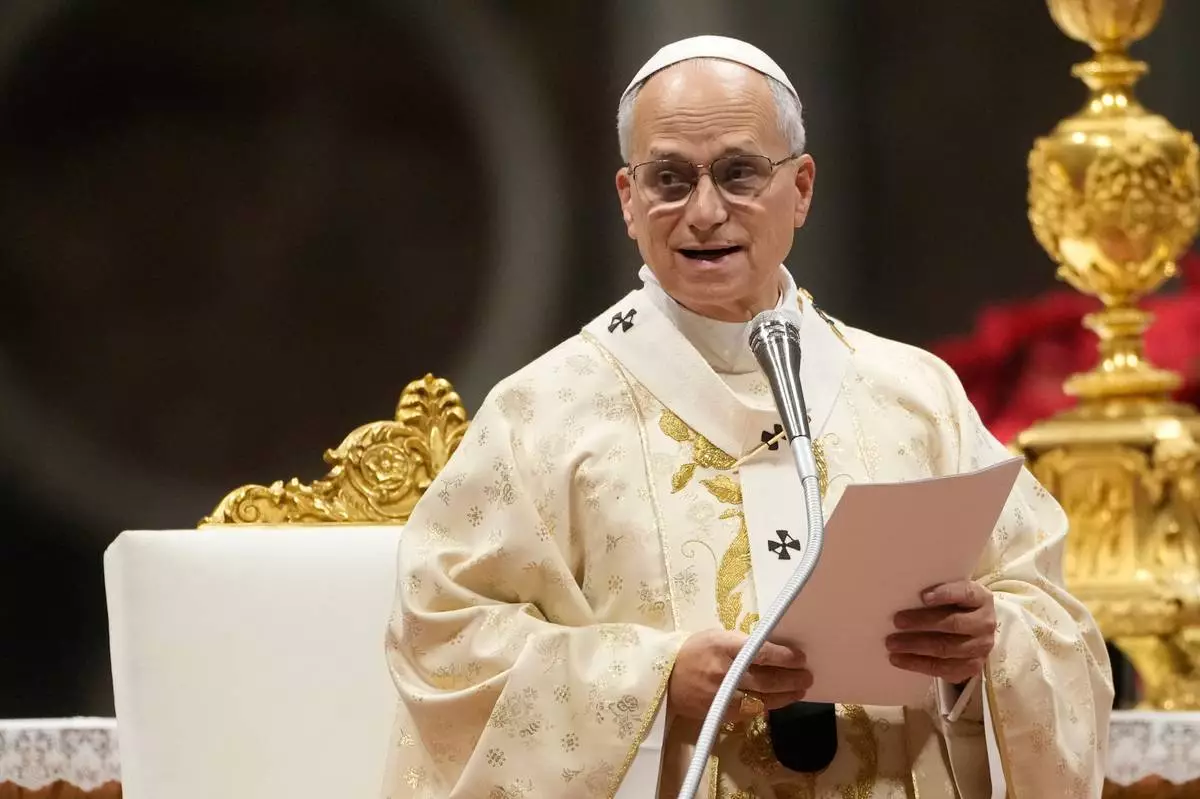
Pope Leo XIV presides over Christmas Day Mass at the St. Peter's Basilica at the Vatican, Thursday, Dec. 25, 2025. (AP Photo/Gregorio Borgia)