Skip to Content Facebook Feature Image

China vows to consolidate steady industrial growth momentum in 2026

China

China

China

China vows to consolidate steady industrial growth momentum in 2026

2025-12-26 17:12 Last Updated At:12-27 15:27

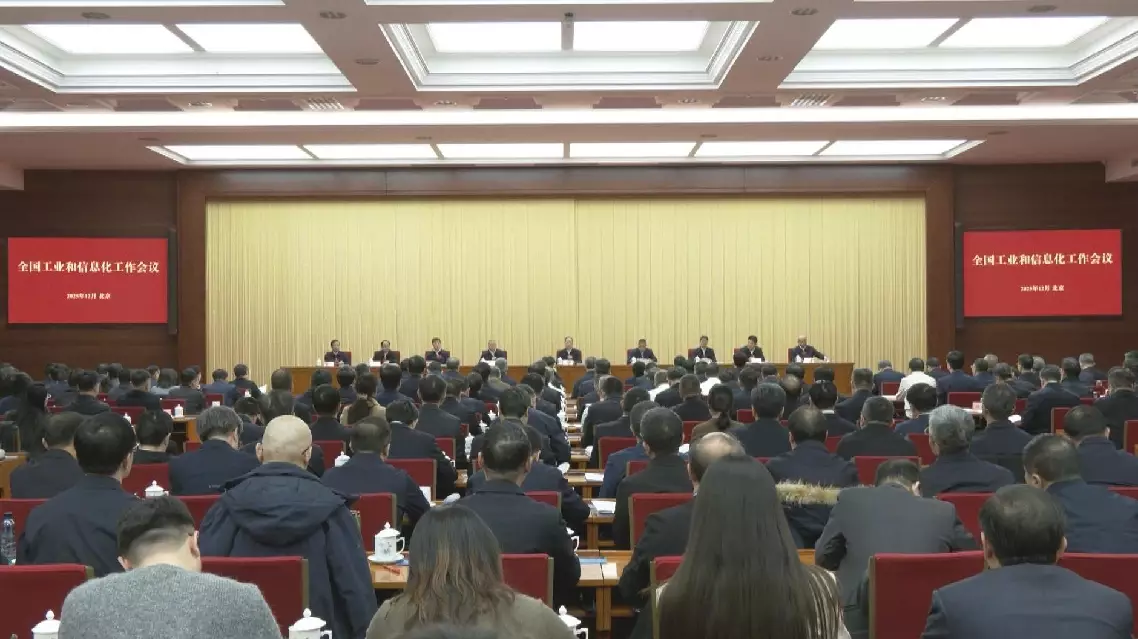
Building on this year's steady progress, China has identified consolidating industrial growth momentum as a key task for 2026, according to a national conference on industry and information technology held Friday in Beijing.

Official data showed that the country's industrial and information technology sector has successfully achieved its annual targets for 2025. According to the Ministry of Industry and Information Technology, the total telecommunications business volume and software business revenue are expected to grow by approximately 9 percent and 12 percent year on year, respectively.

It said China has achieved breakthroughs in industrial technological innovation in 2025, with the core artificial intelligence (AI) industry exceeding 1 trillion yuan (about 142 billion U.S. dollars) in scale.

In addition, China's exports of new energy vehicles surpassed 2 million units in 2025.

Li Lecheng, Minister of Industry and Information Technology, said that in 2026, efforts will be focused on consolidating the steady and improving trajectory of the industrial economy and deepening the implementation of a new round of action plans to stabilize growth in ten key industries, namely, steel, non-ferrous metals, petrochemicals, chemicals, building materials, machinery, automobiles, power equipment, light industry and electronic information manufacturing, which are vital to maintaining stability in the industrial economy and the broader national economy.

"We will accelerate innovative applications of AI and other new technologies while expanding supplies of green, health, niche, trendy, and senior-friendly products, and cultivate new consumption scenarios and business models," said Li.

As part of its 2026 agenda, the Ministry of Industry and Information Technology emphasized that China will also accelerate the enhancement of industrial scientific and technological innovation capabilities. Specific measures include building a nationwide pilot test service network for manufacturing and advancing pilot reforms for the “use first, pay later” model for scientific and technological achievements.

Optimizing and upgrading traditional industries is another key focus for the coming year.

"Our initiatives include promoting new models such as personalization and shared manufacturing to cultivate leading service-oriented manufacturing brands, thereby unlocking new vitality in traditional industries," said Li.

Furthermore, in nurturing and strengthening emerging and future industries, the ministry will focus on developing new pillar industries in 2026, including integrated circuits, new display technologies, new materials, aerospace, low-altitude economy, and biomedicine.
China vows to consolidate steady industrial growth momentum in 2026

China vows to consolidate steady industrial growth momentum in 2026
Of the four mice involved in a recent mission aboard China's space station in orbit, one female has now successfully given birth to healthy offspring on the Earth, the Technology and Engineering Center for Space Utilization (CSU) of the Chinese Academy of Sciences (CAS) has announced.

The four mice were sent into space aboard China's Shenzhou-21 crewed spaceship on Oct. 31, and were housed in a specialized habitat on the space station before returning to the Earth on Nov. 14.

After their return, one female mated with a male and conceived, and later delivered nine pups on Dec. 10. Six of the newborns have survived -- a rate considered normal. Researchers have noted that the mother mouse is nursing normally and the pups appear active and healthy.

"Their offspring all appear normal, so preliminary evidence suggests the space environment may have a very limited impact on the fertility of mice. This lays an important foundation for enabling mice to mate in space in the future, as well as to become pregnant, give birth, and produce offspring there," said Wang Hongmei, deputy director of the Institute of Zoology of the CAS.

According to the CSU, throughout the space mission, an AI-powered monitoring system tracked the behavior of the mice, including movement, feeding and sleep patterns, providing critical data to support real-time decision-making.

The CSU stated that this achievement signifies China's first full-cycle realization of a mammalian space experiment, covering pre-launch preparations, in-orbit operations aboard the Chinese space station, and sample recovery.

This milestone lays a solid foundation for larger-scale mammalian space science experiments in the future, the CSU added.

The monitoring by researchers also revealed that the mother mouse who had been to space showed a parenting style drastically different from that of the ground group. She would seek out a special, hidden and secure corner within her "home" to give birth and would deliberately block the entrance with cotton, appearing exceptionally cautious.

In contrast, the mother mouse from the ground group seemed much more "carefree," with most of her offspring born in cotton nests in open areas.

Scientists will continue to study the postnatal development of the mouse pups, monitoring their growth and physiological changes. Further research may also examine whether these offspring can reproduce normally, helping reveal potential multigenerational effects of space exposure on mammals.

Mouse births pups after space mission, paving way for future research

Mouse births pups after space mission, paving way for future research

Recommended Articles