SHENZHEN, China, Dec. 30, 2025 /PRNewswire/ -- Tencent Cloud, the cloud business of leading global technology and entertainment company Tencent, has been named a Leader in the recently released IDC MarketScape: Asia/Pacific AI-Enabled Front Office Conversational AI Software 2025 Vendor Assessment report (doc #AP52998625, November 2025).
Front office conversational AI brings intelligent, interactive capabilities that enhance user experiences and provide enterprises with end-to-end solutions from service to marketing, significantly improving operational efficiency. Today, it is one of the most representative application scenarios for generative AI.
As a pioneer in conversational AI, Tencent Cloud has accumulated rich experience in product application. For example, Tencent QiDian Customer Service leverages large language models (LLMs) and its proprietary Agent Development Platform (ADP) to power service chatbots for clients like DHL-Sinotrans, reducing daily manual service requests by 200 and increasing chatbot resolution rate from 69% to 74%.
To further elevate interactive experiences, Tencent Cloud AI Digital Human, also built on large language models, features precise intent recognition and lifelike, real-time interactions. This technology has already been deployed by global organizations such as Singapore Changi Airport and the Offshore Company of Vector Group, the world's sixth largest (and Asia's leading) PR company, optimizing their customer experiences.
Tencent Cloud's Agent Development Platform (ADP) leverages Retrieval-Augmented Generation (RAG), workflow orchestration, and multi-agent frameworks to help businesses rapidly build sophisticated AI agents. These agents go beyond answering questions to autonomously execute complex tasks like identity verification, cross-system order tracking, and database queries. The time from application development to launch has been reduced to as little as three minutes. Tencent Cloud's ADP is now widely deployed and has been making real-world impact across sectors such as public affairs, media, and retail, with its capabilities accessible globally via Tencent Cloud's international platform.
For instance, Huazhu Group, a world-class hotel group operating in 19 countries with over 12,000 hotels and 290 million members, partnered with Tencent Cloud's ADP to create a "24/7 Digital Butler" within its app—Huaxia AI. Capable of handling complex tasks such as information inquiries, order management, guest requests, and in-room IoT controls, this digital butler significantly enhances the hotel's operational efficiency.
Similarly, in the financial sector, Tencent Cloud collaborated with a leading securities firm to launch an "Intelligent Investment Assistant." Designed to address investor queries, the assistant can provides information such as company earnings reports, industry trends, market hotspots, and historical stock performance—along with in-depth analysis. To date, the assistant has processed nearly 2 million queries, helping the securities firm achieve a 3x month-over-month increase in user penetration.
Tencent Cloud's conversational AI footprint now extends across the Asia-Pacific region, with significant adoption in Hong Kong SAR, Macau SAR, Singapore, Indonesia, and Malaysia. These solutions are driving digital transformation in sectors such as automotive manufacturing, cross-border logistics, pharmaceutical retail, and financial insurance. By integrating AI conversation into the essential services such as retail, dining, hospitality, and transportation of daily life, Tencent Cloud is making interactions more efficient while maintaining a human-centric approach.
In order to provide solutions tailored to local languages, cultures, and compliance needs, Tencent Cloud has established local teams and technical support centers across the globe, ensuring global enterprises receive responsive, localized service. Looking forward, Tencent Cloud will continue to deepen the integration of AI technology with industry-specific scenarios, offering more intelligent, adaptive, and fine-tuned products and services to help enterprises worldwide harness the power of AI and thrive in the intelligent era.
About Tencent Cloud:
Tencent Cloud, one of the world's leading cloud companies, is committed to creating innovative solutions to resolve real-world issues and enabling digital transformation for smart industries. Through our extensive global infrastructure, Tencent Cloud provides businesses across the globe with stable and secure industry-leading cloud products and services, leveraging technological advancements such as cloud computing, Big Data analytics, AI, IoT, and network security. It is our constant mission to meet the needs of industries across the board, including the fields of gaming, media and entertainment, finance, healthcare, property, retail, travel, and transportation.
About IDC MarketScape:
IDC MarketScape vendor assessment model is designed to provide an overview of the competitive fitness of technology and service suppliers in a given market. The research utilizes a rigorous scoring methodology based on both qualitative and quantitative criteria that results in a single graphical illustration of each supplier's position within a given market. IDC MarketScape provides a clear framework in which the product and service offerings, capabilities and strategies, and current and future market success factors of technology suppliers can be meaningfully compared. The framework also provides technology buyers with a 360-degree assessment of the strengths and weaknesses of current and prospective suppliers.
** The press release content is from PR Newswire. Bastille Post is not involved in its creation. **

Tencent Cloud Named a Leader in IDC MarketScape: Asia Pacific AI-Enabled Front-Office Conversational AI Software 2025 Vendor Assessment
|
The Norwegian Refugee Council's Better Learning Programme, funded by Education Cannot Wait, delivers mental health and psychosocial support alongside education for children in Gaza.
GAZA, Palestine, Dec. 30, 2025 /PRNewswire/ -- In a tent in Deir al-Balah, Gaza, 12-year-old Masa carefully places her colored pencil on the page, tracing the curve of a wave. Her brown hair is pulled back in a ponytail, secured with two plastic barrettes. The sea she draws is calm and glimmering.
In her real world, nothing is calm. But in this small act of creativity – in the rhythm of drawing and comfort of her new learning space – Masa is learning to breathe again.
She has already endured more loss than any child should. "I used to live a beautiful and peaceful life in the Al-Nasr area. My school was my wonderful world where I gathered with friends. But after the war started, we were forced to flee multiple times until we ended up in a tent at the Saned site in Deir al-Balah. My life became nothing but emptiness, suffering and extreme loneliness," Masa says. After attacks and displacement orders forced her to flee her home – and the school and friendships that once gave her joy – she faced a daily battle with fear and feelings of despair.
When a temporary learning space was established at the Saned site, Masa regained a small semblance of the childhood she once knew. She now attends learning sessions in a safe environment where she's rebuilding her lost skills in Arabic and mathematics, making new friends, learning calming and coping techniques, and rediscovering joy through play and art.
This initiative is funded by Education Cannot Wait (ECW), the global fund for education in emergencies and protracted crises in the United Nations, and is part of the Norwegian Refugee Council's (NRC) flagship Better Learning Programme (BLP). For children like Masa, it's a first step towards recovery and hope.
Where Learning Establishes the Foundation for Healing
When Masa's family fled Al-Nasr, the 12-year-old not only left behind her home, but her school, friends and beloved teachers. She spent long days in the family's small tent in Saned site, her anxiety growing in the silence. She says, "I always felt isolated and distressed, with no one to talk to."
Even stepping outside of the tent was dangerous. Her mother urged her to stay inside, afraid for her safety. Her beloved aunt was killed in an airstrike on a school where she was sheltering, and her cousin's leg was amputated after sustaining injuries in the same attack. Masa says, "I woke up terrified many times at night, sometimes waking my brother to calm me. I felt that death was getting closer to us and war and bombings were stealing the people we love."
Everything changed the day a group of teachers visited her family's tent. They spoke to her mother about a new learning tent at the site and encouraged Masa to join.
Today, Masa regularly attends psychosocial and learning sessions through the BLP. The initiative weaves together basic education – including Arabic and mathematics – with therapeutic tools like breathing techniques, storytelling and guided drawing to help children process trauma and stress. "I learned deep breathing exercises, the safe place technique and relaxation methods. I practiced these techniques regularly, especially picturing my safe place," says Masa.
One core aim of the initiative is to teach children self-regulation, calming and coping skills. Now, when Masa feels afraid, she remembers her teacher's words – that negative thoughts make us feel hopeless. She then takes out her drawing supplies or talks to friends to cope.
Educators and community members are also equipped with tools to create safe learning environments and support children's emotional recovery – part of ECW's commitment to holistic quality education. ECW has supported education in the State of Palestine since 2019, where its investments have reached nearly one million crisis-affected children to date, 51% of them girls.
Masa says, "Since joining the sessions at the educational tent, I have felt some hope that life could return to us. I made friends and established a routine in my life. I also started drawing beautiful pictures again."
Rediscovering Hope, One Lesson at a Time
Masa now walks to the learning tent each day, where she reads, draws and relearns math and Arabic – the building blocks to education that two years of war had threatened to erase. She dreams of becoming a doctor. "I want to help children. It is my right, like all children in the world, to dream, grow and build my future," she says.
Yet, for children like her, that future hangs in the balance. Continued investment in education and mental health support is not a luxury – it is a necessity. BLP is just one step in a much longer journey towards recovery. But it is a powerful one.
"This grant from ECW allows us to begin restoring mental health and learning services," says Jan Egeland, Secretary General of NRC. "But it is only a drop in an ocean of need. These children must not be forgotten."
In a corner of a tent in Deir al-Balah, Masa picks up her pencil again. The waves on the page are growing stronger. She still carries the weight of grief, but her drawings whisper something else: resilience. "I love drawing the sea because it reminds me that life is still possible and beautiful."
The Norwegian Refugee Council's Better Learning Programme, funded by Education Cannot Wait, delivers mental health and psychosocial support alongside education for children in Gaza.
GAZA, Palestine, Dec. 30, 2025 /PRNewswire/ -- In a tent in Deir al-Balah, Gaza, 12-year-old Masa carefully places her colored pencil on the page, tracing the curve of a wave. Her brown hair is pulled back in a ponytail, secured with two plastic barrettes. The sea she draws is calm and glimmering.
In her real world, nothing is calm. But in this small act of creativity – in the rhythm of drawing and comfort of her new learning space – Masa is learning to breathe again.
She has already endured more loss than any child should. "I used to live a beautiful and peaceful life in the Al-Nasr area. My school was my wonderful world where I gathered with friends. But after the war started, we were forced to flee multiple times until we ended up in a tent at the Saned site in Deir al-Balah. My life became nothing but emptiness, suffering and extreme loneliness," Masa says. After attacks and displacement orders forced her to flee her home – and the school and friendships that once gave her joy – she faced a daily battle with fear and feelings of despair.
When a temporary learning space was established at the Saned site, Masa regained a small semblance of the childhood she once knew. She now attends learning sessions in a safe environment where she's rebuilding her lost skills in Arabic and mathematics, making new friends, learning calming and coping techniques, and rediscovering joy through play and art.
This initiative is funded by Education Cannot Wait (ECW), the global fund for education in emergencies and protracted crises in the United Nations, and is part of the Norwegian Refugee Council's (NRC) flagship Better Learning Programme (BLP). For children like Masa, it's a first step towards recovery and hope.
Where Learning Establishes the Foundation for Healing
When Masa's family fled Al-Nasr, the 12-year-old not only left behind her home, but her school, friends and beloved teachers. She spent long days in the family's small tent in Saned site, her anxiety growing in the silence. She says, "I always felt isolated and distressed, with no one to talk to."
Even stepping outside of the tent was dangerous. Her mother urged her to stay inside, afraid for her safety. Her beloved aunt was killed in an airstrike on a school where she was sheltering, and her cousin's leg was amputated after sustaining injuries in the same attack. Masa says, "I woke up terrified many times at night, sometimes waking my brother to calm me. I felt that death was getting closer to us and war and bombings were stealing the people we love."
Everything changed the day a group of teachers visited her family's tent. They spoke to her mother about a new learning tent at the site and encouraged Masa to join.
Today, Masa regularly attends psychosocial and learning sessions through the BLP. The initiative weaves together basic education – including Arabic and mathematics – with therapeutic tools like breathing techniques, storytelling and guided drawing to help children process trauma and stress. "I learned deep breathing exercises, the safe place technique and relaxation methods. I practiced these techniques regularly, especially picturing my safe place," says Masa.
One core aim of the initiative is to teach children self-regulation, calming and coping skills. Now, when Masa feels afraid, she remembers her teacher's words – that negative thoughts make us feel hopeless. She then takes out her drawing supplies or talks to friends to cope.
Educators and community members are also equipped with tools to create safe learning environments and support children's emotional recovery – part of ECW's commitment to holistic quality education. ECW has supported education in the State of Palestine since 2019, where its investments have reached nearly one million crisis-affected children to date, 51% of them girls.
Masa says, "Since joining the sessions at the educational tent, I have felt some hope that life could return to us. I made friends and established a routine in my life. I also started drawing beautiful pictures again."
Rediscovering Hope, One Lesson at a Time
Masa now walks to the learning tent each day, where she reads, draws and relearns math and Arabic – the building blocks to education that two years of war had threatened to erase. She dreams of becoming a doctor. "I want to help children. It is my right, like all children in the world, to dream, grow and build my future," she says.
Yet, for children like her, that future hangs in the balance. Continued investment in education and mental health support is not a luxury – it is a necessity. BLP is just one step in a much longer journey towards recovery. But it is a powerful one.
"This grant from ECW allows us to begin restoring mental health and learning services," says Jan Egeland, Secretary General of NRC. "But it is only a drop in an ocean of need. These children must not be forgotten."
In a corner of a tent in Deir al-Balah, Masa picks up her pencil again. The waves on the page are growing stronger. She still carries the weight of grief, but her drawings whisper something else: resilience. "I love drawing the sea because it reminds me that life is still possible and beautiful."
** The press release content is from PR Newswire. Bastille Post is not involved in its creation. **
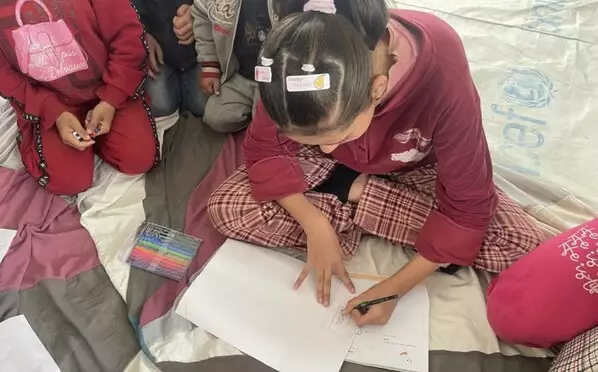
Masa Draws the Sea Again