NEW YORK--(BUSINESS WIRE)--Dec 30, 2025--
CookUnity, the world’s first chef-to-you platform delivering meals from Michelin-starred restaurateurs, James Beard Award winners, and celebrity chefs, kicked off a new partnership with New York Golf Club (“NYGC”), as part of the second season of The Golf League (TGL) Presented by SoFi. As NYGC’s “exclusive meal partner”, CookUnity will provide chef-crafted meals to players and implement activations with fans throughout the TGL season. Together, the two brands are redefining how the next generation of golfers, athletes, and fans fuel performance on and off the course.
This press release features multimedia. View the full release here: https://www.businesswire.com/news/home/20251230869624/en/
As TGL reshapes golf into a dynamic, immersive, technology-powered experience, CookUnity is transforming how high-performing individuals fuel their lives. NYGC athletes, such as Cameron Young, one of the most prominent talents of golf’s next generation, represent a new era of the sport defined by innovation, intensity, and elevated expectations. CookUnity mirrors that evolution by bringing culinary excellence directly into the homes, offices, and daily routines of ambitious consumers.
“NYGC and TGL are bringing tremendous innovation to golf, and we are eager to build on the momentum of Season 1,” said Andrew B. Cohen, the Chief Investment Officer and Co-Founder of Cohen Private Ventures, Steven A. Cohen’s family office that manages NYGC. “We are very excited about this partnership with CookUnity and the innovation that they are bringing to their industry. Together, we are looking forward to making NYGC Season 2 an even bigger success.”
“ At NYGC, athletes are pushing the sport forward with precision, creativity, and passion, qualities that also define CookUnity,” said Michael Baruch, Head of Brand from CookUnity. “ We’re building a platform that brings people closer to culinary excellence and fuels their peak performance, whether they’re stepping onto the course, into the gym, or into a busy day.”
As the exclusive meal delivery partner of NYGC, athletes will have access to CookUnity meals curated to support both high-performance nutrition and premium lifestyle needs. Just as no golfer wants to play the same course every day, CookUnity delivers variety through a rotating menu crafted by 180 world-class chefs such as Marcus Samuelsson, Cat Cora, José Garces, and Einat Admony, giving athletes and customers alike the flexibility and inspiration to keep everyday routines exciting.
“ CookUnity and NYGC share a belief that people shouldn't have to choose between fueling performance and enjoying exceptional food,” said Aalok Kapoor, COO of CookUnity. “ With meals spanning more than 25 different cuisines, we give people the ability to fuel fast-paced, high-achieving lives without sacrificing taste and quality.”
The partnership will feature exclusive content, curated meal experiences, and moments that will connect fans, chefs, and athletes throughout the TGL NYGC season. Additional activations will roll out leading up to a signature activation at the February 24, 2026 match, vs. The Bay Golf Club, where CookUnity will continue showcasing how taste, performance, and access define the lifestyle of the next generation of golfers.
About New York Golf Club:
New York Golf Club features its four-player roster of PGA TOUR stars Xander Schauffele, Rickie Fowler, Matt Fitzpatrick and Cameron Young, to compete in TGL, a tech-infused, 3-on-3 golf league that features teams competing in a season-long, fast-paced competition. The NYGC team is managed by Cohen Private Ventures (CPV), the family office of Steven A. Cohen, and will represent New York against the five other TGL teams, teeing off in the first match of Season 2 last Sunday, December 28 on ABC.
About CookUnity (US)
CookUnity is America’s first chef-to-you meal delivery platform distinguished by the belief that passionate chefs are essential to producing truly great food. The company empowers world-class culinary talent (including Michelin-starred chefs, James Beard Award winners, and Food Network stars) to share their gourmet meals with the masses through its weekly subscription, with over 50 million meals served to date. Every handcrafted dish is delivered fresh in sustainable packaging and ready to eat in minutes—giving discerning diners an elevated solution that’s convenient, nourishing, and affordable. Since 2016, CookUnity has grown to eight kitchens delivering to households across the U.S. and Canada, offering 300+ weekly menu options, and supporting 180 chefs who earn an average of $850K a year. For more, head to CookUnity.com.

CookUnity becomes exclusive meal partner of NYGC
NEW YORK (AP) — Stocks shook off an early stumble to finish with slim gains on Wall Street Thursday and close out their first winning week since the start of the Iran war.
The early decline for stocks was driven by a surge in oil prices following a national address late Wednesday from President Donald Trump. He vowed the U.S. will continue to attack Iran and failed to offer a clear timetable for ending the conflict in the Middle East. Oil prices eased slightly during the day, but still remain elevated well above $100 per barrel.
The S&P 500 rose 7.37 points, or 0.1%, to 6,582.69. Several days of solid gains this week helped the benchmark index notch a 3.4% gain for the week. That’s the first weekly gain since the conflict started for index at the heart of many 401(k) accounts. Stock markets will be closed for Good Friday.
The Dow Jones Industrial Average fell 61.07 points, or 0.1%, to 46,504.67. The Nasdaq composite rose 38.23 points, or 0.2%, to 21,879.18. Both indexes also notched weekly gains.
A barrel of U.S. crude oil rose 11.3% to $111.54, though prices rose close to $114 at one point during the day. The price of Brent crude, the international standard, jumped 7.8% to $109.03 per barrel. Crude oil prices have been the main force behind the sharp swings for stocks globally. Shipping traffic has been severely curtailed in the Strait of Hormuz, where a fifth of the world’s traded oil passes through during peacetime.
Crude oil prices had been sliding back toward $100 per barrel prior to Trump’s address on Wednesday. The U.S. only relies on the Persian Gulf for a fraction of the oil it imports, but oil is a commodity and prices are set in a global market. A disruption anywhere affects prices everywhere.
Stocks have been broadly sliding since the war began, with indexes often rising and falling sharply along with statements from Trump about the direction of the war. Just on Monday, the S&P 500 briefly neared a 10% drop from its record, a steep-enough fall that professional investors have a name for it: a “correction. The index gained ground Tuesday and Wednesday on hope that the war could end soon.
“For markets, a prolonged conflict increases the risk of sustained pressures on inflation, global growth, interest rates, and equity valuations,” wrote Adam Turnquist, chief technical strategist for LPL Financial, in a note to investors.
Airlines and other travel-related companies were among the biggest losers on Thursday. United Airlines fell 3% and Carnival shed 3.5%.
Tesla fell 5.4% after a report showing that sales over the past three months fell short of analysts' expectations.
Several big technology stocks gained ground to help counter losses elsewhere in the market. Intel jumped 4.9% and Advanced Micro Devices rose 3.5%.
Treasury yields remained relatively steady in the bond market. The yield on the 10-year Treasury fell to to 4.30% from 4.32%.
Wall Street is worried that higher energy prices are adding to already stubbornly high inflation. Rising fuel prices take a bigger chunk out of consumers' wallets in several ways. Directly, gasoline prices in the U.S. have surged 36 percent from a month ago to average $4.08 per gallon, according to the auto club AAA.
Indirectly, rising fuel prices tend to make a wide range of services and goods more expensive. Flights become more expensive as airlines raise ticket prices to offset rising fuel costs. Consumer goods become more expensive as shipping and transportation costs rise.
Inflation has been stubbornly above the Federal Reserve's 2% target. The war and its corresponding surge in energy prices effectively pushes inflation higher and that has dashed hopes for the Fed to cut interest rates. Wall Street had hoped for the central bank to cut rates in order to help offset a weakening job market. Lower interest rates could help stimulate the economy by lowering borrowing costs, but they also risk worsening inflation.
Traders came into 2026 forecasting several cuts to the Fed's benchmark interest rate, which influences rates for mortgages and other loans. They are now expecting the benchmark rate to remain steady this year.
The war has also caused an anomaly of sorts in the oil market. Brent crude oil futures are typically priced higher than those for U.S. crude oil, but the war flipped that on its head. Because of the supply constraints, the sooner a buyer needs a barrel of oil, the more they’ll have to pay. Right now, the most actively traded futures contract for U.S. crude oil is for delivery in May, while the Brent futures contract is for delivery in June. That shorter timeframe is why U.S. crude is trading for more than Brent.
Tom Kloza, chief energy adviser at Gulf Oil, points out that a buyer who needs oil immediately will pay about $3 to $5 a barrel above the futures price for U.S. crude and an even steeper premium for Brent.
Associated Press journalists Chan Ho-Him and Matt Ott contributed to this report.

Fishing boats dot the sea as cargo ships, in the background, sail through the Arabian Gulf toward the Strait of Hormuz off the United Arab Emirates, Friday, March 27, 2026. (AP Photo)
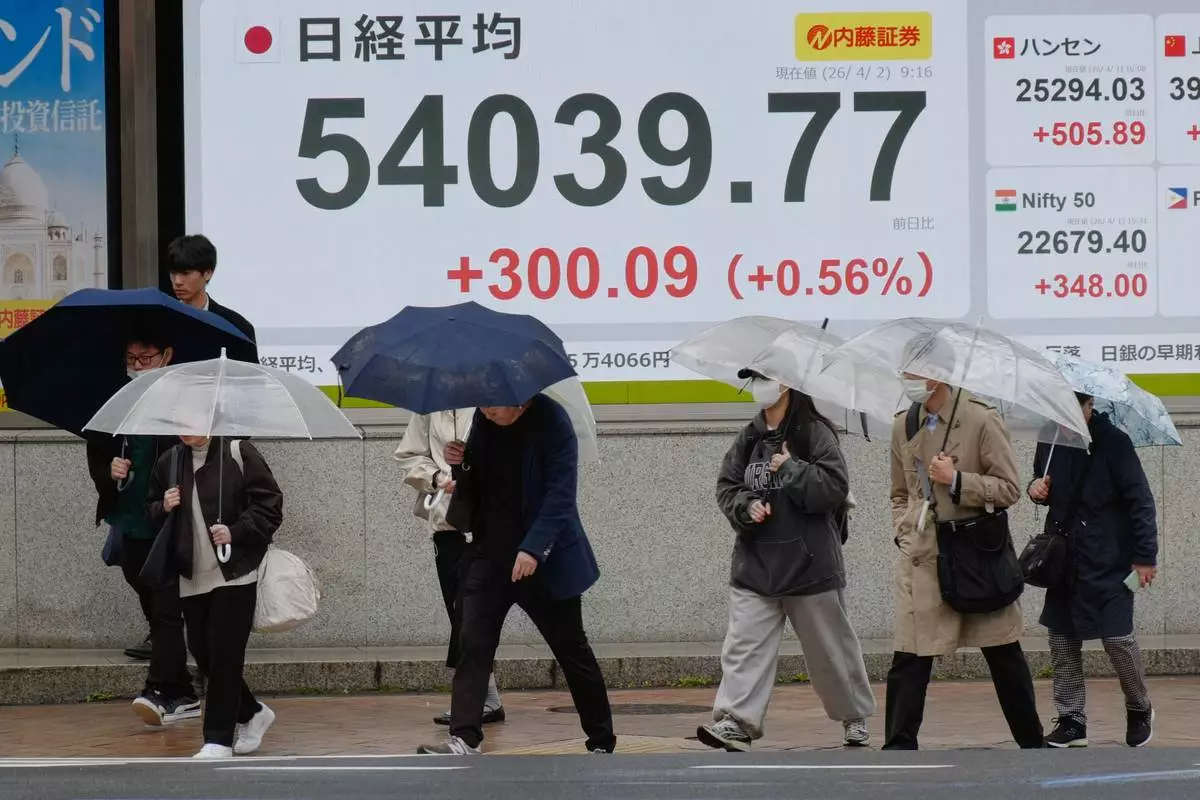
Perople walk in front of an electronic stock board showing Japan's Nikkei index at a securities firm Thursday, April 2, 2026, in Tokyo. (AP Photo/Eugene Hoshiko)
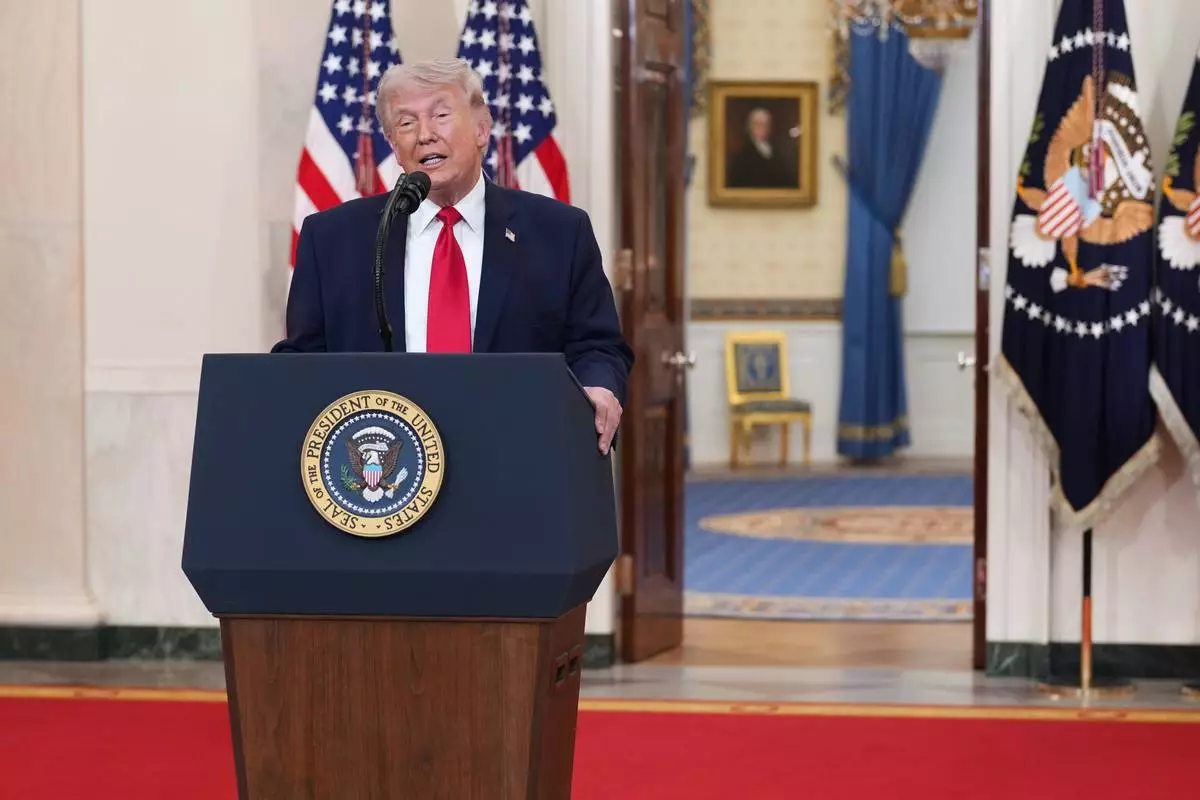
President Donald Trump speaks about the Iran war from the Cross Hall of the White House on Wednesday, April 1, 2026, in Washington. (Doug Mills/The New York Times via AP Pool)
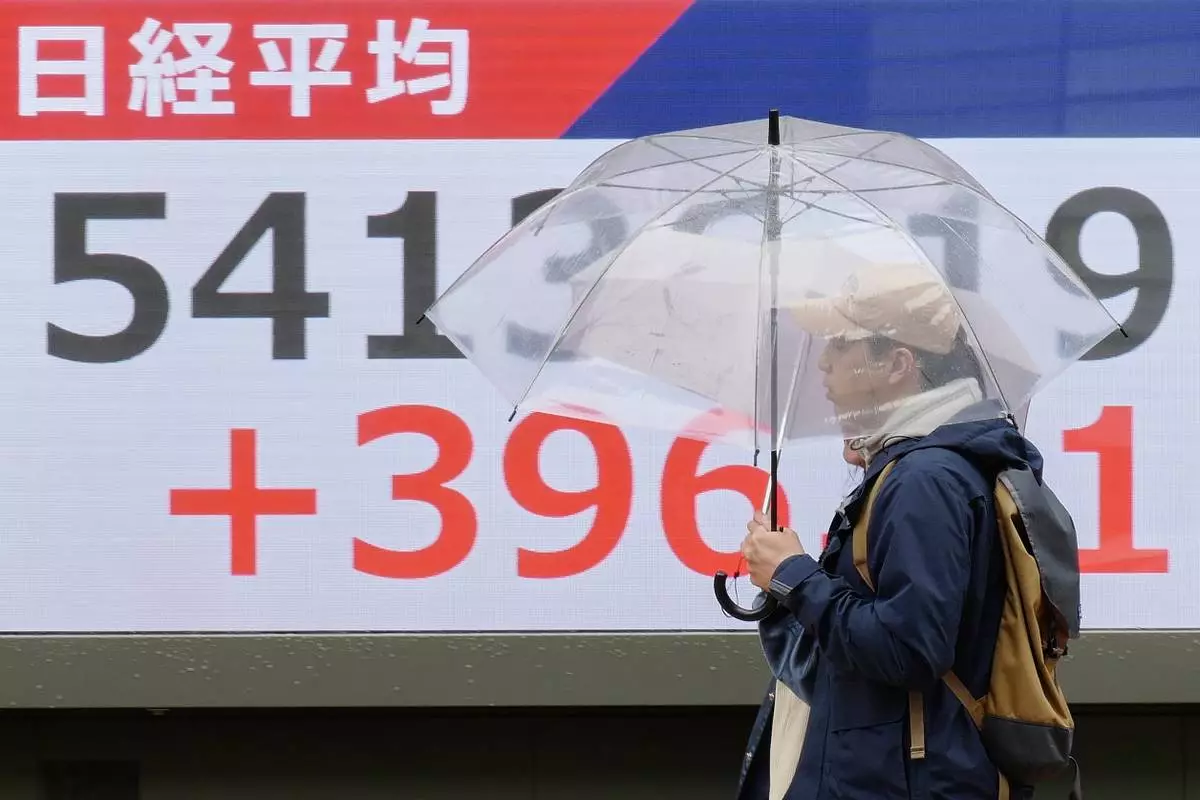
Persons walk in front of an electronic stock board showing Japan's Nikkei index at a securities firm Thursday, April 2, 2026, in Tokyo. (AP Photo/Eugene Hoshiko)