JOHANNESBURG (AP) — At least 41 young men have died as a result of circumcision procedures as part of traditional initiation activities in South Africa in November and December, authorities said Tuesday.
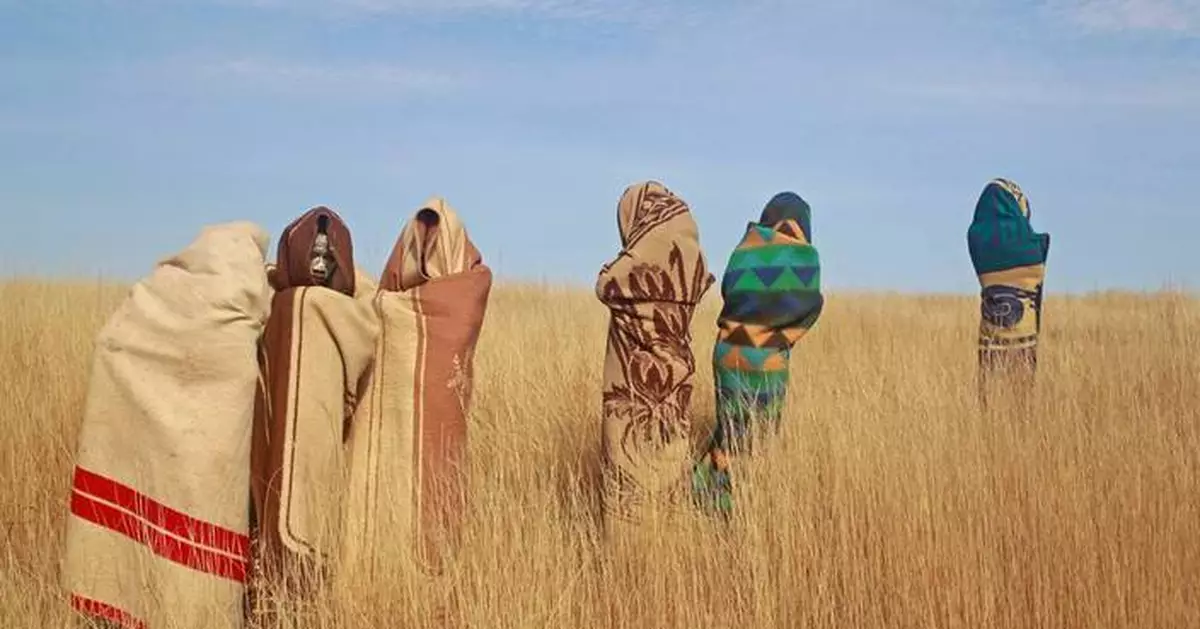
Traditional initiation is a rite of passage into manhood for young men that is practiced annually by various ethic groups in Africa, including parts of South Africa. Among them are the Xhosa, Ndebele, Sotho and Venda communities.
Traditionally, young men are isolated at initiation schools where they are taught cultural values and responsibilities as they become adults. The circumcision part of the initiation results every year in the deaths of some initiates, forcing the government to intervene through legislation.
The laws force initiation schools to be registered with authorities, but this has not stopped the proliferation of illegal initiation schools where many of the deaths are reported.
Parents are expected to pay for their children to be accepted into the initiation school for the prescribed period, which for some is a financial motivation to start an unregistered initiation school.
Initiation periods typically run during winter (June-July) and summer (November-December) school holidays.
South Africa's Traditional Affairs Minister Velenkosini Hlabisa told local broadcasters Tuesday that 41 initiates died during this year's summer initiation. He blamed negligence on the part of both the initiation schools, including registered ones, and parents for not adhering to safety standards and medical advice.
Hlabisa said some of the unproven advice often given to the young men is to avoid drinking water in order to heal faster.
“There is negligence in terms of meeting health standards in some of the initiation schools. If you take your child to an initiation school, you never make a follow-up, you do not monitor, you do not go there to see whether the child does drink water, you are placing your child at risk,” he said.
Eastern Cape province has been identified as a hot spot for the death of initiates, totaling 21 so far.
Hlabisa said 41 people have been arrested in relation to illegal initiation schools, including parents who had supplied wrong ages for their children to be admitted.
Only children who are 16 years and above may be admitted to initiation school with parental consent, according to South African law.
Traditional initiation is widely practiced in African communities, with the return of the initiates often characterized by joyful, cultural celebrations.
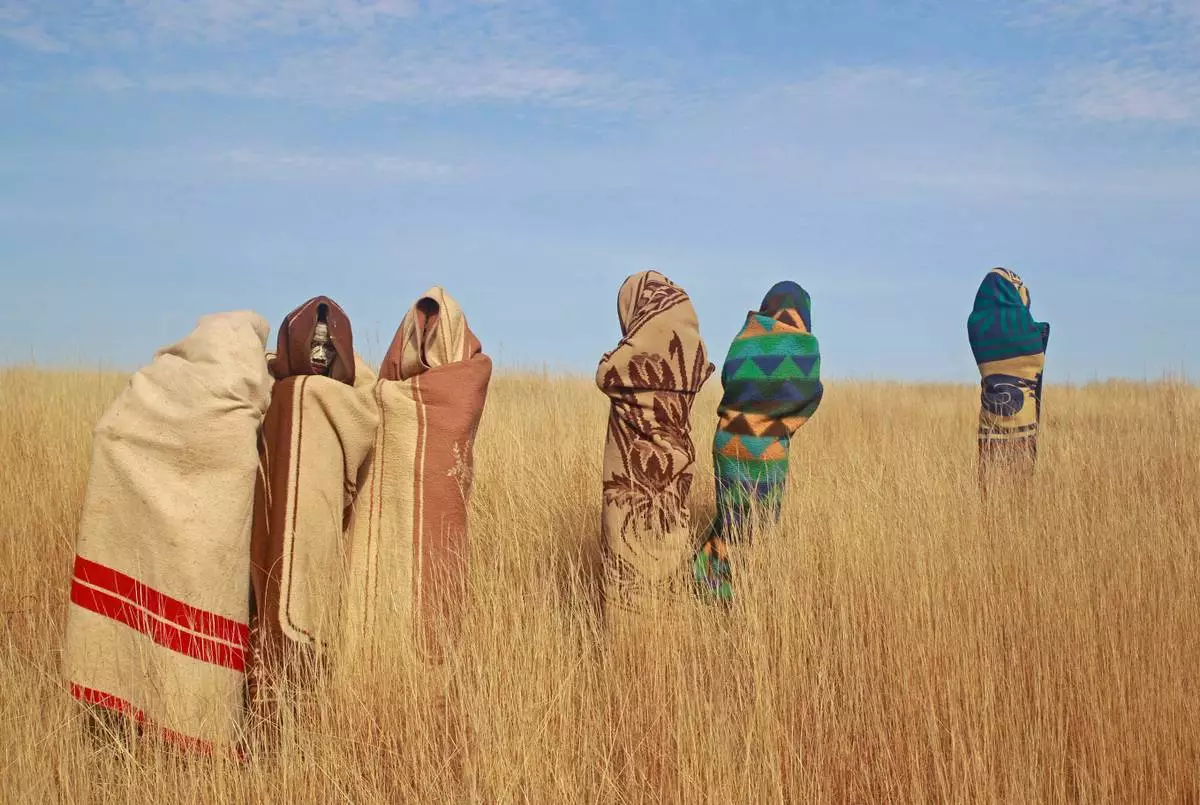
FILE - Xhosa boys stand in a field during traditional Xhosa male circumcision ceremonies into manhood in Qunu, South Africa, on Saturday, June 30, 2013. (AP Photo/Schalk van Zuydam, File)
More artists have canceled scheduled performances at the Kennedy Center following the addition of President Donald Trump’s name to the facility, with jazz supergroup The Cookers pulling out of a planned New Year's Eve concert, and the institution's president saying the cancellations belie the artists' unwillingness to see their music as crossing lines of political disparity.
The fresh round of cancellations after Trump put his name on the building follows an earlier artist backlash in spring. After Trump ousted the Kennedy Center board and named himself the institution's chairman in February, performer Issa Rae and the producers of “Hamilton” cancelled scheduled engagements while musicians Ben Folds and Renee Fleming stepped down from advisory roles.
The Cookers, a jazz supergroup performing together for nearly two decades, announced their withdrawal from “A Jazz New Year’s Eve" on their website, saying the “decision has come together very quickly" and acknowledging frustration from those who may have planned to attend.
The group didn't mention the building's renaming or the Trump administration but did say that, when they return to performing, they wanted to ensure that “the room is able to celebrate the full presence of the music and everyone in it,” reiterating a commitment “to playing music that reaches across divisions rather than deepening them.”
The group may not have addressed the Kennedy Center situation directly, but one of its members has. On Saturday, saxophone player Billy Harper said in comments posted on the Jazz Stage Facebook page that he “would never even consider performing in a venue bearing a name (and being controlled by the kind of board) that represents overt racism and deliberate destruction of African American music and culture. The same music I devoted my life to creating and advancing.”
According to the White House, Trump’s handpicked board approved the renaming. Harper said both the board, "as well as the name displayed on the building itself represents a mentality and practices I always stood against. And still do, today more than ever.”
Richard Grenell, a Trump ally whom the president chose to head the Kennedy Center after he forced out the previous leadership, posted Monday night on X that “The artists who are now canceling shows were booked by the previous far left leadership,” intimating the bookings were made under the Biden administration.
In a statement to The Associated Press, Grenell said Tuesday the ”last minute cancellations prove that they were always unwilling to perform for everyone — even those they disagree with politically," adding that the Kennedy Center had been “flooded with inquiries from real artists willing to perform for everyone and who reject political statements in their artistry.”
There was no immediate word from Kennedy Center officials if the entity would pursue legal action against the group, as Grenell said it would after musician Chuck Redd canceled a Christmas Eve performance. Following that withdrawal, in which Redd cited the Kennedy Center renaming, Grenell said he would seek $1 million in damages for what he called a “political stunt.”
Not all artists are calling off their shows. Bluegrass banjoist Randy Barrett, scheduled to perform at the Kennedy Center next month, told the AP he was “deeply troubled by the politicization” of the venue and respected those who had canceled but feels that “our tribalized country needs more music and art, not less. It’s one of the few things that can bring us together.”
President John F. Kennedy was assassinated in 1963, and Congress passed a law the following year naming the center as a living memorial to him. Scholars have said any changes to the building's name would need congressional approval; the law explicitly prohibits the board of trustees from making the center into a memorial to anyone else, and from putting another person’s name on the building’s exterior.
Associated Press writers Steven Sloan and Hillel Italie contributed to this report.
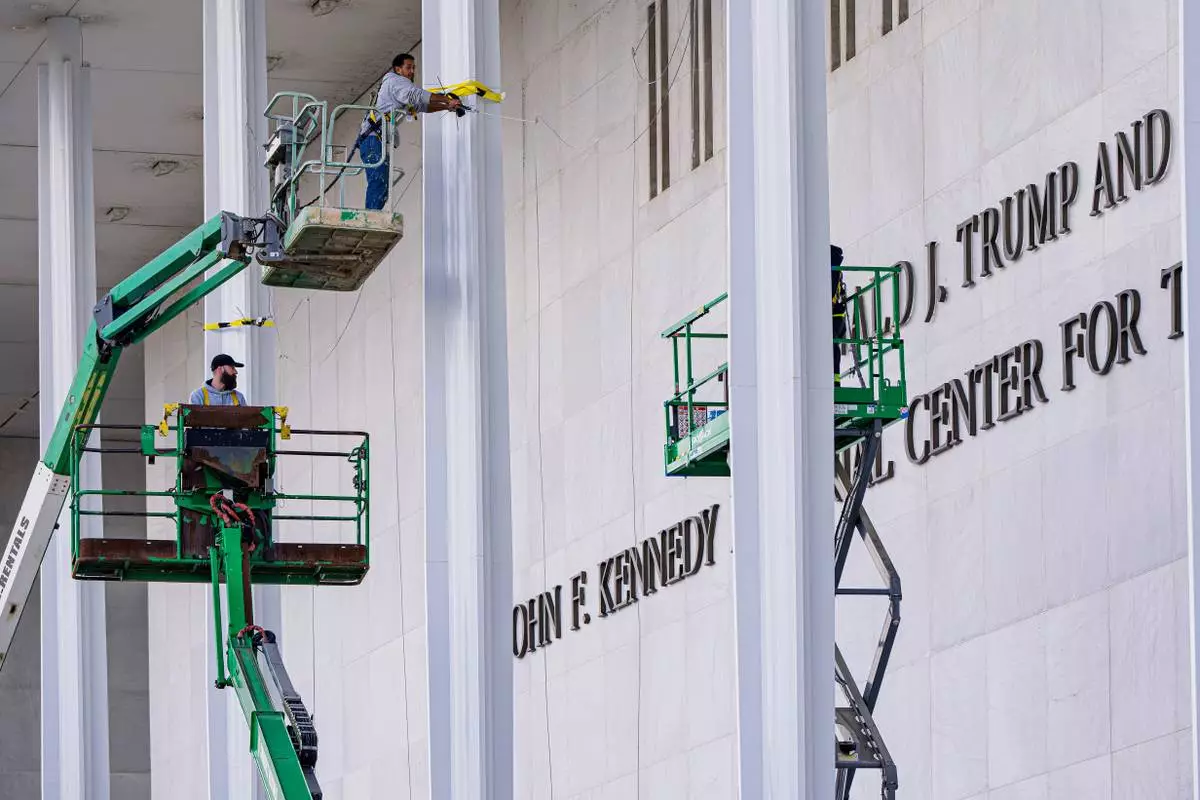
Workers add President Donald Trump's name to the John F. Kennedy Memorial Center for the Performing Arts, after a Trump-appointed board voted to rename the institution, in Washington, Friday, Dec. 19, 2025. (AP Photo/J. Scott Applewhite)
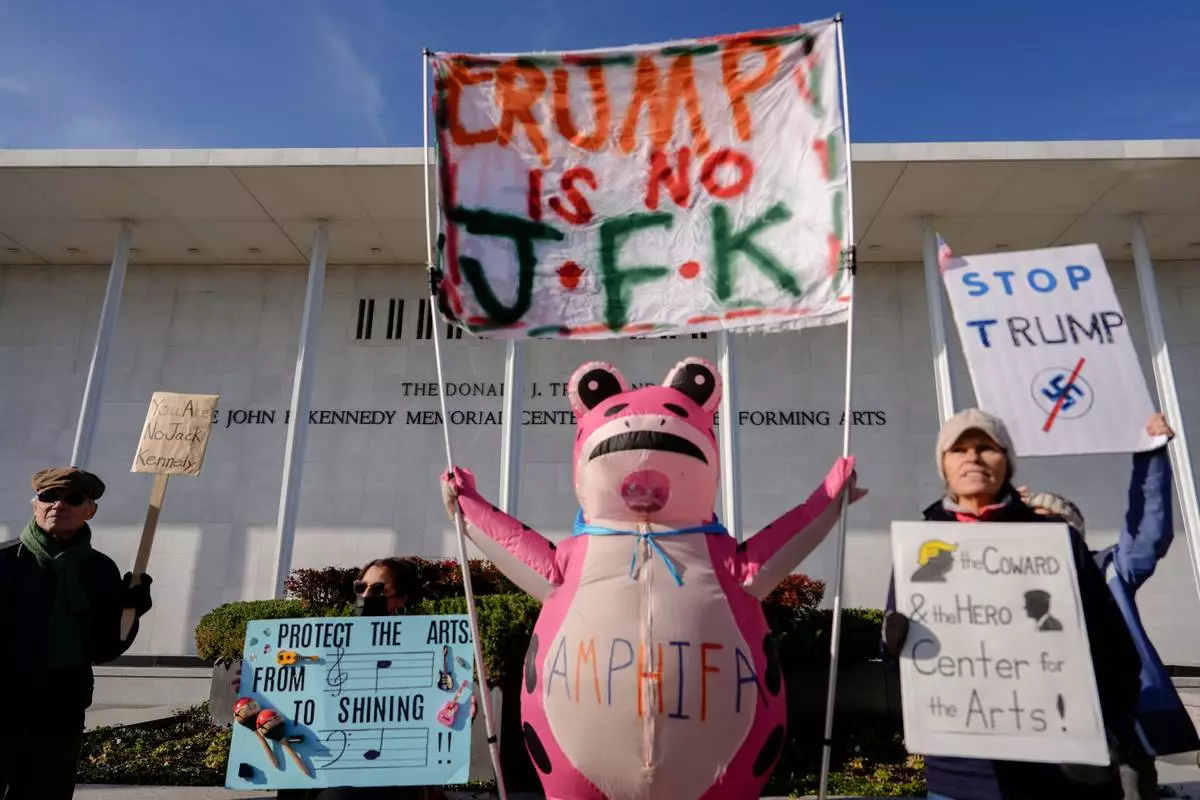
Demonstrators, including Nadine Siler, of Waldorf, Md., dressed in a pink frog costume, hold up signs at a designated protest point in front of the John F. Kennedy Memorial Center for the Performing Arts, a day after a Trump-appointed board voted to add President Donald Trump's name to the Kennedy Center, Saturday, Dec. 20, 2025, in Washington. (AP Photo/Julia Demaree Nikhinson)
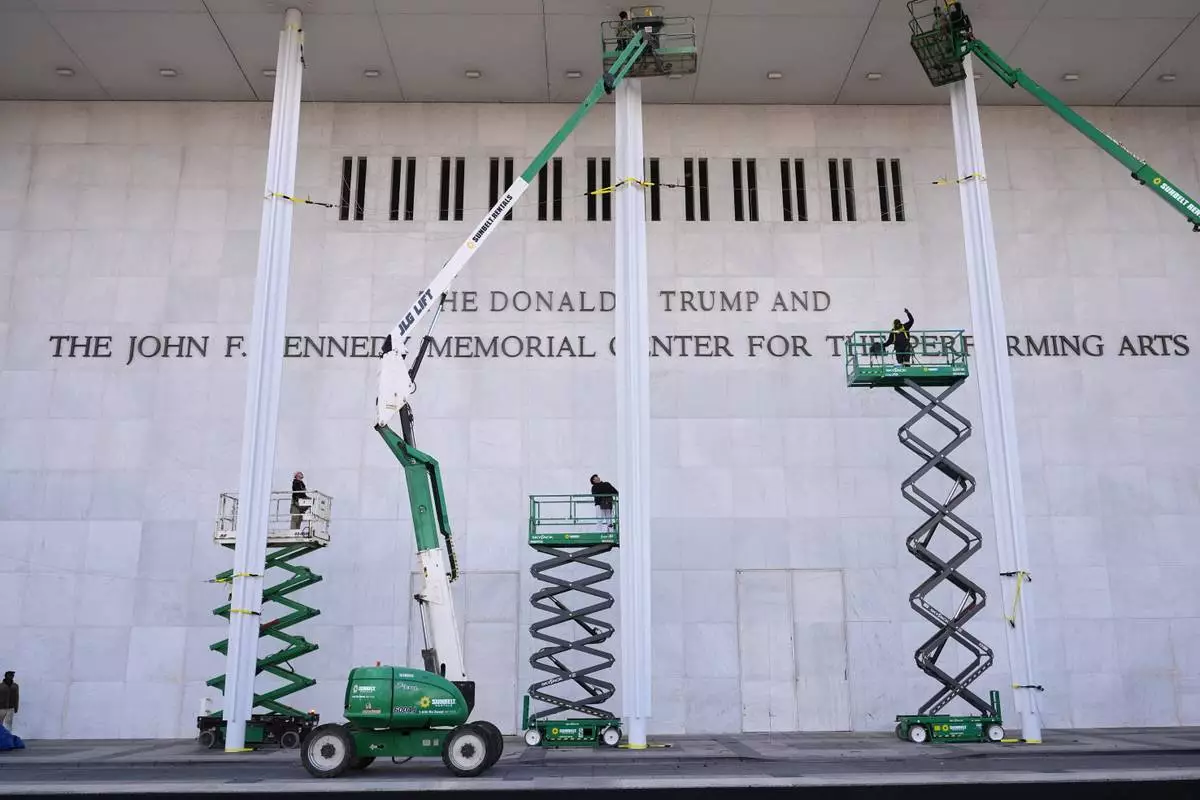
New signage, The Donald J. Trump and The John F. Kennedy Memorial Center For The Performing Arts, is unveiled on the Kennedy Center, Friday, Dec. 19, 2025, in Washington. (AP Photo/Jacquelyn Martin)