The year 2025 saw U.S. tariff policies creating turbulence in global markets, leading to a decline in Europe's trade with the United States and a rise with China.
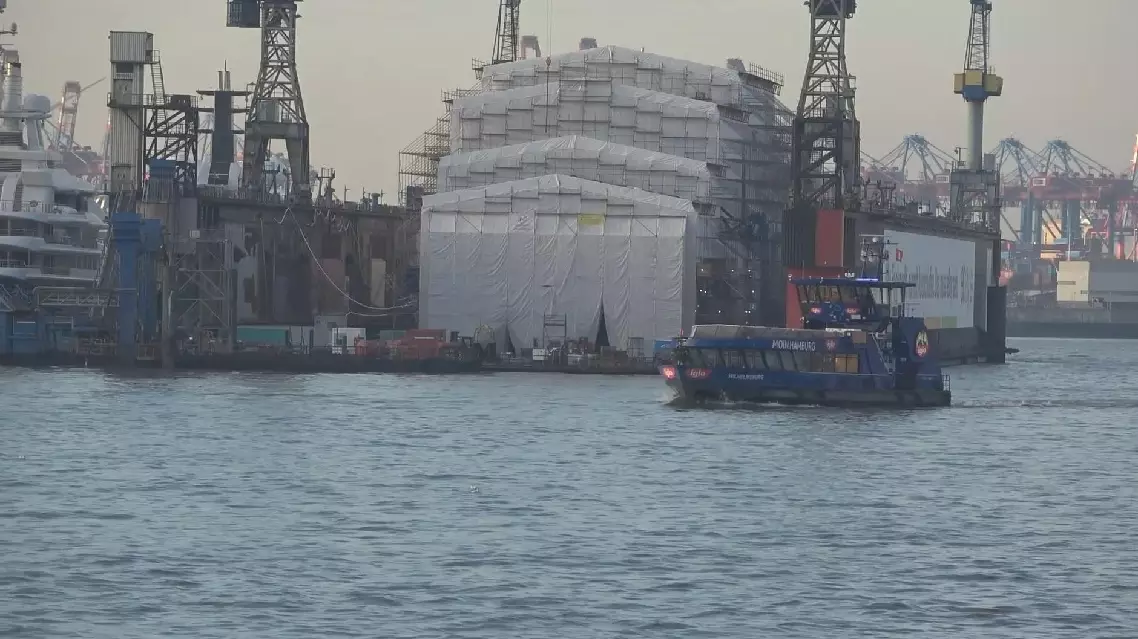
This shift is clearly reflected in changes in container throughput by destination at the Port of Hamburg in Germany. As Germany's largest port and one of the busiest in Europe, the Port of Hamburg serves as a vital window into European economic vitality. Over the past year, the tariff conflicts initiated by the United States has intensified global trade frictions, triggering noticeable changes in both cargo volumes and trade routes here.
"Indeed, we have also observed these shifts in logistics routes. In 2025, the Port of Hamburg's trade volume with the United States has dropped by nearly 24 percent. In stark contrast, however, cargo trade with Asia has seen significant growth. As a port operator, we naturally take note of this," said Axel Mattern, board member of the Hamburg Port Authority (HPA).
The latest data from the Port of Hamburg showed that influenced by U.S. tariff policies, the port's container throughput to the United States fell by 23.9 percent in 2025 to 395,000 20-foot equivalent units (TEUs).
Meanwhile, container throughput to China saw steady growth, rising by approximately 8 percent. These figures clearly reflect the trade dynamics between China and Germany in 2025.
Data from Germany's Federal Statistical Office (Destatis) showed that in 2025, China once again replaced the United States as Germany's largest trading partner. In the first three quarters of 2025, Germany's trade volume with China reached 185.9 billion euros (about 218.11 billion U.S. dollars), a year-on-year increase of 0.6 percent. During the same period, Germany's trade with the United States stood at 184.7 billion euros (about 216.70 billion U.S. dollars), down 3.9 percent year-on-year.
As trade barriers rise between Europe and the United States and supply chain risks intensify, European companies are accelerating the adjustment of their global footprints. Many have been actively seeking alternative partners and diversifying their sourcing toward China and Southeast Asia.
"We will continue to invest -- including in factory construction and lab expansions in China -- and view China as a major growth market, particularly in the battery sector," said David Pier, global head of end use energy storage at BYK, a global supplier of specialty chemicals.
In addition, throughout 2025, Chinese companies engaged in cross-border trade with Europe also have been proactively expanding their presence in the European market.
"Over the past two years, we have clearly seen a notable increase in goods imported from China to Europe, including both physical goods and newer consulting services. This proportion is expected to rise above 50 percent in 2026," said Yuan Wei, general manager of DeStar Freight, a cargo transportation company in Germany.
Despite a complex international environment, China-Europe economic and trade exchanges demonstrated remarkable resilience in 2025.
According to statistics from China's General Administration of Customs (GAC), in the first 11 months of 2025, the EU was China's second-largest trading partner, with bilateral trade totaling 5.37 trillion yuan (about 767.54 billion U.S. dollars). China's exports to the EU grew by 8.9 percent year-on-year, with positive growth to Germany, the Netherlands, France, and Italy -- up 11.0 percent, 3.2 percent, 8.7 percent, and 11.0 percent, respectively.
This growth can be largely attributed to U.S. tariff policies, which have redirected a portion of goods previously exported from China to the United States toward the EU market.
China's main exports to the EU now include mechanical and electrical products, automotive and transport equipment, and various manufactured goods.
"In the past, much of our import business from China to Europe consisted of traditional goods like clothing and footwear. But over the last two years, we have observed a clear rise in imports of new products from high-tech and emerging technology companies," Yuan said.
Together, China and the EU account for more than one-third of the world's economic output and over a quarter of global trade. Strengthening economic and trade cooperation between China and Europe not only promotes their respective development but also makes a positive contribution to global economic stability and growth.
European trade to China rises as US tariffs bite in 2025